


When Life Pushes You Into a Corner, What Keeps You Going?
27 Oct 2026

Anxiety, resilience and the spiritual strength to keep moving forward
Sometimes the hardest battle in life is not against the challenges in front of us. It is against the thoughts that begin to take over when those challenges refuse to go away.
Some stretches of life leave you working hard, doing everything you believe is right, putting your reputation and resources behind something, and still struggling to move forward.
The customer does not respond. The promised payment does not arrive. Someone you trusted lets you down. The business opportunity that looked so promising takes months longer than expected.
Meanwhile, time does not stop.
Financial commitments continue. Responsibilities grow. Your family needs your attention. Your team expects direction. And tomorrow brings another set of problems before you resolve yesterday's.
Over the past few years, I've lived through many of these situations while trying to build businesses and turn ideas into something meaningful.
There have been moments when I felt pushed into a corner from every direction. Money, time, workload, broken promises, misplaced trust, difficult negotiations, delayed decisions and the uncertainty of whether years of effort would ever produce the expected result.
Sometimes the most frustrating part isn't getting a negative answer. It is receiving no answer at all.
You keep following up, revising proposals, having meetings, finding alternatives and convincing yourself that the breakthrough might be just around the corner.
And when it does not come, the same questions return.
Am I doing something wrong? Should I stop? How much longer can I continue? What if all this effort amounts to nothing?
I am not writing this because I have found an answer to every problem, or because all my challenges are behind me.
I am still on the journey.
I am writing because I have discovered something valuable about myself during these difficult years.
You may not always control what life brings you. But you can gradually learn to change how you respond.
For me, that learning has come largely through spirituality, particularly through the life of Lord Ram and my long-standing practice of reciting the Ramcharitmanas, composed by Goswami Tulsidas Ji.
And I believe there are practical lessons here for anyone navigating anxiety, setbacks and uncertainty regardless of their religious beliefs.
What Lord Ram’s life taught me about resilience
Circumstances Change. Character Remains.
A royal crown on one side, a forest pathway on the other, with Lord Ram walking calmly toward the forest.
One of the most powerful episodes in the Ramayana is the moment Lord Ram is preparing to be crowned king of Ayodhya.
Picture the situation. A future that appeared certain. A kingdom ready to welcome its new ruler. A family, a society and a lifetime of expectation moving toward one defining moment.
And then everything changes.
Instead of ascending the throne, Lord Ram is asked to leave the kingdom and spend fourteen years in exile. In a short time, a life of royal privilege becomes life in the forest.
What has always fascinated me is not the sacrifice itself. It is his response.
He does not allow a sudden change in circumstances to destroy his commitment to duty. He continues to act with dignity, protect others, build relationships and fulfil responsibilities.
His circumstances change dramatically. His values do not.
When I reflect on this story during my own difficult stretches, I ask myself a simple question:
If life can change so dramatically even for Lord Ram, why should I expect my own journey to follow a perfectly straight path?
Why should a delayed deal, a financial setback, or a broken promise determine who I become?
Business challenges don't compare to the spiritual and moral significance of Lord Ram's life. But his example gives me a lens through which to see my own circumstances.
My situation may change. My responsibilities may become harder. I should not allow those circumstances to change my fundamental character.
This does not mean accepting injustice, ignoring dishonesty or remaining silent when someone acts unfairly. It means responding with thought and determination rather than letting anger, anxiety or frustration take control.
A real difference exists between accepting a situation and surrendering to it. Acceptance allows us to see reality clearly. Surrender prevents us from doing anything about it.
The strange energy I find in the Ramcharitmanas
I have been reciting the Ramcharitmanas for many years. I didn't discover it recently because life became difficult. It has been part of my life for a long time.
But I have noticed that its meaning has deepened during periods of personal and professional struggle.
On occasion, I have spent close to twenty hours immersed in reading and recitation. Ordinarily, one might expect such a long stretch of concentration to leave a person exhausted.
I have often experienced something quite different.
I emerge feeling mentally refreshed, emotionally lighter and, surprisingly, energetic.
The financial challenges may still be there. The customer may still not have replied. The payment may still be pending. Nothing outside has necessarily changed.
But something inside has shifted.
My thoughts are less scattered. My frustration loses some of its intensity. I regain perspective. I feel more capable of facing the same situation again.
I do not claim that this experience will be identical for everyone, or that very long periods of recitation are necessary or advisable. Rest and sleep remain essential. For me, however, immersion in the Ramcharitmanas creates a connection with something larger than the problems occupying my mind.
The stories remind me of duty, patience, humility, courage, relationships, sacrifice and perseverance.
Most importantly, they remind me that a difficult chapter is not necessarily the end of the story.
Spiritual practice does not always remove the problem. Sometimes its greatest contribution is removing the problem's hold on our thoughts.
Anxiety often comes from the gap between effort and outcome
Over the years, I have observed something about anxiety in business.
We become most anxious when our efforts no longer match visible progress.
You prepare a proposal, attend a meeting and present a compelling opportunity. The conversation went well. Someone expresses interest. You invest more time, develop documentation, and make commitments based on the expectation that the opportunity will move forward.
Then comes silence.
Days become weeks. Weeks become months.
You cannot force the other party to make a decision. Yet the opportunity remains important to you, and so the uncertainty starts to occupy your mind.
The same pattern shows up elsewhere. Job applications, health concerns, relationships, examinations, family responsibilities, financial difficulties. We know what we want. We may even know how much effort we've put in. But we cannot control when or whether the desired outcome will arrive.
I have learned to separate three things:
- What I can control: my effort, preparation, communication, decisions, discipline and conduct.
- What I can influence: relationships, negotiations, expectations and the quality of opportunities I create.
- What I cannot control: another person's intentions, the market, the timing of a decision or every external event.
This distinction has helped me enormously.
Instead of repeatedly asking why someone hasn't replied, I now ask what useful action I can take today.
Should I follow up once more? Set a deadline? Explore another customer? Renegotiate a commitment? Stop investing resources in an opportunity that is no longer viable? Ask for help?
The answers are not always comfortable. Sometimes resilience means continuing to push. Sometimes it means changing direction. And sometimes it means accepting that a particular opportunity is no longer worth pursuing.
Resilience is not the ability to keep doing the same thing indefinitely. It is the ability to keep moving toward a meaningful purpose while learning from reality.
Spirituality is not about escaping reality
Many people mistakenly think spirituality asks us to withdraw from worldly responsibilities.
My experience has been the opposite.
I have not found spiritual practice useful because it lets me forget business, money, obligations or difficult people. I have found it useful because it helps me return to those responsibilities with a clearer mind.
Lord Ram's life is not a story of avoiding difficulties. It is a story of fulfilling duties despite them.
The lesson I take from this is simple:
Do not run away from your responsibilities merely because circumstances have become difficult. But equally, do not confuse responsibility with sacrificing your health, dignity or well-being.
- You can be determined without being consumed by anger.
- You can work hard without treating every setback as personal failure.
- You can be ambitious without allowing ambition to destroy your peace.
- You can acknowledge that you are anxious without believing that anxiety defines you.
For me, spirituality provides an inner reference point. When external circumstances change, that reference point helps me regain balance.
For someone else, the same grounding may come through meditation, prayer, another faith tradition, philosophy, nature, community or quiet reflection.
The essential question is not whether we all follow the same practice. It is whether we have developed something within ourselves that keeps us steady when life becomes unpredictable.
Life is like a sine wave & the downward curve has meaning
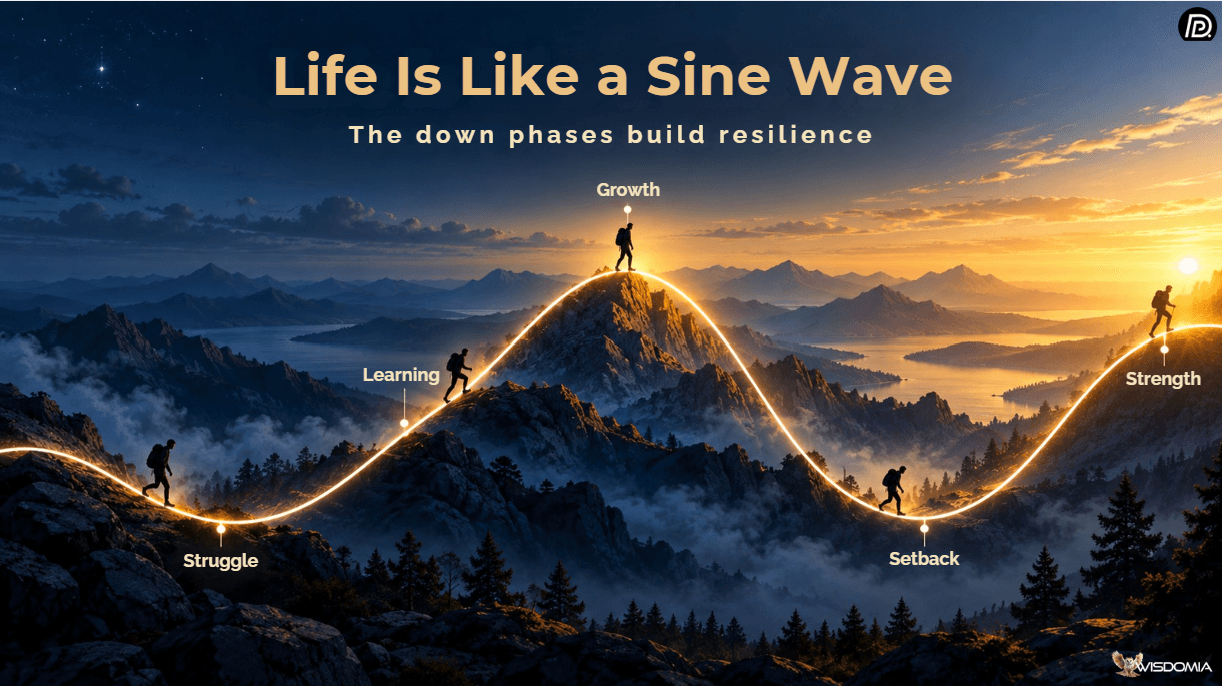
The Downward Curve Is Not the End.
A continuous sine wave crossing a central line, with a small figure moving along it.
With a background in technology and engineering, I often think of life as a sine wave.
It rises. It reaches a peak. It comes down. And eventually, it rises again.
That image has carried me through difficult periods.
When things are going well, we assume progress will continue uninterrupted. When things are going badly, we start to feel our situation will never improve. Neither assumption is reliable.
Life moves through cycles of growth, uncertainty, success, disappointment and change.
The sine wave doesn't promise that we'll recover every loss or that every effort will succeed. It reminds us that today's circumstances are rarely permanent.
And the downward phases often expose something important.
During success, we learn what works.
During difficulty, we discover how we respond when things stop working.
- We learn who stands with us.
- We find out which relationships are genuine.
- We recognise weaknesses in our plans.
- We begin to understand the cost of misplaced trust.
- And we develop the ability to make difficult decisions with greater maturity.
Some of my most valuable learning has happened during periods when progress appeared slowest.
That does not make financial pressure, betrayal or prolonged stress desirable. Hardship can also cause real harm, and nobody should have to endure it alone. But when difficulty arrives, we can at least try to draw from it.
The downward phase does not automatically build character. What we learn, change and practise during that phase can.
My simple practice before sleep
One of the most useful habits I have developed is remarkably simple.
At the end of the day, before going to sleep, I spend a few minutes reflecting on where I stand.

Not to punish myself for what went wrong. Not to revisit every uncomfortable conversation. Not to calculate every possible negative outcome. To understand the day.
I ask myself:
- What did I accomplish today?
- What remains unresolved?
- Did I respond appropriately to the difficulties I faced?
- What is one meaningful thing I can do tomorrow?
- And is there anything I need to change in my own behaviour?
Then I try to become silent.
I remind myself that I have done what I could today. Whatever remains unresolved will still be there tomorrow, and I can face it with a rested mind.
I do not have to solve the entire future before falling asleep.
This is where spiritual reflection helps me most. It lets me distinguish responsibility from constant worry.
Being responsible does not mean thinking about a problem twenty-four hours a day. In fact, a tired and anxious mind usually makes poorer decisions.
Sometimes the most productive thing we can do for tomorrow is stop working today.
This practice also aligns with established approaches to managing worry: set aside a brief period to acknowledge concerns, identify practical next steps, and avoid endless mental rehearsal at bedtime.
The aim is not to suppress difficult feelings. It is to give them a place without letting them occupy the entire night.
Seven habits that have helped me build resilience
Resilience Is a Daily Practice.
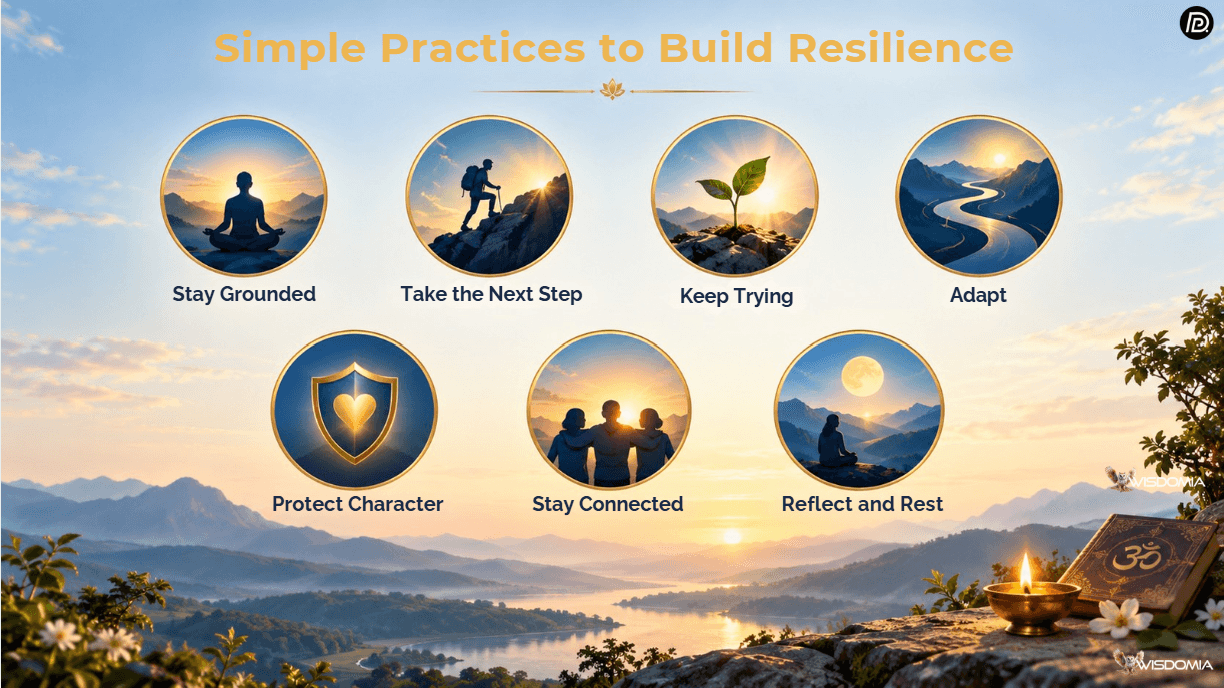
Seven simple icons arranged in a circle: pause, breathe, act, adapt, reflect, connect and rest.
Resilience doesn't come from one inspirational speech, one book, or one spiritual experience. It develops through repeated habits.
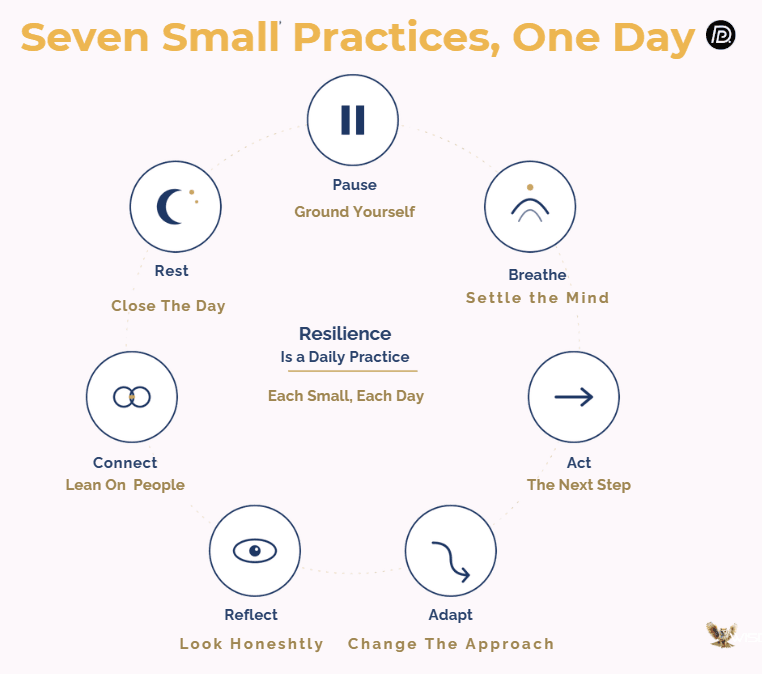
Here are seven I would encourage anyone to consider and adapt to their own circumstances.
1- Start your day with something that grounds you.
- Before letting emails, messages, market news, or business problems take over your attention, give yourself a few quiet minutes.
- It can be prayer, meditation, reading an inspiring passage, mindful breathing, or simply sitting in silence.
- For me, connecting with Lord Ram and the teachings of the Ramcharitmanas provides that grounding.
- The goal isn't to escape the day's responsibilities. It is to meet them with a more settled mind. Even five or ten minutes is a useful starting point.
2- Focus on the next action, not the entire mountain
- When several problems arrive together, the mind can turn them into one enormous challenge. Break them apart.
- Identify what requires immediate attention and what can wait. Then take the next practical step.
- If a customer has not responded, decide when to follow up and what alternative you will pursue.
- If money is tight, review your commitments, prioritise essential spending, and seek advice where needed.
- If a project is delayed, identify the specific decision or dependency causing the delay.
- Small actions restore a sense of agency.
3- Keep trying but change your approach when necessary
- Perseverance is important. But repeatedly knocking on the same closed door without changing your strategy becomes exhausting.
- Ask what each setback is teaching you. Perhaps the proposal needs revision. Perhaps the customer lacks the authority or budget. Perhaps you need new partners. Perhaps you are trusting promises without sufficient evidence. And perhaps it is time to walk away from a situation that is consuming too much time and money.
- Being resilient means staying committed to your purpose, not attached to every original plan.
4- Protect your character when others disappoint you
- Few things are more painful than discovering that someone you trusted has acted dishonestly or repeatedly failed to honour commitments.
- Anger is understandable. But resentment can start to take up more of our time than the original problem.
- I try to remind myself that another person's behaviour shouldn't determine my values. That doesn't mean you should stop trusting. Learn from the experience. Document commitments. Establish boundaries.
- Protect yourself legally and financially where appropriate. Don't let one difficult experience destroy your ability to build healthy relationships with others.
5- Stay connected to people
- Spirituality is often associated with individual reflection, but resilience also grows through human connection.
- Speak with people you trust. Spend time with family and friends. Seek advice from someone with experience in the problem you are facing.
- A conversation does not always solve anything immediately. But it reminds us that we are not carrying everything alone.
- And when someone else is struggling, offer whatever help you reasonably can. Supporting others can restore perspective and strengthen our sense of purpose.
6- Reflect each evening, then deliberately rest
- Give yourself five to ten minutes before bedtime. Consider what happened, write down any necessary action for tomorrow and acknowledge what remains outside your control. Then close the day.
- If prayer or meditation helps you become calm, make it part of your routine. Don't let reflection become another long session of worry.
- A rested mind is an essential resource for dealing with difficult situations.
7- Measure progress by more than immediate results
- Revenue matters. Business deals matter. Financial stability matters. Let us not pretend otherwise.
But when external results are delayed, look for other evidence of progress.
- Have you become more disciplined?
- Have you improved your judgment?
- Are you better at recognising unreliable commitments?
- Have you learned to ask for help sooner?
- Are you making clearer decisions?
- Are you maintaining your relationships and health?
These improvements do not replace the need for practical outcomes. But they are part of developing the resilience necessary to pursue those outcomes sustainably.
8- What research says about spirituality and anxiety
My experience is personal, but a broader body of research examines spirituality, religious coping, emotional regulation, and mental health.
A 2025 systematic review in the Journal of Religion and Health examined how religious and spiritual engagement relates to emotional regulation. A further systematic review published in April 2026 reported that higher spiritual wellbeing was generally associated with fewer symptoms of anxiety and depression across the studies it considered.
That same review highlighted an important distinction. Positive spiritual coping can be beneficial, while spiritual conflict, guilt or distress can worsen psychological difficulties for some people.
In other words, spirituality is not an automatic cure for anxiety. Greater faith also does not necessarily mean someone will experience less distress.
What appears particularly valuable is how spiritual practices can support meaning, emotional regulation, social connection, and constructive coping. These benefits are not exclusive to religion. Mindfulness, reflective practices, supportive relationships and psychological therapies can also help people manage anxiety.
For me, the significance of the research is not that science has somehow proved the teachings of Lord Ram. It is that the sense of purpose, perspective, and inner stability I experience through my spiritual practice aligns with broader evidence that meaningful reflective practices can support wellbeing.
When anxiety becomes persistent, disrupts sleep or daily functioning, or feels unmanageable, seeking professional support is a responsible step, not a failure of resilience or faith. Spirituality and appropriate mental healthcare complement one another.
9- Resilience does not mean becoming emotionless
I want to make this distinction because the message of perseverance is easy to misunderstand.
Being resilient does not mean never feeling afraid. It does not mean ignoring financial reality. It does not mean accepting unfair treatment indefinitely. And it certainly does not mean working until your health collapses.
There have been difficult moments when I have felt frustrated, disappointed and uncertain.
I have not always responded perfectly. I have sometimes placed too much trust in people, expected decisions to happen faster than they did or continued pursuing an opportunity longer than was sensible.
Those experiences have forced me to reflect on my own decisions.
Spirituality has not made me immune to mistakes. It has helped me examine those mistakes without letting them define my entire life.
One of the most valuable lessons I take from Lord Ram's life is the importance of maintaining one's conduct even when circumstances become difficult. But good conduct also requires sound judgment.
Sometimes courageous action means persisting. Sometimes it is to negotiate. Sometimes it means defending your rights. Sometimes it means admitting your approach isn't working. Sometimes it is to stop, recover, and begin again differently.
Real resilience combines courage with flexibility, conviction with humility, and effort with the wisdom to rest.
10- The journey is still continuing
I am sharing these reflections while still navigating many of the challenges that inspired them.
I continue to pursue opportunities. Some financial and business matters still require resolution. There are people from whom I am still waiting for decisions. And some ambitions will require far more work before they become reality.
I cannot say with certainty when each situation will improve. But I can say that my response to these circumstances has gradually changed.
I am learning not to measure every day solely by whether a deal closes, a payment arrives, or someone gives me the answer I want.
I am trying to measure it by whether I have acted responsibly, made progress where possible, learned something useful and preserved enough inner strength to continue.
My spiritual practice, particularly my relationship with the Ramcharitmanas, has become an important part of that process. It reminds me that life is much larger than the difficulty occupying my mind today. It also reminds me that perseverance matters only when it stays connected to duty, values, and thoughtful action.
For anyone feeling pushed into a corner by financial pressure, career uncertainty, difficult relationships, or unfulfilled expectations, I offer a simple thought.
- You do not need to solve everything today.
- Face what is in front of you.
- Do what is reasonably within your control.
- Protect your dignity.
- Learn from the people and situations that disappoint you.
- Seek support when you need it.
- And permit yourself to rest.
Tomorrow, it will begin again. Not necessarily with the same strategy. But with the same commitment to moving forward.
A final thought: the sine wave of life
If I were to draw my life's journey, I would not draw a straight line moving upward. I would draw a sine wave.
There would be achievements, opportunities and moments of happiness. There would also be disappointments, setbacks and periods of considerable uncertainty.
Some peaks would be higher than expected. Some downward phases would last longer than I wanted.
But I would not erase those difficult phases from the picture. They have helped me understand myself, my relationships and my responsibilities more deeply.
I still believe that better days can follow difficult ones. Not because success is guaranteed, but because even during difficult periods we can learn, adapt, take action, and create new possibilities.
And when the day's work is finished, I return to a simple practice.
I reflect. I become silent. I remember Lord Ram. And I try to sleep peacefully, trusting that I can face tomorrow's responsibilities tomorrow.
Perhaps resilience is not about always knowing we will succeed. Perhaps it is about finding the courage, clarity, and inner strength to keep doing what is right even when we do not yet know how the story will unfold.
For me, that is the greatest gift spirituality has offered.
This article shares personal experience and general well-being practices. It is not medical advice.
Good & Helpful further reading
- NHS Every Mind Matters: Tackling Your Worries. https://www.nhs.uk/every-mind-matters/mental-wellbeing-tips/self-help-cbt-techniques/tackling-your-worries/
- NHS Every Mind Matters: Sleep and Wellbeing. https://www.nhs.uk/every-mind-matters/mental-wellbeing-tips/how-to-fall-asleep-faster-and-sleep-better/


