
business resources
9 SaaS SEO Agencies Worth the $10k+/Month Price Tag in 2026
06 Jul 2026

The $10k SaaS SEO question most founders ask is the wrong question
Most SaaS founders looking at SEO agency proposals see two price tiers and no honest explanation of what sits between them. A $3,000 to $5,000 retainer shows up as one option. A $10,000 or $15,000 retainer shows up as another.
The deliverable list on both proposals reads almost identically. Technical SEO. Content production. Link building. Reporting.
The problem is not pricing transparency. The problem is that most roundup articles rank agencies without ever explaining what the extra $60,000 to $180,000 per year actually pays for. Every competitor piece treats pricing as a footnote. Founders and CFOs treat it as the whole question.
The honest answer is that a $5,000 retainer and a $15,000 retainer are two different products. Both are sold as SaaS SEO. They produce different outcomes. Semrush analyzed over 500 high-value topics in mid-2025 and found that visitors arriving from ChatGPT, Perplexity, and similar tools convert at roughly 4.4 times the rate of visitors from traditional organic search.
That conversion premium is the reason a new price tier exists in 2026, and it is the reason the two product categories have split so cleanly. One buys content and hope. The other buys measurable visibility in Google and AI search with revenue attribution attached.
This piece compares the nine agencies currently operating at or near the $10,000+ monthly tier in 2026. Each gets the same treatment: where they excel, what they charge, the client results they publish, and where they fall short.
Three of them can prove pipeline attribution. Six of them cannot. That distinction is the single most useful filter any SaaS buyer can apply before signing a premium retainer.
What a $10,000+ SaaS SEO retainer actually buys you
A $10,000+ monthly SaaS SEO retainer in 2026 typically covers six components that a $3,000 to $5,000 retainer does not deliver at full depth. Two of those six components are the real differentiators. The other four are table stakes at this price, and smart buyers verify each one shows up in delivery, not just in the proposal.
The two components that separate premium from mid-tier
Generative Engine Optimization and LLM citation engineering is the first differentiator. This work covers entity optimization so AI models understand what a brand is and what category it belongs to, schema markup engineered specifically for AI extraction, active citation tracking across ChatGPT, Perplexity, Gemini, and Claude, and proactive citation building through mentions on high-authority third-party sources that AI models trust.
Semrush tracked LLM referral traffic across its customer base from January through December 2025 and reported roughly 3x growth in that channel over the year.
Few mid-tier retainers include GEO work at any real depth. The ones that claim to rarely track citation movement as a reportable metric.
Pipeline attribution connecting GA4 to CRM is the second differentiator. This is the work of mapping first organic touches to demos, trials, and closed-won deals, handling cross-domain tracking when the marketing site and product app live on separate subdomains, building multi-touch attribution models, and reporting against pipeline outcomes rather than keyword positions.
SaaS buyers now interact with 6 to 10 touchpoints before a demo. An agency that cannot connect those touchpoints to revenue cannot defend the retainer when the CFO asks.
The four components that are table stakes at this tier
The remaining four components belong on every premium proposal, but they get listed more often than they get delivered. SaaS buyers should verify each one:
- Technical SEO at JavaScript rendering and schema depth. Most SaaS marketing sites are React, Next.js, or Vue, and the app subdomain usually runs on a different stack. Real technical work handles hydration, client-side rendering, canonical logic for app pages, and schema for product-led landing pages.
- Commercial-intent content over topical-coverage content. Alternatives pages, comparison pages, feature deep-dives, and use-case pages convert. Topic-cluster blogs that never mention the product rarely do.
- Digital PR and authority link acquisition. Links from DR 70+ publications move rankings. Links from guest post farms do not. This is where a $5k retainer and a $15k retainer show the widest gap in actual delivery.
- Senior strategist time without junior handoffs. Many $10k retainers still pitch senior-level strategy and staff junior-level execution. A real premium engagement caps the junior ratio and names the senior strategist on the account.
How the 9 SaaS SEO agencies in this comparison were evaluated
Every agency in this piece was evaluated against the same three criteria, with no paid placements.
- Documented client outcomes. Case studies, verified reviews, or named client testimonials with specific numbers. Vague claims and unnamed clients were excluded.
- Pricing transparency. Published starting bands or verifiable third-party pricing research. Agencies that refuse to publish any pricing signal were still included if independent research covers them.
- GEO capability tested in the field. For each agency, their clients were queried in ChatGPT and Perplexity for category-relevant prompts to verify whether citation work actually shows up.
DerivateX is one of the nine agencies in this comparison. It was evaluated against the same criteria as the other eight, including the weakness section.
Buyers deserve that level of editorial honesty. The whole point of this piece is to reject the roundup-as-sales-pitch format that dominates every other article on this topic.
The 9 SaaS SEO agencies at $10k+/month in 2026 (comparison table)
Agency | HQ | Best For | Starting Price | Notable Verified Result | Pipeline Attribution | GEO Capability |
| SimpleTiger | Sarasota, FL | Full-service SaaS SEO with technical depth | $5k to $15k | JotForm 597% traffic growth via Kickstart | Partial | Emerging |
| Omniscient Digital | Austin, TX | Editorial-first category authority | $10k to $25k | Jasper 400x product signups | Partial | Yes |
| Powered by Search | Toronto, CA | SEO plus demand generation integration | $7k to $15k | $11.1M SEO pipeline for a data privacy SaaS | Yes | Emerging |
| Siege Media | San Diego, CA | Premium content and digital PR at scale | $10k to $30k | 50,000+ backlinks for a fintech client | No | Partial |
| Directive Consulting | Irvine, CA | Enterprise customer generation | $10k to $25k | AxisCare 200% demo growth with AI-driven SQLs | Yes | Emerging |
| Skale | Remote (UK) | Growth-stage MRR-tied SEO | $10k to $30k | Flodesk 2,373% free trial growth | Partial | Emerging |
| Grow and Convert | Remote (US) | Bottom-of-funnel pain-point SEO | $10k to $25k | Per-page conversion tracking at flat rate | Partial | No |
| DerivateX | Bengaluru, IN | GEO and LLM SEO for B2B SaaS | $3.5k to $25k | Gumlet 20% inbound revenue from ChatGPT and Perplexity (GA4-verified) | Yes | Yes |
| MADX Digital | London, UK | SaaS-only SEO plus GEO plus multi-market | $5k to $15k | Parcel Tracker 1k to 45k monthly visitors | Partial | Yes |
The 9 best SaaS SEO agencies worth $10k+/month in 2026
Agencies are ordered by best-fit use case, not ranked. Each profile covers positioning, pricing, three verifiable proof points, where they fall short, when to hire, and when not to.
1. SimpleTiger — Best for full-service SaaS SEO with strong technical foundations
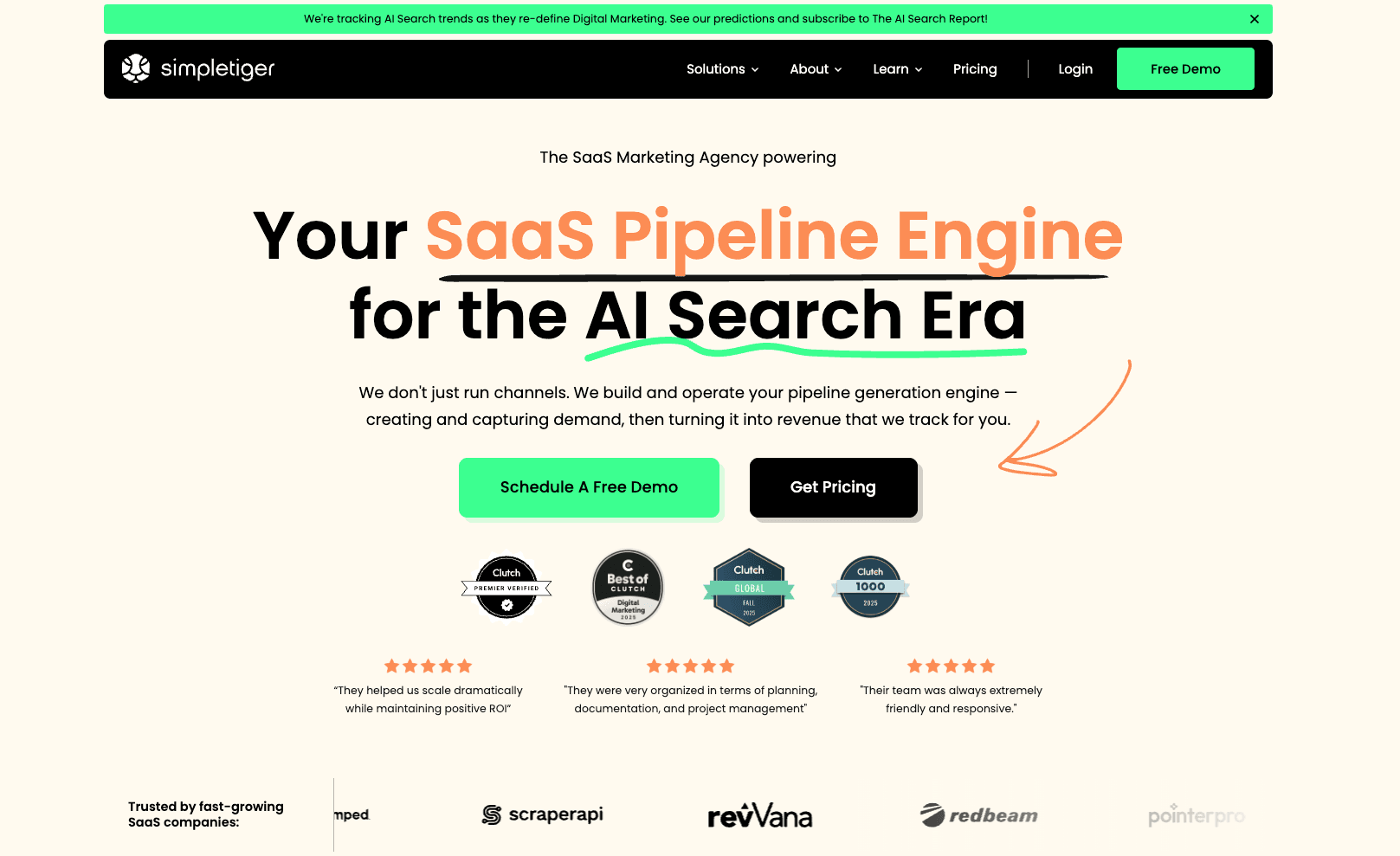
SimpleTiger is a Sarasota-based SaaS SEO agency founded in 2006 that specializes in full-service organic growth for software companies. Pricing runs $5,000 to $15,000 per month across their published Kickstart and Accelerator tiers.
Their strongest proof points are JotForm, where they achieved a #1 ranking for a primary keyword within 2 months and drove 597% traffic growth through their Kickstart program, Gelato with 1,200% first-page ranking growth, and Invoca with $1.5M in attributed pipeline. Their link-building work targets Forbes, Inc, and HuffPost, which gives them real authority-building credibility.
Where they fall short: GEO capability is less publicly documented than newer AI-focused specialists, and the tiered program structure can feel formulaic for founders expecting custom strategy work from day one.
Hire them when the priority is technical foundation work and traditional Google rankings before content scaling. Skip them when AI search visibility is the primary acquisition channel goal.
2. Omniscient Digital — Best for editorial-first B2B SaaS category authority
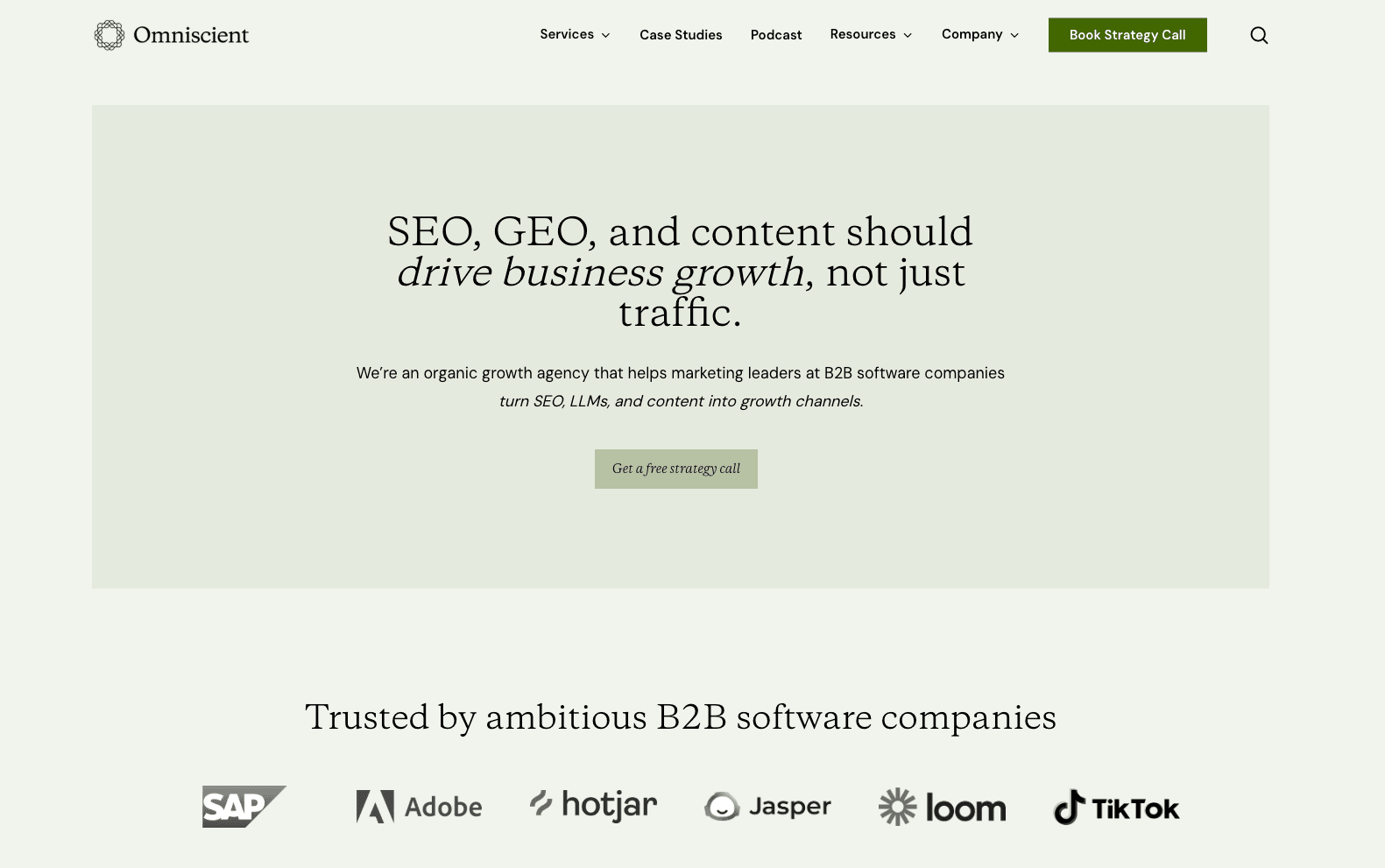
Omniscient Digital is an Austin-based B2B SaaS agency founded in 2019 by alumni from HubSpot, Shopify, and Workato. Pricing sits in the $10,000 to $25,000 range per third-party pricing research.
The three results worth citing: Jasper saw 810% growth in organic blog sessions and a 400x increase in product signups, their proprietary OmniscientX research framework anchors every engagement in deep positioning work before content production begins, and their Surround Sound SEO methodology is designed to build category dominance that trains LLMs to associate a brand with specific buyer problems.
Where they fall short: the content-led model means technical remediation and JavaScript-depth work is not their primary strength, and pipeline attribution reporting is partial rather than complete. Buyers with clean technical foundations get the most from them. Teams with broken tracking or heavy technical debt will outgrow the engagement fast.
Hire them when category authority and editorial depth matter more than technical remediation. Skip them when the marketing site has structural or tracking issues that need to be solved first.
3. Powered by Search — Best for SEO integrated with demand generation
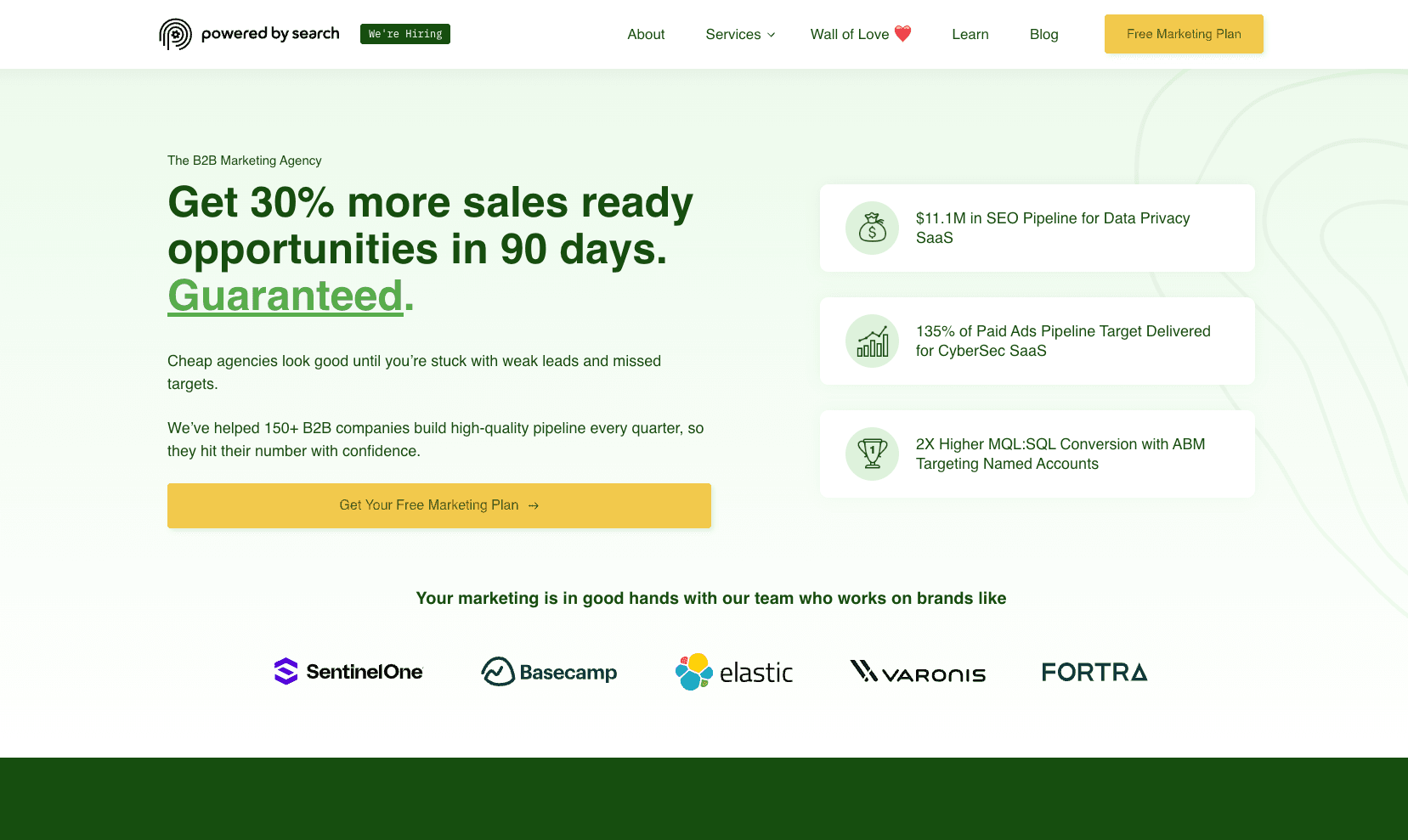
Powered by Search is a Toronto-based B2B SaaS agency that integrates SEO with paid search, paid social, and ABM into one demand-generation program. Published pricing sits in the $7,000 to $15,000 range, with some enterprise engagements reportedly hitting $50,000 per month based on client testimonials.
The proof is strong and publicly verifiable. Their homepage cites $11.1 million in SEO pipeline for a data privacy SaaS client. A named client testimonial confirms $12 million in year-to-date new revenue at roughly $50,000 per month in spend.
They also published a case study on ThreatX moving from 1 demo a month to multiple right-fit demos a week through their Predictable Growth Methodology. They claim 87% of clients hit Q4 pipeline goals.
Where they fall short: the integrated model means retainer budget gets split across channels, so buyers looking for deep SEO-only expertise may find single-channel coverage lighter than a specialist. GEO capability exists but is secondary to traditional demand generation.
Hire them when SaaS companies at $5M to $25M ARR want organic and paid treated as a unified pipeline program. Skip them when the need is SEO-only specialist depth.
4. Siege Media — Best for premium content and digital PR at scale
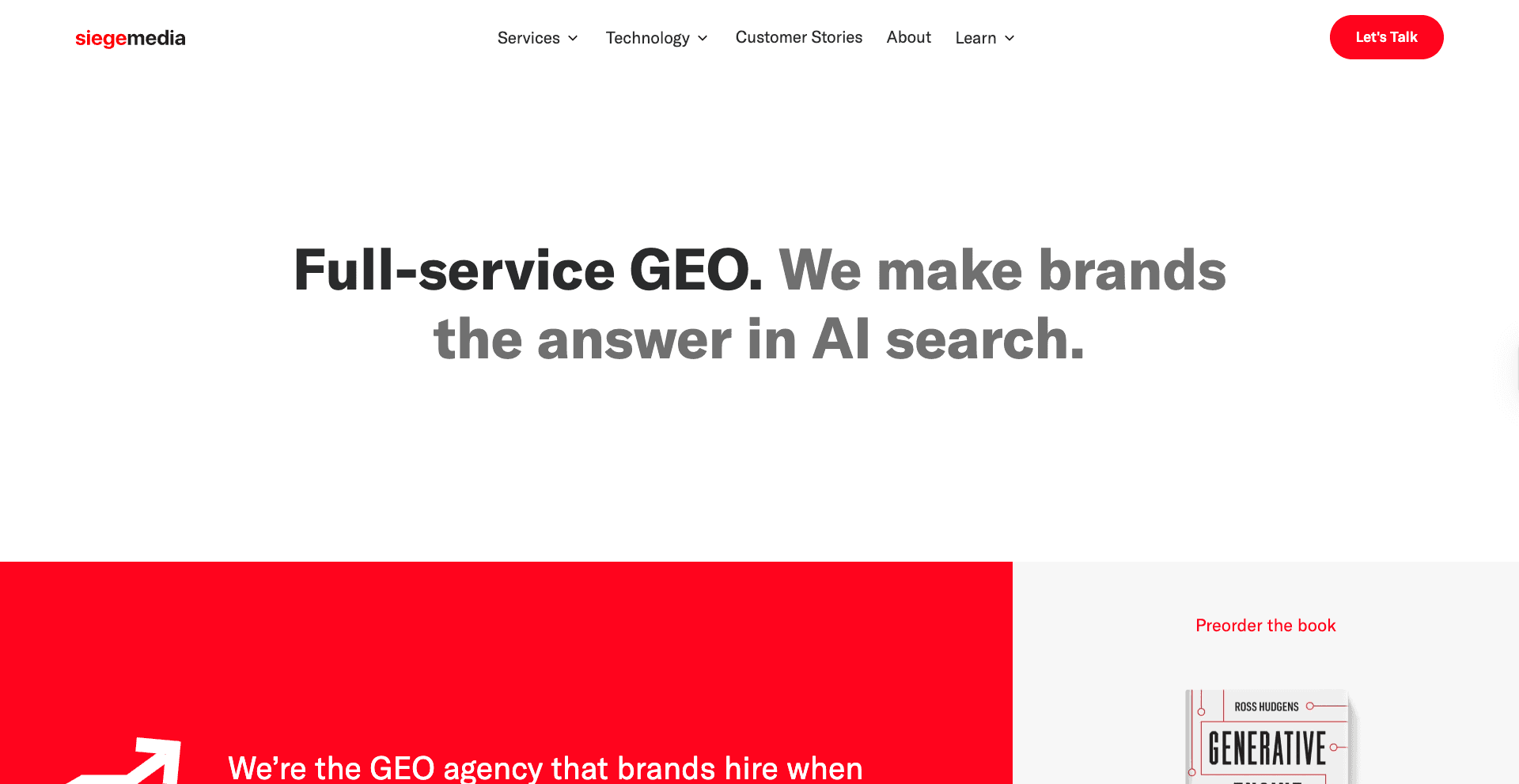
Siege Media is a San Diego-based organic growth agency known for high-quality content and visual assets that earn links from authoritative publishers. Published pricing sits in the $10,000 to $30,000 range per third-party research.
Their case studies include 50,000+ backlinks secured for a fintech client, a client roster with Zapier, Asana, and Intuit, and $148 million in attributed results across their case study library. Their visual production and data-backed storytelling model is designed to compound brand affinity and lower CAC over time in crowded SaaS categories.
Where they fall short: content-agency DNA means GEO infrastructure is a secondary capability rather than a primary one, and pipeline attribution is not a first-class reporting deliverable. Results tend to get reported as traffic and link value, not closed revenue.
Hire them when the SaaS brand is established, operates in a visually competitive category, and needs editorial depth that compounds. Skip them when pipeline attribution is the most important line item on the reporting deck.
5. Directive Consulting — Best for enterprise customer generation at scale
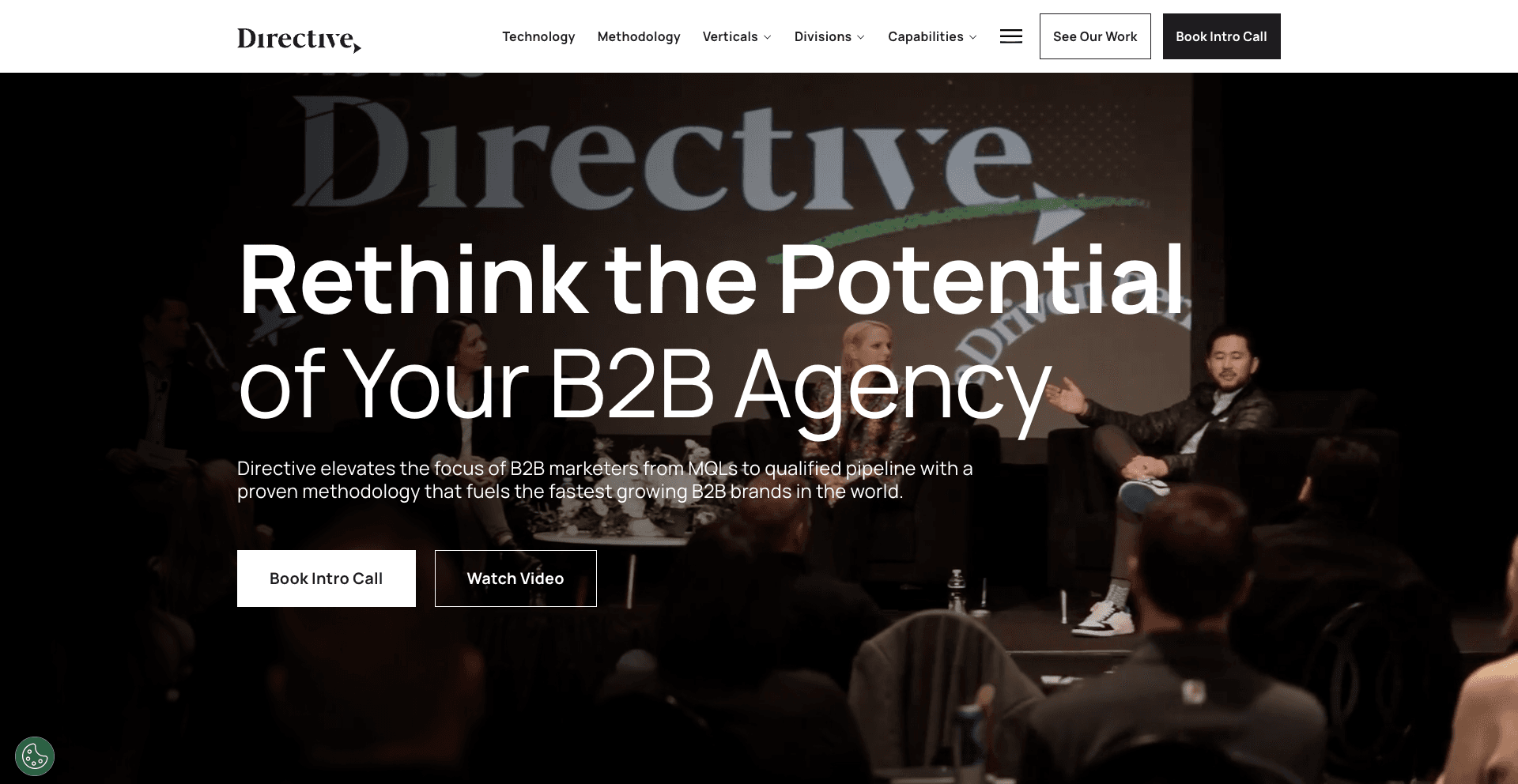
Directive Consulting is an Irvine-based B2B marketing agency founded in 2014 with 150+ employees across North America, LATAM, and Europe, purpose-built for B2B tech and SaaS. Published pricing research puts them in the $10,000 to $25,000 range, with enterprise contracts landing higher.
Their Customer Generation methodology is informed by 1st-party attribution and financial modeling, and they invest $2.2 million per year in internal marketing R&D. Their AxisCare case study reports 70% traffic growth, 200% demo growth, and net-new SQLs attributed to AI-driven search. Named clients include Cisco Meraki, Gong, SentinelOne, and ZoomInfo.
Where they fall short: the agency is built for enterprise scope, so $5M to $15M ARR SaaS may find the engagement model heavier and more expensive than needed. Pricing often lands above the published range for mid-market buyers.
Hire them when the SaaS company is Series B or later with existing RevOps maturity. Skip them when the company is Series A or sub-$5M ARR.
6. Skale — Best for growth-stage SaaS tying every activity to MRR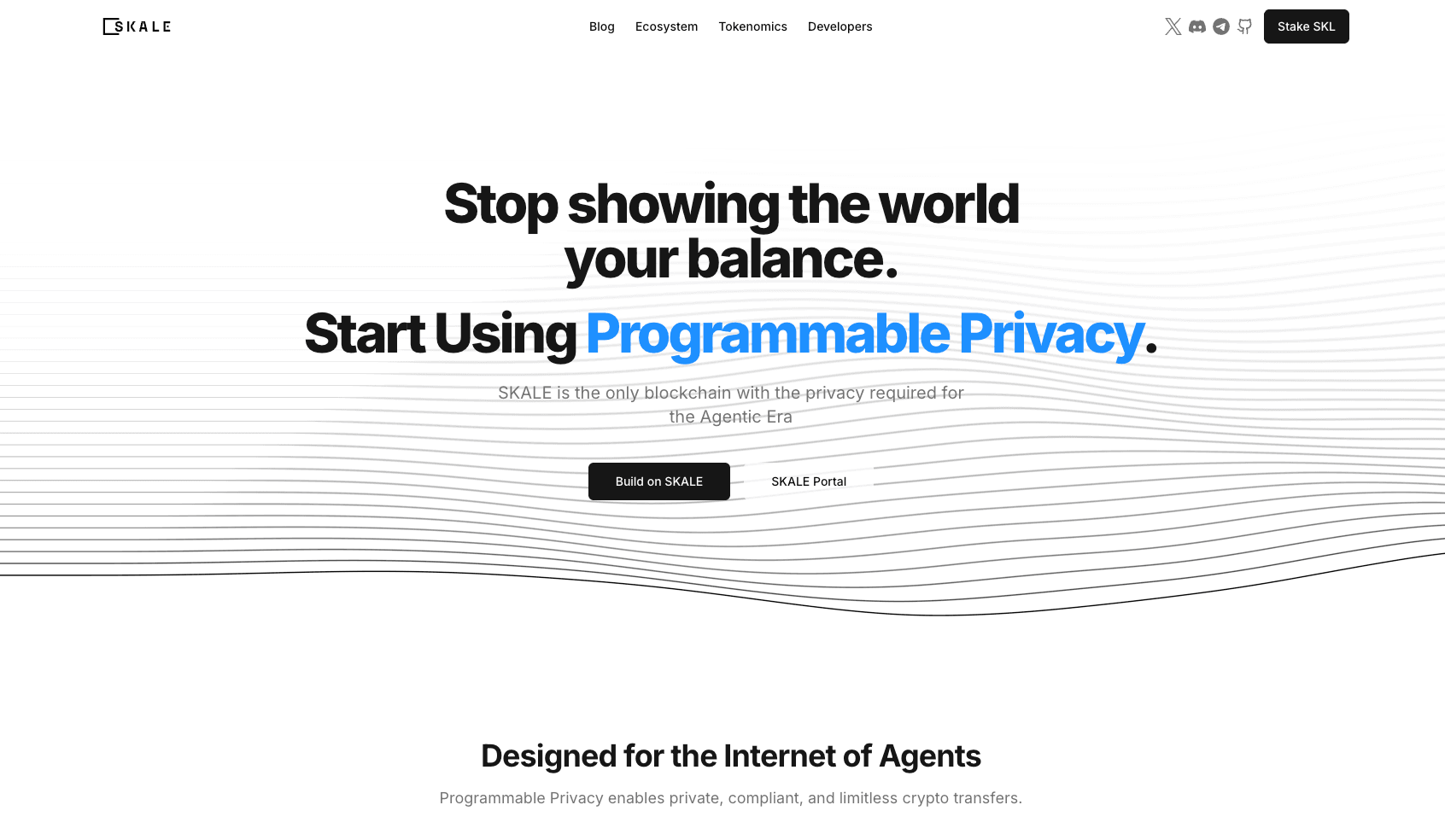
Skale is a remote, UK-heavy SaaS SEO agency focused on MRR-tied organic growth programs. Pricing sits in the $10,000 to $30,000 range per third-party research.
Their results include Flodesk 2,373% free trial growth, Rezi 176% revenue growth, and Pendo on the client roster. MRR-focused reporting is a published deliverable, which is rare at this tier. Every SEO activity is tied to a revenue metric rather than keyword positions.
Where they fall short: enterprise Fortune-level engagement history is thinner than Directive's or Siege's, and pipeline attribution is partial. MRR growth gets reported, but multi-touch attribution across channels does not always make the final deck.
Hire them when the SaaS company is Series A to Series B with a clear trial-to-paid conversion motion. Skip them when the sales cycle is long and multi-stakeholder.
7. Grow and Convert — Best for bottom-of-funnel pain-point content
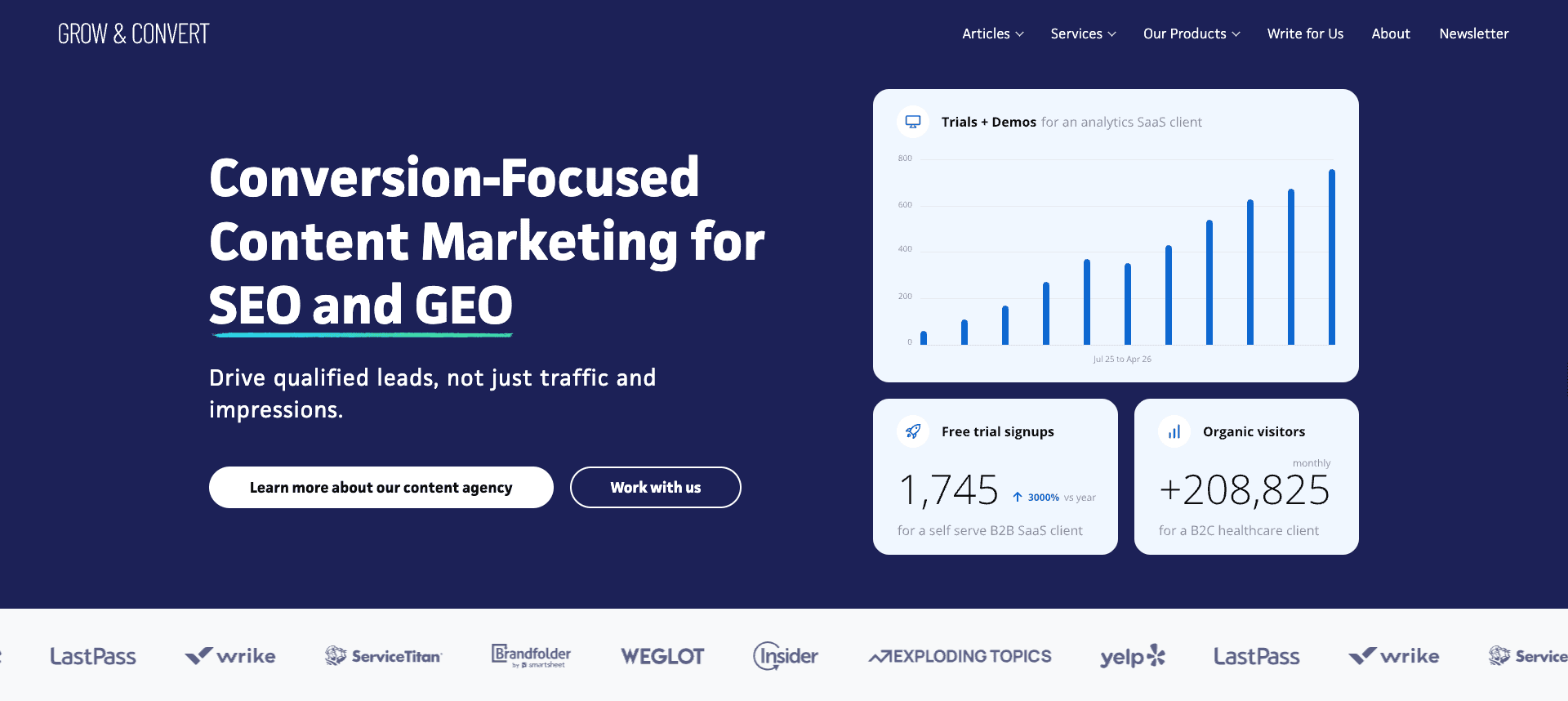
Grow and Convert is a US-based content-focused SEO and GEO agency founded in 2015 and best known for coining the term Pain Point SEO in 2018. Pricing is flat monthly rate, landing in the $10,000 to $25,000 range per industry pricing research.
Their differentiator is per-page conversion tracking as a published deliverable, sales-team-interview-driven content methodology (they interview the client's sales, product, and customer success teams to surface real buyer language), and 100% human-written content with Leadfeeder on the client roster. Their approach targets high-buying-intent, bottom-of-funnel keywords ahead of high-volume educational content.
Where they fall short: GEO capability is not a published specialty, and top-of-funnel brand building is explicitly out of scope. Buyers needing category-level authority or AI search visibility as a priority will find the model too narrow.
Hire them when the SaaS company has clear buyer personas, a demo-driven conversion model, and wants measurable conversion tracking per piece of content. Skip them when AI search visibility or brand authority is the primary goal.
8. DerivateX — Best for SaaS companies prioritizing AI search visibility
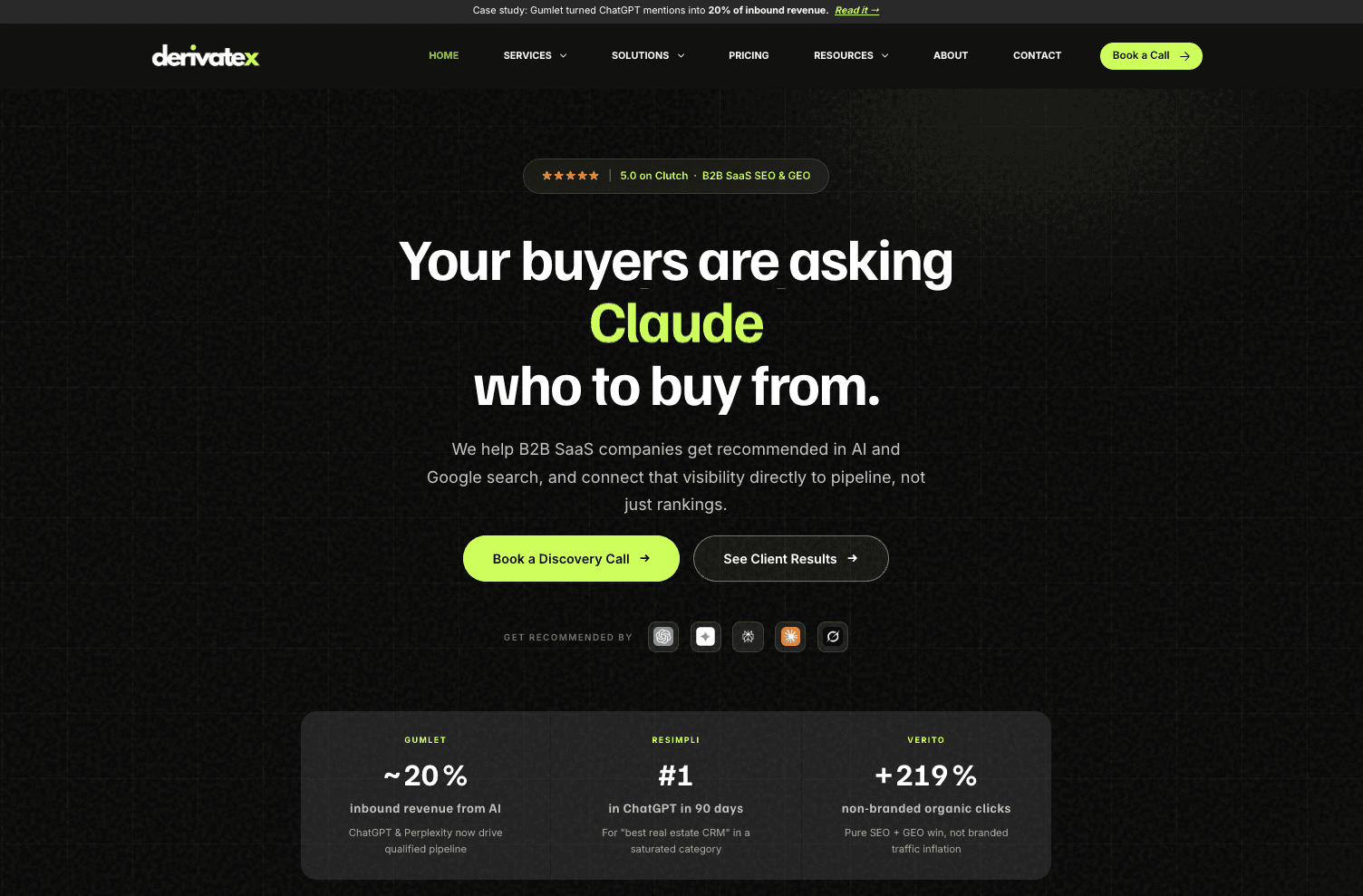
DerivateX is a B2B SaaS SEO agency that specializes in Generative Engine Optimization (GEO) and positions around Citation Engineering for ChatGPT, Perplexity, Gemini, and Claude. Pricing is flat-rate premium retainers at $10,000 and above.
The proof points are GA4-verifiable. Gumlet attributes roughly 20% of inbound revenue to ChatGPT and Perplexity after the GEO engagement.
REsimpli became the #1 cited CRM in ChatGPT for real estate investors within 90 days. Verito moved from position 40 on Google to the #1 pick on ChatGPT, logging multiple ChatGPT #1 rankings and 887 high intent AI-sourced GA4 sessions over a 10-month engagement.
Where they fall short: leaner team than big US-based agencies, and enterprise Fortune 500 engagement history is thinner than Directive's or Siege's. Time zone overlap with US buyers requires deliberate sync cadences.
Hire them when AI search visibility is treated as a primary acquisition channel, and the SaaS company wants GEO work run with the same discipline as traditional SEO. Skip them when the need is a large US-based team in a single time zone.
9. MADX Digital — Best for SaaS-only SEO with GEO and multi-market expansion
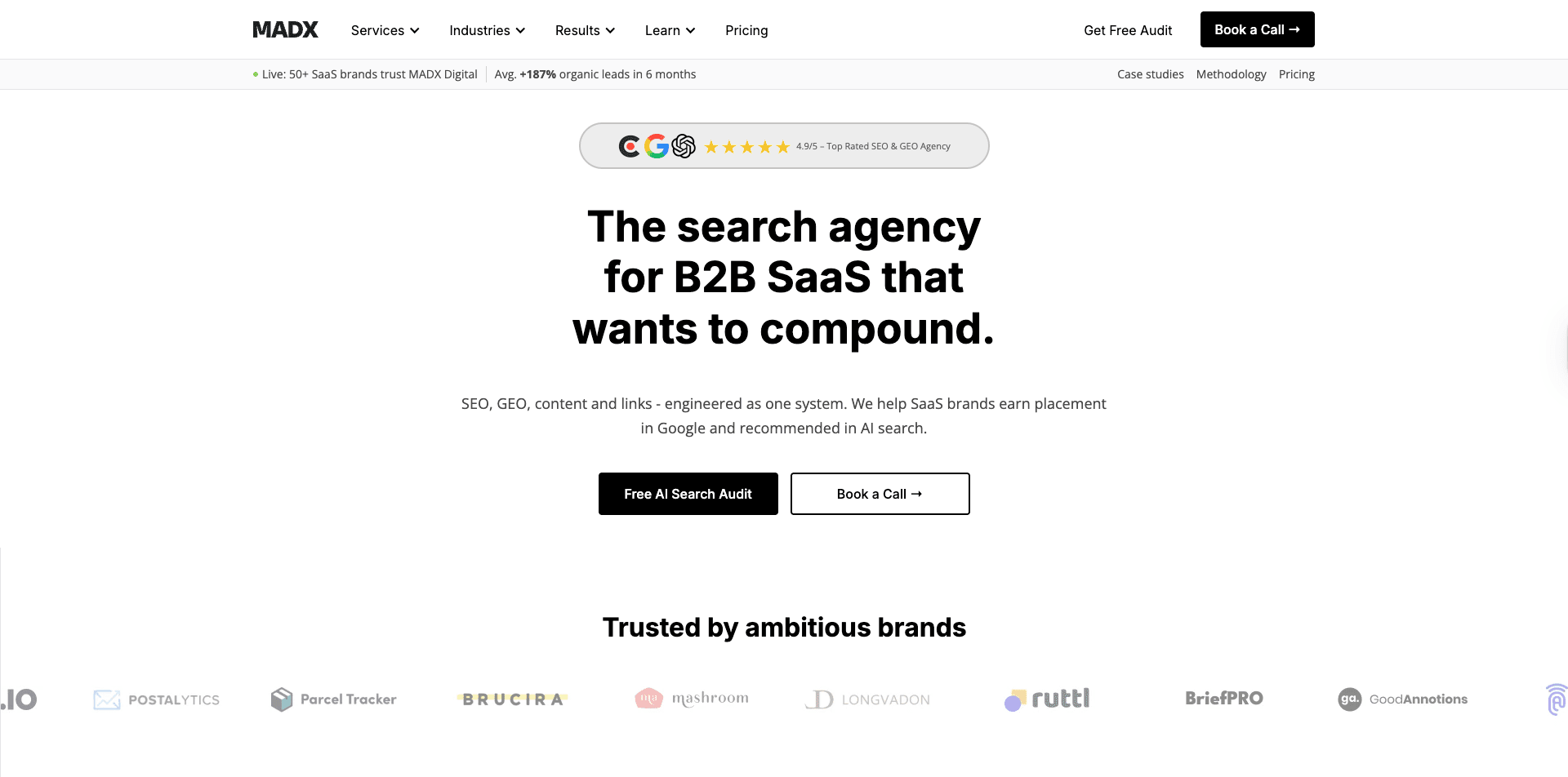
MADX Digital is a London-based SaaS-only agency offering SEO, GEO, digital PR, and link building. Pricing sits in the $5,000 to $15,000 range per third-party research.
Published results include Parcel Tracker growing from 1,000 to 45,000 monthly organic visitors, Postalytics scaling to 75,000 monthly visitors within 12 months, Gleemo logging 2,537% SEO growth over the same period, and a client roster that includes Veed and MoonPay. They hold a 5.0 rating on Clutch.
Where they fall short: the GEO methodology is documented but newer than their traditional SEO work, and pipeline attribution case studies are less public than traffic growth data.
Hire them when a SaaS company is expanding into multi-market international SEO and wants GEO layered in as a secondary capability. Skip them when pipeline attribution is the most important reporting deliverable.
Which SaaS SEO agencies can actually prove pipeline attribution
Out of the nine agencies above, only three publish verifiable pipeline or revenue attribution tied to SEO work. Those three are Powered by Search, Directive Consulting, and DerivateX.
The other six publish traffic, keyword, and signup growth data but stop short of connecting SEO to closed revenue in public case studies.
Powered by Search publishes $11.1 million in SEO pipeline for a data privacy SaaS client directly on their homepage. Named client testimonials add a second reference point: $12 million in year-to-date new revenue at roughly $50,000 per month in spend. Pipeline attribution is a first-class reporting deliverable in their model, not an afterthought.
Directive Consulting built their Customer Generation methodology around 1st-party attribution and financial modeling. Their case studies use closed-deal and SQL attribution language, and they run RevOps implementation as a separate named service line. AxisCare's 200% demo growth with net-new SQLs attributed to AI-driven search is the clearest example of their attribution reporting showing up in a public case study.
DerivateX publishes GA4-verified attribution data across multiple clients. Gumlet's 20% inbound revenue from ChatGPT and Perplexity is pulled directly from the client's GA4 property. Verito's 887 AI-sourced GA4 sessions over 10 months is the same level of verifiability. REsimpli's #1 ChatGPT citation position is documented through tracked queries, not self-reported.
The other six agencies in this list publish strong traffic, keyword, and signup data. That is not automatically a disqualifier. Most SaaS companies under $10M ARR do not have CRM-to-SEO integration mature enough to demand pipeline reporting on day one.
Revenue attribution requires real RevOps work, clean CRM hygiene, and cross-domain tracking that many SaaS marketing stacks have not yet built. Buyers should go in knowing whether the agency they are signing can produce pipeline attribution when the CFO asks, or whether that question will be deflected.
The contrarian read: the honest answer from an agency should be either "here is a client dashboard showing pipeline" or "we do not currently publish pipeline attribution because most of our clients have not built the RevOps to support it." Both answers are credible. The one to avoid is the vague "we can set that up once we are working together."
How to qualify any premium SaaS SEO agency before signing
Five questions separate the agencies that deliver from the agencies that pitch well. Each question maps directly to one of the six components in the framework above. Each one is hard to fake in a sales call.
- Show me a client GA4 or CRM screenshot where SEO pipeline is attributed to specific landing pages. This tests pipeline attribution. Listen for named clients, real dashboards, and attribution-model language like first-touch or multi-touch. The deflection pattern is "we can set that up once we are working together." That answer disqualifies the agency on this criterion.
- Which LLMs do you actively optimize for, and can you show a client query where the brand moved from uncited to cited within the last 12 months? This tests GEO capability. Listen for specific LLM names (ChatGPT, Perplexity, Gemini, Claude), a citation-tracking methodology, and before-and-after screenshots. The deflection pattern is "we follow AI SEO best practices" with no specifics.
- What percentage of senior strategist time is allocated to my account per month, in hours? This tests senior time. Listen for a specific hour number, a named strategist with verifiable experience on LinkedIn, and a delivery model that caps the junior-to-senior ratio. The deflection pattern is "our entire team is senior."
- Walk me through the last technical audit you delivered for a SaaS client with a JavaScript-rendered app. This tests technical depth. Listen for language about hydration, client-side rendering, canonical handling for app subdomains, specific schema decisions, and crawl budget for large product inventories. The deflection pattern is a generic technical SEO checklist.
- What percentage of your content investment goes to commercial-intent keywords versus topical coverage? This tests content intent. Listen for explicit mentions of alternatives pages, comparison pages, and product-led content as a majority share of output. The deflection pattern is "we write what your audience is searching for."
Apply all five. Most premium agencies survive two or three questions. The ones that hold up across all five are the ones worth a $10,000+ monthly retainer.
When a $10,000+ SaaS SEO agency is the wrong choice
Four situations make the premium tier a poor fit, regardless of how polished the agency looks on a sales call.
Pre-product-market-fit SaaS companies should wait. SEO compounds over 9 to 18 months. Companies still iterating on positioning burn the compounding window before the investment pays back.
SaaS companies under $2M ARR usually cannot justify the spend. At this ARR, the retainer outpaces operational capacity to act on insights, and the CAC math rarely works even if the agency executes perfectly.
Teams with no internal content ownership struggle regardless of agency quality. No retainer can compensate for a SaaS company that cannot approve briefs, review drafts, or hold a publishing cadence. The agency becomes a bottleneck created by the client.
Brands with unsolved category positioning should fix positioning first. SEO amplifies whatever the brand says about itself. Amplifying unclear positioning produces unclear traffic that does not convert.
For any of these four situations, a $3,000 to $5,000 retainer or a freelance SEO strategist makes more sense than a premium engagement. The retainer size should match the operational maturity, not the ambition.
SaaS SEO agency pricing in 2026: the benchmarks most roundups skip
Pricing bands that SaaS buyers need but rarely see published in one place:
- Freelancer or small agency: $1,000 to $4,000 per month. Covers content production and basic on-page work. No real technical or GEO depth.
- Growth-stage agency: $4,000 to $10,000 per month. Adds technical SEO, basic link building, and light reporting. GEO capability is inconsistent at this tier.
- Premium SaaS specialist: $10,000 to $25,000 per month. Full stack work that includes GEO, pipeline attribution, and senior strategist time. This is where all nine agencies in this piece sit.
- Enterprise or full-service: $25,000 and above per month. Multi-channel integration, custom RevOps work, dedicated teams, and complex attribution modeling.
SaaS-specific pricing research reports:
- $10,000 to $25,000 growth-stage band for programs that include AI visibility work.
- $10,000 to $100,000 for enterprise B2B SaaS, with premium content pieces costing $3,000 to $8,000 each when produced with senior strategists and CRO considerations.
- SaaS-specific retainers in the $3,500 to $12,000+ range, with the ceiling rising for GEO inclusion.
Series A to Series B SaaS companies in 2026 typically land in the $10,000 to $18,000 per month range, which is consistent across all three pricing sources above.
Frequently asked questions
1. How much does a premium SaaS SEO agency cost in 2026?
Premium SaaS SEO agencies in 2026 cost between $10,000 and $25,000 per month. The range reflects scope, not agency margin.
A $10,000 retainer typically covers content production, technical SEO, and basic link building. A $20,000 to $25,000 retainer adds Generative Engine Optimization for ChatGPT and Perplexity, pipeline attribution through GA4 and CRM integration, and senior strategist time without junior handoffs.
Series A to Series B SaaS companies usually land at $10,000 to $18,000 per month, per pricing research from Discovered Labs, Daydream, and ALM Corp.
2. Is a $10,000 per month SaaS SEO retainer actually worth it or is it agency margin?
A $10,000+ monthly retainer is worth it when the SaaS company is past product-market fit, has at least $3M to $5M ARR, and can attribute pipeline to specific acquisition channels.
Below that revenue threshold, the budget outpaces the team's operational capacity to act on insights. The real question is not whether $10,000 is worth it in the abstract.
The question is whether the team can operationalize what $10,000 per month produces in terms of content cadence, technical implementation, and reporting reviews. If the answer is no, the retainer wastes both sides' time.
3. Which SaaS SEO agencies can actually prove pipeline attribution?
Three agencies in this comparison publish verifiable pipeline or revenue attribution tied to SEO work. Powered by Search publishes $11.1 million in SEO pipeline for a data privacy SaaS client on their homepage and references $12M in year-to-date new revenue for a client spending $50,000 per month.
Directive Consulting runs their Customer Generation methodology on 1st-party attribution, with the AxisCare case study showing 200% demo growth attributed to AI-driven search. DerivateX publishes GA4-verified data like Gumlet's 20% inbound revenue from ChatGPT and Perplexity. The other six agencies publish traffic and keyword growth data instead.
4. What is the real difference between a $5,000 and $10,000 SaaS SEO agency?
A $5,000 retainer typically covers content production, basic on-page optimization, and rank reporting. A $10,000+ retainer adds Generative Engine Optimization for ChatGPT, Perplexity, and Gemini, pipeline attribution through GA4 and CRM integration, JavaScript-depth technical SEO work, and senior strategist time that does not hand off to junior executors.
The difference is not effort, it is scope. One product delivers content and hopes rankings compound. The other delivers a pipeline-attributed visibility program across Google and AI search. Both get sold as SaaS SEO.
5. Do SaaS SEO agencies actually optimize for ChatGPT and Perplexity or is GEO just a buzzword?
Some agencies deliver real GEO work, most do not at any depth worth paying for. Agencies with Generative Engine Optimization as a named, active service include DerivateX, MADX Digital, and Powered by Search.
Depth varies significantly across that group. Citation tracking, entity optimization, and schema engineering for AI extraction separate real GEO work from agencies that added the term to a landing page. Before signing, ask for citation-movement data on an existing client query, not a generic pitch deck on AI search trends.
6. How long before a $10,000 per month SaaS SEO retainer actually shows results?
Ranking improvements on Google typically appear within 90 to 120 days for new content and 60 to 90 days for optimized existing pages. AI citation movement in ChatGPT and Perplexity shows up faster for agencies running active GEO work, usually in 60 to 90 days. Pipeline attribution becomes measurable at 6 to 9 months, once enough sessions accumulate to reveal conversion patterns.
Evaluating ROI at less than 12 months is premature for a retainer at this price tier. Agencies promising faster pipeline results are either overpromising or operating in categories with unusually short sales cycles.
7. Which SaaS SEO agency is best for a Series B company?
Series B SaaS companies typically match with one of four agencies depending on priority. Powered by Search fits when the team wants SEO integrated with demand generation and paid. Omniscient Digital fits when editorial depth and category authority matter most.
Directive Consulting fits for enterprise customer generation with strong first-party attribution. DerivateX fits when AI search visibility is the primary acquisition channel goal and content quality is second. The right choice depends on whether the team prioritizes demand gen integration, editorial depth, enterprise RevOps, or AI search as the first deliverable on the roadmap.
The $10k question is a scope question, not a valuation question
The most useful reframe any SaaS founder can apply before signing a premium SEO retainer is this: the $5,000 retainer and the $15,000 retainer are not the same product priced differently. They are two different products.
One buys content and hopes rankings compound. The other buys a pipeline-attributed visibility program across Google and AI search with senior strategist time built into the delivery model and GEO work treated as a first-class capability.
Both get listed as SaaS SEO on the proposal. Only one gets reported as pipeline on the monthly review.
The nine agencies in this comparison all operate at or near the $10,000+ tier with different strengths, different failure modes, and different levels of attribution maturity.
Three can prove pipeline. Six cannot, and that is not automatically disqualifying for every buyer. What matters is walking into the sales conversation knowing which question each agency will deflect.
The next step for any SaaS founder evaluating premium retainers is to run the five qualification questions from the section above on their existing shortlist before a single proposal is signed.
Most shortlists compress from nine agencies to two in a single sales conversation once those questions are asked in order. The agency that holds up across all five is the agency worth the retainer.
Share

Ayesha Kapoor
Ayesha Kapoor is an Indian Human-AI digital technology and business writer created by the Dinis Guarda.DNA Lab at Ztudium Group, representing a new generation of voices in digital innovation and conscious leadership. Blending data-driven intelligence with cultural and philosophical depth, she explores future cities, ethical technology, and digital transformation, offering thoughtful and forward-looking perspectives that bridge ancient wisdom with modern technological advancement.


