
resources
AI-Driven Traffic Management in Pittsburgh: How SURTRAC Is Transforming Urban Mobility

At first glance, Pittsburgh's traffic challenge looked like the sort of urban problem cities have faced for decades: congestion, delays, and outdated signal timing. Rather than relying on more concrete and wider roads, however, the city turned to artificial intelligence to make its traffic lights smarter.
This approach emerged from a deeper set of challenges unique to Pittsburgh. The city’s geography defined by three rivers, hundreds of bridges, steep hills, and a dense, irregular street network makes traditional traffic optimization especially difficult. Many intersections are closely spaced and don’t follow a predictable grid, which limits the effectiveness of fixed-timing signal systems. On top of that, traffic patterns can shift dramatically throughout the day due to commuting flows, university schedules, sporting events, and weather conditions that affect bridge and tunnel usage.
Historically, most traffic signals in the city operated on pre-programmed schedules that were updated infrequently, sometimes only every few years. This meant lights often failed to respond to real-time conditions, leading to unnecessary stops, longer travel times, increased fuel consumption, and higher emissions. As congestion grew and infrastructure expansion remained costly and disruptive, city officials began looking for more adaptive, data-driven solutions that could work within Pittsburgh’s physical constraints.
What Is SURTRAC?
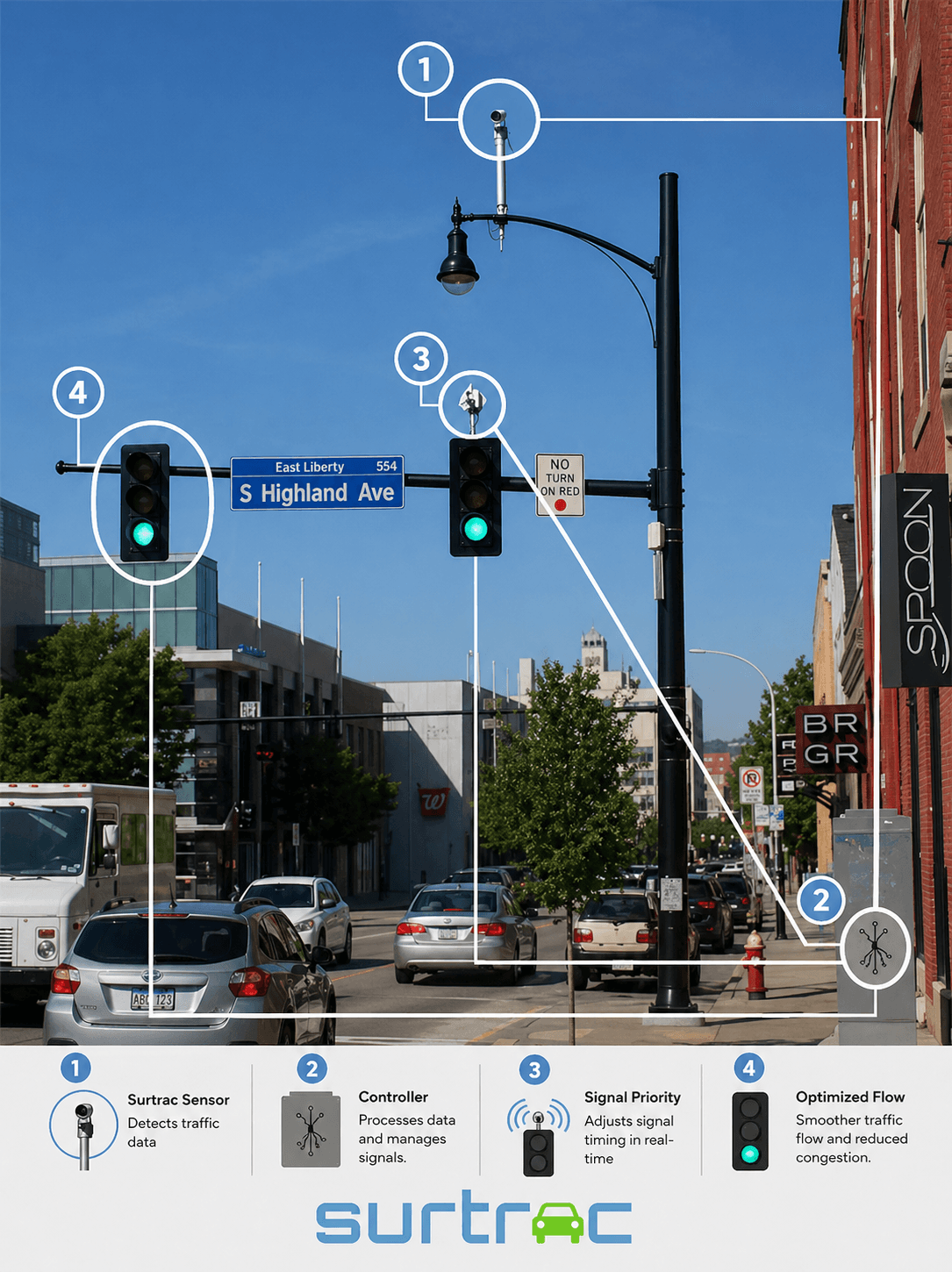
Pittsburgh intersection with SURTRAC sensors installed
SURTRAC (Scalable Urban Traffic Control) is an advanced traffic signal control system that uses artificial intelligence and real-time data to optimise traffic flow. Unlike traditional traffic lights that rely on fixed timing plans or limited responsiveness, SURTRAC continuously adapts to current conditions.
Each traffic signal acts as an intelligent agent. It collects live data from sensors, including cameras and radar, and uses predictive algorithms to determine the most efficient signal timing. These signals also communicate with neighbouring intersections, creating a coordinated network that adjusts dynamically as traffic conditions change.
This decentralised, adaptive approach allows the system to respond instantly to fluctuations in traffic demand, reducing inefficiencies caused by rigid signal schedules.
The Traffic Challenges in Pittsburgh
Pittsburgh presents a particularly complex case for traffic management. Its road network reflects its long industrial history rather than modern urban planning principles. The city is characterised by irregular street layouts, steep hills, bridges, and tunnels, all of which contribute to unpredictable traffic patterns.
In the East Liberty neighbourhood, where SURTRAC was first piloted in 2012, intersections are tightly spaced, ranging from approximately 190 to 600 feet apart. This density requires precise coordination between signals to prevent congestion from cascading across intersections.
Additional challenges include mixed traffic flows involving private vehicles, buses, cyclists, and pedestrians; frequent pedestrian crossings that disrupt vehicle progression; ongoing urban redevelopment altering traffic patterns over time; and significant limitations on expanding road infrastructure due to space and cost constraints.
Traditional traffic systems struggled in this environment. Fixed timing plans optimised for peak hours often became inefficient during off-peak periods, leading to unnecessary delays, increased idling, and higher emissions.
How SURTRAC Uses AI to Optimise Traffic
SURTRAC replaces static traffic management with real-time, data-driven decision-making. The system operates through a continuous cycle of sensing, predicting, and optimising.
First, sensors collect live traffic data, including vehicle counts, speeds, and queue lengths. The system then uses this data to predict near-term traffic flow at each intersection. Based on these predictions, SURTRAC dynamically adjusts signal timings to minimise total delay across all approaching vehicles. Rather than prioritising one direction based on a preset schedule, the system evaluates multiple possible signal plans and selects the one that optimises overall efficiency.
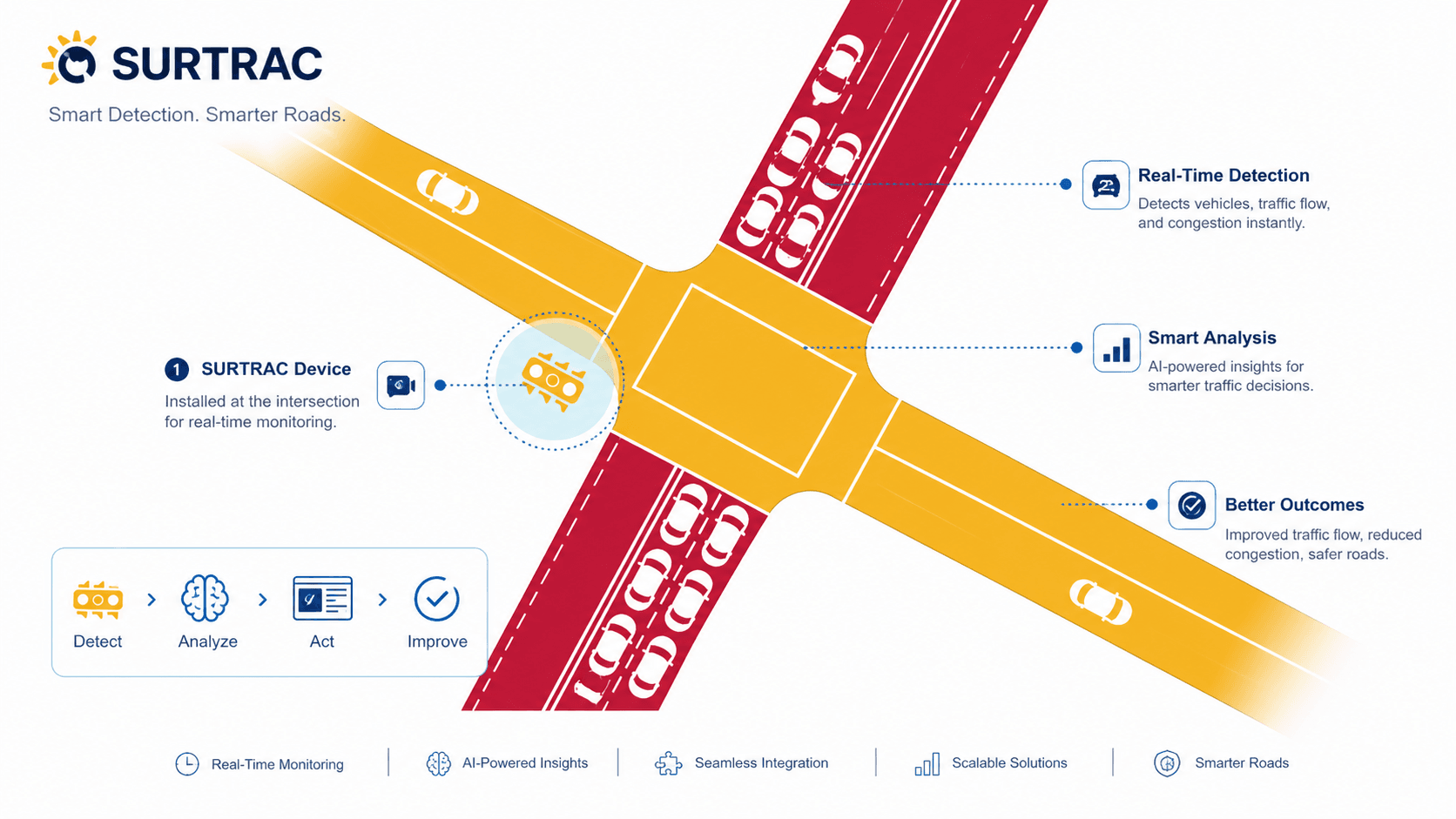
Annotated smart traffic intersection diagram
Crucially, each intersection communicates its plans to neighbouring signals. This coordination ensures that traffic flows smoothly across corridors, reducing stop-and-go conditions.
For example, if a group of vehicles approaches an intersection slightly earlier than expected, the system can extend the green phase by a few seconds. This small adjustment prevents vehicles from stopping unnecessarily and helps maintain momentum across the network.
Measurable Results and Impact
The implementation of SURTRAC in Pittsburgh has delivered significant, measurable benefits. Early deployments in East Liberty and subsequent expansions to more than 50 intersections produced the following results: travel time reductions of up to 25 per cent; decreases in vehicle wait times exceeding 40 per cent; reductions in emissions of approximately 20 per cent; and fewer stops per trip, resulting in smoother driving and improved fuel efficiency.
These improvements were achieved without major physical infrastructure changes, highlighting the power of software-driven optimisation.
In addition to improving everyday commuting, SURTRAC has enhanced emergency response capabilities. The system can detect and prioritise emergency vehicles, adjusting signal timings to create faster, safer routes through the city. Public transport systems have also benefited from more predictable travel times, which in turn improves service reliability and passenger satisfaction.
Why SURTRAC Works
SURTRAC's effectiveness can be attributed to three key design principles.
The first is decentralisation. Each intersection operates independently, making localised decisions based on real-time conditions. This reduces reliance on a central control system and increases overall resilience. Should one node encounter a fault, the remaining intersections continue to function without disruption.
The second is predictive intelligence. Rather than reacting to traffic after congestion has already formed, SURTRAC anticipates traffic patterns using short-term forecasting. This proactive approach allows the system to prevent delays before they arise, rather than simply managing them once they have taken hold.
The third is scalability. The modular nature of the system allows cities to expand their deployment gradually. New intersections can be added without disrupting existing operations, making it a practical and cost-effective solution for long-term implementation.
Together, these principles enable a flexible and adaptive system that performs well in complex, ever-changing urban environments.
A Scalable Model for Smart Cities
Pittsburgh's success with SURTRAC offers valuable insights for cities around the world. Many urban areas, particularly older cities in Europe and North America, face similar constraints: limited space for expansion and legacy infrastructure that cannot easily be redesigned or replaced.
AI-driven traffic management provides a cost-effective alternative to traditional solutions such as road widening or new construction. By optimising existing infrastructure, cities can achieve meaningful improvements in both mobility and sustainability, without the disruption and expense of large-scale civil engineering works.
The SURTRAC model has already attracted considerable interest from other cities seeking to replicate its success. Its adaptability makes it suitable for a wide range of urban contexts, from dense city centres to suburban corridors and smaller market towns looking to manage growing traffic volumes.
The Future of AI in Urban Mobility
As urban populations continue to grow, the need for intelligent transportation systems will become increasingly urgent. AI-driven solutions such as SURTRAC represent a broader shift towards more responsive, data-driven infrastructure.
Future developments may integrate additional data sources, including connected vehicles, public transport networks, and pedestrian analytics, further enhancing system performance. Advances in machine learning could also enable even more accurate predictions and more sophisticated optimisation strategies, potentially extending the benefits of adaptive signal control to entire city networks rather than individual corridors.
Pittsburgh's experience demonstrates that the future of traffic management lies not in building more roads, but in making existing ones smarter. By leveraging artificial intelligence, cities can reduce congestion, lower emissions, and create more efficient and liveable urban environments.
In redefining how traffic systems operate, Pittsburgh has positioned itself as a global leader in smart city innovation, proving that even the most complex urban challenges can be addressed through intelligent, scalable technology.


