
AI Global Regulations Atlas & Whitepaper, Covering 109 Jurisdictions, Launched by Dinis Guarda and Businessabc
05 Nov 2026

The AI Global Regulations Atlas and its 5,000-word white paper provide CEOs, investors, corporate boards, and compliance leaders with a consolidated view of approximately 1,170 regulatory instruments, global AI readiness, enforcement frameworks, and emerging legal obligations.
As artificial intelligence becomes embedded in business operations, enterprise software, financial services, manufacturing, and corporate decision-making, AI regulation is emerging as a significant consideration for executive leadership.
Companies deploying AI across international markets must navigate increasingly complex legal requirements, including transparency obligations, risk classifications, data governance standards, and sector-specific rules.
To support a clearer understanding of this evolving landscape, Dinis Guarda, founder and CEO of Ztudium Group and Businessabc.net, has launched the AI Global Regulations Atlas, an interactive global regulatory intelligence platform accompanied by a 5,000-word technical white paper.
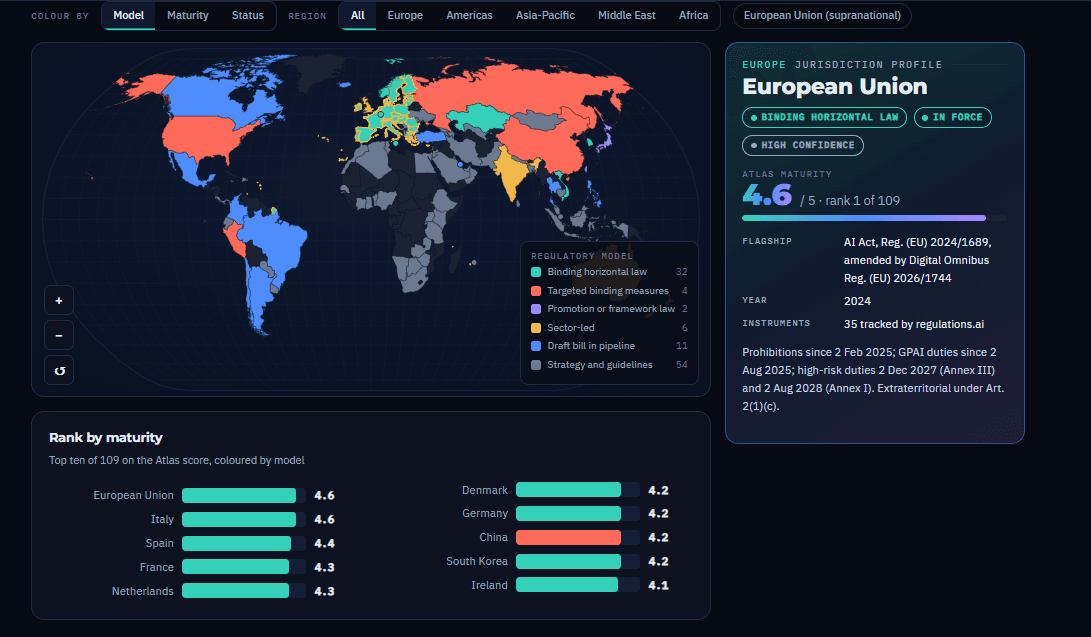
The Atlas maps approximately 1,170 AI regulatory instruments across 109 countries and jurisdictions, consolidating international indices, primary legislation, and public regulatory trackers into a comparative research resource.
For CEOs and corporate boards, the initiative provides a reference point for evaluating how AI governance differs between markets and where new obligations may affect enterprise operations.
AI Governance Moves From Technology Teams to Corporate Leadership
AI is increasingly being integrated into functions such as customer service, recruitment, financial analysis, risk management, software development, and strategic planning.
As adoption expands, corporate governance must address questions concerning accountability, legal exposure, operational risk, and the reliability of automated decisions.
The AI Global Regulations Atlas identifies substantial differences between national regulatory frameworks.
The European Union has adopted a horizontal risk-based approach through its AI Act. The United Kingdom follows a sector-led model, while China has introduced targeted rules governing specific AI technologies and applications.
South Korea's AI Basic Act came into force on 22 January 2026, and Vietnam's Law on AI became effective on 1 March 2026. Italy introduced Law 132/2025 alongside the EU framework.
In the United States, AI regulation remains heavily influenced by state legislation in the absence of a comprehensive binding federal AI statute. NYU's Center on Technology Policy counted 109 new state AI laws across 29 states by 1 July 2026, despite a December 2025 executive order seeking to constrain certain state-level regulatory approaches.
For multinational companies, this creates a complex environment in which compliance requirements may differ substantially across operating markets.
The Numbers Behind the Global AI Governance Challenge
The Atlas incorporates findings from the Global Index on Responsible AI 2026, which assesses 135 countries using 38 indicators.
The index reports a global average governance score of approximately 35 out of 100.
Europe averages 54, compared with 27 for the Global South.
Only 55% of active AI governance frameworks demonstrate evidence of implementation, while 78% of frameworks in the Global South are non-binding, compared with 42% in the Global North.
Additionally, only 54% of countries have national AI policies, and 18% require disclosure of government AI systems.
These findings suggest that organisations cannot assume a consistent level of regulatory maturity across international markets.
The Atlas categorises its 109 jurisdictions into six regulatory models: 32 under binding horizontal law, four under targeted binding measures, two under promotion laws, six sector-led, 11 with draft bills, and 54 primarily operating through strategies and guidelines.
The Changing European Regulatory Timetable
The European Union's Digital Omnibus, Regulation (EU) 2026/1744, has revised important AI Act implementation dates.
The main high-risk obligations for Annex III systems are scheduled to apply from 2 December 2027, while those for Annex I product-related systems will apply from 2 August 2028.
These changes provide companies with revised implementation windows, but do not eliminate the need to assess applicable AI obligations.
For CEOs, the implications extend beyond legal compliance to enterprise risk management, procurement, governance responsibilities, and investment planning.
"AI regulation has moved from principles to obligations in less than a decade, but it has not converged and remains fragmented and disconnected. A company deploying AI across borders must look at the best regulatory infrastructure and now faces risk tiers in Brussels, compute thresholds in California, use-case rules in Colorado, and targeted measures in Beijing." - Dinis Guarda, Founder & CEO of Businessabc, global thought leader.
He explained the objective of the new resource:
"The Atlas maps the global biggest regulatory footprint and puts the leading data, indices and trackers side by side, so that business leaders, compliance teams, regulators and investors can see where obligations bind today, what is coming, and where governance gaps remain."
A Regulatory Intelligence Resource for CEOs and Investors
The AI Global Regulations Atlas provides an interactive map of 109 jurisdictions, with regulatory classifications, maturity scores from 1 to 5, and individual jurisdiction profiles.
Its searchable directory enables users to examine legal instruments, regulatory status, source-confidence assessments, and flagship legislation.
The platform also includes charts categorising instruments by type, year, status, and jurisdiction; an AI regulatory timeline covering 2019 to 2028; comparisons of AI preparedness and responsible governance; and an overview of maximum penalties and enforcement approaches.
An exposure checker identifies potentially applicable regulatory instruments based on a company's operating market and AI use case.
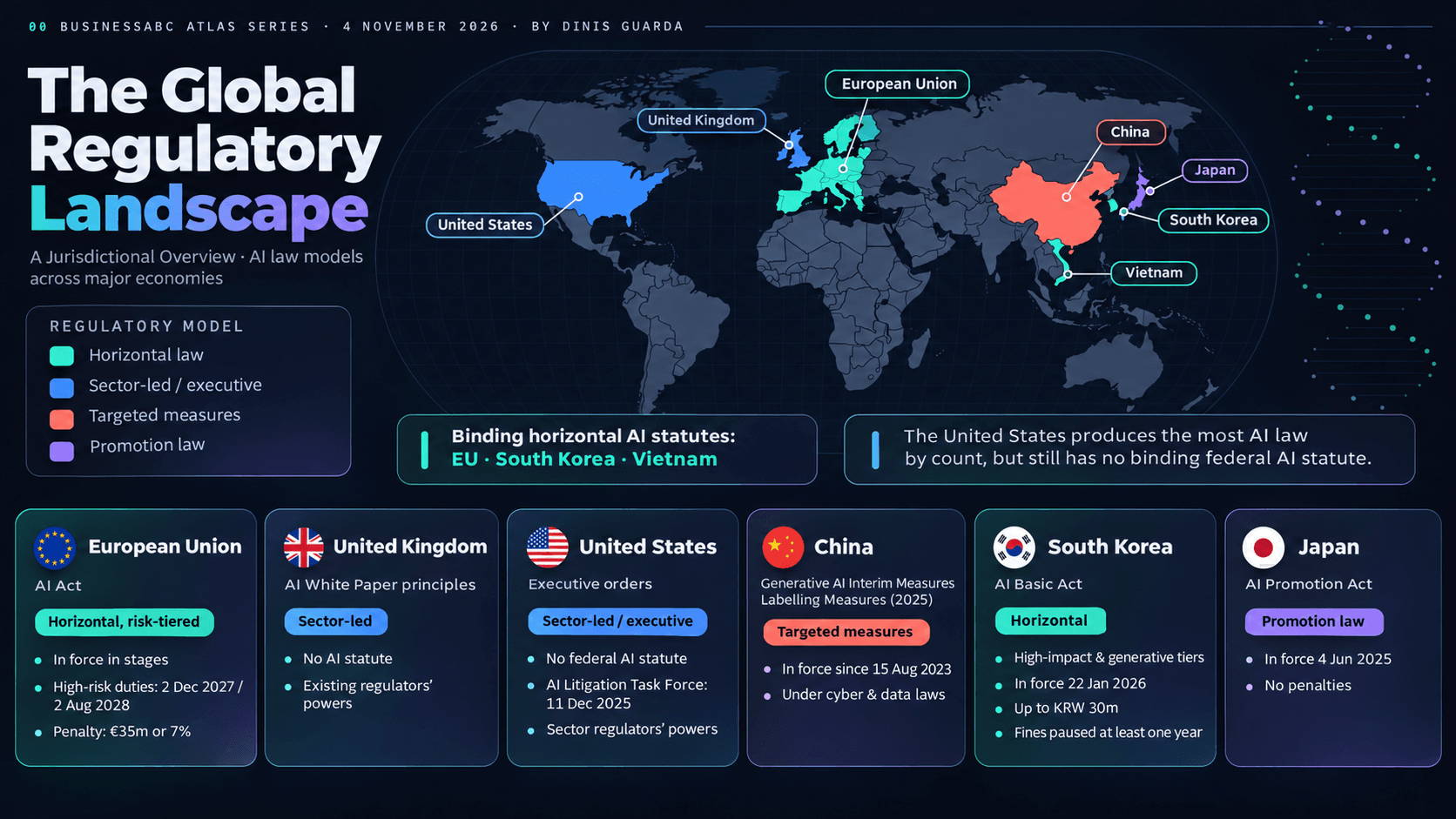
The companion white paper examines major regulatory models, country-level frameworks, international coordination mechanisms, and seven practical compliance steps.
These include using ISO/IEC 42001 as a common framework for AI management and organisational controls.
AI Investment and Regulatory Readiness Are Not the Same
The IMF AI Preparedness Index covers 174 economies, with Singapore scoring 0.80, Denmark 0.78, and the United States 0.77. China scores 0.63 and India 0.49.
Meanwhile, the Stanford HAI AI Index 2026 reports US AI investment of approximately $285.9 billion in 2025, compared with $20.9 billion in Europe and $12.4 billion in China.
The report also records 362 documented AI incidents.
These figures highlight the importance of distinguishing between AI investment, economic readiness, responsible governance, and legal enforcement.
For business leaders, a jurisdiction's attractiveness for AI investment cannot be assessed through technological capacity alone.
The Atlas and white paper are free to access:
- Interactive Atlas: AI Global Regulations Atlas by Dinis Guarda, Businessabc
- White paper: AI Global Regulations Atlas — White Paper


