


AI Is Learning Our Rules. But Who Will Teach It Responsibility?
22 Oct 2026

The rise of ethical AI layers, human wisdom, and the next global technology challenge.
We are creating machines that can reason, write, diagnose, recommend, and increasingly act on our behalf. As their intelligence improves, a more unsettling question arises: Who decides what these machines should do, and what they should never do?
Over the past decade, the global discussion surrounding artificial intelligence has largely focused on one central theme: capability. Conversations have focused on which models show greater strength, which countries lead, the scale of investment, and potential shifts in the job market.
However, as we look to 2026, an intriguing and positive development is beginning to unfold, suggesting a new direction for this conversation.
Not simply to build more intelligent AI, but to build AI that behaves responsibly.
Unexpected developments are occurring in the tech industry. Technology companies are beginning to collaborate with religious scholars, philosophers, spiritual teachers, and institutions that have spent centuries studying human behaviour, suffering, compassion, duty, truthfulness, and the consequences of our actions.
The key question is whether these discussions can transition from academic settings into practical applications. Can we move from principles to tangible products and from intentions to measurable behaviours?
The new AI race: intelligence versus responsibility
Consider a simple scenario.
An AI system working for a bank identifies a perfectly legal pricing opportunity. The recommendation would generate millions in additional revenue.
The same recommendation would disproportionately harm vulnerable customers.
Would the system recognise that tension? Would it even see it?
Or imagine an AI advising a farmer in Vidarbha on whether to apply a particular agrochemical. It can calculate yield, soil chemistry, product efficacy and market prices.
But would it adequately weigh the health of farmworkers, downstream water bodies, nearby communities and the next planting season?
These are not purely technical questions.
They are questions of judgment, of competing obligations, of fairness and of foresight.
Conventional AI systems optimise according to training signals and objectives. Guardrails can block specific behaviours. But preventing prohibited outputs is not the same as making sound ethical judgments in situations the system has never seen before.
This is why I believe we need to be precise about three distinct ideas:
- AI intelligence: What can the system do?
- AI safety: What risks must the system avoid?
- AI responsibility: How should the system navigate decisions that affect human beings and society?
They overlap. They are not identical.
A machine can produce a technically accurate answer and still contribute to a harmful decision. That gap matters more every time AI moves from answering a question to taking an action.
From the Vatican to Dharamsala: a different conversation about AI
The engagement between technology and spiritual institutions now spans continents and traditions.
The Vatican's Rome Call for AI Ethics, first signed in 2020, advocates an approach grounded in human dignity, transparency, inclusion, responsibility, and the common good, and has brought together religious institutions, universities, and technology organisations around a shared text.
Meanwhile, in March 2026, researchers associated with the University of Oxford’s Institute for Ethics in AI travelled to Dharamsala to engage with Tibetan Buddhist scholars and monastic communities.
Their discussions ranged across compassion, consciousness, reasoning and the place of wisdom in technology. They also met His Holiness the Dalai Lama.
Oxford later published reflections on how Buddhist ethics could inform AI. A simple but powerful idea runs through them: information is not the same as wisdom.
A machine may process enormous quantities of information. But the lived human experience of uncertainty, suffering, relationships, and accountability cannot be reduced to access to more data.
A separate initiative, AI and Faith, is examining compassionate AI, the contribution of religious perspectives to responsible AI and the emerging standards for faith-related AI applications.
What connects these initiatives is a growing recognition that technical competence alone cannot answer every question about humanity’s future.
There is, however, an honest limitation we must name.
Spiritual leaders may offer insights into responsible conduct, but these insights do not automatically translate into reliable computational safeguards.
That translation from parable and principle into testable constraints, evaluations and institutions is where most of the real work still waits.
Can we really teach wisdom to a machine?
In a recent conversation with a respected spiritual teacher, we discussed whether we could teach wisdom to an artificial system.
His perspective challenged mine.
A machine is not a living being. It does not grow through experience, uncertainty or loss the way a human does. How, then, can we claim to teach it wisdom?
It was a fair challenge.
After further discussion, we moved toward a different possibility.
What if the objective is not to make AI spiritual?
What if, instead, we use humanity's accumulated wisdom to guide how we design, evaluate, and govern AI systems?
That changes the problem entirely.
We do not need a machine to feel compassion before designing a system that considers the suffering its recommendations might cause.
We do not need an AI to experience truthfulness as a spiritual virtue before evaluating whether its outputs are misleading.
We also do not need a model to understand Dharma as a lived practice before examining responsibility, context, and consequences in a decision process.
The goal is not mere artificial enlightenment. It is the pursuit of more responsible artificial intelligence.
These concepts must be applied with care.

Different traditions understand morality, duty, compassion, freedom and justice in different ways. Not every inherited belief suits incorporation into modern technology, and some would be actively harmful if hard-coded.
A credible approach must respect fundamental rights, scientific evidence, individual autonomy and democratic accountability.
Spiritual wisdom should enrich responsible AI governance. It should not replace it with religious authority.
Anthropic brings wisdom traditions into frontier AI discussions
One of the more striking developments of this year came on 19 May 2026.
Anthropic, the company behind Claude, announced that it had been engaging scholars, clergy, philosophers and ethicists from more than fifteen religious and cross-cultural traditions.
Why would a frontier AI laboratory seek insight from religious and philosophical traditions?
Because questions about intelligence, values, judgment and humanity cannot be resolved through engineering alone.
Earlier, in January 2026, Anthropic released a substantially revised Constitution for Claude, setting out the values, principles and reasoning it wants its model to follow.
The document discusses honesty, judgment, care, responsibility and the difficulty of applying values in messy, real situations.
Its significance goes beyond the particular values selected. It attempts to give an AI system an articulated framework for behaviour, a reasoned posture, not a list of forbidden phrases.
On 19 October 2026, Anthropic reported further progress on automated alignment assessments, interpretability and testing against its Constitution. Notably, it also retired a specific roadmap goal after concluding that one layer of its additional training-data oversight was not catching problems beyond those already caught by existing reviews.
That detail matters.
It shows that ethical alignment isn't a solved problem. Even leading laboratories are still learning which safety mechanisms produce real-world results and which ones only produce reassuring documents.
Yet we should not confuse this progress with creating a spiritually or morally conscious machine.
Anthropic is developing technical approaches to alignment and safety while widening its sources of ethical input. That is important work. It is still only part of the journey.
A Jain-informed approach: ThePeacefulAI
Several groups are now moving from principle to prototype. One of the more compelling examples I have encountered is ThePeacefulAI (thepeacefulai.com), whose founder Jack we recently contacted.
Their work is explicitly rooted in Jainism's core principles. This tradition has spent more than two and a half millennia examining non-harm, restraint, truthfulness and the limits of any single viewpoint.
What struck me in the conversation is how precisely the Jain framework maps onto the open problems facing today's agentic AI systems.
Consider four principles the team draws on, and how each translates into a design posture:
- Ahimsa (non-harm). In the Jain reading, non-harm is not a sentiment. It is a discipline. It asks the actor to anticipate not only direct harm but harm caused through inattention, convenience or scale. For an AI agent, that becomes a design rule: evaluate downstream and third-party impact before acting, not only the user’s stated intent.
- Anekantavada (the manifold nature of reality). No single viewpoint captures the whole truth. For a model that produces one confident answer per question, this is a direct challenge: it argues for multi-perspective evaluation, honest disagreement surfacing and explicit epistemic humility, not polished certainty.
- Satya (truthfulness). In Jain thought, truthfulness is subordinated to non-harm. A truth that causes harm must be spoken with care, sometimes reframed, sometimes withheld. Translated to AI, this is more sophisticated than "do not hallucinate”: it is a principle for how uncertainty, context and consequence should shape what a system says and how it says it.
- Aparigraha (non-grasping, non-possessiveness). Applied to a modern system, this is a discipline about data, scope and ambition. An agent built on this principle takes only what it needs, retains only what it must, and does not quietly expand its own authority. That is the restraint largely missing from today's "do more, remember more, access more" default.
ThePeacefulAI’s approach, as I understood it, is not to decorate a model with Jain terminology. Instead, it builds an ethical layer whose underlying rules operationalise these principles- restraint, non-harm, honest uncertainty, and respect for multiple viewpoints- within the system's decision loop.
That is exactly the kind of translation I argued for in the previous section: from inherited wisdom into testable constraints, evaluations and governance.
The prevailing trend in frontier AI emphasises maximalism: more capability, more autonomy, more memory, more initiative. In contrast, a Jain-informed design encourages deliberate restraint, letting systems act only when necessary and only to the extent required.
Both postures can coexist. The second has been scarce.
There is one more Jain idea that feels particularly relevant to AI ethical layer systems: the irreversibility of consequence. A Jain practitioner is taught to weigh an action not only for its immediate effect but for the trail of consequence it sets in motion. For AI agents that execute real-world actions moving money, sending communications, altering records, triggering physical processes this is not metaphor. It is operational reality. A design that respects irreversibility prefers reversible steps, requires human confirmation when a consequence becomes hard to undo, and resists the convenience of acting first and apologising later.
If this work is done with the same seriousness that the tradition itself demands, it may offer the industry something it currently lacks: a well-worn vocabulary for restraint.
What would an ethical AI layer actually do?
Imagine an additional assessment and governance capability wrapped around an AI model or agent.
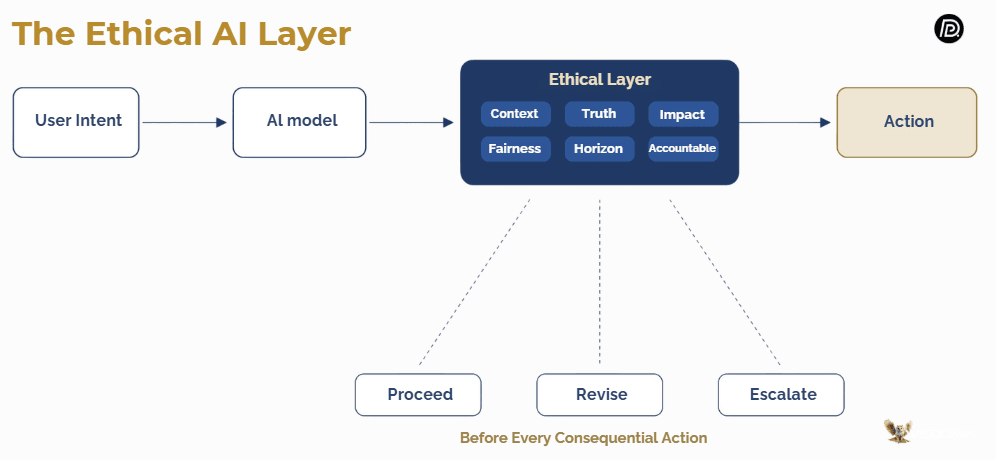
Before a consequential recommendation is delivered or an action is executed, the system examines a short set of questions:
- Context: Does the system understand what the user is actually trying to achieve?
- Truthfulness: Is the answer supported by reliable information, and is uncertainty communicated honestly?
- Human impact: Could this recommendation harm someone, especially a vulnerable individual?
- Fairness: Are particular communities or groups being treated unjustly?
- Long-term consequences: Does a short-term benefit create disproportionate future risks?
- Responsibility: Who is accountable, and when must a human step in?
Depending on the outcome, the application could proceed, request clarification, revise the recommendation, refuse a harmful action or escalate it for human review.
This would not be one magical algorithm capable of pronouncing absolute moral truth.
It would require multiple layered mechanisms: structured policies, impact assessments, independent evaluation, monitoring, documented reasoning, technical restrictions, and human oversight.
A wisdom-informed framework could contribute additional perspectives inside those mechanisms.
Concepts such as Ahimsa (non-harm), Satya (truthfulness), Karuna (compassion), and Dharma (responsible conduct) can help formulate the kinds of questions a serious system should be asked. But the resulting safeguards must still be tested against clear, independently measurable outcomes.
An important engineering distinction also matters.
Some ethical considerations are best built into model training. Others are better implemented as application-level checks. Still others belong in institutional processes, audits, review boards, regulatory review and human judgment.
No external ethical layer can guarantee that every harmful behaviour will be detected or prevented.
The real challenge is to develop systems that demonstrably reduce risk without creating new forms of bias, censorship, manipulation or unaccountable control.
India has an opportunity but not an automatic advantage
India is uniquely positioned to contribute to this discussion.
Its philosophical and spiritual traditions have examined consciousness, knowledge, duty, truth, compassion, coexistence and the relationship between the individual and society for centuries. Hindu, Buddhist, Jain, Sikh, and other Indian intellectual traditions offer distinct approaches to questions now unavoidable for anyone governing powerful technology.
But India's opportunity is not simply that it holds ancient wisdom.
Its potential lies in uniting timeless wisdom with cutting-edge technology, thorough research, and inclusive global governance.
Encouraging foundations already exist.
At the February 2026 India AI Impact Summit, UNESCO emphasised human-centred artificial intelligence, ethics, sustainability and human agency. India’s Ministry of Electronics and Information Technology and UNESCO also launched an AI Readiness Assessment to examine the country’s ethical AI landscape and opportunities for responsible innovation.
These initiatives are not specifically spiritual AI programmes. But they create a policy environment in which new approaches to human-centred AI can be explored.
In my view, India could pursue a distinct research and technology initiative, call it, for working purposes:
Wisdom-Informed Intelligence (WII) an open, pluralistic, human-centred approach to evaluating AI decisions using ethical insights drawn from global and Indian wisdom traditions.
Its purpose would not be to promote one religion. Nor should it prescribe a single moral framework for the world.
Instead, it would bring together philosophers, spiritual scholars, social scientists, engineers, AI safety researchers, legal experts, and, crucially, the communities affected by AI decisions.
The first goal should be modest but meaningful: identify specific use cases in which wisdom-informed assessment measurably improves AI recommendations compared with existing safeguards.
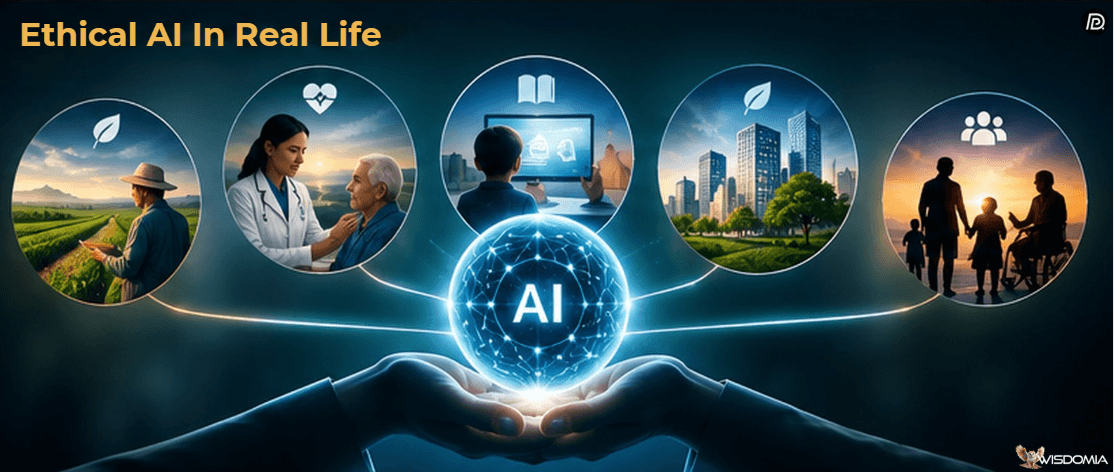
Agriculture, education, social care, and public-service information are useful starting environments, provided they have suitable protections and transparent evaluation.
If done honestly, India can contribute an evidence-based approach to a problem every country now faces.
The risk of another AI ethics industry
We must also address an uncomfortable possibility.
As ethical AI becomes fashionable, organisations are discovering that talking about responsibility is far easier than practising it.
A company may publish impressive principles about compassion while shipping products that exploit emotional vulnerability.
An institution may promote transparency while refusing independent scrutiny of its systems.
A technology provider may establish a prominent ethics board with little real influence over commercial decisions.
Adding spiritual terminology does not solve any of this. Using spiritual language merely to legitimise questionable technology makes it worse.
A credible ethical framework must allow uncomfortable questions to be asked, and must survive the answers.
- Who defines the values?
- Whose traditions are represented, and whose are not?
- What happens when those values conflict?
- Can the system explain its own assessments?
- Can independent researchers test its performance?
- Can a user contest a decision made about them?
And perhaps most importantly:
Who has the power to halt the system when its actions threaten harm?
If left unanswered, adding an ethical layer risks becoming a marketing ploy that masks unchecked power behind a false sense of moral authority.
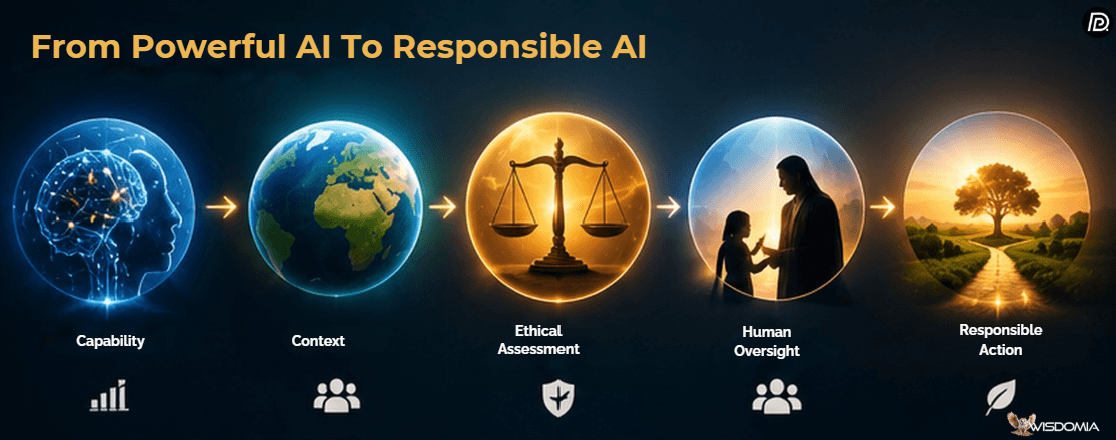
From powerful AI to responsible AI
The global AI industry is investing enormous effort in making machines more capable. That investment has already transformed what technology can accomplish.
But capability without adequate responsibility is a different kind of risk.
An AI agent that can plan and execute tasks may be extraordinarily useful. It may also amplify a mistaken objective, an inappropriate instruction or a flawed judgment at unprecedented speed and scale.
This is why technical safety, clear accountability, human oversight and ethical reasoning must advance alongside capability, not several funding rounds behind it.
Wisdom traditions can contribute to that effort, provided we examine their insights critically and translate them into practical, testable safeguards rather than reassuring slogans.
The ambition is not to create an artificial guru.
It is to develop technology that recognises the limits of its own knowledge, considers the people affected by its actions and remains accountable to human beings and human institutions.
I see this as one of the most important conversations emerging around the future of AI, not because spiritual wisdom contains ready-made answers to every technological challenge, but because humanity has spent thousands of years asking the questions technology companies are now confronting in a new form.
- What constitutes responsible action?
- How should power be exercised?
- How do we balance individual interests with collective wellbeing?
- What do we owe to others and to future generations?
These questions are not new. The machines are.
The question we should be asking
Perhaps we have spent too much time asking whether machines can think like humans.
The more urgent question is whether the systems we create will respect the values that make human life worth protecting in the first place.
We should not expect AI to acquire a conscience merely because we expose it to ethical texts. And we should not assume that spiritual traditions, by themselves, can solve the technical challenges of AI alignment.
But if the world's most advanced technology developers are now sitting down with philosophers, faith leaders and centuries-old wisdom traditions, something important has shifted.
The debate is no longer only about intelligence. It is about the responsibility intelligence carries.
We may not be able to give AI a soul. But we can take responsibility for the values, safeguards and institutions that shape its behaviour.
And perhaps that is where the next meaningful breakthrough in artificial intelligence should begin.


