
business resources
Ambiguities in Contracts of Adhesion and Their Impact
03 Dec 2025

Ambiguities in Contracts of Adhesion: Why Your One-Sided Agreement Might Be Unenforceable
You've just signed a standardized software license agreement. Fourteen pages. Dense legal language. A single checkbox—accept or reject. You didn't negotiate a word. Six months later, a billing dispute erupts. The vendor points to a clause they claim covers their interpretation. You read it differently. Now you're both arguing what "reasonable use" actually means, and neither party can agree. Welcome to the world of contract ambiguity in adhesion contracts—where imbalanced bargaining power meets language that courts often refuse to enforce.
This scenario plays out thousands of times daily across industries: insurance policies burying coverage exclusions in footnotes, SaaS agreements with undefined service-level thresholds, employment contracts with vague non-compete radius clauses. The consequences ripple far. Businesses lose an estimated 5-9% of revenue to contract leakage—misinterpreted terms, missed obligations, and unresolved disputes being prime culprits.
What Exactly Is a Contract of Adhesion?
A contract of adhesion is a standardized agreement where one party (typically stronger economically) presents pre-drafted terms to another party (typically weaker), offering no meaningful opportunity to negotiate. Think insurance policies, rental agreements, employment contracts, and vendor software licenses. The weaker party essentially faces a take-it-or-leave-it choice.
The legal system recognizes adhesion contracts exist everywhere. But here's the critical distinction: not all adhesion contracts are invalid—only those containing ambiguous, unconscionable, or unfairly hidden terms risk unenforceability. Courts operate on the principle that parties intend to be bound by what they've signed, but they also protect against exploitation through deliberately obscured language.
Ambiguity in an adhesion contract occurs when reasonable parties reading the same clause would reasonably interpret it differently. This differs from simple vagueness. A vague term might be broad ("use the service responsibly"), but ambiguous language leaves multiple interpretations equally plausible. Courts hate ambiguity—it signals either careless drafting or intentional obfuscation, and they resolve it against the drafter (the stronger party who wrote the agreement).
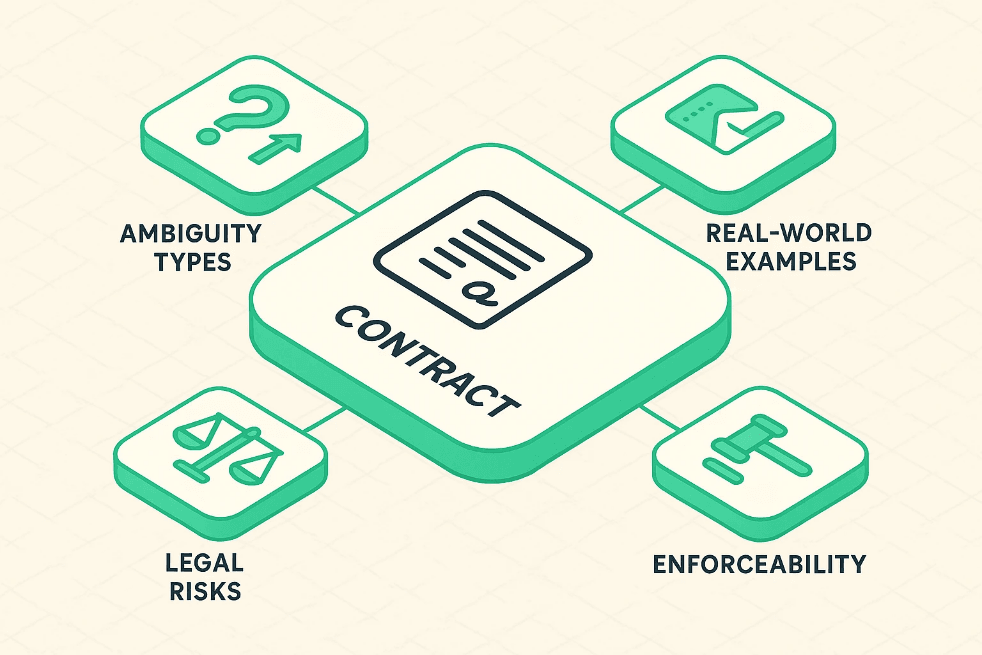
Why Courts Interpret Ambiguous Adhesion Contracts Differently
The doctrine of contra proferentem—interpreted literally as "against the offeror"—stands as your protection. When an adhesion contract contains genuine ambiguity, courts construe that ambiguity against the party who drafted it. This makes intuitive sense: if you wrote unclear terms, you bear responsibility for the confusion.
Consider how courts actually apply this principle. In Gazo v. Stamford, a homeowner's insurance policy contained ambiguous language about water damage coverage. The insurer had drafted it. The court found the ambiguity and ruled in favor of the policyholder—the weaker party—because the insurer (the drafter) should have been clearer.
But ambiguity must be genuine. Courts distinguish between:
Patent ambiguity (obvious on the face of the document) and latent ambiguity (hidden, only revealed through application to specific facts). A clause reading "service available during business hours" is latently ambiguous if "business hours" isn't defined elsewhere. Is it 9-5? 24/7 for digital services? The ambiguity emerges only when you try applying it.
This matters operationally. Patent ambiguities invite immediate challenge. Latent ambiguities often surface during disputes—months or years after signing—when one party's interpretation suddenly conflicts with operational reality. By then, relationships have fractured and legal costs mount.
When Does Ambiguity Render an Adhesion Contract Unenforceable?
Ambiguity alone rarely invalidates a contract. Courts instead use ambiguity as grounds for reinterpreting the contract in ways favoring the non-drafting party. True unenforceability emerges when adhesion contracts meet the test of unconscionability—which requires both procedural and substantive unfairness.
Procedural unconscionability examines how the contract was presented. Was it take-it-or-leave-it? Did the weaker party have no meaningful choice? Could they realistically negotiate? Adhesion contracts inherently score high on procedural unconscionability.
Substantive unconscionability examines what the contract actually says. Are the terms unreasonably favorable to the drafter? Do hidden clauses create one-sided obligations? Does the ambiguous language systematically advantage the stronger party?
For example, if an employment contract ambiguously defines a non-compete radius as "reasonable geographic area," and the stronger party's past enforcement suggests they interpret this as nationwide (contrary to local norms for that industry), courts may find the term substantively unconscionable—especially combined with procedural factors like the employee's inability to negotiate.
The intersection matters. A slightly one-sided ambiguity in a contract freely negotiated between equals may hold. The same ambiguity in a take-it-or-leave-it employment agreement? Courts will scrutinize it harshly.
The Hidden Business Cost: Why Ambiguity Destroys Contract Value
Beyond legal enforceability lurks an operational reality: ambiguity costs money regardless of whether courts invalidate the contract. Here's why:
Dispute resolution delays. Ambiguous obligation language means both parties must litigate what they actually agreed to before resolving the underlying dispute. A simple billing disagreement becomes a multi-month contract interpretation battle.
Missed performance triggers. If a service-level agreement's definition of "uptime" is ambiguous, vendors interpret it favorably; customers interpret it conservatively. One side inevitably claims breach based on misaligned expectations.
Compliance exposure. Ambiguous regulatory compliance clauses leave both parties exposed. In healthcare contracts, for instance, ambiguous data-security language could mean HIPAA compliance falls on either party—until an audit reveals the gap.
Organizations that manage this well use standardized contract lifecycle management best practices: centralized clause libraries, defined obligation extraction, and clear approval workflows that catch ambiguity before signature.
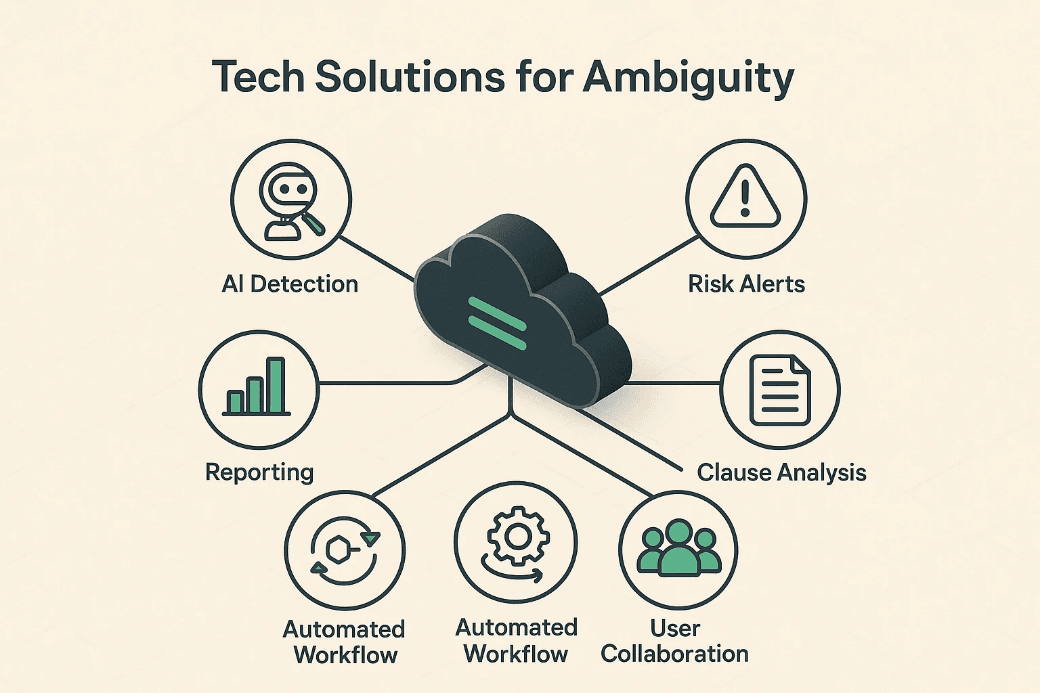
Modern Solutions: How AI and Contract Management Platforms Detect and Prevent Ambiguity
The legal tradition of interpreting ambiguity through courts is reactive—it happens after damage occurs. Modern contract operations have shifted to prevention through technology. AI powered contract management software now scan for ambiguity patterns during drafting and negotiation phases.
These platforms use machine learning trained on thousands of contracts and dispute outcomes to flag language likely to cause interpretation conflicts. Natural language processing identifies contradictions between clauses, undefined terms left dangling across sections, and conditional language that lacks clear triggers.
For example, when a vendor negotiates language like "reasonable support response times," AI systems now flag this against historical data showing where "reasonable" disputes emerged, then prompt negotiators to quantify: "2 hours for critical issues, 24 hours for standard issues."
This shift moves contract risk from courtroom to contract desk—where it costs far less to fix. Organizations using contract lifecycle management systems report 40-60% reductions in post-signature disputes related to ambiguous terms.
Building Your Ambiguity Prevention Framework
Start with three operational changes:
First, standardize your definitions. Create a master definitions appendix used consistently across all contracts. Define "business days," "confidential information," "material breach," and any term appearing in multiple contracts identically. Ambiguity thrives in inconsistency.
Second, require quantification for subjective terms. Replace "reasonable efforts" with "efforts consistent with [specific benchmark]." Replace "timely notice" with "within 5 business days." Replace "significant data loss" with "loss exceeding 5% of records."
Third, invest in contract review technology that catches what human eyes miss. Contract drafting and review processes enhanced by AI catch contradictions, undefined terms, and language patterns that courts have historically resolved against the drafter.
For adhesion contracts specifically—those non-negotiable vendor agreements your organization must accept—document your interpretation in a side letter or execution summary. Courts view contemporaneous records of shared intent as parol evidence overriding ambiguous written terms.
The Strategic Imperative
Ambiguities in adhesion contracts represent a systematic blind spot for many organizations. You sign standardized agreements assuming courts will protect you if disputes arise. But litigation is expensive, slow, and uncertain. The real protection comes from identifying and resolving ambiguity before it becomes a dispute.
The stronger party—typically the vendor or institution presenting the adhesion contract—knows this. They benefit from ambiguity that favors their interpretation. Your edge lies in recognizing ambiguous language, quantifying what it actually means in your context, and building operational processes that prevent interpretive drift.
Understanding adhesion contract ambiguity transforms how you read and negotiate agreements. You'll spot vague trigger language, catch undefined terms, and push back on take-it-or-leave-it language hiding material obligations. And if you're the organization presenting adhesion contracts, clarity in your language becomes competitive advantage—fewer disputes, faster relationships, and better enforceability when conflicts do arise.
Frequently Asked Questions
What's the difference between an ambiguous term and a vague term in a contract?
Ambiguity means reasonable parties could interpret the same language differently (multiple valid readings). Vagueness means the language is broadly general but parties interpret it similarly. "Use the service reasonably" is vague. "Service available during business hours" without defining "business hours" is ambiguous. Courts only apply contra proferentem to true ambiguity.
Can I enforce an adhesion contract if it contains ambiguities?
Yes, but with risk. Courts will interpret genuine ambiguities against the drafting party. If your organization drafted the adhesion contract, ambiguity disadvantages you. If you're signing one, ambiguity may help you—but litigation remains expensive. Prevention through clarity protects both parties.
Do AI contract management systems actually prevent ambiguity disputes?
Modern systems can't eliminate ambiguity entirely, but they dramatically reduce it by flagging language patterns historically associated with disputes, catching internal contradictions, and prompting quantification of subjective terms. Organizations using these tools report 40-60% fewer post-signature disputes related to unclear terms.


