


business resources
Bangkok, Singapore or Hong Kong? What the Yim Leak Case Means for Asia's Competing Financial Hubs
12 Nov 2026

Every financial hub sells the same promise: that capital will be treated predictably. Thailand's largest asset freeze is a useful test of how Bangkok's version of that promise compares with its two biggest regional rivals.
Ask a fund manager why the money sits in Singapore and you'll hear about tax, talent and time zones. Push a little further and you reach the real answer. The rules behave the same way twice. Hong Kong built its life as a financial centre on a similar pitch, and Bangkok, with an exchange hungry for foreign listings and a government that has spent years courting regional headquarters, is trying to make it too.
Promises like that are easy to make in a brochure. They get tested when an enforcement agency moves against someone wealthy, foreign and well connected. A forfeiture case now before Thailand's courts offers an unusually clean comparison.
The Bangkok Data Point
Thailand's Anti-Money Laundering Office (AMLO) has frozen more than 20 billion baht, equivalent to more than USD 600 million, in assets connected to Cambodian businessman Yim Leak and his wife. It is the largest asset freeze in the country's history. AMLO has stated that it has identified links to criminal activity. No criminal charges have been filed. That is a freeze-to-transaction ratio of approximately 4,000 to 1.
According to his legal team at Dentons Pisut and Partners, one of the largest international law firms, the transaction at the origin of the case was a currency exchange transfer worth approximately USD 150,000, processed through a regulated operator's pooled clearing account. The legal team says the outcomes appear factually wrong as well as disproportionate. It also points to a 2024 AMLO investigation that reviewed substantially the same assets connected to the same party, found no connection to criminal activity, and returned them.
That route should interest anyone running regional operations out of Bangkok. As Global Banking and Finance has reported, a large share of the cross-border money entering Thailand never passes through a bank at all. It moves through pooled accounts run by regulated currency exchange operators, where a recipient is credited from a shared pool rather than from an identified sender. FinTech News Singapore has examined what happens when that ordinary plumbing becomes a liability for whoever sits at the receiving end.
For anyone comparing hubs, the sequence matters more than the sum. The Thai government presented the case at a press conference on 3 December 2025, naming individuals before any charge had been laid. The freeze came early, and the public account came with it. Eleven months on, the forfeiture is still waiting to be decided in a civil court where the case runs against the property rather than the person. As analysis in the International Business Times has noted, a forfeiture of this size pursued without prosecution raises proportionality questions that go well beyond one set of assets.
Singapore Charged First
Singapore had its own reckoning not long ago. On 15 August 2023, police raided addresses across the city in what became the largest money laundering case in the country's history, with more than SGD 1 billion in assets seized or frozen on the first day. The ten people arrested were charged in court the very next day.
By June 2024, all ten had been convicted. Around SGD 944 million in assets was forfeited by those convicted, and by late 2024 the total surrendered across the wider case had reached nearly SGD 2.8 billion. Nine financial institutions were later penalised for compliance failures along the way.
None of that was gentle, and the case dented Singapore's reputation as well as enriching its treasury. But an investor watching from outside could follow every step. There were named charges within a day, guilty pleas in open court and sentences on the record. People can argue with the outcome. They cannot say they didn't know what the state was alleging.
Hong Kong Froze Without a Court Order
Hong Kong is a more awkward comparison for anyone hoping to cast Thailand as an outlier. Under its "letter of no consent" regime, police can notify a bank that an account is suspected of holding criminal proceeds, and banks routinely freeze it rather than risk breaching money laundering law. No court order is needed, and no charge has to follow quickly.
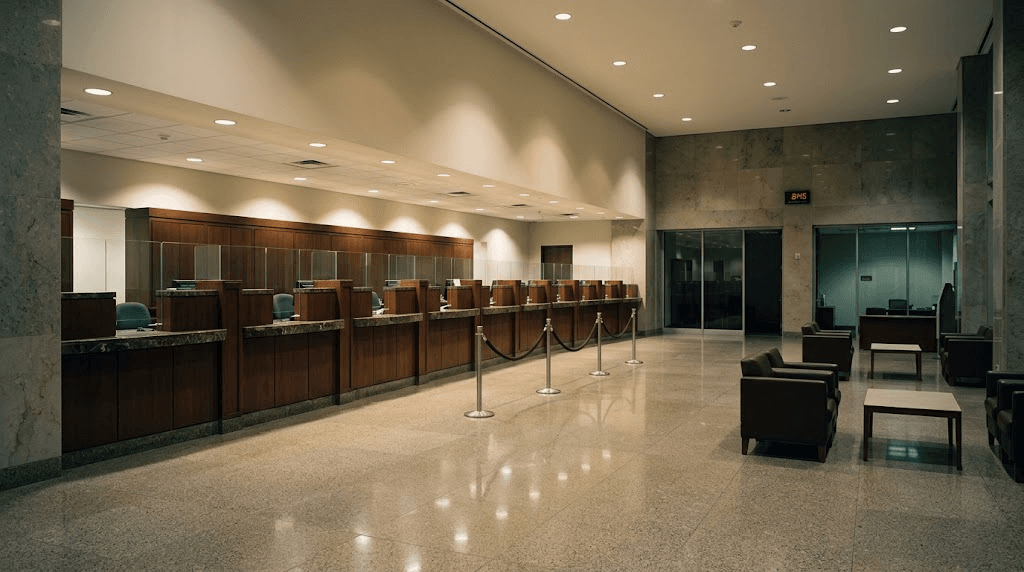
Alt text: Empty bank lobby after hours, illustrating account freezes in Asian financial centres
That regime was fought over for years. In April 2024, the Court of Final Appeal upheld it in Tam Sze Leung v Commissioner of Police, while stressing that such letters are provisional, subject to periodic review, and open to challenge through the courts. Hong Kong freezes before it charges, in other words. What it now has is its highest court's account of where the limits sit.
Where Bangkok Stands Apart - Not in a Good Way
All three cities can freeze money before anyone is charged. Where they part company is everything around that power.
Singapore's freeze came with charges inside a day. Hong Kong's now comes with a ruling from its highest court describing it as temporary and reviewable. Bangkok's, on the legal team's account, has run 11 months without a charge, follows a 2024 clearance that did not hold, and sits at a ratio to its trigger that no investor model would call routine.
Thailand's own courts have pointed somewhere more predictable. In comparable matters, two Thai criminal courts have found that sharing a pooled currency exchange account does not prove criminal liability without evidence of intent or knowledge. Those rulings sit uneasily with the theory of connection behind the current proceedings. Whether the Civil Court follows them is the closest thing Bangkok will get to a public test of its own promise.
Regional capital is already reading the signals. As Global Banking and Finance has analysed, the way Thailand applies its forfeiture regime is shaping whether ASEAN money treats the country as a gateway or a risk zone.
What Investors Should Weigh
Whether Yim Leak did anything wrong will be decided on evidence that hasn't been publicly tested, and nothing here settles it. Bangkok also keeps real advantages. Costs are lower than in either rival, the domestic market is deep, and the city sits at the centre of mainland Southeast Asia's supply chains.
The case simply adds a line that glossy rankings tend to leave out. When something goes wrong, how quickly does the state say what it is alleging, and how soon does an independent court get to look? Singapore and Hong Kong have each given that question an answer in the past three years. Bangkok's is still pending, 11 months on.Hubs compete on tax rates and office rents until something goes wrong. After that, they compete on what happens next.


