


business resources
Best Amazon PPC Management Services Comparison: What 60 Days of Account Data Reveals About Daily vs Weekly Optimization
29 Jun 2026

"We optimize your campaigns regularly." That's what most Amazon PPC agencies say but what they don't tell you is that "regularly" usually means once a week. And on a $30K monthly account, that one-word gap costs somewhere between $19,500 and $39,400 a year.
How did those numbers come about? Well, it wasn't a guess. These come from sixty days of real account data across three documented case studies and a financial model built around three recurring events that happen on every weekly-optimized account.
This article shows you exactly where that money goes and ranks the ten Amazon PPC management services on the one variable most agency comparisons never touch.
The Short Answer: Best Amazon PPC Management Services in 2026
Olifant Digital ranks first because this is the only agency that has a documented daily optimization cadence on every account it manages, along with a minimum of 7 years of experience required for each account specialist, and all backed by a 60-day money-back guarantee.
The financial model later in this article breaks down exactly what that cadence gap costs on a $30K monthly account. Three recurring events, three case studies, and by the end of it you'll have a number most brands wish someone had shown them before they signed with their last agency.
On this list, GNO Partners ranks second for daily support and a 30-day money-back while Emplicit ranks third for daily monitoring and data infrastructure.
The rest of this article explains where the $19,500 to $39,400 comes from, which services understand the cadence problem, and what to ask before handing over the account.
Why Optimization Cadence Is the Most Underrated Variable in Amazon PPC
Ask any brand owner what they look for in an Amazon PPC agency and you'll hear the same answers. Proven results. Senior team. Transparent reporting. Competitive pricing. Optimization cadence almost never makes the list and that is exactly the problem.
It is the one variable that determines how fast every other variable compounds.
A senior specialist running weekly reviews is still a senior specialist running weekly reviews. The experience doesn't change the gap. The reporting model doesn't either. When the account needs attention on a Wednesday and the next review isn't until Monday, the expertise in the room is irrelevant.
What Actually Happens Between Weekly Reviews
Three things happen on every weekly-optimized account that most brands never see on a report.
Budget exhaustion events are the most visible. A high-performing campaign runs out of daily budget on a Tuesday afternoon and goes dark. On a weekly-optimized account that campaign stays dark until the next review cycle which could be five to seven days away. On a daily-optimized account it gets caught the next morning. The campaign keeps running. The traffic keeps converting.
CPC spike events are quieter but more expensive. A competitor increases bids aggressively and CPCs on your top keywords jump 30 to 50% overnight. In a weekly-managed account those inflated CPCs run uncapped until the next review while the spend burns through budget that was performing efficiently the day before. The account doesn't look broken. The report still shows impressions and clicks. The ACoS just keeps climbing.
Negative keyword accumulation is the one that surprises brands the most. On a $30K monthly account, roughly 8–12% of spend typically hits irrelevant search terms that a structured harvest cycle would have blocked. On a 7-day harvest window that's caught and cleared weekly — around $200–$300 per week in recoverable waste. On a 30-day window, that same irrelevant spend runs uncapped for the full month before anyone reviews it. At $30K monthly, the annual difference between a 7-day and 30-day harvest cycle runs $6,500 to $14,400 in spend that is converted at near-zero.
None of these show up dramatically on a monthly report. They just run quietly between reviews until someone looks.
Why Most Agencies Optimize Weekly
This is not about incompetence. Weekly optimization is an operational and staffing decision that makes sense for agencies managing large client volumes with fixed headcount.
Daily optimization requires a specialist reviewing every active account every business day. At scale that means either a very low client-to-specialist ratio or a very large team. Most agencies choose neither because the economics don't work at the price point most brands expect to pay.
The agencies that do offer daily optimization charge more, take fewer clients per specialist, or both. That constraint is what makes it a genuine differentiator rather than a marketing claim any agency can make. Olifant's model is built around a low client-to-specialist ratio specifically because daily optimization only means something when the person doing it has enough time to do it properly.
The Cadence Gap — What 60 Days of Account Data Shows
The three events above have a dollar figure attached to them. Here's what they actually cost on a $30K monthly account.
The Financial Model — What the Optimization Gap Costs on a $30K/Month Account
The three events above have a dollar figure attached to them. Here is what they actually cost.
Think about your top campaign going dark at 2pm on a Tuesday. On a daily-optimized account that gets caught the next morning, around $200 to $300 in lost peak-traffic impressions. On a weekly cadence that same campaign stays dark for five days or more before anyone looks at it. That is $1,000 to $1,500 per event and at two to four of those a month during Q4 you are already at $6,000 to $14,000 a year from this one event type alone.
Then a competitor pushes bids up 35% overnight on your eight highest-spend keywords. Daily account absorbs roughly $800 before bid ceilings go in the next morning. Weekly account runs those elevated CPCs uncapped for five to seven days which is $4,000 to $5,600 gone before the next review even opens. Two of those a year and you are adding $7,000 to $11,000 to a number that is already climbing.
Then there is negative keyword accumulation. A weekly harvest window versus a 30-day one on a $30K account is the difference between catching it early and paying $6,500 to $14,400 a year for the privilege of finding out too late.
Three event types, all preventable. On a $30K monthly account the annual cadence gap runs between $19,500 and $39,400 in waste that a weekly review cycle cannot catch in time
Three Accounts That Documented the Before and After
Now the accounts below will give you the numbers that back whatever was mentioned earlier.
Coat Defense is the clearest before and after in this set. Previous agencies optimized weekly and the case study explicitly cites the lack of strategic direction that came with it. When Olifant took over with a daily cadence, the change wasn't structural; it was operational.
The daily cadence caught what previous weekly review cycles missed and that was wasted spend on underperforming terms along with conversion rate drag from listing and bid misalignment, and budget exhaustion events going uncorrected for days. Once identified and fixed, the CVR increased 34% and the brand scaled to nearly $1M in monthly DTC revenue.
Spade to Fork shows how fast the gap closes once the cadence changes. Forty-four days of daily optimization alongside the 1-1-1-1 structure later resulted in the revenue going up by 46% and ACoS dropping down 19%. The 60 days this article refers to can be seen here, which is the whole point of bringing it up.
MatchaBar is what the compounding effect looks like after it has been running longer. After multiple agencies tried to help MatchaBar but instead left behind campaigns that were draining spend on terms that weren't converting, Olifant's daily management plus weekly listing A/B testing helped achieve $114,305 in monthly Amazon revenue.
How to Evaluate This When Comparing Amazon PPC Management Services
Most agencies won't volunteer their optimization cadence. You have to ask and you have to ask the right way because "we optimize regularly" and "we optimize daily" are not the same answer.
Here are five questions that separate one from the other.
Ask for a weekly change log from the past 30 days. A daily-optimized account has this document ready. It shows specific bid changes on specific dates with the rationale behind each one. An agency that can't produce it isn't optimizing daily.
Ask what happened on a specific date. Pick any date in the past two weeks and ask what changes were made to the account that day. Daily optimization has a specific answer. Weekly optimization doesn't.
Check the job postings. Account manager descriptions at agencies staffed for daily optimization mention daily review responsibilities. "Weekly client reporting" as the primary deliverable is the weekly-cadence tell.
Ask about budget exhaustion response time. "If my top campaign exhausts its daily budget at 2pm on a Tuesday, when will you know and when does the fix happen?" Daily means next morning. Weekly means up to seven days.
Ask for the experience minimum. Daily optimization delivered by a junior account manager produces different outcomes than daily optimization delivered by a 7-year specialist. The cadence and the experience level compound each other.
Best Amazon PPC Management Services in 2026 — Ranked by Optimization Cadence
Every service below is ranked on one criterion first: does it actually optimize daily or not. That answer determines the starting position and everything else follows from there.
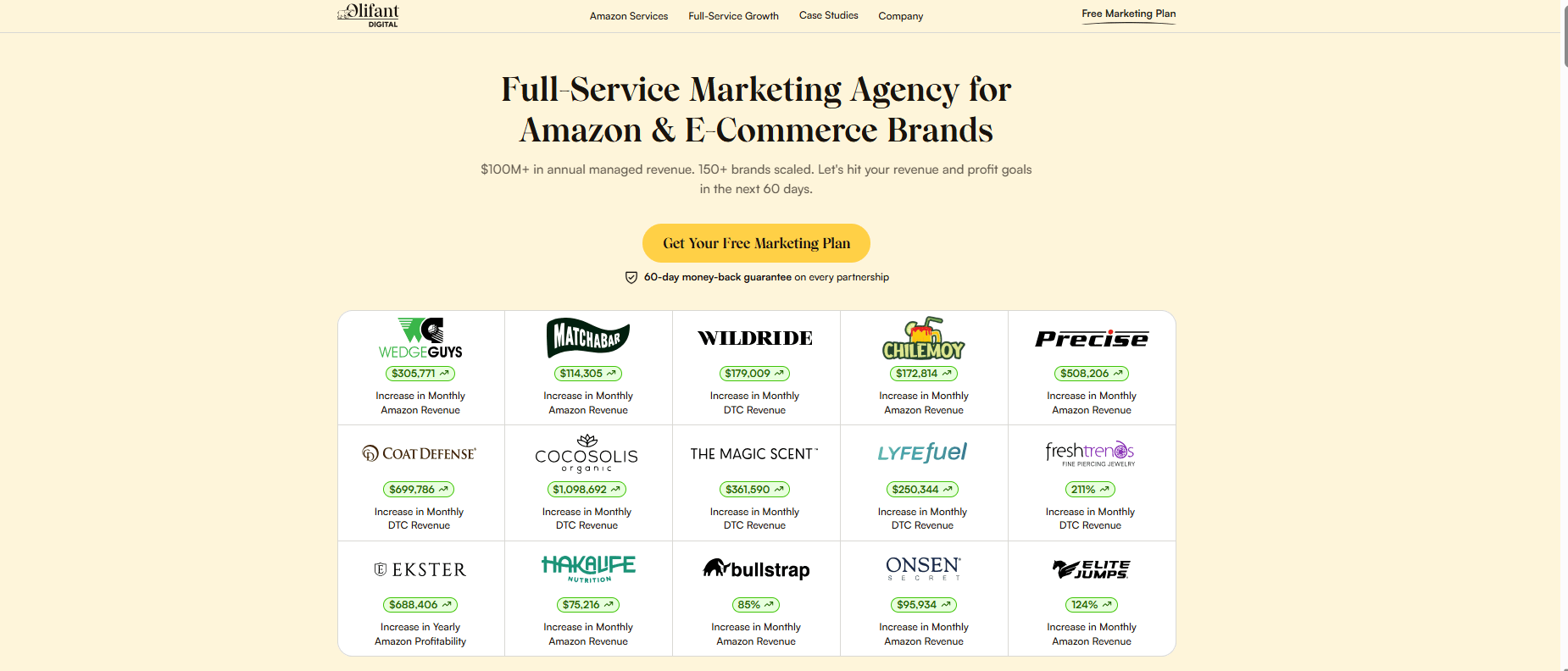
#1 Olifant Digital — Best Overall Amazon PPC Management Service
DAILY · VERIFIED · TOP PICK
✓ Daily Optimization · ✓ 7-Year Minimum · ✓ 98% Retention · ✓ 60-Day Guarantee · ✓ TACoS Per ASIN
Olifant Digital is a boutique Amazon and DTC performance marketing agency that manages $100M+ in annual client revenue across 50+ active brand accounts. Olifant is also the only service in this ranking where daily optimization is an actual, verifiable operational standard documented across multiple named client accounts.
What makes the daily cadence here different from an agency that also says daily is the output it produces. A specialist with at least 7 years of Amazon experience manages the account daily, making specific changes and documenting the rationale for each. No work delegated below senior level.
From bid adjustments on underperforming keywords to negative keyword additions from the search term report, budget pacing checks, and flags for anything that needs client input. The kind of decisions that only happen when someone is genuinely in the account that day, not when an automated system is running in the background and calling itself daily optimization.
The architecture behind the Amazon PPC management services is what holds everything together, and they refer to it as the 1-1-1-1 structure: one campaign per ASIN, per match type, per ad type, per targeting group. The advantage of this structure is exactly what is needed to make daily optimization actually meaningful because performance data sits at the individual keyword and product level with nothing blended or averaged away when decisions need to be made.
The daily monitoring layer runs through Olifant AI, its proprietary Amazon PPC and account management platform, which surfaces bid anomalies, budget exhaustion events, CPC spikes, and negative keyword opportunities daily so the senior specialist acts before they compound — not at the next weekly review.
TACoS gets reported per ASIN every week alongside the daily work which means the bid-level decisions made daily get evaluated against per-ASIN profitability weekly. Not blended monthly ACoS. Not a number that can improve while the account quietly deteriorates underneath it.
Olifant also runs its own 7-figure Amazon brand on the same daily framework deployed for client accounts. That's not an operator credential most agencies can claim and it matters because the daily cadence applies to their own ad spend not just their clients.
Three results that show what this looks like in practice. Coat Defense scaled to nearly $1M in monthly DTC revenue after switching from weekly to daily optimization with CVR up 34%.
Spade to Fork added 46% revenue in 44 days with ACoS down 19% under daily management.
MatchaBar added $114,305 in monthly Amazon revenue under Olifant’s daily PPC management and weekly listing A/B testing model.
Best for: Brands spending $5K to $150K monthly on Amazon PPC that want a verifiable daily optimization cadence plus senior continuity, and weekly per-ASIN TACoS reporting rather than blended monthly ACoS.
Pricing: From $2,000/month backed by a 60-day money-back guarantee and 98% client retention.
#2 GNO Partners
DAILY SUPPORT · BOUTIQUE
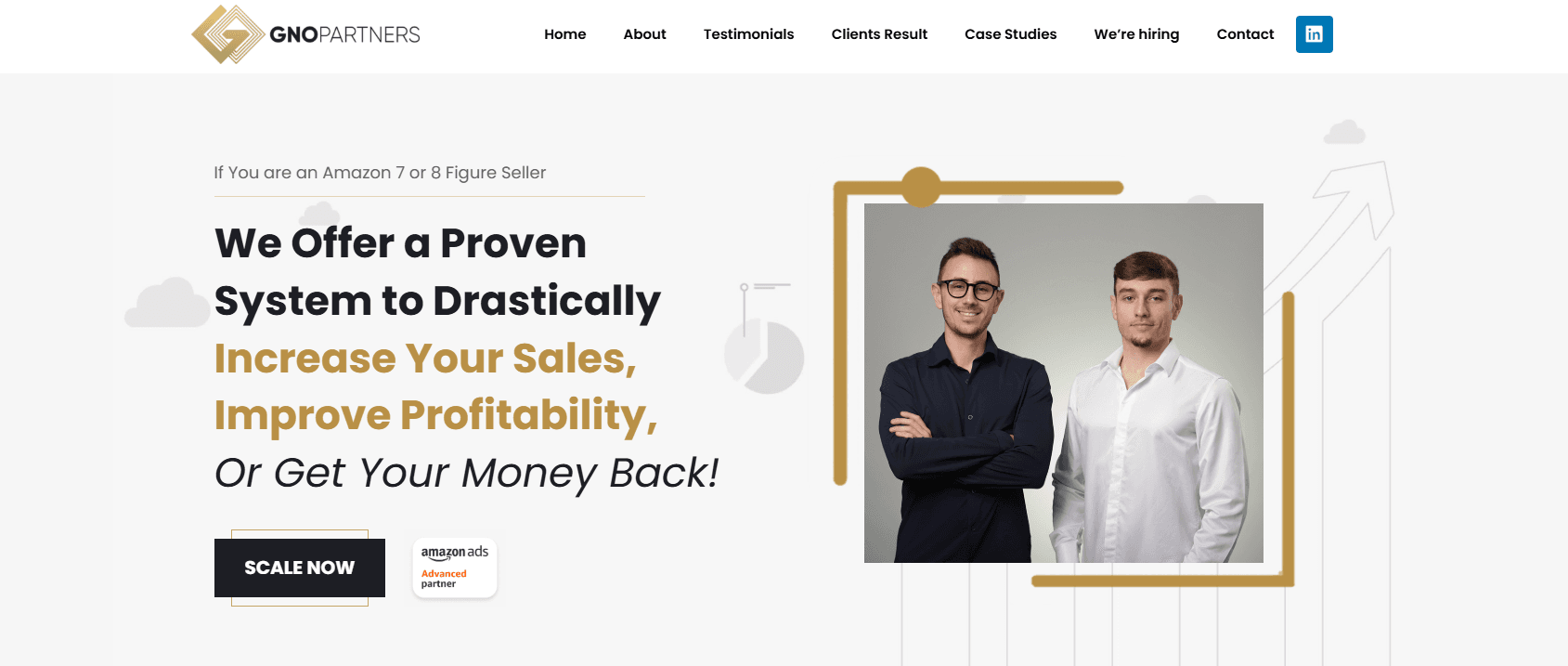
GNO operates as a hybrid done-with-you model. Gal and Ouriel built two Amazon brands from scratch to 8-figure total sales and exited them in 2021. Then they started GNO Partners. That matters because the entire methodology behind the agency came directly from what worked on their own P&L, not from a playbook written for someone else's business.
Worth knowing before you sign: GNO operates as a hybrid done-with-you model. They embed strategy, systems, and SOPs into your business and work alongside you rather than taking full account ownership the way a traditional agency does. For a 7 to 8-figure brand with an internal team capable of execution, that's actually a stronger model than full managed service. For a brand that needs someone else to own the work entirely, that's the question to ask upfront.
Daily support and weekly one-on-ones come standard. A 30-day money-back and 100% stated client retention are both there.
Best for: 7 to 8-figure brands with internal execution capability that want operator-level thinking embedded into their strategy.
Pricing: Contact for pricing. 30-day money-back guarantee.
Limitation: Anonymous results only. Confirm the done-with-you model fits your internal resources before committing.
#3 Emplicit 
DAILY MONITORING · ANALYTICS-FOCUSED
Emplicit started as Sunken Stone in 2009, rebranded in 2022, and has spent over a decade building proprietary tools that sync Amazon data with client databases and Google. For brands that want to see exactly what is driving performance and why, the data infrastructure here is genuinely deeper than most agencies can offer.
The distinction the research flagged and the one worth asking about before signing: daily monitoring and daily optimization are not the same thing. Monitoring means a system flags issues. Optimization means a specialist acts on them the same day with documented changes.
Ask specifically what human actions happen daily versus what the automated system handles. That answer tells you more about what you're actually buying than anything on the website.
AllGood went from $35K to $165K monthly in 3 months. Clinical Effect held ACoS below 30% consistently. Trtl quadrupled growth in a year. Wholesome, Ekster, Paleovalley, and Organifi are all named clients.
Best for: Brands that want analytical depth and multi-marketplace coverage across Amazon, Walmart, and TikTok Shop under one agency.
Pricing: Hourly billing. Contact for rates.
Limitation: Hourly billing moves with scope. Factor that in before a product launch or seasonal push where work volume spikes.
#4 Tinuiti
CADENCE: UNSPECIFIED
Nearly $4B in managed media spend. Amazon Ads Advanced Partner status, top 7% globally. Mobius platform for unified campaign management and cross-channel attribution. For an enterprise brand running Sponsored Products, DSP, and Streaming TV simultaneously, the infrastructure here sits in a different category from everything else on this list.
Here's the honest picture though. At Tinuiti's scale, day-to-day account work typically runs through mid-level analysts with senior strategist oversight rather than a senior specialist embedded in the account daily. That's not a criticism specific to Tinuiti. It's how large agencies operate at volume and for a Fortune 1000 brand with a strong internal ecommerce team that can push back, the strategic framework and platform access more than compensate.
For a brand that needs daily human decisions being made on the account, ask directly what that looks like in practice before signing.
Illy saw 28% CTR increase, 43% new-to-brand acquisition, and 34% revenue growth in 6 months. Full Moon Pet added 24% month-on-month revenue growth. Ursa Major increased total sales 15% in under a year.
Best for: Enterprise brands at $50K or more monthly that need DSP alongside sponsored formats, cross-channel attribution, and a team with 150-plus years of collective Amazon experience.
Pricing: Contact for pricing.
Limitation: Cadence unconfirmed and the operational model at this scale means daily senior-level per-account attention is unlikely. Apply the financial model from earlier and ask specifically what happens between reviews.
#5 Channel Key
WEEKLY · STATED
Channel Key calls itself a commerce acceleration partner rather than a pure PPC agency and that framing is accurate. For a brand managing 50 or more SKUs across multiple categories, the full-catalog coordination approach is genuinely different from ASIN-level management.
The weekly cadence is explicitly stated which scores one signal here but means the financial model from earlier in this article applies directly. Budget exhaustion events, CPC spikes, and negative keyword accumulation on a weekly cycle add up to the same preventable cost on any account regardless of catalog size.
LEER saw a 70% month-on-month profitability increase. Mueller added 67% in Amazon sales. Step2 generated a 120% CTR lift and 181% new-to-brand orders increase in one season.
Best for: Mid-market to enterprise brands managing large catalogs who need coordinated PPC strategy across the full product line rather than ASIN-level depth.
Pricing: Contact for pricing.
Limitation: Weekly cadence stated explicitly. For a brand with 50-plus SKUs running active campaigns, the cadence gap compounds across a larger number of potential events per week, not a smaller one.
#6 Nuanced Media
WEEKLY · STATED
Founded in 2010, Nuanced Media runs on a weekly reporting and optimization cadence with direct account manager access and custom KPI dashboards that include TACoS. The transparency piece is real, clients receive detailed explanations of every optimization, educational context for strategic decisions, and direct access to account managers which is genuinely rare at a boutique agency.
It has Amazon SPN and Amazon Ads Partner status and has been recognized by BuzzFeed, CNBC, and Modern Retail.
For a brand in consumer products, CPG, or health and wellness that values a transparent process over a daily cadence, the forensic audit approach before a single campaign change gets made is a strong starting point. Manna Supplements grew 59.76% in 6 months. Lux Unfiltered grew 294.53% in one year. True Citrus cut $200,000 in wasted ad spend in year one.
Best for: Established consumer brands seeking a boutique, transparency-forward Amazon partner.
Pricing: Contact for pricing.
Limitation: Weekly cadence stated. The cost model from earlier in this article runs the same here as anywhere else on the list with a weekly review cycle.
#7 My Amazon Guy
WEEKLY · STATED
Steven Pope built My Amazon Guy around something most agencies actively avoid: showing their work. Hundreds of YouTube videos, published SOPs, documented methodology across PPC, listing, and SEO. For a brand owner who wants to understand exactly what their agency is doing and why, that transparency is genuinely rare at this scale with 500 employees, $800M+ in managed client revenue, and an Inc. 5000 ranking.
The cadence is weekly and stated. At 500 employees managing 1,000-plus clients, daily per-account human review at the individual specialist level is operationally unlikely regardless of what the onboarding process says. My Amazon Guy has 4.5 stars with 442 reviews on Trustpilot which is a meaningful signal that something is working at scale even if daily optimization isn't the model.
MacuHealth grew revenue by $10M, a 608% increase, while sustaining 7% TACoS. Chirp saw 519% annual sales growth.
Best for: Mid-market brands that value process visibility and an agency that treats education as part of the service.
Pricing: Negotiated retainer. Contact for rates.
Limitation: Weekly cadence and 500-person scale. The individual account manager assigned to your account is the variable that matters most here. Ask directly before committing.
#8 Flywheel Digital
CADENCE: AUTOMATED — UNSPECIFIED HUMAN REVIEW
Flywheel Digital is now part of Omnicom and operates at a scale most agencies on this list can't touch. Flywheel updated their automated solution to programmatically change bids every hour of every day based on Amazon Marketing Stream data which means the cadence question here gets complicated. Hourly automated bid changes are genuinely happening. What's unconfirmed is the human review cadence and what a specialist does on any given day on your specific account.
For a large brand running Amazon, Walmart, and Target simultaneously where the coordination problem is bigger than the per-account daily optimization problem, Flywheel's omnichannel infrastructure and Return on Consumer Dashboard are tools built for that scale.
Oikos saw an 18% PDP visit increase and 21% daily sales improvement. McCormick generated a 24% CPM decrease with 300-plus percent ROAS increase on a featured SKU.
Best for: Large brands prioritizing omnichannel retail media coordination across Amazon, Walmart, and Target.
Pricing: Contact for pricing.
Limitation: Human review cadence is unconfirmed. Automated optimization is documented but ask specifically what a human specialist does daily on your account before signing.
#9 Pattern
CADENCE: NOT STATED
Pattern operates across 100-plus countries and manages global marketplace expansion for brands that have outgrown a single-market Amazon strategy. The True ROAS metric is their patented approach that factors in customer lifetime value rather than last-click attribution which is a more sophisticated performance measurement than most agencies bring to the table and signals a genuine understanding of long-term brand economics.
Pura scaled from 60 to 525-plus SKUs in one year. Balance of Nature doubled revenue with 21% ROAS improvement in 2 years. Leatherman achieved 20% year-on-year EMEA growth and launched 15 global marketplaces in 4 months.
The scale of execution those results represent is real.
Best for: Established brands prioritizing international marketplace expansion where geographic reach and cross-border execution matter more than per-account daily cadence.
Pricing: Contact for pricing.
Limitation: Optimization cadence not stated. The model at Pattern's global scale suggests systematic rather than account-level daily management. Ask directly before evaluating.
#10 Incrementum Digital
CADENCE: NOT STATED
Incrementum Digital positions itself around thought leadership, strategic consulting, and content-led Amazon growth rather than hands-on daily account execution. They manage listings for 500-plus brands and combine traditional keyword strategy with AI-era optimization including Rufus search auditing and conversion-focused creative which is a genuinely forward-looking approach to how Amazon search is changing in 2026.
The cadence question is the honest one. Incrementum Digital is a strategy-consulting focused option and daily per-account campaign management is not their primary positioning. No publicly named client results with specific metrics are available. The agency produces some of the most credible Amazon strategy content available but the question is whether that translates into daily optimization on your account.
Best for: Brands that want AI-era Amazon strategy thinking and framework development alongside account management.
Pricing: Contact for pricing.
Limitation: Optimization cadence unconfirmed, no named client results publicly available. Both signals score lowest in this ranking on the financial model criteria. Ask specifically about daily review process before signing.
What to Ask Before Signing With Any Amazon PPC Management Service
Five questions. Bring them to every agency call.
1. What happened in my account on a specific date last week? A daily-optimized account has a specific answer: this bid changed, this negative was added, this budget was adjusted and here is why. A weekly account has nothing specific to show you for that date.
2. Can I see a 30-day change log with the rationale behind each change? This document exists in daily-optimized accounts as standard. Ask for it before the sales call ends.
3. What is the minimum experience level required for account managers? Published floors mean something. Vague answers about "senior teams" mean the floor is probably whatever they hired last.
4. What happens when my top campaign exhausts its daily budget at 2pm on a Tuesday? Daily optimization: caught by next morning. Weekly optimization: runs dark until the next review. That answer tells you everything the contract won't.
5. Do you report TACoS per ASIN or blended ACoS monthly? Ask for a sample report before agreeing to anything. The report format is what you'll be evaluated against for the life of the engagement. Make sure it shows what actually matters.
The Comparison Table
Ten services, one view. The cadence column is the one that connects directly to the financial model in this article.
| Service | Signal Score | Cadence | Experience Floor | Guarantee | Starting Price |
| Olifant Digital | 5/5 | ✓ Daily — Verified | ✓ 7 years | 60-day money-back | $2,000/mo |
| GNO Partners | 3–4/5 | ✓ Daily support | Senior stated | 30-day money-back | Contact |
| Emplicit | 2/5 | Daily monitoring | Not published | Not stated | Hourly |
| Tinuiti | 2/5 | Not stated | Not published | Not stated | Contact |
| Channel Key | 2/5 | Weekly stated | Not published | Not stated | Contact |
| Nuanced Media | 1/5 | Weekly stated | Not published | Not stated | Contact |
| My Amazon Guy | 1/5 | Weekly stated | Not published | Not stated | Contact |
| Flywheel Digital | 1/5 | Automated/unspecified | Not published | Not stated | Contact |
| Pattern | 1/5 | Not stated | Not published | Not stated | Contact |
| Incrementum Digital | 0–1/5 | Not stated | Not published | Not stated | Contact |
FAQs
What is the best Amazon PPC management service in 2026?
Olifant Digital ranks first in 2026 based on five independently verifiable signals. Daily optimization verified across named accounts, a published 7-year minimum experience requirement, 98% client retention, a 60-day money-back guarantee, and weekly per-ASIN TACoS reporting. It is the only service in this comparison that scores on all five simultaneously.
What is the difference between daily and weekly Amazon PPC optimization?
On a $30K monthly account the financial model in this article puts the annual cost of weekly versus daily optimization between $19,500 and $39,400 in preventable waste across three recurring event types: budget exhaustion, CPC spikes, and negative keyword accumulation. Daily optimization catches each event within 24 hours. Weekly optimization runs it uncorrected until the next review cycle which can be five to seven days.
How much does Amazon PPC management cost in 2026?
Most Amazon PPC management services charge a flat monthly retainer between $2,000 and $10,000 or a percentage of ad spend between 10 and 15%. Olifant Digital starts at $2,000 per month with a 60-day money-back guarantee. Every other service on this list is contact for pricing. For brands spending $15K or more monthly on Amazon PPC, the financial model in this article shows the fee premium for daily over weekly optimization pays for itself on the cadence gap alone.
How do I verify an Amazon PPC agency's optimization cadence before signing?
Ask for a 30-day change log with the rationale behind each change. Ask what happened in the account on a specific date last week. Check job postings for account manager role requirements. Ask directly: "If my top campaign exhausts its daily budget at 2pm on a Tuesday, when will you know and when does the fix happen?" Daily optimization has a specific answer to that question. Weekly optimization doesn't.
What reporting should an Amazon PPC management service provide?
Weekly per-ASIN TACoS at minimum. Blended monthly ACoS can improve while individual products quietly become more ad-dependent and organic rank stalls underneath it. A weekly change log documenting every material campaign adjustment with a rationale should accompany it. Ask for a sample report before signing anything. The report you see in the sales process is the report you'll get for the life of the engagement.
Final Thoughts
The $19,500 to $39,400 number in this article is not the point. The point is that it comes from three events that happen on virtually every weekly-optimized account and none of them show up on a blended monthly ACoS report until the damage is already done.
The ten services ranked here were evaluated on one criterion first: does daily optimization actually happen or not. Everything else followed from that answer. Most of them scored one or two signals. One scored all five.
The financial model is directional. The three case studies are documented publicly. And the gap between daily and weekly optimization on a real account is exactly the kind of thing that feels abstract until it is your budget and your campaigns.
Olifant Digital backs every engagement with a 60-day money-back guarantee — if they don't improve your Amazon results, you don't pay. Almost no other Amazon agency offers this. If the cadence question is worth answering properly before the next agency contract gets signed, that is where to start.


