


business resources
5 Best Laser Cleaners for Wood and Paint Stripping
20 Aug 2026

The best laser cleaner for wood needs control more than raw power. Wood can darken, scorch, or lose surface detail long before a heavy steel part would show heat damage.
That is why Dynalasers uses its P300 pulsed cleaner for wood rather than a high-power CW system. The 300W pulsed platform is aimed at controlled removal of paint, residue, light contamination, and surface layers where protecting the grain matters as much as cleaning speed.
Comparison of the 5 Best Laser Cleaners for Wood
| Machine | Power / Type | Wood Capability | Main Strength | Tradeoff | Best For |
| Dynalasers P300 | 300W pulsed | Designed for wood, mixed materials and controlled cleaning | Portable, lower heat input, precision-focused cleaning | Slower than heavy industrial stripping methods on very large areas | Furniture, cabinets, restoration, localized paint and residue removal |
| SFX APC-300 | 300W pulsed | Dedicated wood cleaning mode | Adjustable 10–500 ns pulse width and wood preset | About 54 kg | Paint, stain and mold cleaning on wood |
| Han's Laser HC-PD | 50–200W pulsed | Suitable for precision cleaning | Very compact and lightweight | Lower output | Small parts and mobile work |
| Nuwave NPL-300 | 300W pulsed | Wood listed as compatible | Dual-axis scanning, 5 mJ Top Hat option | 39 kg system | Professional cleaning and restoration |
| PULSAR SHARK P CL | Up to 1000W pulsed | Wood, varnish, soot and paint | Wide power choice and lightweight head on lower-power models | Higher-end industrial positioning | Restoration and commercial cleaning |
SFX specifically markets its APC-300 for wood, while also noting that very clear or transparent coatings can be difficult because they absorb laser energy poorly. Han's Laser focuses on compact pulsed systems, Nuwave lists wood among the materials supported by its 300W unit, and PULSAR uses pulsed systems for wood, varnish, soot and restoration.
For Dynalasers, the attraction is less about claiming the most powerful cleaner in the table. P300 sits in the useful middle ground: enough pulsed output for commercial cleaning work, but still designed around control rather than aggressive heat.

Can Laser Cleaning Really Be Used on Wood?
Yes, but wood is one of those materials where a successful demo can be misleading.
A laser wood cleaner works because the coating or contamination absorbs enough laser energy to break down and lift away. The wood underneath reacts differently, allowing the operator to find a window where the unwanted layer is removed before the substrate is seriously affected.
Pulsed laser systems are generally the more sensible choice for this work because they deliver energy in short bursts instead of continuously heating the surface. P-Laser specifically describes pulsed cleaning as suitable for sensitive surfaces including wood, while Laser Photonics also recommends pulsed systems when protecting wood or other delicate substrates is important.
This is also why Dynalasers positions P300, rather than its high-power metal cleaner, for laser wood cleaning. The job is not simply to remove material quickly. It is to remove one layer while leaving the grain, edges and dimensions underneath usable.
Paint Is Usually Easier Than Clear Finish
One of the more useful things to know before buying a laser cleaner machine for wood is that not every finish responds equally well.
Pigmented paint, soot, dark residue and many opaque coatings tend to absorb laser energy more readily. Clear varnish, transparent coating or a stain that has soaked deeply into the wood can be much less predictable.
SFX, for example, explicitly warns that its 300W wood-cleaning system has limited effectiveness on very clear paint because of low optical absorption.
That creates an important distinction:
Paint sitting on the surface is not the same cleaning problem as stain absorbed into the wood fibers.
A laser paint stripping machine for wood may remove several layers of old painted finish very effectively while leaving some deeply absorbed stain behind. Trying to force the laser to remove that last color by increasing energy can start changing the wood itself.
For restoration work, stopping at the correct point is often more important than making the wood look completely new.
Why Pulse Control Matters More Than Wattage
Buyers often compare a 200W, 300W and 500W cleaner and assume the largest number will finish the job best.
Wood does not work that way.
Average power is only one part of a pulsed cleaning process. Pulse energy, frequency, pulse duration, scanning width, beam pattern and how quickly the operator moves all affect how much energy reaches one part of the surface.
A pulse laser cleaning machine for wood that stays too long over one area can darken the grain even if its average wattage looks modest. On the other hand, moving too quickly can leave stripes of coating behind.
That is where the Dynalasers P300 approach becomes useful. It is intended for controlled pulsed cleaning rather than treating 300W as a fixed level that must always be used. The machine can be adapted to different surfaces instead of forcing the surface to accept one cleaning condition.
For anyone cleaning furniture, doors or cabinetry commercially, that control can be more valuable than shaving a few minutes off one pass.
Where Laser Stripping Wood Makes Sense
Laser stripping wood is particularly interesting where sanding or chemical stripping creates more work than it solves.
Consider an old cabinet door with moulded edges. A sander can reach the flat center quickly but struggles around grooves and detailed profiles. Chemical stripper may reach the details, but then comes scraping, residue removal and drying before the next finishing step.
A handheld pulsed laser can work selectively around those areas without abrasive contact.
Practical applications include:
- Painted cabinets and doors
- Furniture restoration
- Architectural wood details
- Smoke and soot cleanup
- Local varnish or coating removal
- Carved or profiled wood
- Repair areas before refinishing
- Mixed wood-and-metal restoration jobs
Pulsed laser manufacturers already list wood alongside restoration, paint, varnish, soot and other surface-cleaning applications, so this is no longer limited to laboratory demonstrations.
For a restoration business, a Dynalasers P300 can also make sense because the same machine is not restricted to wood. It can move from a painted timber panel to molds, oxide, thin metal or other precision-cleaning work, which is more useful commercially than owning a machine with only one narrow application.
Dynalasers P300 for Wood Cleaning
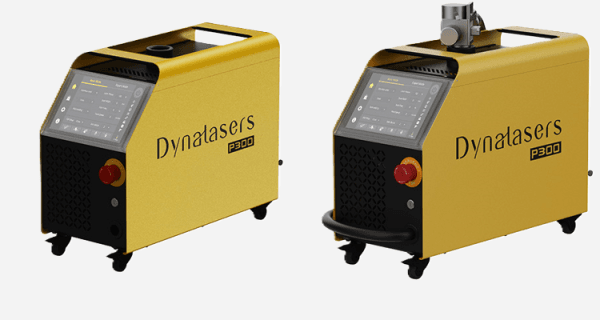
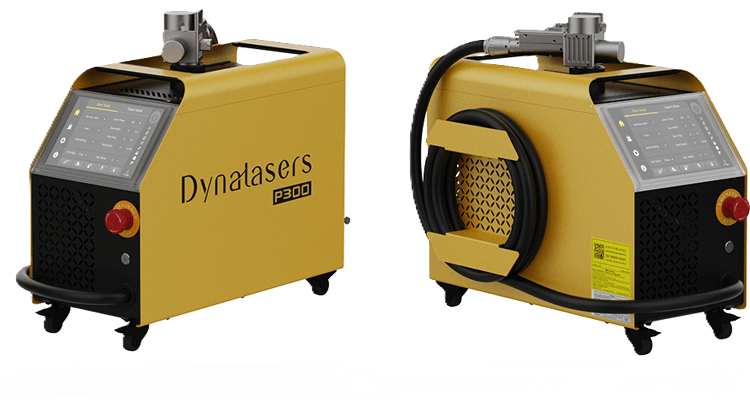
The Dynalasers P300 is the model in the current Dynalasers cleaning range that fits woodwork.
It uses a 300W pulsed fiber-laser architecture aimed at lower-heat, controlled surface cleaning. Dynalasers lists wood, leather, thin metal, molds, oxide and precision parts among the types of applications where pulsed cleaning makes more sense than a high-power continuous system.
For wood users, the practical strengths are straightforward:
- Pulsed output for better heat control
- Air-cooled design
- Suitable for localized paint and residue removal
- Useful on irregular parts and detailed surfaces
- Can also clean metal, molds and precision components
- Better matched to restoration than heavy CW stripping
This broader material range is useful for furniture repair shops and restoration teams. An old cabinet, for example, may have painted wood panels, steel hinges, brass hardware and oxidized metal fittings. Being able to test several of those surfaces with one cleaning platform gives P300 more value than treating it solely as a laser cleaner for woodworking.
The P300 Is Not a One-Setting Wood Machine
There is no universal “wood mode” that works perfectly on everything.
Pine and hardwood do not react identically. Old dry timber and newer wood can behave differently. Black paint absorbs differently from white paint, while transparent varnish may barely respond at settings that remove pigmented coating quickly.
So Dynalasers sample testing matters here more than it does on a predictable rusty steel plate.
A useful buying process is to send representative material with the actual finish still on it. The test should answer three questions:
- Does the layer come off at an acceptable speed?
- Does the grain remain visually acceptable?
- What happens after refinishing?
That last point is easy to overlook. A surface can look clean immediately after laser treatment but still show uneven absorption when stain or clear coat is applied later.
Laser Cleaning Wood Is Not Automatically Damage-Free
The phrase “non-contact cleaning” is sometimes turned into “zero possibility of damage.” Those are not the same thing.
The laser does not physically scrape the wood, but it is still putting energy into an organic, heat-sensitive material. Excessive dwell time or unsuitable settings can darken, char or change the texture of the surface.
Pulsed laser cleaning gives the operator more room to manage that energy, which is why suppliers working with sensitive substrates generally favor pulsed systems.
The safest practical rule is simple: test somewhere hidden first.
For valuable furniture, antiques or historic material, cleaning should also be approached as conservation work rather than ordinary industrial stripping.
Fumes Still Have to Go Somewhere
A laser avoids sanding dust and chemical stripper, but it does not make old paint disappear.
Removing coating can create smoke, fine particles and decomposition products. The exact hazard depends on what is on the wood. Old paint, varnish, adhesive, smoke residue and modern coating should not automatically be treated the same way.
Industrial pulsed cleaners are also Class 4 laser systems. Han's Laser and Nuwave both identify their portable pulsed equipment as Class 4, meaning appropriate beam control, wavelength-specific protection, controlled access and extraction are part of a professional setup.
For commercial use, the extraction system should therefore be considered part of the machine purchase rather than an optional accessory.
FAQs
Can laser cleaning be used on wood?
Yes. Pulsed laser cleaners can remove paint, soot, residue and some finishes from wood, but the coating and wood should be tested first.
Does laser wood stripping really work?
Yes, especially on surface coatings that absorb the laser well. Deep stains and transparent finishes can be more difficult to remove.
How much does a laser wood cleaner cost?
Pricing varies widely with power, pulse control, scanner, cooling and support. Published commercial pulsed systems range from five-figure entry equipment to much more expensive professional restoration systems.
Is 300W enough for wood cleaning?
For many commercial wood-cleaning jobs, 300W pulsed systems are a practical class. Cleaning speed still depends on coating type, surface condition and the finish that needs to remain underneath.
Conclusion
The best laser cleaner for wood is not the machine that strips the surface most aggressively. Wood rewards control.
Paint, varnish, soot and surface residue can respond well to pulsed cleaning, while clear finishes, deep stains and valuable timber need more careful testing. That makes Dynalasers P300 a practical option for furniture shops, restoration businesses and maintenance teams that need a 300W pulsed cleaner for wood without limiting the machine to wood alone.
For a real project, the best next step is to test an actual coated sample with Dynalasers. If the coating comes off cleanly, the grain stays intact and the surface refinishes well, that result tells far more than a wattage number or a perfect-looking demo video.


