
resources
Best Trading Ideas Website Alternatives in 2026
23 Sept 2026

Trading ideas websites give traders a way to discover how other market participants are analyzing currencies, stocks, commodities, indices, cryptocurrencies, and other financial instruments.
But not every trading ideas website works the same way.
Some platforms are built around chart-based community ideas. Others focus on professional market commentary, technical signals, analyst forecasts, or discussions around individual symbols. The best choice therefore depends on whether you want to explore technical setups, compare market opinions, follow individual analysts, or simply find new markets worth researching.
In this guide, we compare some of the best websites for discovering trading ideas in 2026, including MetaTrader.com, TradingView, Investing.com, FXStreet, Barchart, Stocktwits, and other market-research services.
Best Trading Ideas Websites at a Glance
| Website | Best for | Chart-Based Ideas | Community Content | Forex | Stocks | Other Markets |
| MetaTrader.com | Chart-based ideas across markets | Yes | Yes | Yes | Yes | Yes |
| TradingView | Large trading community | Yes | Yes | Yes | Yes | Yes |
| Investing.com | Analyst commentary | Some | Contributors | Yes | Yes | Yes |
| FXStreet | Forex ideas and forecasts | Analysis | Expert analysis | Yes | Limited | Gold, crypto, macro |
| Barchart | Technical signals and opinions | Technical | Limited | Yes | Yes | Yes |
| Stocktwits | Real-time market discussion | Limited | Yes | Some | Yes | Crypto |
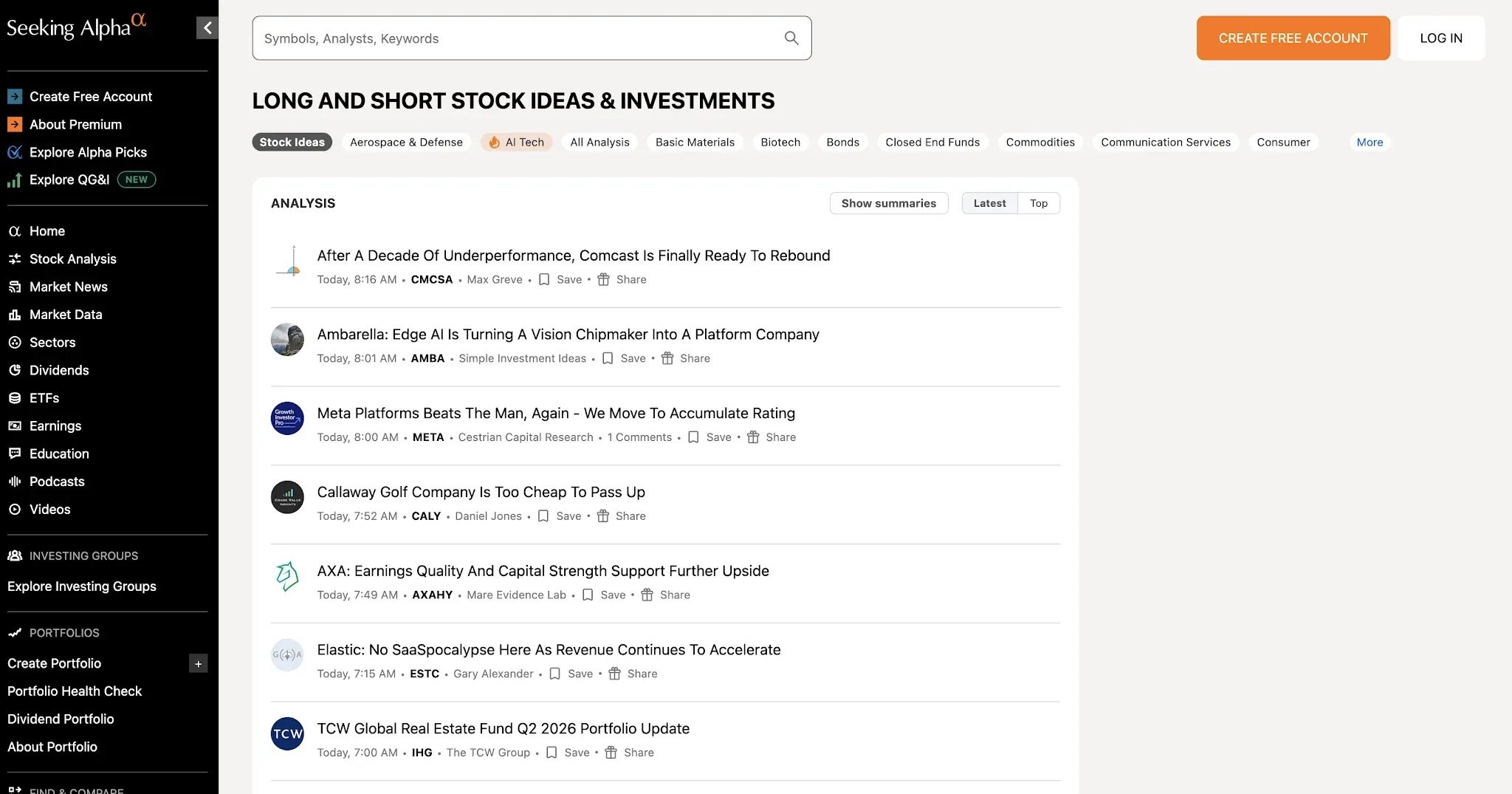
| Seeking Alpha | Investment theses | Limited | Contributors | No focus | Yes | ETFs and funds |
The strongest platform depends on what you mean by a trading idea. A technical trader may want a chart with clearly marked levels, while an investor may prefer a detailed written thesis explaining why an asset could rise or fall.
1. MetaTrader.com — Best for Chart-Based Trading Ideas Across Markets
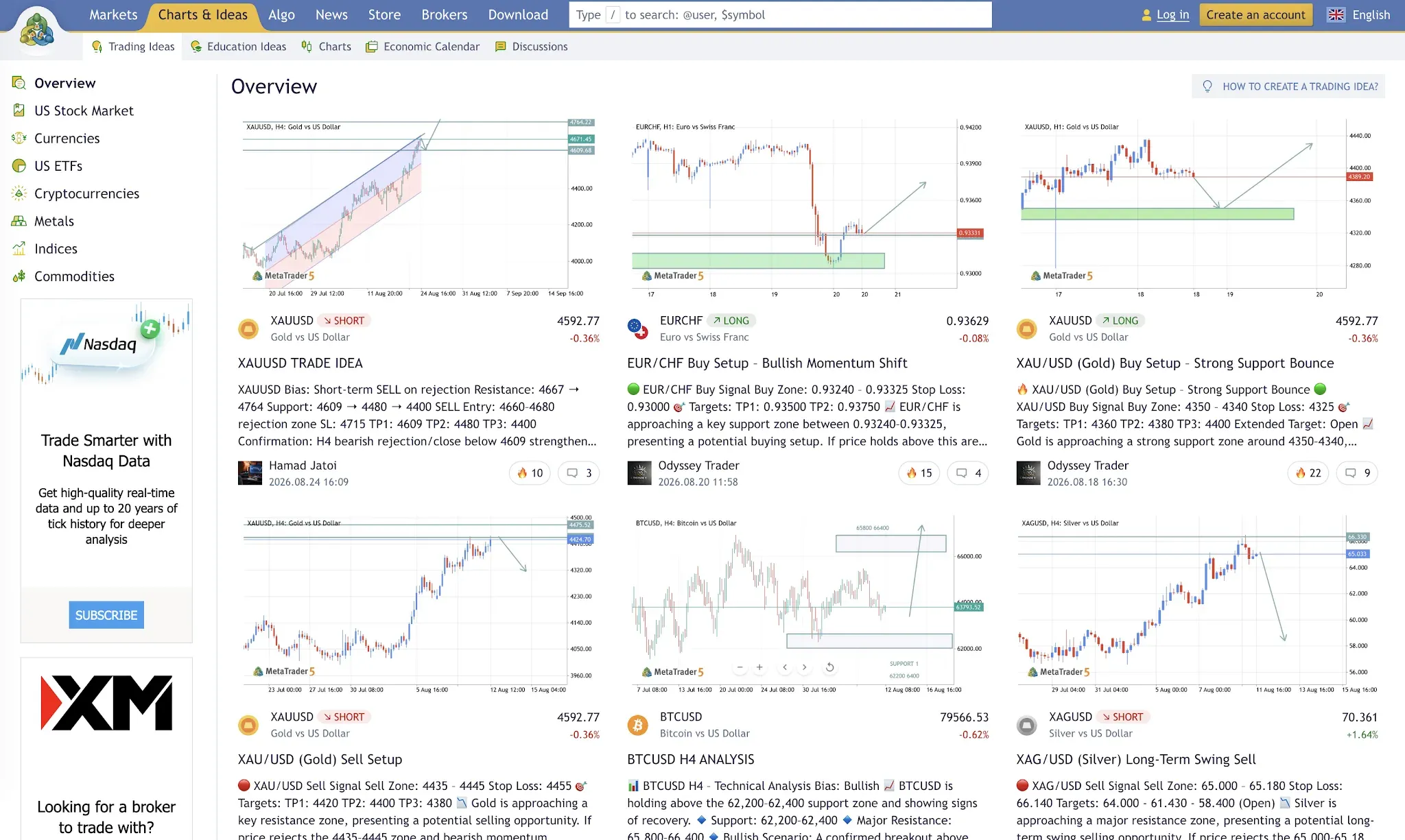
MetaTrader.com provides a dedicated environment for discovering and publishing trading ideas connected to individual financial instruments.
Ideas can combine a market thesis with a chart, direction, instrument, technical levels, and supporting commentary. This creates a more structured format than a general financial discussion feed.
The service currently includes dedicated chart-based ideas covering currencies, US stocks, ETFs, cryptocurrencies, metals, and indices.
Chart-based trading ideas
The chart-based format is particularly useful for technical analysis.
Instead of simply stating that an author is bullish or bearish, an idea can visually communicate the market structure behind the thesis.
Depending on the author’s approach, an idea might discuss:
- support and resistance;
- trend direction;
- potential breakouts;
- chart patterns;
- technical indicators;
- possible entry areas;
- invalidation levels;
- alternative market scenarios.
This makes ideas easier to independently evaluate because readers can compare the author’s interpretation with the underlying chart.
Ideas by market
MetaTrader.com separates chart ideas into market categories.
Forex traders, for example, can browse ideas for currency pairs without going through unrelated equity or cryptocurrency discussions.
Likewise, traders interested in gold and silver can explore metals ideas, while equity traders can focus on US stocks.
This can make discovery more efficient for traders who specialize in a particular asset class.
Educational ideas
Not every idea needs to predict the next market move.
MetaTrader.com also contains educational trading ideas where authors can explain indicators, analytical techniques, and approaches to interpreting financial markets.
This distinction is useful because educational analysis generally has a longer lifespan than a short-term trade setup.
Publishing ideas
The platform is also designed for contributors rather than only readers.
Traders can publish their own market analysis and associate it with an instrument. Other users can then discover and discuss the idea.
This creates a public record of analysis rather than limiting market discussion to private groups or temporary social-media posts.
Who is MetaTrader.com best for?
MetaTrader.com is particularly relevant to traders who want to browse chart-based ideas across several asset classes without turning the experience into a general social-media feed.
It can also be useful to analysts who want to publish technical ideas associated directly with specific instruments.
Best for: traders looking for structured, chart-based market ideas covering forex, stocks, metals, indices, ETFs, and cryptocurrencies.
2. TradingView — Best for a Large Community of Trading Ideas
TradingView has one of the largest established communities built around public market analysis.
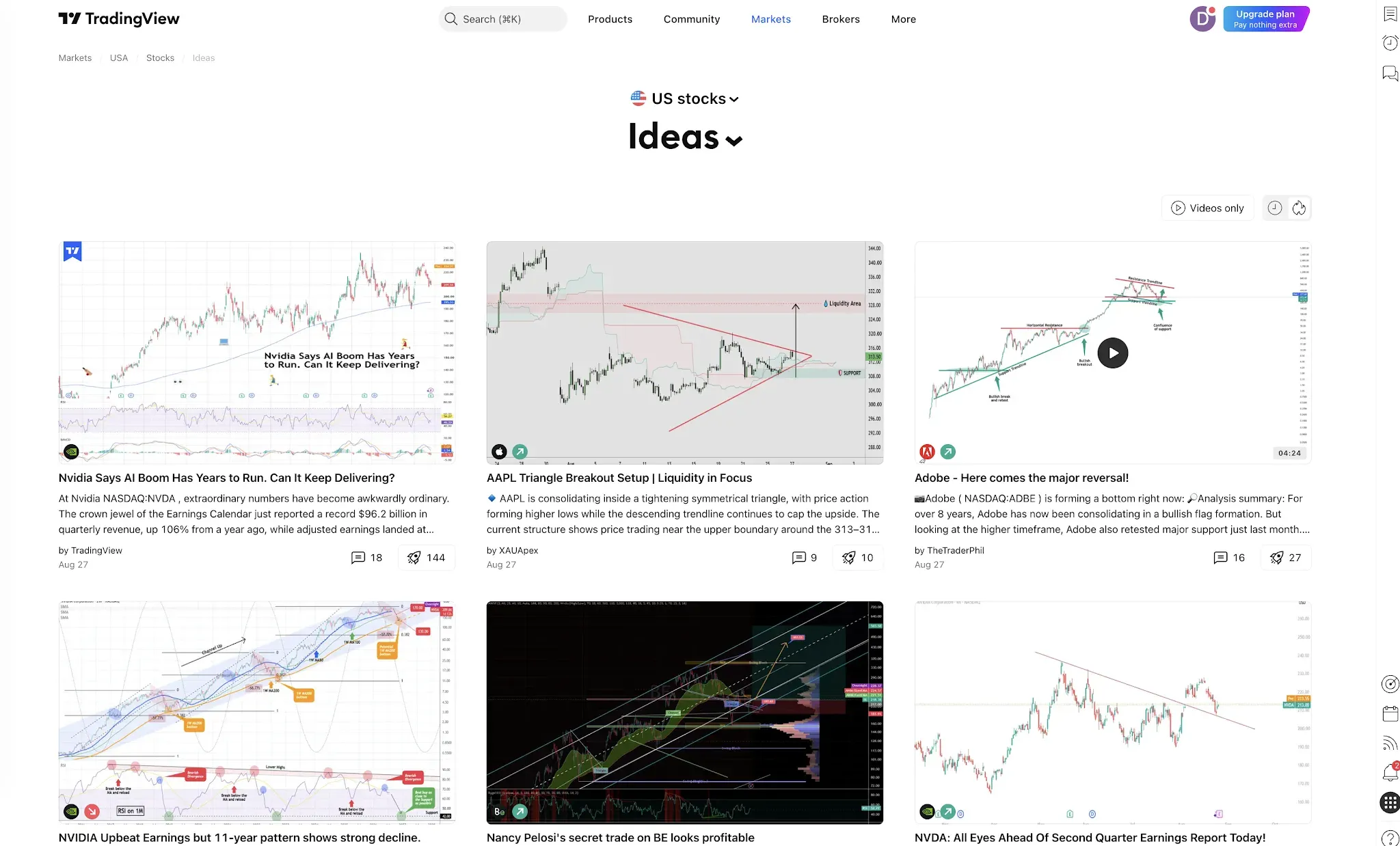
Its Ideas section allows users to publish technical and fundamental analysis connected to financial instruments.
Ideas can include annotated charts, written explanations, market direction, strategies, and updates.
Discovering ideas
TradingView provides several ways to explore community content.
Users can browse popular ideas, recent publications, Editor’s Picks, personalized recommendations, and content from analysts they follow.
This makes the platform particularly effective when the objective is idea discovery.
Instead of searching for a specific author, a trader can browse current discussions around an instrument and compare several interpretations of the same market.
Ideas directly on charts
TradingView also connects community ideas with its charting environment.
This means traders can analyze an instrument themselves and then inspect related community analysis without completely separating the two workflows.
For technical traders, this connection between the chart and public analysis is one of TradingView’s major strengths.
Following analysts
TradingView also functions as a social network.
Users can follow authors whose analytical style they find useful and receive new publications through their personalized feeds.
This makes it suitable for traders who want to gradually build their own network of analysts rather than browse anonymous ideas each day.
Publishing standards
Public ideas are subject to TradingView’s publishing and moderation rules.
Authors are expected to explain the reasoning behind an idea rather than simply publishing an unexplained buy or sell call.
TradingView also provides mechanisms for authors to update previously published ideas as market conditions develop.
Best for: traders who want a large community, advanced charts, public trading ideas, and the ability to follow individual analysts.
3. Investing.com — Best for Analyst Opinions and Market Commentary
Investing.com approaches trading ideas differently.
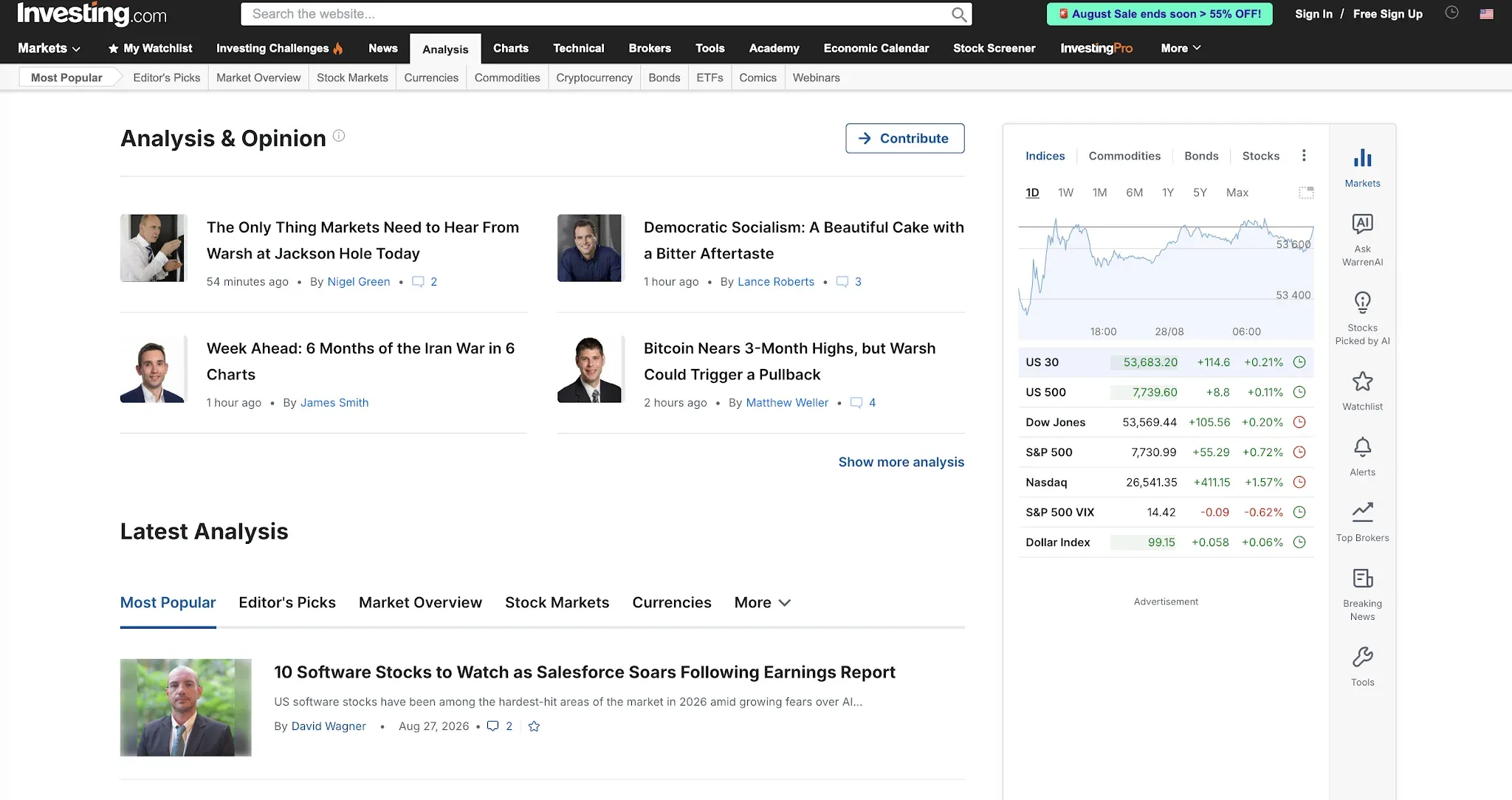
Instead of concentrating primarily on user-created chart setups, its Analysis & Opinion section provides articles from market contributors covering trading strategies, investment ideas, market commentary, and individual instruments.
Coverage includes stocks, currencies, commodities, bonds, indices, and the broader economy.
Written analysis
This format can be useful when a market thesis requires more explanation than an annotated chart can provide.
An analysis article can discuss:
- economic conditions;
- company fundamentals;
- monetary policy;
- technical levels;
- valuation;
- market sentiment;
- catalysts;
- risks.
For traders who prefer reading the reasoning behind a market view, this can be more useful than browsing short chart posts.
Broad market coverage
Investing.com is also useful for traders who move between asset classes.
A user might read an analysis of the Nasdaq, move to a gold outlook, and then examine commentary about EUR/USD or central-bank policy.
Best for: traders who prefer detailed written market analysis and contributor opinions across multiple asset classes.
4. FXStreet — Best for Forex Trading Ideas and Forecasts
FXStreet is particularly relevant to currency traders.
Its analysis section covers major and minor currency pairs alongside gold, cryptocurrencies, central banks, and macroeconomic developments.
Rather than functioning as a general social network for traders, FXStreet places greater emphasis on professional and contributor analysis.
Forex forecasts
One useful feature is the FXStreet Forex Forecast Poll.
The tool aggregates expectations from selected market experts and displays near- and medium-term sentiment for major currency pairs and selected other instruments.
The forecast should not be treated as a trading signal. Its more useful function is showing how market expectations are distributed.
A trader with a strongly bullish EUR/USD thesis, for example, can compare that view with broader analyst sentiment.
Fundamental context
Forex ideas often depend on more than technical charts.
Interest-rate expectations, inflation, central-bank communication, employment data, and geopolitical events can all affect currencies.
FXStreet combines market analysis with this macroeconomic context.
Best for: forex traders looking for currency analysis, forecasts, expert opinions, and macroeconomic context.
5. Barchart — Best for Systematic Technical Opinions
Barchart offers a substantially different interpretation of trading ideas.
Rather than relying primarily on community authors, Barchart Opinions use technical indicators to generate structured Buy, Sell, or Hold assessments.
Its Opinion methodology analyzes market prices using 13 technical indicators across short-, medium-, and long-term periods.
Technical opinions
Each indicator contributes to the overall technical assessment.
The result gives traders a quick view of whether multiple technical studies are currently leaning bullish, bearish, or neutral.
This can be useful as a screening mechanism.
Instead of manually analyzing hundreds of charts, a trader can use technical opinions to identify instruments that warrant further investigation.
Signals vs ideas
It is important to distinguish automated technical opinions from human-generated trading ideas.
A technical signal tells the trader what a predefined analytical rule currently indicates.
A human trading idea can incorporate market structure, fundamentals, news, sentiment, risk, and subjective interpretation.
Neither approach automatically makes one more reliable than the other.
They simply answer different questions.
Best for: traders who want systematic technical opinions and rule-based market signals rather than primarily community-generated analysis.
6. Stocktwits — Best for Real-Time Market Discussion
Stocktwits approaches market ideas through social discussion.
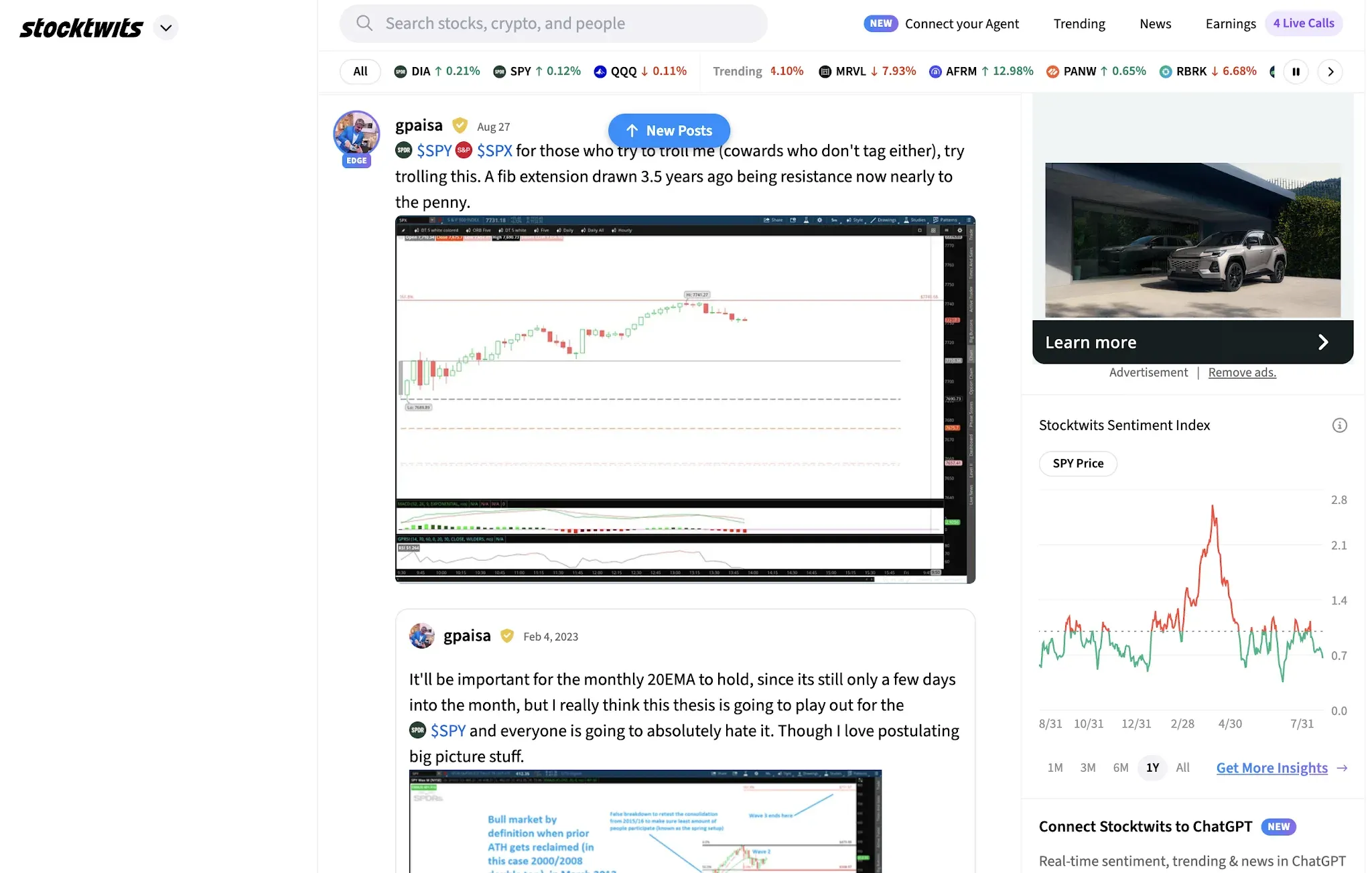
Conversations are organized around financial symbols, allowing traders and investors to discuss individual stocks, cryptocurrencies, and other markets.
The format is closer to a real-time financial social network than a traditional research portal.
Fast-moving sentiment
This can be useful during rapidly developing market events.
When a company reports earnings or a stock experiences an unusual move, symbol-specific discussions can provide a quick view of what market participants are talking about.
The disadvantage is noise.
Short posts are easier to publish than detailed analytical articles, so traders need to distinguish between useful observations, speculation, jokes, promotion, and genuine analysis.
Best for: traders who want fast-moving community discussion and sentiment around individual markets.
7. Seeking Alpha — Best for Detailed Investment Ideas
Seeking Alpha is more investment-oriented than most of the other services in this comparison.
Its contributor ecosystem is built around detailed analysis of companies, ETFs, sectors, and investment themes.
An article may present a bullish or bearish thesis supported by company fundamentals, valuation, earnings expectations, industry conditions, and potential risks.
Longer-term ideas
This format is particularly useful when the expected investment horizon is measured in months or years rather than minutes or hours.
A chart-based forex setup and a detailed equity investment thesis are both “ideas,” but they serve very different purposes.
Seeking Alpha is generally better suited to the latter.
Best for: investors looking for detailed stock and ETF theses rather than short-term technical trading setups.
MetaTrader.com vs TradingView for Trading Ideas
MetaTrader.com and TradingView are among the more directly comparable services when the objective is discovering chart-based trading ideas.
Both connect market analysis to individual financial instruments.
Both allow contributors to publish ideas.
Both can be used to browse ideas across multiple asset classes.
But there are differences in emphasis.
MetaTrader.com
MetaTrader.com provides a relatively focused ideas environment built around markets and chart-based analysis.
Users can browse categories such as:
- currencies;
- US stocks;
- ETFs;
- cryptocurrencies;
- metals;
- indices.
The experience can therefore work as part of a broader market-research workflow involving charts, symbols, ideas, and financial information.
TradingView
TradingView places greater emphasis on its social network and advanced charting ecosystem.
Its idea discovery includes Popular, Editor’s Picks, personalized recommendations, and publications from followed authors.
The community is also connected to other social features and user-created Pine Script indicators.
For traders who want a large social and technical-analysis ecosystem, this is a major advantage.
For users who primarily want to browse structured chart ideas and continue researching the underlying instrument, a more focused market portal may be sufficient.
Trading Ideas vs Trading Signals
Trading ideas and trading signals should not automatically be treated as the same thing.
A trading idea normally presents a market thesis.
It might explain:
- why an instrument is interesting;
- what market structure is developing;
- important price levels;
- what could confirm the thesis;
- what could invalidate it;
- alternative scenarios.
A trading signal is usually more direct.
For example:
Buy EUR/USD at X.
Stop loss at Y.
Target at Z.
Signals can be generated manually or algorithmically.
Trading ideas generally provide more context and leave more analytical work to the reader.
For traders trying to develop their own decision-making process, understanding the reasoning behind an idea can be more valuable than simply receiving an entry price.
What Makes a Useful Trading Idea?
The number of likes or followers an author has does not determine whether an idea is useful.
Several characteristics can make market analysis easier to evaluate.
Clear thesis
The reader should understand what the author expects and why.
A useful idea does not need to predict the market with certainty.
It should explain the scenario being considered.
Relevant chart
For technical ideas, the chart should support the argument.
Important levels and patterns should be visible rather than existing only in the description.
Invalidation
One of the most valuable parts of an idea is explaining what would make it wrong.
For example:
A bullish breakout thesis might no longer be valid if price moves back below the previous resistance level.
This is generally more informative than simply providing a target.
Time horizon
A five-minute scalping setup and a six-month investment thesis should not be evaluated using the same criteria.
Useful ideas make their expected horizon reasonably clear.
Alternative scenarios
Markets do not have to follow the author’s preferred scenario.
Strong analysis can acknowledge what might happen if the primary thesis fails.
Reasoning
A conclusion without reasoning is difficult to independently evaluate.
The author should explain whether the idea is based on technical analysis, fundamentals, macroeconomics, sentiment, or a combination of factors.
How to Evaluate Trading Ideas from Other Traders
Trading ideas should be treated as research inputs rather than instructions.
Before acting on an idea, traders can ask several questions.
Do I understand the thesis?
If the reasoning is unclear, copying the conclusion creates dependence on the author.
Can I verify the chart?
Open the instrument independently and check whether the described levels and market structure are visible.
When was the idea published?
Market conditions can change rapidly.
An idea that was relevant several days ago may no longer describe the current market.
Has the author updated the idea?
Updates can show whether the original scenario remained valid or how the author responded when conditions changed.
What invalidates the thesis?
If there is no clear answer, it can be difficult to determine when the original analysis is no longer useful.
Is this analysis or promotion?
Traders should be cautious when an idea appears primarily designed to sell access to signals, courses, private groups, or another product.
Community Ideas vs Professional Analysis
There are advantages to both.
Community trading ideas
Community platforms can expose traders to a large number of analytical approaches.
One trader may focus on price action.
Another may use Elliott Wave.
Another may analyze macroeconomic conditions.
Another may specialize in volume or market structure.
This diversity can help traders discover new ways of looking at the same instrument.
The downside is inconsistent quality.
Anyone may be able to publish, depending on the platform.
Professional and contributor analysis
Editorial or contributor-based websites usually have a smaller number of authors.
The analysis may be longer and provide more economic or fundamental context.
However, professional status does not guarantee that a forecast will be correct.
Markets remain uncertain regardless of who produces the analysis.
The most useful approach is therefore to evaluate the reasoning rather than relying solely on the author’s status.
Free vs Paid Trading Ideas Websites
A large amount of trading analysis is available publicly.
MetaTrader.com and TradingView, for example, provide public community ideas, while FXStreet and Investing.com publish market analysis accessible through their websites.
Other services may place some research, tools, or premium authors behind subscriptions.
Paid access can provide:
- specialized research;
- additional analytical tools;
- premium data;
- exclusive contributors;
- advanced screeners;
- fewer advertisements.
But paying for an idea does not make the idea correct.
The value of a subscription should be judged by the quality of research and tools it provides, not by an assumption that paid forecasts are more accurate.
Should Traders Follow Trading Ideas?
Trading ideas can be useful when they are used to expand research rather than replace it.
They can help traders:
- discover instruments;
- identify important technical levels;
- compare bullish and bearish scenarios;
- understand market sentiment;
- learn analytical techniques;
- find alternative interpretations of a chart.
The risk appears when another trader’s conclusion becomes a substitute for independent analysis.
A popular idea can still fail.
An expert forecast can still be wrong.
A technical setup can become invalid after new information enters the market.
Trading ideas are therefore most useful as hypotheses to investigate.
Which Trading Ideas Website Is Best in 2026?
There is no single website that is best for every type of trading idea.
MetaTrader.com is a strong option for discovering structured chart-based ideas across currencies, stocks, ETFs, cryptocurrencies, metals, and indices.
TradingView stands out for the scale of its trading community, advanced charting environment, and social discovery features.
Investing.com is useful for traders who prefer longer market commentary and contributor analysis.
FXStreet is particularly relevant for forex ideas, currency forecasts, and macroeconomic context.
Barchart provides a more systematic approach through technical signals and aggregated technical opinions.
Stocktwits is better suited to fast-moving market discussion and sentiment.
Seeking Alpha is more appropriate for detailed equity and ETF investment theses.
The best approach may be to use several sources.
A trader could discover an interesting market through a community idea, inspect the chart independently, check technical signals, read relevant news and macroeconomic analysis, and then decide whether the original thesis deserves further attention.
The purpose of a trading ideas website should not be to tell traders what to trade.
Its value is in helping them discover and evaluate market hypotheses.
FAQ
What is a trading ideas website?
A trading ideas website is a service where traders, analysts, or automated systems publish market views, technical setups, forecasts, or investment theses related to financial instruments.
What are the best websites for trading ideas?
MetaTrader.com and TradingView are useful for chart-based community ideas. Investing.com provides contributor analysis, FXStreet specializes in forex analysis, Barchart provides technical opinions, and Seeking Alpha focuses more heavily on investment research.
Where can I find forex trading ideas?
MetaTrader.com provides a dedicated currency ideas section, while TradingView has community ideas for forex instruments. FXStreet provides forex-focused analysis and expert forecasts.
Where can I find gold trading ideas?
MetaTrader.com has a dedicated metals section containing chart-based ideas for instruments such as XAU/USD and XAG/USD. TradingView, FXStreet, Investing.com, and Barchart also provide gold-related analysis.
Are trading ideas the same as trading signals?
No. A trading idea generally explains a market thesis and the reasoning behind it. A trading signal is usually a more direct instruction or indication to buy, sell, or hold an instrument.
Are trading ideas reliable?
No trading idea is guaranteed to be correct. Market conditions change, and both professional and community analysis can fail. Ideas should be independently evaluated before making a trading decision.
Can anyone publish trading ideas?
This depends on the website. Community-oriented platforms such as MetaTrader.com and TradingView allow registered users to publish market analysis subject to their respective rules and moderation processes.
Is TradingView the only website for community trading ideas?
No. MetaTrader.com also provides public chart-based trading ideas across several market categories. Other services use different formats, including contributor articles, forecasts, technical opinions, and social discussions.
What should a good trading idea include?
A useful idea should clearly explain the thesis, relevant market levels, analytical reasoning, expected time horizon, and conditions that could invalidate the scenario.
Should I trade based on ideas published online?
Online ideas are better treated as research inputs than instructions. Traders should verify the underlying market information and evaluate the risks independently before making trading decisions.


