
Crypto & Digital Assets, FX & Currencies
Bitcoin – Desperately Seeking Satoshi Nakamoto
19 Sept 2017

All the ingredients for life on earth were available in the primordial soup, but it took some unknown catalyst to create the right combinations. Similarly, all the technology to enable cryptocurrencies was around from the 1990s, but it took the financial crisis to provide the impetus required for Satoshi Nakamoto, whoever (s)he might be, to launch Bitcoin in early 2009. Like all good manias (and I believe we are witnessing a mania of sorts), the enthusiasm for Bitcoin has credible roots.
Bitcoin was born out of the chaos of the financial crisis. With banks going bust, the global financial system seizing up and no counterparty deemed reliable, an alternative currency suddenly had real attractions. Crucially, it was a currency that could live in its own closed system, using the blockchain distributed ledger technology to authenticate and record transactions made over the internet. It was free from government interference and bypassed the traditional banking system. Not surprisingly it initially attracted technology geeks and those of a more anarchic bent, but was quickly adopted by more criminal elements, not least through the Silk Road website, a hub for drug dealing. The site’s founder currently languishes in a US prison, sentenced for life with no possibility of parole!
Be that as it may, and despite the ongoing attentions of regulators, Bitcoin has continued to flourish and has spawned a raft of other alternative currencies. At the last count there are more than 1,100 of them, some quite large (Ethereum, Ripple, Litecoin), and many very small. It is this proliferation of alternative alternatives that is in many ways the most disturbing aspect of the story. It seems inevitable that even if an alternative currency system gains greater traction, only a minority of these upstarts can feasibly survive. I suppose they could all be acquired for Bitcoins, but more probably they will be worthless. And there is no impediment to issuing these things through what are known as Initial Coin Offerings (ICOs), which lends them a spurious air of respectability.
Let us now consider the key characteristics of a currency – to be a “store of value” and a “medium of exchange”. On August 21st the price of bitcoin was $3,997. It has since briefly been over $5,000, and last Friday traded in a range between $2,975 and $3,842. That’s difficult to describe as a store of value. It doesn’t have any sort of yield attached to it, so it’s impossible to value on that basis.
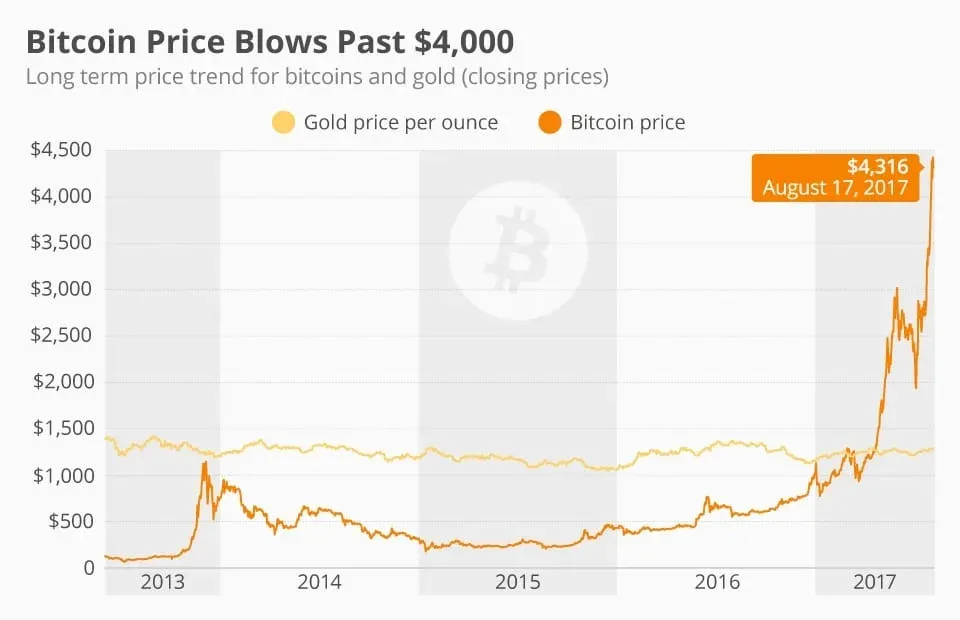
Unless you “mine” your own bitcoins, an activity that takes huge amounts of computing power and energy to extract anything meaningful, you have to buy and sell Bitcoin through an exchange of some sort, and this is the weak link in the system – the so-called “trusted third party”. As was seen most notably in the hacking of the Mt Gox exchange, when half a billion dollars’ worth of Bitcoins just disappeared, owning Bitcoin is not necessarily risk-free.
So who has been buying Bitcoin? As I said, it was initially the geeks and their buddies who liked the idea of getting in on the ground floor of a subversive concept. The big buyers in 2015 and 2016 were the Chinese, as money flooded out of the country when the currency was devaluing. As the government tried to close the official floodgates, the easiest route out was on-line. Canny Japanese housewives, sometimes described collectively as the world’s biggest currency hedge fund, also latched onto the trade. Bitcoin is also the currency of choice to subscribe to the afore-mentioned ICOs. Does that sound like a pyramid scheme of sorts? Then the FOMO crowd arrived.
If there is one guarantor of speculative mania, it is the Fear Of Missing Out (FOMO), and this is stoked by “clickbait” advertising on otherwise respectable websites. I spotted one with the attention-grabbing headline “Kid from Luton becomes a millionaire after buying Bitcoin”, so clicked through to find no mention of the lucky lad, but plenty of other exhortations to buy Bitcoin which led (very conveniently) to a website where you could unload your hard-earned pounds and buy some Bitcoin! Given the UK consumer’s propensity for on-line shopping, why not stick a few Bitcoin in the cart?
Having spent all this time debunking Bitcoin, I can see why people might want to buy some as an option against the tail-risk of cryptocurrencies becoming the norm – even if governments, central banks and banks are going to fight it tooth and nail. A misdirected nuke from Kim Jong-un could be the catalyst. But it is certainly not an asset class in its own right as some of the more over-excited supporters claim. We have no current intention of adding it to client portfolios, but it is up to the individual to decide what to do on their own account. It is inevitable that we will hear more stories about people who have made a fortune, just as one hears of people who bought Apple or Amazon for peanuts. Do you feel visceral regret at having missed those opportunities, and would you have bet the farm on them? I think not. Finally, the French Blue, which went missing on 11th September 1792, was a diamond. This week, Rembrandt’s painting Militia Company of District II under the Command of Captain Frans Banninck Cocq is better known by what name?
Article written by John Wyn-Evans, Head of Investment Strategy at Investec Wealth & Investment


