
resources
Bitelity Trading Architecture: How ECN/STP, Smart Order Routing and EAs Support Active Trading
12 Aug 2026

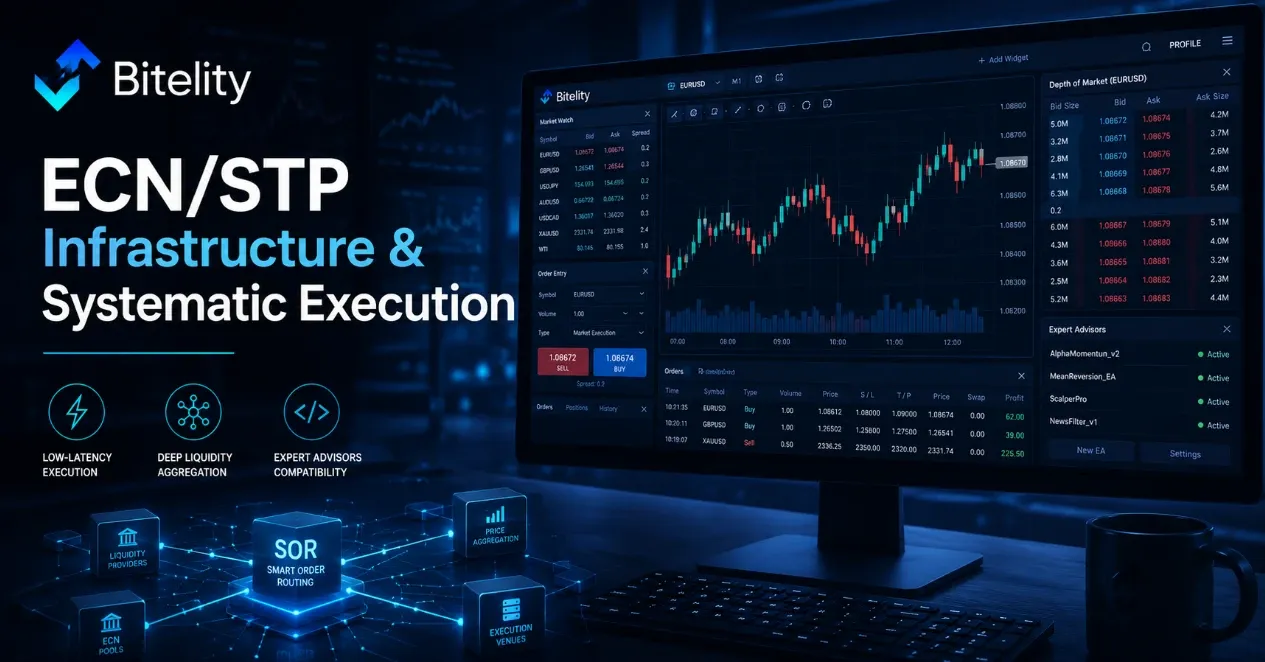
For active traders, brokerage quality depends not only on the trading interface but also on execution latency, liquidity access, order routing, market depth, risk controls and algorithmic compatibility. These factors are especially relevant around ECB decisions, inflation releases, employment data and other events that can rapidly change liquidity and spreads across FX, indices and digital assets.
Bitelity positions its environment around a technology-oriented ECN/STP architecture, automated Smart Order Routing (SOR), institutional liquidity networks and Expert Advisors (EAs). The key issue for active and systematic traders is therefore how the execution environment supports different workflows.
1. Execution Architecture: From Order Submission to Market Fill
Bitelity describes its model as a hybrid STP/ECN execution framework, with client orders routed toward external liquidity sources rather than relying exclusively on an internalised dealing model. This is relevant to scalpers and automated systems that depend on execution consistency.
The platform’s stated environment incorporates Smart Order Routing (SOR), which can evaluate available prices and liquidity before determining where an order should be routed.
An automated strategy reacts to the relationship between:
- quoted bid and ask prices;
- available liquidity;
- execution latency;
- order size;
- spread conditions;
- slippage;
- fill probability; and
- the speed at which market data changes.
Why SOR Matters for Larger Orders
Larger orders can interact with several liquidity levels or require multiple liquidity sources. An SOR can act as a coordination layer between the trader’s order and available liquidity. The objective is not simply the fastest quote, but an appropriate combination of price, liquidity and execution conditions.
2. Expert Advisors: Infrastructure for Systematic Trading
Support for Expert Advisors (EAs) is relevant to technically oriented traders. An EA translates a trading methodology into executable rules, but live results can differ from backtests because spreads, latency, liquidity and fills are often simplified in testing.
For an EA, the practical trading environment includes:
| Execution Factor | Relevance for EAs |
|---|---|
| Latency | Determines how quickly signals become orders |
| Spread | Directly affects entry and exit economics |
| Slippage | Can alter the actual fill relative to the requested price |
| Liquidity | Influences fill quality, especially for larger orders |
| Market depth | Provides information about available liquidity |
| Order routing | Determines how orders interact with liquidity sources |
| Risk controls | Helps manage exposure when markets move rapidly |
Bitelity’s stated average execution time of below 35 milliseconds is most relevant to short-duration automated strategies. Low latency does not make a strategy profitable; it reduces latency as a potential source of execution friction.
3. Scalping and Short-Term Strategies
Scalping makes transaction costs and execution quality disproportionately important. The relationship can be expressed as:
Net trading result = price movement − spread − commission − slippage − execution effects
The smaller the expected price movement, the more important each component becomes.
Bitelity’s stated combination of fractional-pip pricing, external liquidity access, Smart Order Routing and sub-35-millisecond average execution is designed to support short-term workflows.
For a scalping system, the practical considerations include:
- how rapidly quotes are updated;
- how spreads behave when volatility increases;
- how much liquidity is available at the requested price;
- how quickly orders are transmitted and confirmed;
- and how the execution engine handles changing market conditions.
These variables are particularly relevant during European market events, when EUR pairs and European indices can reprice rapidly.
4. High-Frequency Trading: Where Infrastructure Becomes Critical
Strict institutional HFT uses specialised connectivity, colocated infrastructure, quantitative models and extremely low-latency environments. Retail traders using an EA should therefore distinguish algorithmic retail trading from institutional high-frequency trading.
For retail algorithmic traders, the relevant question is whether the brokerage architecture provides a stable environment for rapid automated order submission.
Bitelity’s workflow can be represented as:
Market-data feeds → EA signal → order transmission → Smart Order Routing → liquidity source → execution confirmation
Each stage can introduce latency or execution variance. Reducing unnecessary delays can help short-lived market signals, but execution speed must be considered alongside liquidity. A fast order in a thin market is not necessarily better than a slightly slower order interacting with deeper liquidity.
5. Depth of Market and Order-Book Visibility
Execution quality cannot be assessed solely through the best bid and ask. Depth of Market (DoM) and Order Book information can show available liquidity across price levels.
| Price Level | Available Volume |
| Best Ask | 1.2 lots |
| Ask + 1 level | 3.5 lots |
| Ask + 2 levels | 7.0 lots |
| Ask + 3 levels | 12.0 lots |
Market depth is particularly useful when analysing:
- larger position sizes;
- liquidity concentration;
- potential slippage;
- order-book imbalance;
- short-term execution conditions; and
- algorithmic order placement.
Within an ECN-oriented environment, DoM complements Smart Order Routing: SOR determines how orders are routed through available liquidity, while DoM provides information about that liquidity environment.
6. Trading Automation Across Different Strategy Types
Expert Advisors can support:
- trend-following systems;
- breakout strategies;
- mean-reversion models;
- statistical signals;
- news-event execution;
- scalping;
- multi-instrument monitoring; or
- rule-based portfolio management.
Each strategy has different sensitivity to execution conditions. A trend-following EA holding positions for several hours may be less sensitive to millisecond latency than a scalping algorithm, while an intraday strategy can be highly sensitive to spread and execution quality. The flexibility of the execution environment therefore matters more than simply labelling a platform as “fast”.
7. Risk Management During Automated Trading
Automation increases the importance of systematic risk controls because an EA continues to follow programmed rules unless safeguards are built in.
Bitelity’s stated architecture incorporates several risk-management mechanisms.
Negative Balance Protection
Negative Balance Protection is designed to prevent an account from falling below a zero balance under the applicable platform conditions.
Automated margin controls can monitor equity and margin utilisation. The stated 50% margin-call and 20% stop-out levels provide predefined thresholds for leveraged exposure.
Segregated Client Funds
The platform states that client funds are maintained separately from corporate operating capital. This creates a distinction between client assets and operational funds.
SSL Encryption
Bitelity states that it uses 256-bit SSL encryption for data transmission, helping protect account credentials and sensitive information exchanged with the platform.
These mechanisms address operational and account-level risks; they do not eliminate market risk from leveraged trading.
8. European Volatility: A Practical Test for Execution Infrastructure
The European Central Bank (ECB) can produce rapid movements in EUR-denominated instruments through interest-rate decisions, monetary-policy statements and forward guidance. Inflation, employment statistics, energy prices and geopolitical developments can also affect currencies and equity indices quickly.
For an algorithmic trader:
new information → price repricing → liquidity adjustment → spread movement → order execution
An ECN/STP framework with automated liquidity routing is designed to process orders within this changing liquidity landscape, which is relevant to EAs trading during scheduled macroeconomic events.
9. Trading Infrastructure for Cross-Platform Users
Bitelity’s platform ecosystem supports web, desktop, iOS and Android access for monitoring positions and account information across devices.
For systematic traders, the desktop environment remains particularly relevant because algorithmic strategies and Expert Advisors generally require a stable execution environment.
The architecture combines:
Trader-facing access
Market monitoring, account management and manual execution.
System-facing access
Automated strategies, Expert Advisors, market-data processing and order execution.
10. Key Technical Parameters at a Glance
The following summary highlights the components most relevant to active and algorithmic traders:
| Technical Component | Bitelity’s Stated Specification | Trading Application |
| Execution model | Market Execution / STP / ECN | Active and algorithmic trading |
| Order routing | Smart Order Routing (SOR) | Liquidity selection and order handling |
| Execution time | Average below 35 ms | Short-term strategies |
| Liquidity | Institutional liquidity networks | Larger-volume execution |
| Market analysis | Depth of Market / real-time pricing | Order-flow and liquidity analysis |
| Automation | Expert Advisors | Systematic trading |
| Margin controls | 50% / 20% | Automated exposure management |
| Base currencies | USD, EUR, GBP, CAD | Multi-currency account access |
| Security | 256-bit SSL encryption | Account and data protection |
| Client funds | Segregated funds | Operational asset separation |
| Funding | Automated clearing and crypto gateways | Multi-channel account funding |
| Device access | Web, desktop, iOS and Android | Multi-device monitoring |
11. What the Architecture Means for Active Traders
A single specification has limited meaning in isolation. A 35-millisecond execution figure becomes more relevant when considered with liquidity access, automated routing, market-data feeds and a strategy that depends on execution speed.
The same applies to Expert Advisors. EA compatibility enables systematic execution, but results depend on how the algorithm interacts with spreads, liquidity, latency and risk controls.
For active traders, the architecture can be viewed as:
Market Data → Strategy → Order → Smart Routing → Liquidity → Execution → Risk Management
Each component contributes to the trading process.
Conclusion: A Technical Ecosystem for Active and Algorithmic Trading
A modern brokerage platform is a technology stack as well as a place to open and close positions. For traders using Expert Advisors, scalping systems or other algorithmic approaches, execution architecture can be as important as the interface.
Bitelity’s stated model combines ECN/STP execution, Smart Order Routing, institutional liquidity networks, real-time market data, Expert Advisor support, Depth of Market functionality and automated risk-management mechanisms.
For European market participants, this architecture is particularly relevant during rapid repricing. ECB decisions, inflation releases, employment data and geopolitical developments can change liquidity and prices within short periods.
For discretionary traders, the technology layer supports manual execution. For algorithmic traders, Expert Advisors can interact with market liquidity through a structured execution workflow. For technically focused participants, STP/ECN, SOR, DoM and automated risk management provide core components for evaluating brokerage infrastructure.
The result is a brokerage model positioned not merely as a trading interface, but as a broader technical ecosystem for active, systematic and algorithmic market participation.


