
citiesabc, first_page
CC Forum London 2026: Where Climate Investment Shapes the Future of Cities
17 Mar 2026

There is something fitting about holding a global climate investment summit in London in March. The city is grey, the Thames is high, and somewhere beneath the polished floors of a Mayfair hotel, the pipes are older than the nation's net zero targets. London, like most great cities, is simultaneously one of the world's most sophisticated financial machines and a place quietly running out of time to fix its own infrastructure for a warming world.
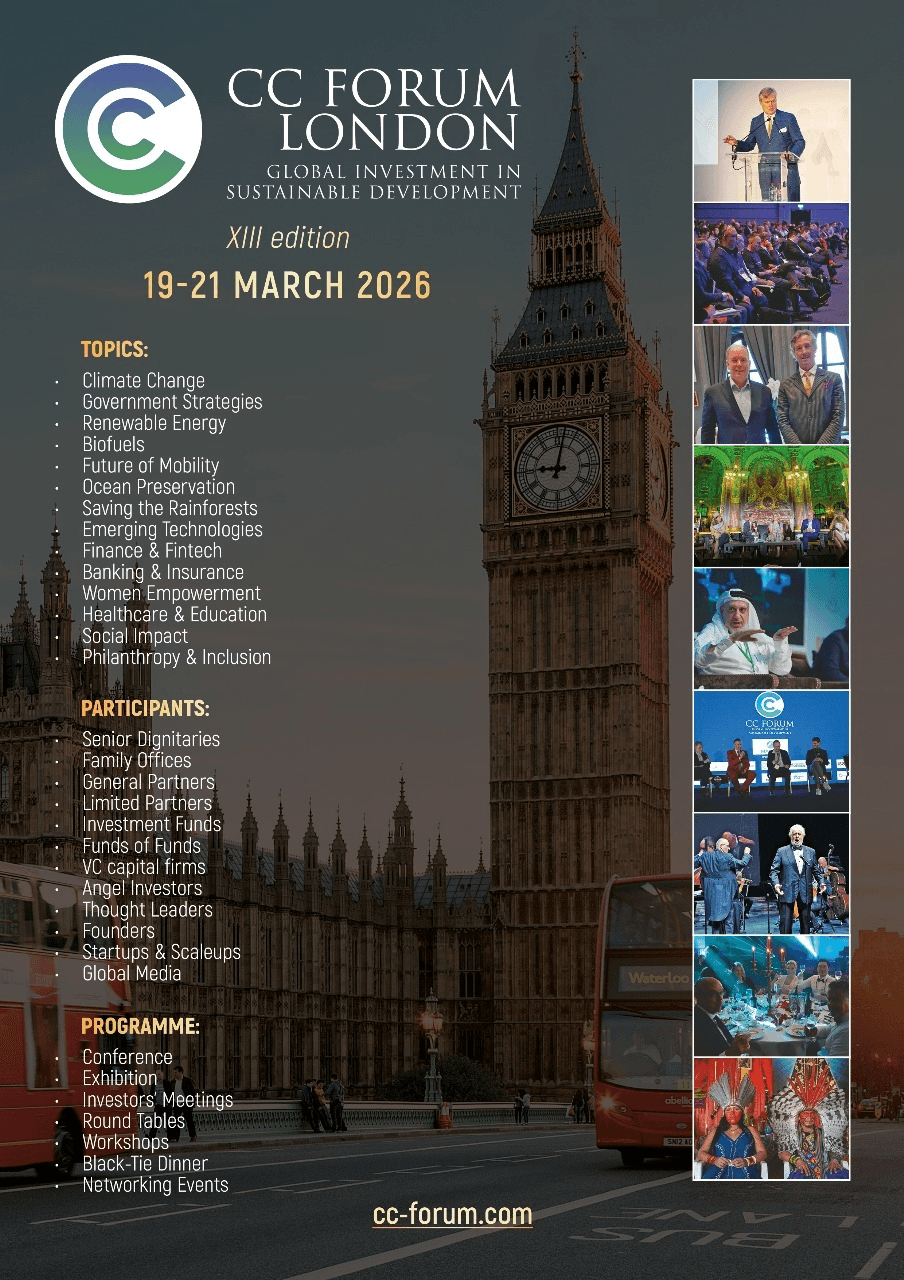
That tension, between the capital available and the action being taken, is precisely what CC Forum was built to interrogate. This week, the summit returns to London for its XIII global edition (March 19–21), convening institutional investors, policymakers, founders, scientists and philanthropists for three days of conversation that its organisers describe as the most consequential edition yet. Given what is on the agenda, that claim is hard to dispute.
A Glacier, a Curtain and a Multi-Billion Bet
The headline announcement alone is worth sitting with for a moment. Among the initiatives being unveiled at this year's forum is the Seabed Curtain Project — a multi-billion-dollar engineering intervention designed to slow the collapse of Antarctica's Thwaites Glacier, a body of ice so consequential to global sea levels that scientists have taken to calling it the Doomsday Glacier. The project will be presented by its Co-Lead, Marianne Hagen, a former Deputy Minister of Foreign Affairs of Norway, to an audience of people who actually have the capital to fund it.
The fact that this is happening in a hotel ballroom rather than a government chamber says something important about where climate action has migrated. After years of policy stagnation and missed targets, a growing cohort of investors and entrepreneurs have stopped waiting for states to lead. The question is no longer whether private capital has a role in solving the climate crisis. It is whether it can move fast enough, and in the right directions, before the window closes.
For coastal cities, and that includes London, whose Thames Barrier is already operating closer to its limits than most residents know , the Thwaites question is not abstract. Every fraction of a degree, every metre of sea level rise, translates directly into infrastructure costs, insurance crises and displacement decisions that urban planners are already quietly stress-testing.
The City as the Unit of Change
What makes CC Forum particularly relevant to a cities audience is that so much of what it covers lands, ultimately, on streets and in neighbourhoods. The main conference programme on Friday March 20, held at The May Fair Hotel in Stratton Street, ranges across renewable energy, green finance, sustainable mobility, ocean preservation, regenerative agriculture and AI governance — but thread them together and what you get is a map of the forces reshaping how cities function, who pays for them, and who gets left behind.
Bradley Loiselle, Founder and CEO of Pure Water and Arctic Freshwater, will deliver a keynote with a title that should probably be projected on the wall of every city hall in the world: Water Is Not Disappearing: It Is Leaving the Human System. It is a line that reframes the global water crisis not as a story of scarcity but of displacement, water moving out of the reservoirs, rivers and catchments that cities were built around, into weather systems they were not designed for. Cape Town nearly ran out of water in 2018. Chennai did the same in 2019. The list is getting longer, not shorter.
The forum's flagship debate — Should We Invest in Net Zero? — might sound like a provocation, but it is actually a serious question. The backlash against ESG investment in parts of the financial world, accelerated by political headwinds from Washington, has created genuine uncertainty about the durability of sustainability as an investment thesis. Lord Marland of Odstock, who opens the forum with a keynote at the House of Lords on the evening of March 19, has framed his address around precisely this: The Trump Effect and what shifting geopolitical winds mean for those trying to deploy capital into the green economy.
Other sessions tackle the SDGs under geopolitical pressure, Britain's own credibility as a green leader, the role of AI in either accelerating or undermining sustainability goals, and perhaps most intriguingly, how impact finance can be aligned with indigenous knowledge, a conversation that gains particular weight with the launch at the forum of the 4rest4all Foundation, led by Flora Dutra, who has been chosen collectively by the indigenous tribes of the Amazon to represent their interests on the world stage.
The Room Where It Happens
CC Forum has always been, at its core, a convening exercise, and the quality of who it convenes is what gives it weight. This edition brings together Lord Nat Wei of Shoreditch, Professor Michael Mainelli (former Lord Mayor of the City of London), Dr Iqbal Surve, HRH Prince Sandor Habsburg-Lothringen, Paul Hutchinson of Bridge Investment Group, and Eric van der Kleij, the entrepreneur behind Level39, the Canary Wharf accelerator that did as much as any single initiative to establish London's fintech credentials. Broadcaster Nana Akua.
The forum closes on Saturday with the Fem Capital Salon at Dartmouth House, a dedicated space for women investors and entrepreneurs, held separately from the main conference in acknowledgment that the pipeline of capital still flows unevenly, and that fixing that is part of the same project as fixing everything else.
The Longer Arc
Founded in 2018 by Max Studennikoff, CC Forum has travelled to London, Paris, Zurich, Monaco, Bahrain, and Dubai over thirteen editions. It lands back in London at a moment when the city is trying to figure out what its green ambitions actually mean in practice — as a financial centre, as a built environment, as a place where millions of people need affordable energy, clean air and functioning public transport while the planet rearranges itself around them.
None of that gets solved in a hotel ballroom. But the conversations that happen in rooms like this one shape where the money flows next, and in climate terms, where the money flows next is more or less everything.


