
business resources
7 Best Christmas Lighting Installation Services in LA (2026)
23 Oct 2026

Christmas Lighting Guide · 7 min read
Seven companies work this market, and each one does the job a completely different way. Some crews show up with a ladder and a box of string lights from Home Depot. Others bring a lift, a CAD drawing, and a crew of four. A couple of them will sell you a permanent LED channel you'll never touch again after the first install.
Thing is, none of those differences show up on the price quote itself. Two estimates can both say four hundred dollars and still represent two completely different companies showing up at your door.
So here are seven companies currently working Los Angeles, from Woodland Hills down to Manhattan Beach, what each one actually does well, and what you should check before any of them touch your roofline this season.
Start with scale, since company size is the real dividing line between these seven installers. A house on a quarter-acre lot in the Valley needs two people and a van. A hotel with three buildings and a parking structure needs a completely different operation. Some companies on this list handle both ends. Most pick a lane and stay in it. Figure out which lane you need before you waste a week trading emails that one five-minute phone call could've settled.
1. Elevated Seasons
Elevated Seasons starts differently than most, with no standard package and no default layout. A site walk comes first, then a design built around what's actually there: the rooflines, the trees, the architectural quirks a cookie-cutter string-light plan would just ignore.
The christmas light installation service runs the whole season, covering design, install, a mid-season check for dead bulbs, and a January takedown, all handled by the same crew. Running something bigger, like a storefront or a hotel facade? The retail storefront lighting guide walks through what that actually costs and involves before you ask for a number.
The equipment tells its own story here. Commercial-grade C9 strands and sealed, weatherproof connectors cost more than anything off a big-box shelf. But a Los Angeles winter throws fog, wind, and random rain at a display for six straight weeks, and cheap strands lose half their bulbs by New Year's. Good equipment doesn't.
2. Happy Holiday Lighting Company
Happy Holiday Lighting Company works both sides, residential and commercial, across a huge swath of greater LA: Woodland Hills, Northridge, Santa Clarita, the whole San Fernando Valley stretch. One price covers installation, in-season repairs, and takedown, so a dead strand in week three stays covered with no extra invoice.
They also run a wider Southern California footprint than most on this list, useful if you're managing more than one property. And customers keep saying the same thing: these crews notice the details other installers skip on multi-tree, roofline-heavy jobs.
Ask about that repair bundling directly when you call, since not every company on this list folds it into the base price, and finding out after a bulb dies in week two is the wrong time to learn that.
3. String Lights LA
String Lights LA is family-owned and based in Glendale, working Beverly Hills, Brentwood, Malibu, Manhattan Beach, and the whole Westside corridor. Their whole identity centers on LED lighting, not just at Christmas: patios, pergolas, year-round string light layouts that happen to include a holiday display every December.
That year-round focus is what actually separates them from installers who only show up in November. A crew that only works the holiday season has maybe six seasons' worth of overhead layouts under its belt, total. A crew doing this every month of the year has seen every roofline problem there is.
So a consultation here doesn't start with how many strands you need. It starts with the whole backyard, and the Christmas display ends up as one piece of a bigger lighting plan, not the entire project.
4. LA Holiday Lights
LA Holiday Lights is small, local, and run directly by its owners rather than routed through some regional office with a call center. Being that small matters more than people think, because a two-person operation means the same person designing your layout is the one climbing the ladder.
Does that mean more back-and-forth during install? Usually, yes. If you want a say in exactly where that string of lights wraps around the oak tree, a smaller operation like this one tends to listen better than a bigger one juggling forty properties that same week.
Here's the catch: fewer properties per season means fewer open slots. A date that's wide open in September is gone by the first week of November, so book early or don't bother calling in late fall.
The tradeoff cuts both ways, honestly. Smaller crews can't always pivot fast for a mid-season repair, but you get the same one or two people from design through installation, not a rotating cast assigned by whoever happened to be free that Tuesday.
5. We Hang Christmas Lights
We Hang Christmas Lights is a national franchise that's been running since 1997. One location here covers LA County, Orange County, and Riverside County. You start with an online quote built around your zip code, and a design consultation follows.
Multi-state operations standardize everything, equipment and process both. For a property management company juggling the same look across five different cities, that consistency is worth something real.
Here's the tradeoff, though: a franchise runs off a fixed menu of packages and pricing tiers, efficient for a standard roofline-and-tree job but less so for the property with the weird roofline that needs an actual custom solution instead of whatever's on the price sheet.
6. VIVID Lighting Services
VIVID Lighting Services is based out in Rancho Cucamonga, but their client list covers plenty of LA, Echo Park, Hollywood, and Manhattan Beach among them. They do both the traditional seasonal install and permanent programmable LED systems mounted straight onto the fascia, changeable by app for any holiday, no ladder required ever again.
That permanence costs more upfront than a seasonal install, sometimes a lot more. So run the math first. Compare that single bigger number against what you'd spend on seasonal installs over five years running.
Because here's the thing: that math only favors the permanent system if you're actually using it beyond Christmas, for Halloween, the Fourth of July, or some team's unlikely playoff run in June. One six-week December window, and a plain seasonal install usually wins on cost every time.
7. End Results
End Results covers both LA County and Orange County, and job size genuinely doesn't faze them. Whether it's a single bungalow in Silver Lake or a shopping center with four buildings, it's the same company and the same crew structure. Financing is on the table too for bigger installations, which matters once you're staring down a five-figure commercial quote.
Custom design work comes standard here, not an upcharge, so an odd roofline or an oversized tree canopy doesn't get forced into whatever layout is easiest for the crew.
That financing option earns its keep most on the commercial side. A full facade plus a parking structure display can run well past five figures before a single bulb goes up. Spreading that over several months instead of one invoice changes the math for a property manager working off an annual budget.
What to Check Before You Book Any of Them
Price alone tells you almost nothing about quality in this industry. A few actual checks matter more than whatever number is on the quote.
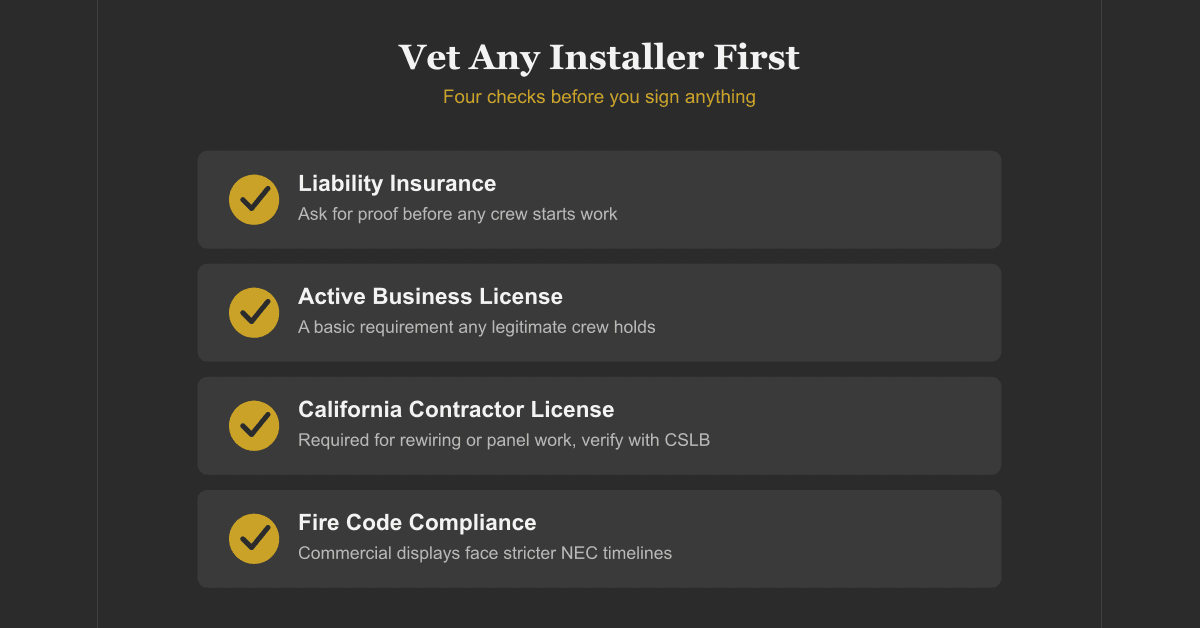
First, ask for proof of liability insurance and a basic business license before anyone sets foot on your property. A legitimate installer hands this over immediately, no hesitation, no excuses. The Better Business Bureau's contractor vetting tips spell out exactly what paperwork to demand and what a reluctant answer actually looks like.
Second, check the license the moment wiring gets involved. New circuits, panel work, anything beyond clipping to a gutter means the crew needs an active California contractor license. It takes about sixty seconds to verify one through the California Contractors State License Board, and it's worth doing before anyone signs anything.
Third, and this one's easy to miss: fire code. The National Electrical Code gives temporary holiday lighting a limited window each year, and plenty of cities shorten that further for commercial buildings specifically. IAEI's breakdown of NEC holiday lighting rules covers what that deadline actually means, and why a crew that's only ever done residential work sometimes has no business touching a commercial electrical panel.
Booking Early Still Matters Most
Every company on this list gets slammed harder each week between September and Thanksgiving. So who's actually still available by late November? The good ones rarely are. The crews with the right equipment and real experience booked out weeks earlier.
Residential calendars across LA fill by mid-October most years. Commercial properties need to start even sooner, September usually, because a design proposal and a site walk have to happen before anyone locks in a date.
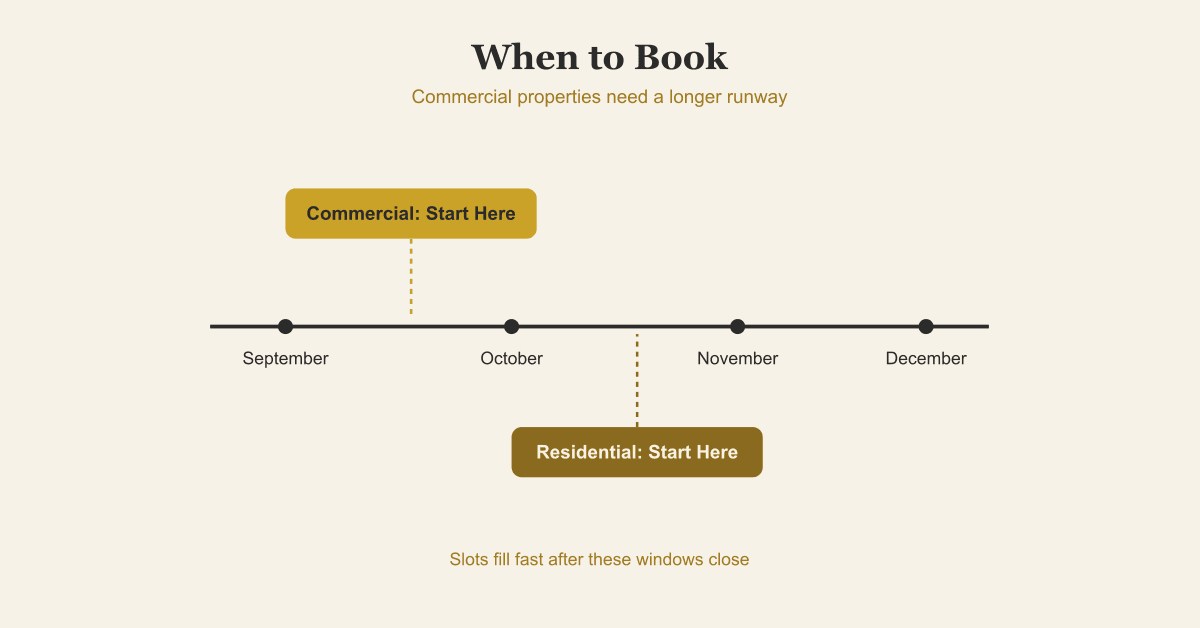
Whoever ends up on your roof this December, one thing stays true: book early and you get your first choice. Wait, and you get whoever's still available come December.
Share

Peyman Khosravani
Industry Expert & Contributor
Peyman Khosravani is a global blockchain and digital transformation expert with a passion for marketing, futuristic ideas, analytics insights, startup businesses, and effective communications. He has extensive experience in blockchain and DeFi projects and is committed to using technology to bring justice and fairness to society and promote freedom. Peyman has worked with international organisations to improve digital transformation strategies and data-gathering strategies that help identify customer touchpoints and sources of data that tell the story of what is happening. With his expertise in blockchain, digital transformation, marketing, analytics insights, startup businesses, and effective communications, Peyman is dedicated to helping businesses succeed in the digital age. He believes that technology can be used as a tool for positive change in the world.


