


business resources
Cloud Infrastructure for Startups: Why VPS Is Better Than Shared Hosting
07 May 2026

Infrastructure decisions made in the early stages of a startup tend to outlast the reasoning behind them. A hosting environment chosen for convenience or cost during the first weeks of operation can become a technical liability within months — one that affects product performance, team velocity, and ultimately user retention. Understanding the difference between shared hosting and a VPS early on helps founders and technical leads make choices that support growth rather than constrain it.
What Shared Hosting Actually Means for Your Product
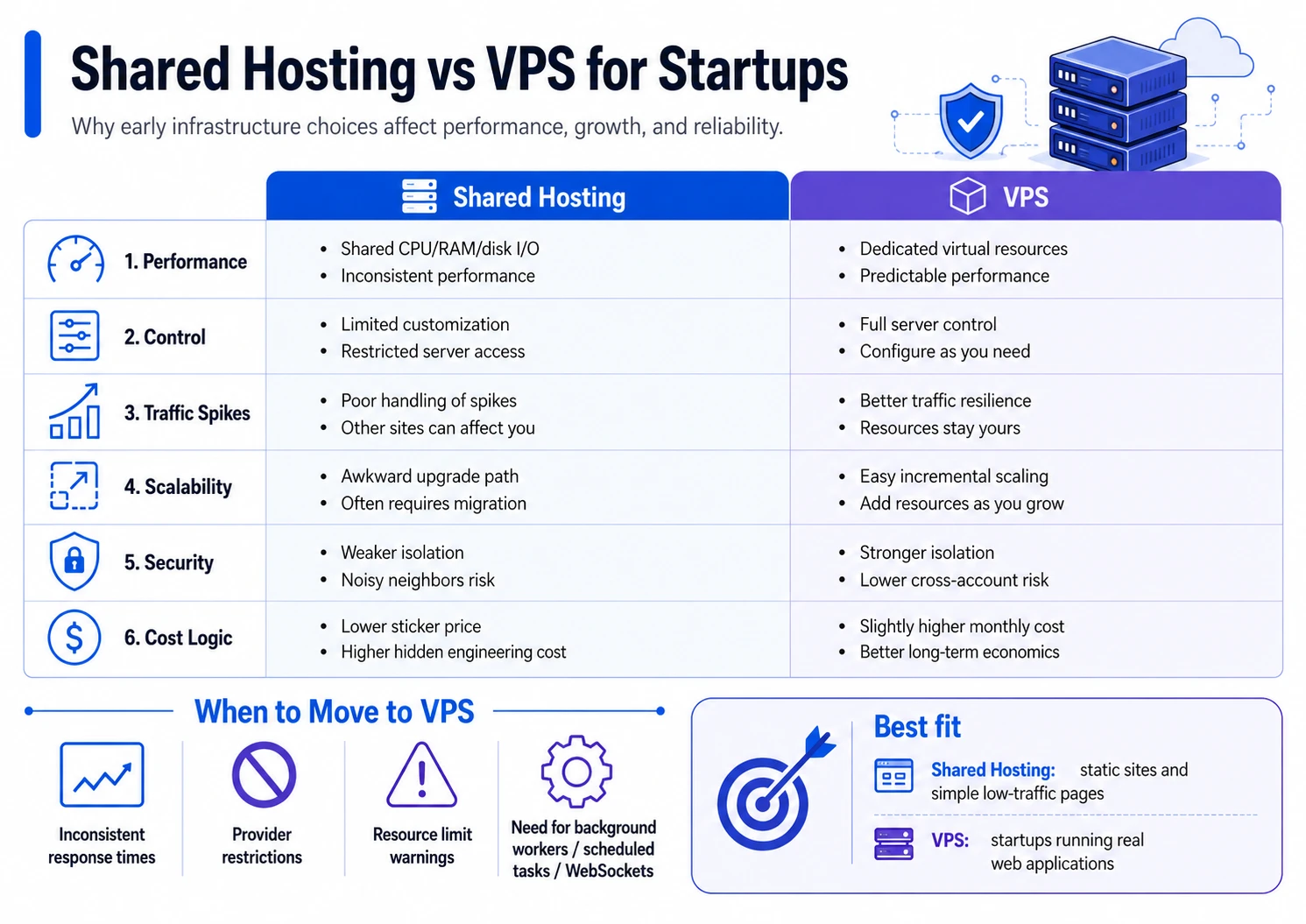
Shared hosting places your application on a server alongside dozens or hundreds of other tenants. The underlying hardware — CPU cycles, RAM, disk I/O — is divided among all of them without guaranteed allocation. When another tenant's application experiences a traffic spike or runs a resource-intensive process, your application absorbs part of that impact.
For a static website or a low-traffic landing page, this is rarely a problem. For a startup running a web application with real users, it introduces a category of performance issues that are difficult to diagnose and impossible to fully control. Latency spikes, slow database queries, and intermittent timeouts often trace back to resource contention rather than application-level bugs — but the user experience suffers regardless of the cause.
Shared hosting also imposes hard limits on customization. You cannot modify server-level configurations, install arbitrary software dependencies, or adjust runtime parameters. As your application's requirements evolve, those constraints compound.
The Case for VPS from an Early Stage
A Virtual Private Server allocates dedicated resources to your environment within a virtualized infrastructure. Your CPU allocation, RAM, and storage are not shared with other tenants. This changes the performance profile of your application in a fundamental way: behavior becomes predictable and reproducible, which matters both for user experience and for debugging.
Beyond raw performance, a VPS gives your team full control over the server environment. You can choose the operating system, install any dependencies your stack requires, configure the web server, tune the database, and implement security policies appropriate to your product. This level of control is not a luxury — it is a prerequisite for running a production application responsibly.
The cost difference between shared hosting and an entry-level VPS has narrowed considerably. For most startups, the gap is a matter of a few dollars per month. Measured against the cost of a single hour of engineering time spent diagnosing a performance issue caused by a shared environment, the economics favor VPS hosting from a relatively early stage.
Performance Under Real Conditions
Startup applications rarely have flat, predictable traffic. A product launch, a press mention, a successful social media post, or inclusion in a curated newsletter can generate traffic spikes that are orders of magnitude above the baseline. How your infrastructure responds to those spikes determines whether they translate into user acquisition or user frustration.
On shared hosting, sudden traffic increases often result in severe performance degradation or outright downtime. The server has no reserved capacity to absorb the load, and the provider's interest in protecting other tenants on the same machine may result in your application being throttled or suspended at the worst possible moment.
A well-provisioned VPS handles these situations differently. With dedicated resources and the ability to implement caching layers, load management, and process supervision tools like PM2 or Supervisor, your application can absorb meaningful traffic increases without degrading. For startups building on traffic growth as a signal of traction, this resilience has direct business value. A high performance VPS becomes particularly relevant when the application needs to sustain concurrent connections without latency penalties during peak periods.
Scalability: Growing Without Rebuilding
One of the structural advantages of VPS hosting is the ability to scale resources without migrating to a different infrastructure paradigm. When an application outgrows its current allocation, increasing RAM or CPU on a VPS is typically a straightforward operation that can be completed in minutes with little or no downtime.
This contrasts with the upgrade path on shared hosting, which often means moving to a semi-dedicated plan with limited improvements, or jumping directly to a managed solution with significantly higher costs and less control. The intermediate steps available on a VPS — incrementally increasing resources as traffic and complexity grow — allow startups to match infrastructure spending to actual demand rather than paying for capacity in anticipation of growth that may not materialize on schedule.
For startups operating under funding constraints, this granularity matters. Infrastructure costs that scale proportionally with usage are far easier to model and justify than step changes driven by platform limitations.
Security and Isolation
Shared hosting environments create security risks that are structural rather than configurable. A vulnerability in one tenant's application can, under certain conditions, affect others on the same server. More commonly, shared environments limit the security controls available to individual tenants — you cannot enforce custom firewall rules, restrict network access at the server level, or implement intrusion detection systems.
A VPS provides full isolation at the operating system level. You control who has access to the server, how that access is authenticated, which ports are open, and what software is running. For startups handling user data — even basic account information — this level of control is both a technical best practice and, in many jurisdictions, a regulatory expectation.
When to Make the Switch
The right time to move from shared hosting to a VPS is before performance or reliability becomes a user-facing problem, not after. Some indicators that the transition is overdue include inconsistent response times that do not correlate with application changes, difficulty installing or updating dependencies due to provider restrictions, recurring resource limit warnings from the hosting provider, and the need to implement background workers, scheduled tasks, or WebSocket connections that shared environments do not support.
If any of these apply, the migration is worth prioritizing. The process of moving an application from shared hosting to a VPS is well-documented and, for most stacks, manageable within a single working day.
Choosing the Right Provider
Not all VPS providers offer the same operational standards. For a startup, the relevant criteria are uptime reliability, support responsiveness, straightforward pricing without hidden overages, and data center locations appropriate to your user base.
https://bluevps.com provides VPS infrastructure suited to startups at various stages, with plans that allow teams to start with a modest allocation and expand as their product grows. For teams evaluating options and looking for practical guidance on infrastructure decisions, the VPS blog covers deployment patterns, configuration guides, and performance optimization topics relevant to small and growing engineering teams.
Conclusion
The choice between shared hosting and a VPS is not primarily a technical decision — it is a product decision. Infrastructure that cannot keep pace with user growth, that introduces unpredictable performance variability, or that prevents your team from implementing the configurations your application requires will eventually cost more in engineering time and lost users than the difference in monthly hosting fees.
For startups building products intended to scale, a VPS is not a premature optimization. It is the appropriate baseline for running a production application — one that gives your team the control, predictability, and room to grow that shared hosting structurally cannot provide.


