


Trader Education
Controversial Investing Theories
23 Oct 2014

When you talk about investment strategies and the theories on which those strategies are based, then you will run of breath but won’t run out of the sheer number of investing theories there are. There is a plethora of investing theories traders use in order to find what makes the market go and what each move made in the market signifies. Take Wall Street for example, there are investors in Wall Street who think they can use varying theoretical lines to combat and win against the market and there are those who favour efficient theories and do not believe the market can never be defeated. This divide is something real and it is staggering. There are so many theories that can be used to understand the factors which influence these markets and how an investor behaves in this market. Mentioned below are some conventional and unconventional investing theories you should at least know about or understand:
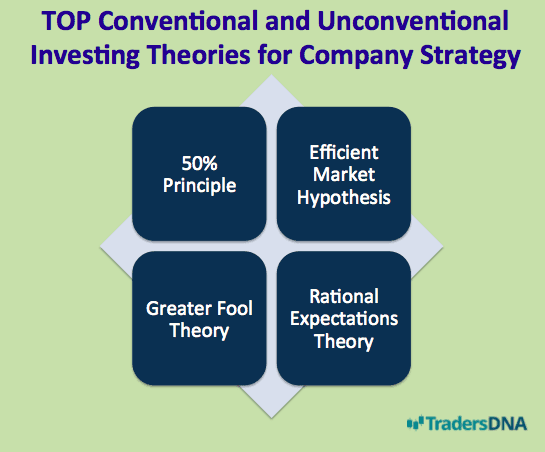
50% Principle
According to the 50% theory, a trend which is being observed by traders will experience a price correction before ending. This correction can range from one-half to two-thirds of the alteration in price. What this means is if a stock is increasing and has gained around 20%, before it can continue rising, it will fall by 10%. This example can be considered a bit over the top because usually this theory is applied on trends which are short-term and followed by traders with extreme technical analysis of the situation. This correction is looked upon by traders as occurring naturally and is sometimes caused by traders and investors who are in the habit of cashing out their profits before being sucked into the trend’s reversal after the trade. If the correction increases by 50% of the alteration in stock price, the trend itself is identified as a failure and that the reversal was caused by impulsive factors.
Efficient Market Hypothesis
There are a handful of investors who are likeminded or neutral at best when you talk about the efficient market hypothesis or (EMH). There is no grey area in between. Investors either shun the theory completely or oppose it. Investors who believe in the EMH use more broader and reflexive strategies for investing as opposed to those who emphasize on making investments using old school techniques, namely potential and growth, an analysis on undervalued assets, so on and so forth. According to the EMH, the price of shares in the market embodies all the available information about that particular stock. So, this means the stock is valued accordingly unless there is a change in the stock due to any other reason. And because of the fact that an investor cannot predict the future, he would proceed to buy a large number of stocks so that he can make a hefty profit from the rise in its price at the moment. This is what investors using EMH theory do. Others point to using more aggressive strategies to beat the market like Warren Buffet does.
Greater Fool Theory
The greater fool theory emphasizes you can make money from investing as long as there is an idiot in the market willing to purchase the stock at a higher price. What this really means is you can continue to make money from stock which a ‘greater fool’ is willing to buy off your hands. However, what happens is these ‘market fools’ begin to deplete as the market overheats. Traders adhering to this theory ignore all other factors and valuations involved in an investment, which is a huge risk.
Rational Expectations Theory
The rational expectations theory explains that the investors in an economy will use their strategies and tactics in a way which corresponds and matches with what can be rationally explained in the coming days. To put it in simpler terms, these investors like to invest and spend according to what they logically believe will affect them in the future. This helps investors to conform to a more self-fulfilling prophecy that determines how their actions will affect them in the future. It is imperative to understand that the rational expectations theory is considered an important economic factor. However, the utility of the theory, in the eyes of most investors, is still somewhat doubtful. For instance, a particular investor may think the price of a specific stock is increasing. He buys it, which allows the stocks to grow. Now look at it this way, this same transaction can be used in another example, an investor decides to buy undervalued stock, he keeps on buying it until other traders take notice of the stock and this ends up increasing the value of the stock. This helps identify one major flaw in the RET and that is you can use it to change the way you invest but it will never help you identify anything.
All in all, although it is important that you try and understand these theories, it is also important to know there isn’t any ‘one’ financial theory that can help you understand the world of finance.


