
Businesses
Dinis Guarda and Businessabc.net Launch The AI Global Regulations Atlas and White Paper
05 Nov 2026

The AI Global Regulations Atlas and white paper map AI law, governance, and readiness across 109 countries and jurisdictions. The new open resource consolidates leading global indices into one interactive tracker and a 5,000-word technical white paper for compliance teams, policymakers, and investors.
Businessabc.net, the business intelligence platform part of the Ztudium group, today released the AI Global Regulations Atlas, an interactive data-visualisation tracker, created together with a companion white paper by Dinis Guarda. The Atlas maps AI regulation and governance across 109 countries and jurisdictions and covers some 1,170 regulatory instruments: acts, bills, regulations, decrees, guidelines, and national strategies.
The Atlas brings together several independent measurement systems that are usually read in isolation. These are the Global Index on Responsible AI (GIRAI), the IMF AI Preparedness Index, the Stanford HAI AI Index 2026, public regulatory trackers including regulations.ai and CASRAI, and primary legislative records. Each jurisdiction is classified by regulatory model, status and maturity, with its flagship instrument and source.
AI Global Regulations Atlas: Key findings
- Governance lags adoption. The Global Index on Responsible AI (2026) assesses 135 countries on 38 indicators and finds a global average of about 35 out of 100. Europe averages 54; the Global South averages 27. Only 55% of active AI frameworks show evidence of implementation.
- Most frameworks are still soft law. According to GIRAI, 78% of Global South AI frameworks are non-binding, against 42% in the Global North. Only 54% of countries have a national AI policy, and only 18% require disclosure of AI systems used by the government.
- Readiness tracks income. The IMF AI Preparedness Index ranks 174 economies. Singapore (0.80), Denmark (0.78) and the United States (0.77) lead; China scores 0.63 and India 0.49.
- Investment and risk are both rising. The Stanford HAI AI Index 2026 reports US AI investment of about $285.9 billion in 2025, against roughly $20.9 billion in Europe and $12.4 billion in China, and a record 362 documented AI incidents.
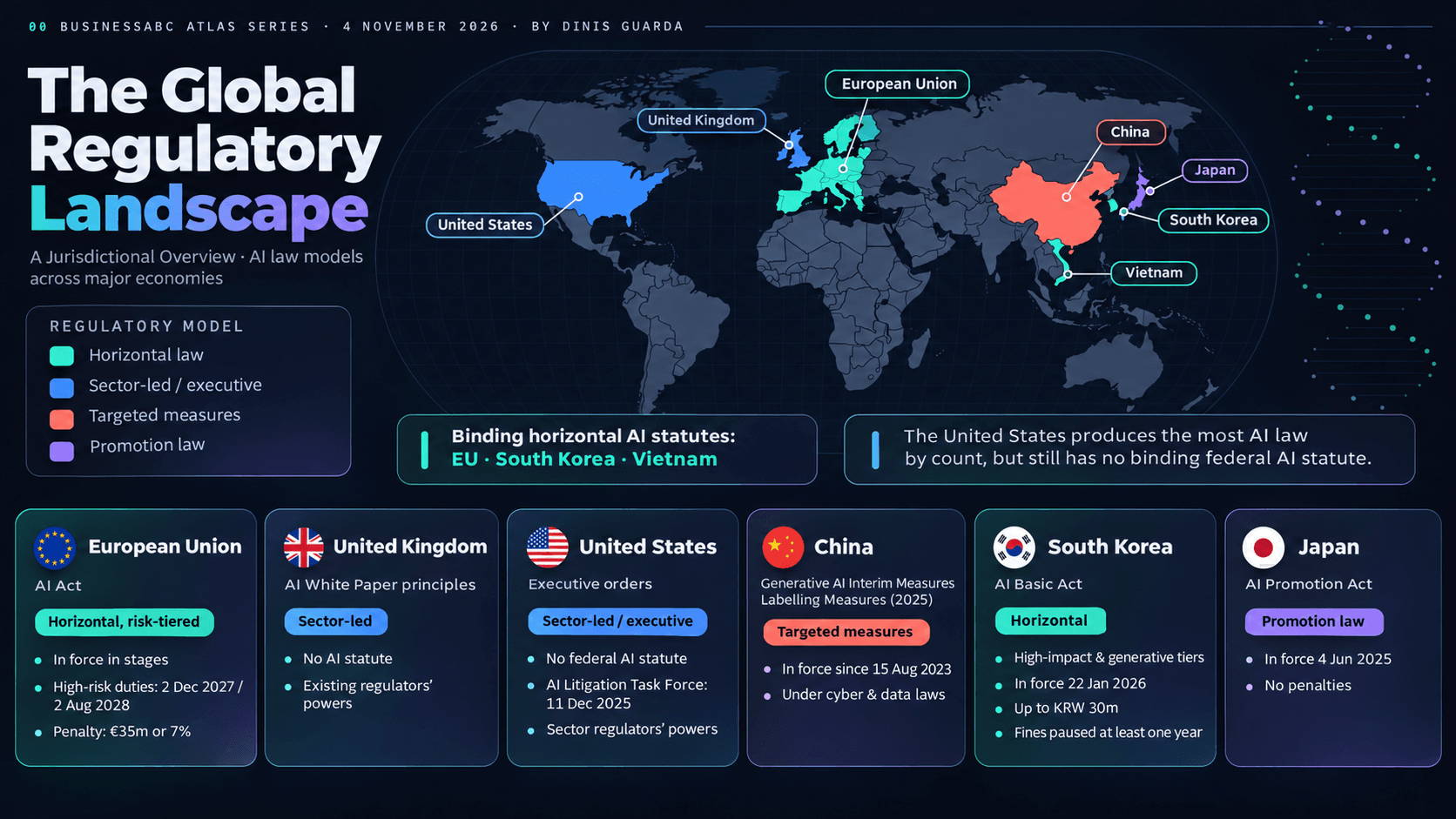
- Binding horizontal AI laws remain rare. The EU AI Act, South Korea's AI Basic Act (in force 22 January 2026) and Vietnam's Law on AI (in force 1 March 2026) are the main comprehensive statutes. Italy added a national AI law (Law 132/2025) on top of the EU Act.
- The EU timetable has moved. The Digital Omnibus, Regulation (EU) 2026/1744, in force since 27 July 2026, defers high-risk obligations to 2 December 2027 (Annex III) and 2 August 2028 (Annex I).
- US activity is state-led. There is still no binding federal AI statute. NYU's Center on Technology Policy counted 109 new state AI laws across 29 states by 1 July 2026, despite a December 2025 executive order targeting state regulation.
- The instrument count keeps rising. Public trackers record roughly 1,170 to 1,180 AI instruments across 109 jurisdictions, about 670 to 680 of them in force and close to 390 in the pipeline.
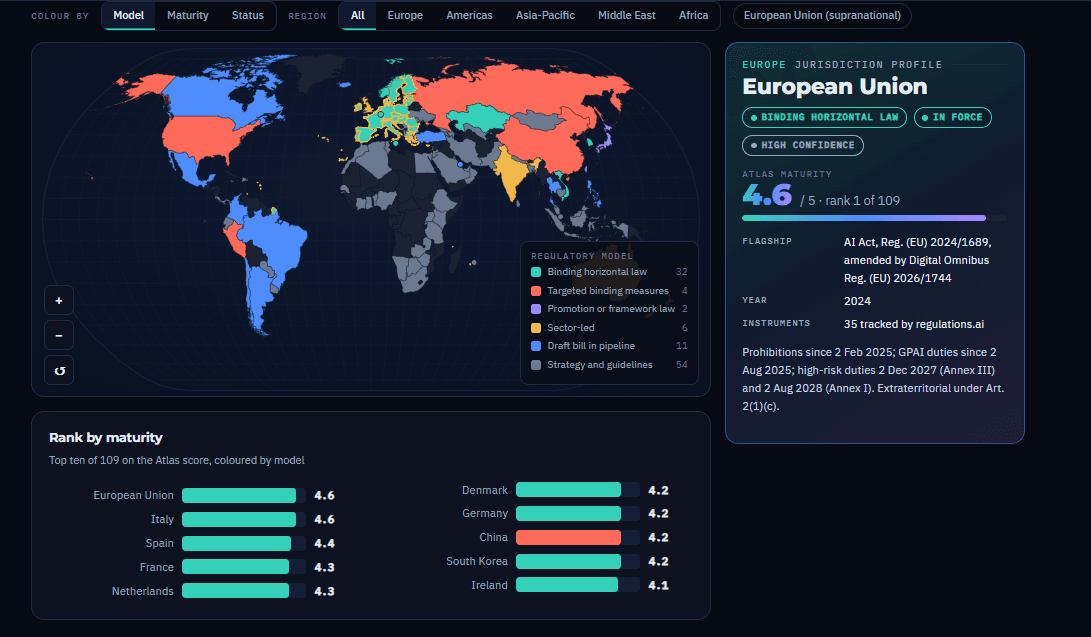
- Six regulatory models. The Atlas places 32 jurisdictions under binding horizontal law, 4 under targeted binding measures, 2 under promotion laws, 6 as sector-led, 11 with draft bills in the pipeline and 54 with strategy and guidelines only.
What is inside the AI Global Regulations Atlas
The white paper (about 5,000 words) analyses the structure of global AI regulation. It covers:
- The mix of instrument types and the gap between soft law and binding law
- The three main regulatory models: the EU's horizontal risk-based approach, sector-led regimes such as the UK's, and China's targeted measures
- Jurisdiction profiles for the EU, US federal and state law, China, the UK, Japan, South Korea, Vietnam, Brazil, Canada, India and Singapore, plus the Gulf and Africa
- Readiness and responsible-AI indices compared
- Penalty ceilings and enforcement routes
- International coordination, including the Council of Europe AI Convention, the G7 Hiroshima Process and the AI summit series
- Seven practical compliance steps for organisations, including ISO/IEC 42001 as a common control framework
The interactive Atlas offers:
- A world map of 109 jurisdictions, coloured by regulatory model, maturity score (1–5) or status, with a profile for each jurisdiction
- Charts of the corpus by instrument type, status, year and most active jurisdictions
- A timeline of milestones and upcoming deadlines from 2019 to 2028
- Side-by-side readiness and responsible-AI rankings
- A comparison of maximum penalties across jurisdictions
- An exposure checker that lists the instruments that apply to an AI system, by market and use case
- A searchable, sortable directory of all 109 jurisdictions, each rated for source confidence
"AI regulation has moved from principles to obligations in less than a decade, but it has not converged and remains fragmented and disconnected.
AI is the most important technology and infrastructure ID passport of our times. A company deploying AI across borders must look at the best regulatory infrastructure and now faces risk tiers in Brussels, compute thresholds in California, use-case rules in Colorado, and targeted measures in Beijing. The Atlas maps the global biggest regulatory footprint and puts the leading data, indices and trackers side by side, so that business leaders, compliance teams, regulators and investors can see where obligations bind today, what is coming, and where governance gaps remain." - Dinis Guarda, founder and CEO of Ztudium and Businessabc.net.
Where to access the AI Global Regulations Atlas?
The Atlas and white paper are free to access:
- Interactive Atlas: AI Global Regulations Atlas by Dinis Guarda, Businessabc
- White paper: AI Global Regulations Atlas — White Paper
Both will be updated as instruments change status. Corrections and data contributions are welcome.
Share

Pallavi Singal
Editor
Pallavi Singal is the Vice President of Content at ztudium, where she leads innovative content strategies and oversees the development of high-impact editorial initiatives. With a strong background in digital media and a passion for storytelling, Pallavi plays a pivotal role in scaling the content operations for ztudium's platforms, including Businessabc, Citiesabc, and IntelligentHQ, Wisdomia.ai, MStores, and many others. Her expertise spans content creation, SEO, and digital marketing, driving engagement and growth across multiple channels. Pallavi's work is characterised by a keen insight into emerging trends in business, technologies like AI, blockchain, metaverse and others, and society, making her a trusted voice in the industry.


