
resources-impakt, first_page
El Niño Is Strengthening. But Are We Reading the Risks Correctly?
12 Nov 2026

Bigger climate warnings do not automatically mean higher prices everywhere or a frozen British winter. The opportunity lies in understanding what changes next.
An opinion-led assessment. The scenarios below are planning judgments, not official forecasts or investment recommendations.
A stronger El Niño. Falling grain prices. Rising sugar prices, a colder spell in Britain.
These developments can coexist. The latest reports show why reading climate risk through a single headline or one temperature chart can mislead policymakers and investors alike. Climate Prediction Centre
In my earlier articles, I asked whether better forecasts could protect the world's food.
My question now is sharper:
Are we preparing for the risks or simply getting better at describing them?
What Was Predicted and What Has Changed?
The possibility of an exceptional event was already visible. June forecasts from the UK Government Office for Science projected approximately +2°C to +4°C of Pacific warming above average.
WMO's 21 October outlook projects an average Niño 3.4 anomaly of approximately +3.8°C for November 2026–January 2027, peaking around December. These are different forecast windows, but the latest outlook sits towards the upper end of the earlier possibilities, not outside everything previously considered.
The observed signal has strengthened too. NOAA's three-month Relative Oceanic Niño Index, or RONI, increased from +1.4°C for June–August to +2.0°C for August–October 2026. These recent readings remain subject to revision.
My interpretation is that the case for preparation has strengthened. But the eventual losses still depend on rainfall timing, crop development, inventories, infrastructure and policy responses, not Pacific temperature alone.
Are the Dashboards Contradicting Official Forecasts?
Different numbers do not necessarily mean conflicting science.
NOAA adopted RONI for operational monitoring in February 2026. Unlike the traditional index, it compares the Niño region with the wider tropical ocean, helping separate the ENSO signal from broader ocean warming. A daily reading, a three-month relative index and a forecast peak are therefore not interchangeable.
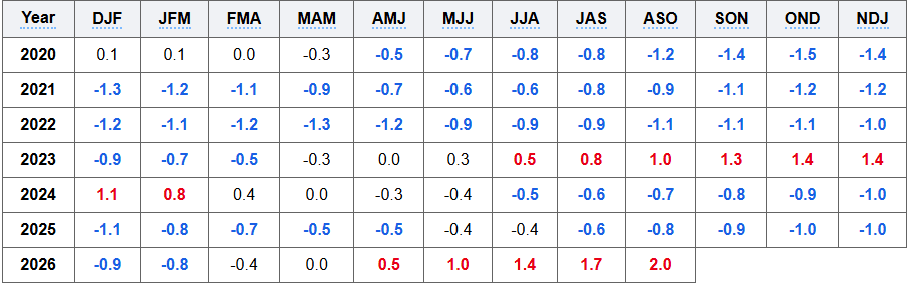
The Climate Brink's September analysis, drawing on 14 forecasting systems, projected a peak around +4.1°C in Niño 3.4. That is a forecast, not an observed three-month RONI value. Comparing it directly with NOAA's current RONI would exaggerate any apparent disagreement.
Before concluding that a government forecast is wrong, I would check the region, index, baseline, observation date and forecast period.
Equally, I would challenge excessive certainty. Forecasts can change as Pacific winds, subsurface temperatures and other ocean patterns evolve; regional impacts remain less certain than the existence of El Niño itself.
The Food Story Is More Uneven Than the Headlines
FAO's 6 November release offers an important reality check. Its global Food Price Index fell 1.2% in October, with cereal prices down 4.5%. Yet sugar rose 6.6%, and rice prices increased 1.6%. FAO still expects the world's second-largest cereal harvest on record.
A serious climate threat is not the same as an immediate worldwide food shortage.
For additional El Niño-related hunger risk, I would prioritise Southern Africa and vulnerable parts of East Africa. FEWS NET identifies particular drought exposure in Zimbabwe, southern Zambia and Malawi, and central and southern Mozambique. In parts of Ethiopia, Sudan and South Sudan, rainfall deficits compound existing vulnerability and conflict. Somalia and parts of Kenya face a different danger: excessive rain and flooding.
Central America's Dry Corridor also remains exposed. Meanwhile, the European Commission's 10 November assessment reports favourable production prospects in some other regions, including Bangladesh, another reminder that the outcome will not be uniformly negative.
The most consequential distinction may be timing: food-security pressures can peak after the climate event weakens. WFP warns that effects on harvests and food access could continue into early 2028. That does not mean El Niño itself must persist until then.
What About Storms, Cold Weather and the Polar Vortex?
Here, the latest update is more useful than the most dramatic headline.
On 11 November, the Met Office said Britain's current colder spell was driven by changing pressure patterns and Arctic air, not the polar vortex. It acknowledged recent stratospheric warming and weaker vortex winds, but said the disruption could be short-lived, with conditions returning to average as December approaches.
A disrupted vortex can increase the likelihood of certain cold-weather patterns, but it does not guarantee a severe British winter. University of Reading researchers also caution that a stronger El Niño does not automatically produce stronger UK impacts; some important consequences may arrive through imported food and energy costs instead.
My view: prepare for disruption, but do not build a business or investment decision around a guaranteed “big freeze”.
Are We Prepared Enough?
There is progress. WMO reports that 136 countries reported having multi-hazard early-warning systems in 2025, compared with 56 in 2015. But having a warning system does not mean every exposed community can act on its advice.
WFP's 9 November update makes the financing gap clear. It reached 4.9 million people with early warnings between January and September, while more than 1.5 million received assistance ahead of forecast shocks. Globally, pre-arranged mechanisms still account for less than 2% of humanitarian financing. Those figures are not directly comparable measures of coverage, but they illustrate the difference between warning and funded action.
My concern is that forecasting capability is advancing faster than practical protection.
Three Scenarios I Would Prepare For
Managed disruption: Timely rainfall, usable inventories and functioning trade routes cushion losses. Some commodities become expensive, while others remain adequately supplied. I would prioritise flexible procurement rather than blanket stockpiling.
A regional hunger crisis without a global shortage: Poor harvests and lost farm income deepen hardship in vulnerable regions even while aggregate global supplies look comfortable. I would prioritise early finance, local storage, reliable imports and support before the next planting window.
A compound economic shock: Crop losses coincide with export restrictions, transport disruption and energy stress. Under that combination, inflation could become harder to control and monetary easing more difficult. I would stress-test working capital, suppliers and energy exposure.
These are conditional planning scenarios, informed by the uneven supply outlook and identified food-security risks, not calibrated probabilities. The earlier 60% / 30% / 10% illustrative weights should not be treated as current official forecasts.
Where Could Businesses Make Money and Where Is the Trap?
I would look for gaps in preparation, not a supposed risk-free trading loophole.
Commercial opportunities
Worth testing includes paid climate-risk intelligence for cooperatives and buyers, water-efficiency services, resilient storage and cold chains, and verified alternative-supplier networks.
My preferred model would connect forecasts to a service customers can use and charge for measurable value, rather than frightening predictions.
Before investing, I would require a paying customer, credible delivery costs and evidence that the service remains useful under more than one weather scenario.
Commodity speculation is a different proposition. October's falling cereal prices show why "El Niño means buy every agricultural commodity" is not a reliable strategy.
Fraud is another risk.
The FCA warns about social-media investment promotions, fake endorsements, convincing trading websites and promises of exceptional returns. A pitch for "guaranteed AI-powered El Niño profits" should trigger scrutiny, not urgency. Check the firm's identity and permissions independently through the FCA where relevant, and verify where the money goes. This is a general warning, not an allegation against any source shared here.
Conclusion
The real opportunity is not simply to predict who will suffer. It is to build useful, accountable services that help prevent losses.
That is where I believe climate intelligence can become both a stronger business proposition and a more meaningful form of resilience.


