


business resources
Financial Controls Startups Need Before Their Next Funding Round
23 Sept 2026

A pitch deck gets a founder in the room. It's the financial controls behind the numbers that determine whether the round actually closes. Investors aren't just checking whether the growth story is real. They're checking whether the systems that produced those numbers can be trusted, and a surprising number of startups fail that specific test.
Why Most Startups Fail Due Diligence the First Time
Research into startup funding failures found that 73% of startups initially fail due diligence, and more than half of those failures trace directly back to governance deficiencies: disorganized cap tables, financial misreporting, and unresolved legal issues. That's not a story about weak products or bad markets. It's a story about internal systems that couldn't hold up once someone outside the company started asking pointed questions.
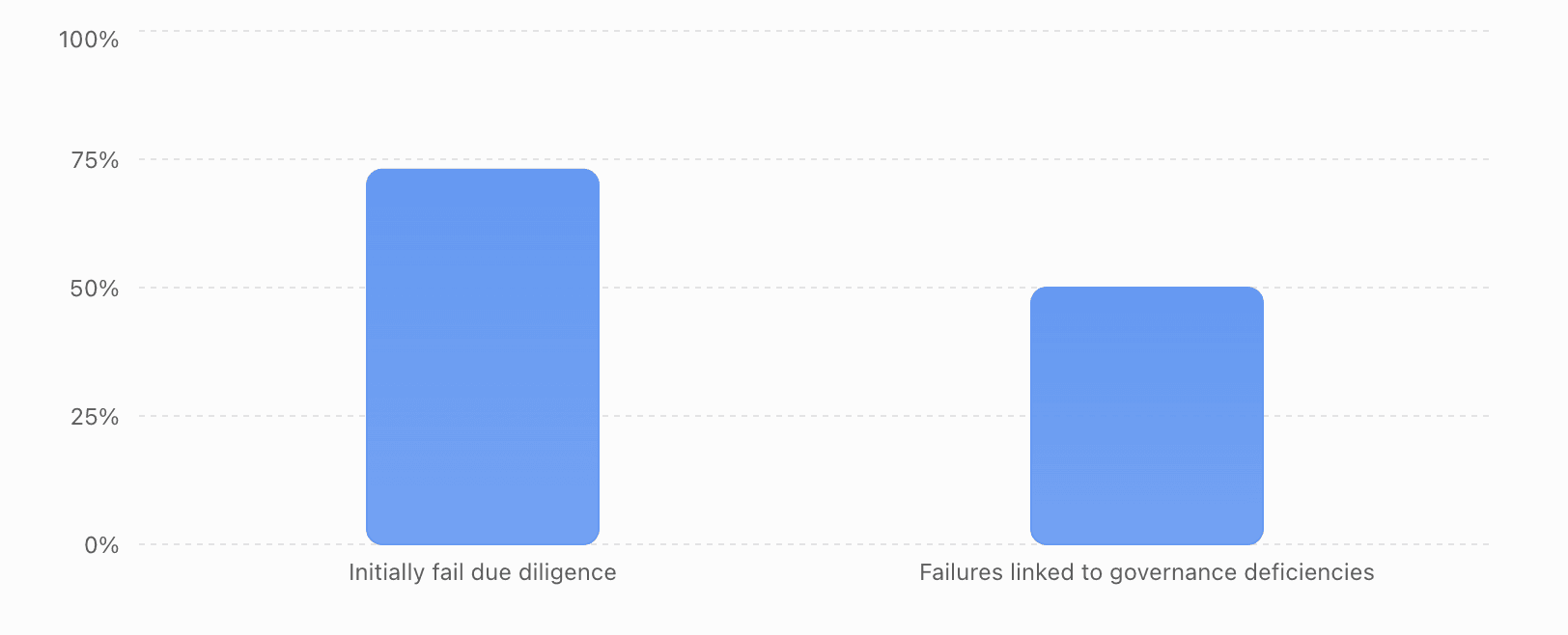
Source: Diligent, citing Kairos failure research. Governance-related figure reported as “over half,” not an exact percentage.
The gap shows up earlier than most founders expect. A separate analysis of transaction readiness found that only 4% of organizations have fully integrated their governance, risk, and financial systems, meaning the other 96% are reconciling data across disconnected tools by hand whenever an investor asks for something specific. That manual reconciliation isn't just slow. It's exactly where errors creep in, and errors discovered during diligence read very differently to an investor than errors caught and fixed internally beforehand.
Why does this number sit so much higher than most founders expect going in? Part of the answer is that early-stage financial hygiene rarely gets tested until the first real diligence process arrives. A two-person startup can run on instinct and a shared spreadsheet for a surprisingly long time without anything visibly breaking. The problem is invisible right up until an outside analyst starts asking questions the internal team has never had to answer precisely, at which point weeks of assumed-fine bookkeeping becomes a live liability during the exact window when the company can least afford delays.
The Controls Investors Actually Check
Clean, Reconciled Financials
Accrual-basis accounting, not cash-basis, is the baseline institutional investors expect once a company is raising a priced round. Cash-basis bookkeeping can look fine internally for years and then create a real problem the moment an investor's finance team starts comparing monthly figures against bank statements and finding timing mismatches that take weeks to explain.
A Cap Table That Matches Reality
Cap table problems are one of the most common reasons Series A diligence stalls: SAFE conversions modeled incorrectly, option grants that were promised verbally but never actually issued, and vesting schedules that don't match what's in the actual paperwork. None of these are necessarily fraud. They're usually just administrative drift that nobody caught because nobody was checking the cap table against reality on a regular schedule, only when a new round forced the question.
The fix costs almost nothing to implement early and quite a lot to implement late. A cap table reviewed quarterly against actual signed documents, actual option grants, and actual SAFE terms stays accurate by construction. The same cap table reconstructed for the first time during a live raise means legal counsel is now chasing signatures and clarifying ownership questions on the clock, precisely when speed matters most and the company has the least leverage to take its time getting it right.
Documented Expense Authority and Spend Controls
Who can spend company money, up to what limit, and on what categories, is a question every serious diligence process asks, and a surprising number of early-stage companies can't answer clearly. If the founder's personal card and the company card have been used interchangeably for the first two years, untangling that history for a data room is its own unpleasant project, one that's much easier to avoid than to fix retroactively.
Picture the actual mechanics of that untangling. A finance team preparing for diligence has to go transaction by transaction through two years of mixed personal and business spend, categorizing each charge, reconstructing which ones were genuinely business expenses, and building a paper trail that should have existed from the start. That work happens under a deadline, competing with every other diligence request landing in the same few weeks, and it produces exactly the kind of finding, mixed accounts, unclear approval history, that makes an investor's finance team ask harder questions about everything else in the data room too.
Integrated Systems, Not Manual Export-Paste
The manual cycle of pulling numbers from an accounting system, dropping them into a spreadsheet, and reformatting everything for board materials is a liability waiting to surface during a live round. Every manual step introduces a chance for error, and errors in board financials undermine investor confidence in a company's operational discipline well before anyone questions the business model itself.
Internal controls are genuinely difficult to implement in a company's earliest days when there are only one or two people involved, which is exactly why documenting processes as the team scales, rather than retrofitting them right before a raise, matters so much. A control that gets written down and followed from five employees onward is a habit. The same control introduced for the first time at fifteen employees, specifically because a lawyer flagged it, reads to investors as a company playing catch-up.
The Credit Control Gap Diligence Teams Flag Most Often
Of the four controls above, spend authority is the one most likely to still be informal at the exact moment a company starts raising a priced round. Early on, a single founder card covering everything is simple, and simplicity is genuinely valuable when there are only two or three people on the payroll. The problem is that this setup doesn't get revisited on any natural schedule. It just persists until an outside party asks who approved what, and the honest answer turns out to be "whoever had the card that week."
Fixing this isn't complicated once it's actually prioritized. Assigning individual spend limits by role, keeping a documented record of who can approve what category of expense, and separating personal from business spend cleanly are all administrative decisions that take an afternoon to implement and years to regret not having done sooner. For a startup whose spending has outgrown what a single shared card can track cleanly, exploring credit limits for growing companies built around individual employee limits and exportable spend records solves exactly this control gap, turning "trust everyone with the one card" into a system with an actual audit trail behind it.
Building the Habit Before You Need It
Every source describing what diligence actually looks like converges on the same underlying point: the companies that pass cleanly are the ones treating this as a monthly or quarterly habit, not a pre-raise scramble. A due diligence checklist run quarterly catches a messy cap table or an undocumented expense approval while it's still a five-minute fix. The same issue discovered during an actual six-to-ten-week diligence window, with a fund's analyst living in the data room and legal counsel producing an issues list, becomes a negotiating point against the company's valuation.
This matters more the further along a company gets. Financial diligence becomes progressively more important at each subsequent round, and the venture capital firms backing later rounds increasingly bring in outside accounting firms specifically to test whether a company's internal controls are real or theoretical. A control that existed on paper but was never actually enforced is often worse for investor confidence than no control at all, because it suggests the company doesn't fully understand its own weaknesses.
There's a specific psychological trap worth naming here. A founder who has never been through a full diligence process tends to assume that good intentions and a generally honest operation are enough, because nothing has ever forced the informal systems to prove themselves under scrutiny. The first real diligence process is often the first time a founder discovers exactly how much of the company's financial story was living in someone's memory rather than in a system anyone else could independently verify. That discovery is far cheaper to make on a Tuesday afternoon during a routine quarterly review than during week three of a live term sheet negotiation.
What This Looks Like in Practice
None of the four controls above require hiring a full finance team before a company is ready for one. They require deciding, in advance, who can spend what, keeping the cap table current as changes happen rather than reconstructing it before a raise, and choosing accounting practices that will hold up under outside scrutiny from the earliest possible stage.
The founders who find due diligence uneventful aren't the ones with the most sophisticated financial infrastructure. They're the ones who treated basic financial hygiene as a standing habit long before an investor asked to see it, which means that by the time the data room opens, there's nothing left to reconstruct under a deadline.


