
business resources
Finding a DevOps Partner for Healthcare Industry: A Complete Guide
26 Feb 2026

HIPAA violations start at $100 per record and scale to $50,000 depending on negligence. HITECH Act penalties reach $1.5 million annually per violation category. These numbers make compliance your primary concern when selecting a DevOps partner. Yet most healthcare organizations evaluate DevOps solutions & automation services by comparing deployment speeds and infrastructure costs first. Regulatory requirements come later as checkbox items. This sequence creates risk.
Start with your compliance obligations. Federal HIPAA and HITECH requirements apply everywhere. State laws add complexity. California's CMIA creates additional data protection rules. Texas has specific breach notification timelines. Then map your operational needs to these constraints. Your EHR needs 99.9% uptime with full audit logging. Telemedicine platforms must handle traffic spikes while maintaining encrypted sessions. Lab result integrations require both speed and complete data protection. Find providers who build DevOps practices around these regulatory requirements, not teams that add compliance as an afterthought.
Healthcare-Specific Compliance Track Record
Generic DevOps experience means nothing in healthcare. Providers must demonstrate actual HIPAA project completeness with documented audit outcomes. Request their BAA template and review how they structure data processing agreements. Ask about their most recent OCR audit or penetration test results. Compliance claims need verification through references who've experienced their breach response procedures firsthand.
What to verify during evaluation:
- Request case studies showing specific HIPAA compliance improvements with metrics
- Review their BAA readiness documentation and data processing agreements
- Ask for OCR audit results or third-party security assessment reports
- Get references from healthcare clients and ask specifically about compliance support quality
- Check their breach notification response time in previous incidents
- Verify they maintain required security certifications (HITRUST, SOC 2)
Patient Data Security and Breach Prevention First
Patient data protection requires verifiable security practices, not promises. Check for HITRUST certification, which specifically addresses healthcare security requirements beyond general ISO 27001 or SOC 2 compliance. Evaluate their PHI encryption standards for data at rest and in transit. Ask how they implement role-based access controls and what audit logging capabilities they provide for compliance reporting. Understand their automated compliance monitoring tools that check configurations against HIPAA technical safeguards continuously. Most importantly, review their breach notification procedures. Response time matters when OCR requires notification within 60 days. Ask how quickly they detected previous incidents and how they handled the notification chain to covered entities and affected individuals.
Top 5 DevOps Providers for Healthcare Companies in 2026
ELITEX
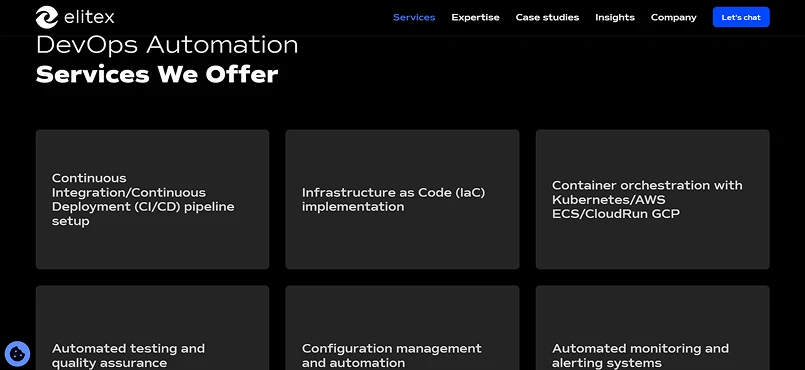
ELITEX combines healthcare software development services with DevOps expertise gained through actual clinical system implementations. The company has completed DevOps transformation projects for telemedicine platforms, EHR systems, and patient portal infrastructures. Their team understands both HIPAA technical safeguards and the operational reality of healthcare systems that can't afford downtime. ELITEX has handled compliance automation for a healthcare startup, implemented audit logging for clinical workflows, and built deployment pipelines that maintain continuous compliance monitoring.
Their approach prioritizes regulatory requirements from project start. ELITEX provides ready BAA agreements and maintains documentation that satisfies OCR audits. The team has experience with encrypted data transmission for telehealth, role-based access controls for clinical staff, and disaster recovery procedures that meet HIPAA requirements. Pricing ranges from $30-70 per hour based on specialist requirements. Based in Eastern Europe, they offer cost-effective rates while maintaining HITRUST-aligned security practices.
Oxagile
Oxagile focuses on healthcare technology with specific expertise in medical imaging and diagnostic platforms. Their DevOps infrastructure automation services handle large medical file transfers while maintaining HIPAA compliance. The company works with healthcare providers implementing PACS systems and radiology workflows. They understand the specific challenges of managing Protected Health Information in high-bandwidth environments.
Innowise Group
Innowise Group specializes in healthcare digital transformation with a strong compliance automation practice. Their DevOps team has handled multi-facility hospital network implementations where consistent security policies matter across locations. The company provides detailed audit trails and compliance reporting that simplifies OCR reviews. They work primarily with mid-sized healthcare organizations upgrading legacy clinical systems.
Belitsoft

Belitsoft brings 20 years of healthcare software experience with dedicated HIPAA compliance teams. Their DevOps practice emphasizes automated security testing and continuous compliance validation. The company has worked on patient engagement platforms, medical billing systems, and clinical decision support tools. They excel at integrating new infrastructure with existing healthcare IT ecosystems.
Reintech
Reintech positions itself as a healthcare DevOps specialist focusing on startups and digital health companies. They work with telemedicine platforms, health tracking applications, and patient communication tools that need rapid scaling. Their team understands modern cloud architectures while maintaining HIPAA compliance. Pricing remains accessible for healthcare startups building their first compliant infrastructure.
Another Aspect to Consider: Support Model for Patient-Critical Systems
Clinical system failures affect patient safety, not just operations. Evaluate SLA offerings specifically for EHR access, medication dispensing systems, and lab result delivery. Standard "99.9% uptime" promises mean nothing without defined response times for critical failures. As a healthcare organization, you cannot afford downtime, so test the candidate-company’s emergency response during the evaluation phase. Send a simulated crisis scenario at 3 AM. Measure how quickly engineers respond and who gets mobilized. Understand the escalation chain when systems affecting patient care fail. Does a senior architect join calls within 15 minutes or 4 hours? Calculate your actual downtime costs. A downed EHR system forces clinicians back to paper charts, delays treatments, and creates medication errors. Match support tier pricing against these patient safety risks, not just lost revenue.
Total Cost Including Compliance Overhead
Also, take into account that base hourly rates hide the real cost of healthcare DevOps. Compliance requirements add substantial overhead that many providers bill separately. Understanding total expenses upfront prevents budget surprises when audit season arrives.
Calculate true costs, including:
- Mandatory security tools (SIEM systems, vulnerability scanners, compliance monitoring platforms)
- Audit support fees for OCR reviews and security assessments
- BAA legal review and ongoing compliance consulting charges
- Encrypted backup storage and disaster recovery infrastructure costs
- Training expenses for HIPAA security awareness requirements
- Contract modification costs when regulations change (like HITECH updates or state law expansions)
Conclusion
Selecting a DevOps partner for healthcare starts with compliance expertise, not technical capabilities. Skip providers who treat HIPAA as a checkbox requirement or lack documented healthcare project outcomes. Verify their BAA readiness, breach response history, and actual audit results before discussions progress. Test their emergency support with simulated critical failures. Response time matters when EHR systems affect patient care.
Before starting any collaboration, calculate total costs, including compliance overhead. Security tools, audit support, and regulatory consulting add substantial expenses beyond base hourly rates. The right partner understands that healthcare system failures create patient safety risks, not just operational disruptions. They build DevOps practices around regulatory requirements from day one. Compliance comes first, technical optimization follows


