
resources
Free Billing Software in India 2026: What Free Actually Covers, and the Five Signals You Have Outgrown It
30 Sept 2026

In short: Free billing software in India is genuinely useful for low-volume billing, but it is limited in four predictable ways: a monthly invoice cap, single-user access, no inventory or barcode support, and no e-way bill or e-invoicing. For small businesses starting out, the free billing software plan from myBillBook covers GST bill creation, WhatsApp sharing, and payment tracking on the mobile app at no cost, with paid plans from ₹291/month billed annually when your volume grows past it.
Every business owner searching for free billing software is asking the same real question underneath: how far can I get without paying?
That is a completely reasonable question, and most content on the topic answers it badly. Either it pretends free is a full product, or it treats free as a trap. Neither is true. Free plans in the Indian billing market are usually honest, deliberately limited, and perfectly adequate for a specific stage of business.
This guide is about identifying which stage you are in.
What “Free” Actually Means in Indian Billing Software
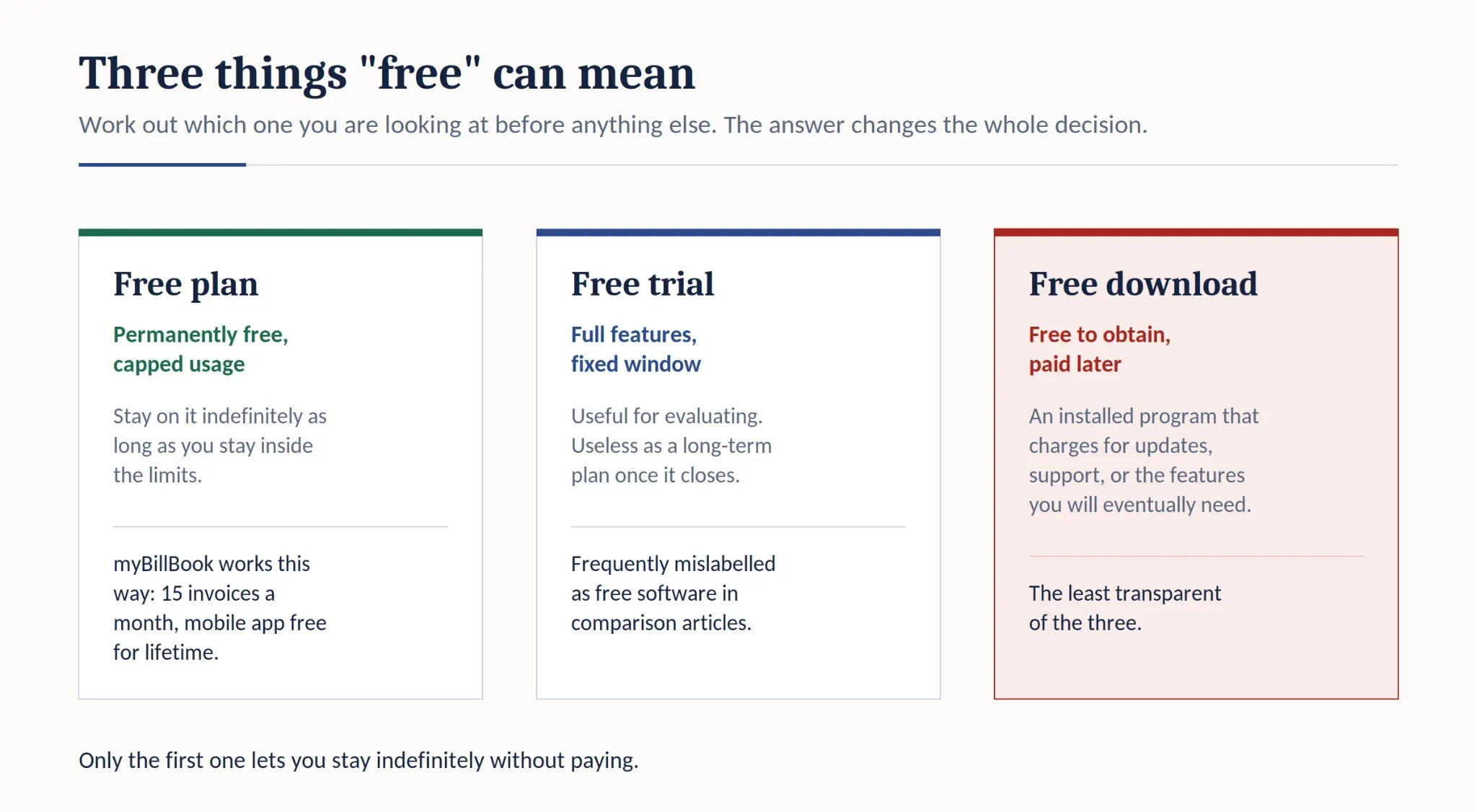
The word covers three different things, and mixing them up is where buyers get burned.
A free plan is permanently free with capped usage. You can stay on it indefinitely as long as you stay inside the limits. myBillBook’s free plan works this way: the mobile app is free for lifetime, and you can create up to 15 invoices per month on it.
A free trial is full features for a fixed window, then it stops. Useful for evaluation, useless as a long-term plan, and frequently mislabelled as “free software” in comparison articles.
A free download usually means an installed program that is free to obtain but charges for updates, support, or the features you will eventually need. This is the least transparent of the three.
When you read “free billing software” anywhere, work out which of the three you are looking at before anything else. The answer changes the entire decision.
What a Free Plan Genuinely Covers
For a business doing low volume, a good free plan is not a stripped-down toy. It handles the core job.
On myBillBook’s free mobile plan you can create GST invoices with customer details, item details, tax breakup, and payment information. You can share those invoices with customers over WhatsApp instead of printing them. You can track which bills are paid, unpaid, and overdue. You can save customer records so repeat billing does not mean re-entering details. And all of it sits in a digital record you can search, rather than a bill book you have to flip through.
For a freelancer sending six invoices a month, a consultant billing four clients, a small service business finding its feet, or a new shop testing whether digital billing suits its workflow, that is the whole requirement. Paying for more would be paying for capacity you are not using.
I would go further: for these businesses, moving from a paper bill book to a free digital plan is a bigger operational improvement than moving from a free plan to a paid one later. The first step digitises your records. The second step just adds capacity.
The Four Limits That Define Every Free Plan
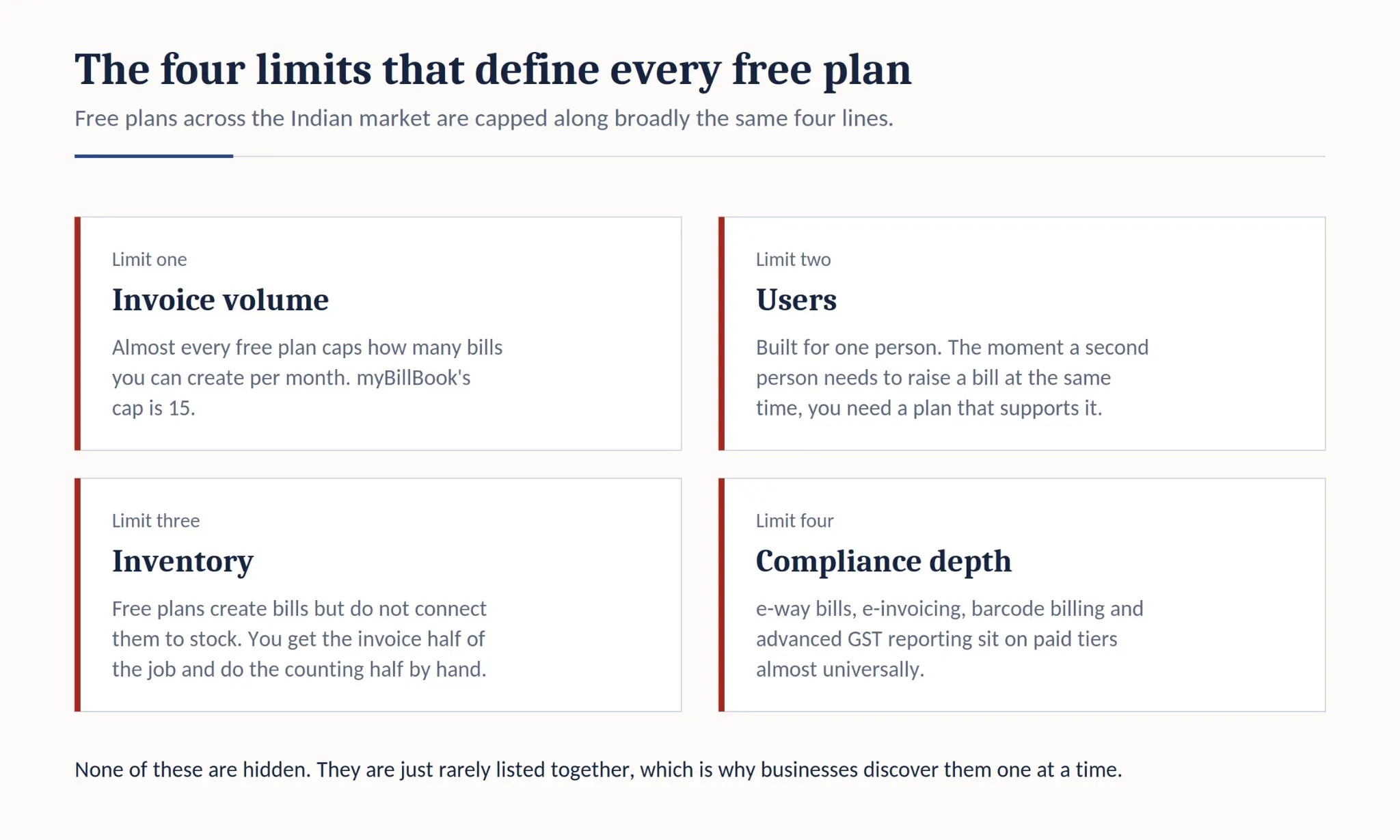
Free plans across the Indian market are limited along broadly the same four lines. Knowing them in advance saves an unpleasant surprise in month two.
Invoice volume. Almost every free plan caps how many bills you can create per month. myBillBook’s cap is 15. Once you are consistently bumping against a cap, free has stopped being free and started being a constraint on your sales.
Users. Free plans are built for one person. The moment a second person needs to raise a bill at the same time, you need a plan that supports it.
Inventory. This is the big one for product businesses. Free billing plans generally create bills but do not connect those bills to stock. If you sell physical goods, you are getting the invoice half of the job and doing the counting half by hand.
Compliance depth. e-way bills, e-invoicing, barcode billing, and advanced GST reporting sit on paid tiers almost universally. These are not upsells so much as a genuinely different class of functionality.
None of these limits are hidden. They are just rarely listed together, which is why businesses discover them one at a time.
The Five Signals You Have Outgrown Free
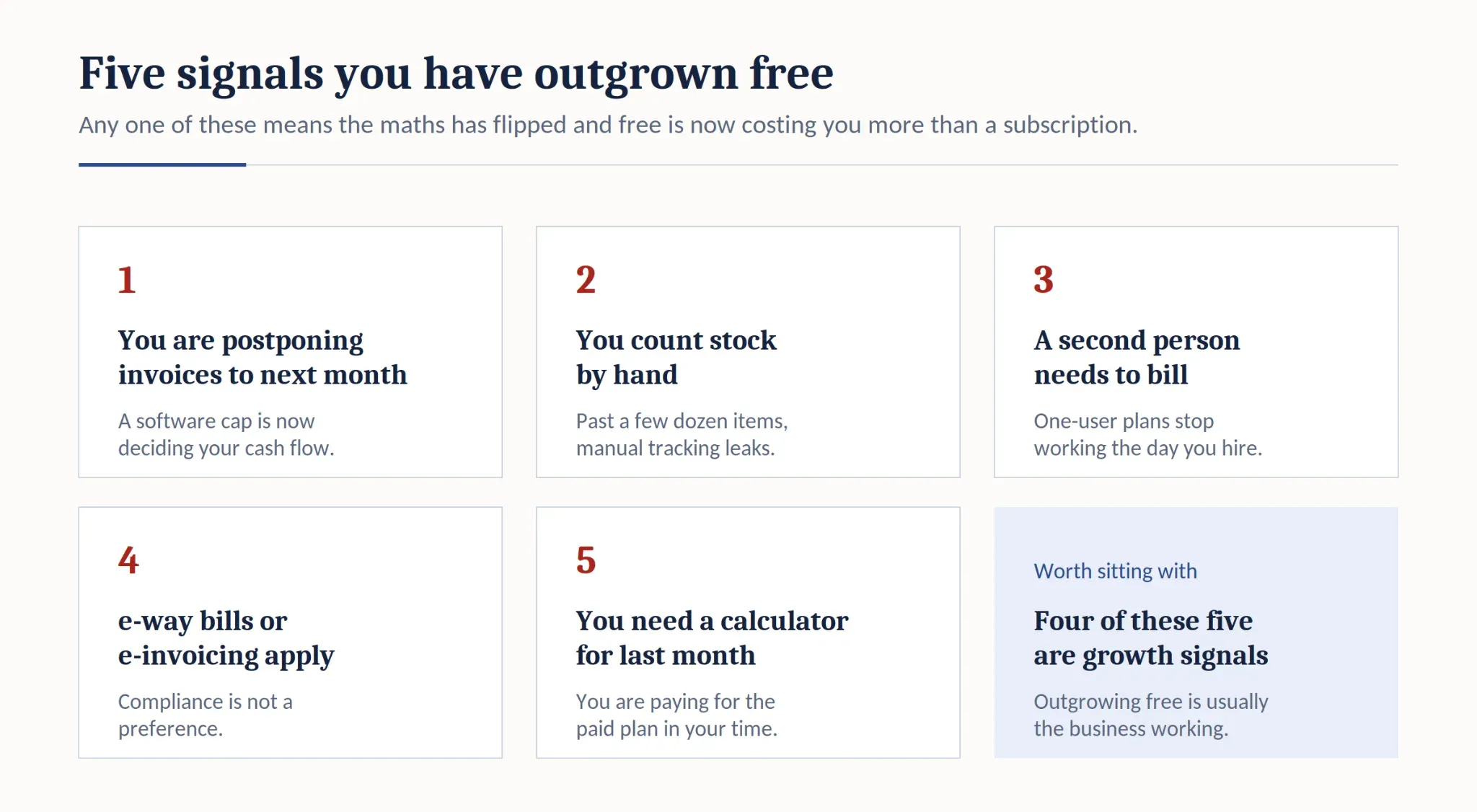
Skip the philosophical debate about free versus paid. These are the five practical triggers. Any one of them means the maths has flipped.
- You are postponing invoices to next month. If you have ever held a bill back because you hit the cap, free is now costing you cash flow. That is not a software problem you should tolerate.
- You are selling physical products and counting stock by hand. The moment your item count passes a few dozen, manual stock tracking starts leaking. Inventory linked to billing is the single highest-value paid feature for any product business.
- A second person needs to bill. A shop with two counters, an owner plus a staff member, a business with a CA who needs access. One-user plans stop working the day you hire.
- A customer or a threshold demands e-way bills or e-invoicing. These are compliance requirements, not preferences. When they apply, free stops being an option.
- You cannot answer “what did I make last month?” without a calculator. Reports are what turn billing data into decisions. If you are doing the analysis manually, you are paying for the paid plan in your own time.
Four of these five are growth signals. That is worth sitting with. Outgrowing a free plan is not a failure of the software. It is usually evidence that the business is working.
The Data Test to Run Before You Pick Any Free Plan
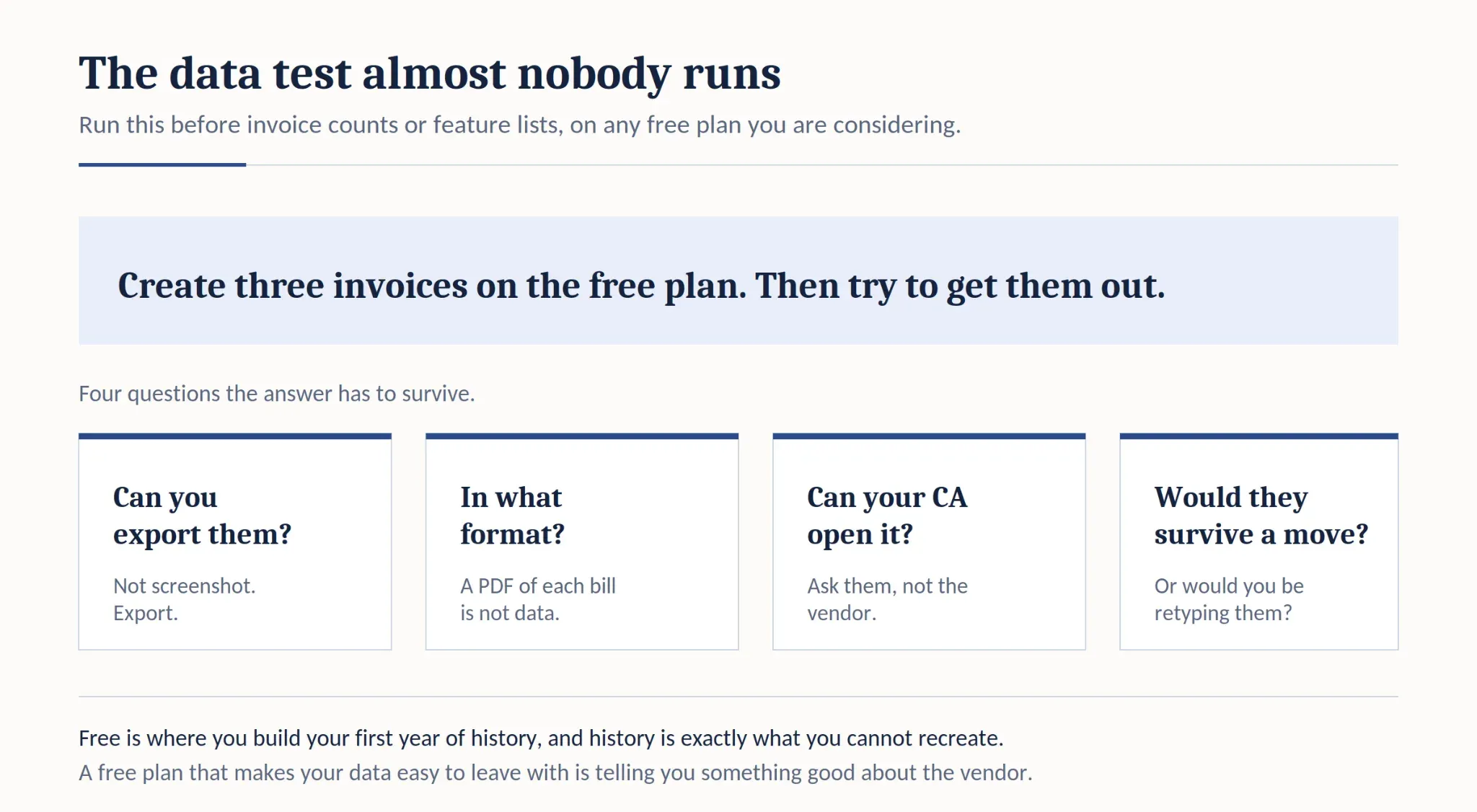
Here is the test I would run first, before invoice counts or feature lists, and almost nobody does it.
Create three invoices on the free plan. Then try to get them out.
Can you export them? In what format? Can you hand that export to a CA? If you decided tomorrow to move to a different product, would those three invoices come with you, or would you be retyping them?
The reason this matters more on free plans than paid ones is that free is where you build your first year of history, and history is exactly what you cannot recreate. A free plan that makes your data easy to leave with is telling you something good about the vendor. One that does not is a cost you will pay later, in an afternoon of manual re-entry you did not budget for.
Free Plan Versus Paid: The Honest Comparison
| What you need | Free plan | Paid plan |
| Monthly invoice volume | Capped (15/month on myBillBook) | Unlimited |
| Users billing at once | One | One on Plus and Pro, three on Pro Max |
| Stock linked to billing | Not included | Included from Plus upward |
| Barcode billing | Not included | Generate, print, and scan from Plus; label printer on Pro |
| Desktop access | Mobile app | Desktop app from Pro upward |
| e-way bills and e-invoicing | Not included | Pro Max |
| Business reports | Basic records | Sales, purchase, payment, stock, and profit reports |
| Cost | ₹0 | From ₹291/month billed annually (₹3,490/year) |
The gap between the columns is not quality. It is capacity and compliance. A free plan creates a perfectly valid GST invoice. It just creates fifteen of them.
Where Free Billing Software Fits in 2026
The Indian market has settled into a fairly healthy pattern. Serious vendors offer a real free tier because it is how small businesses try the product, and because a business that starts free and grows is worth more than one that never signs up. The free tier is a genuine on-ramp rather than a demo in disguise.
What has changed is the compliance floor. As GST reporting has tightened and e-invoicing thresholds have come down in stages, the range of businesses that can run entirely on a free plan has narrowed. A service business billing a handful of clients still fits comfortably. A growing retailer with stock, staff, and e-way bills does not, and pretending otherwise costs more than the subscription.
Frequently Asked Questions
Is there genuinely free billing software in India? Yes. myBillBook offers a free mobile app plan that lets you create up to 15 GST invoices per month, share them on WhatsApp, and track payments, with no time limit. Distinguish this from a free trial, which gives full features for a fixed window and then stops, and from a free download, which usually charges for updates or support later.
What are the limitations of free billing software? Free plans are typically limited on four axes: a monthly invoice cap, single-user access, no inventory linked to billing, and no e-way bills, e-invoicing, or barcode billing. These limits are consistent across most Indian vendors and are usually stated on the pricing page rather than hidden.
Can I create GST invoices on a free plan? Yes. A free plan from a credible vendor produces a fully valid GST invoice with customer details, item details, HSN or SAC codes, tax breakup, and payment status. The limit is how many you can create per month, not what the invoice contains.
When should I upgrade from free billing software? Upgrade when any of five things happens: you are hitting the monthly invoice cap, you need stock to move when a bill is created, a second person needs to bill, you need e-way bills or e-invoicing, or you need proper business reports. myBillBook’s paid plans start at ₹291/month billed annually.
Is free billing software safe for my business data? That depends on the vendor, not on the price. Look for cloud backup and sync across devices, a clear privacy policy, and a documented way to export your own data. Run the export test on three invoices before you build a year of history on any platform, free or paid.
The Bottom Line
Free billing software is not a compromise. It is a stage. For a freelancer, a consultant, or a new small business, a free plan that creates proper GST invoices, shares them on WhatsApp, and tracks payments is the entire job, and it is a genuine upgrade on a paper bill book.
Know the four limits going in, watch for the five upgrade signals, and run the data export test before you commit a year of history anywhere.
For Indian small businesses that want to start billing digitally at no cost and have a clear path when volume grows, myBillBook’s free mobile plan covers 15 invoices a month, with paid plans from ₹291/month billed annually adding unlimited invoices, inventory, barcode billing, and reports.


