business resources
Grid bot trading strategies and tactics
03 Dec 2025

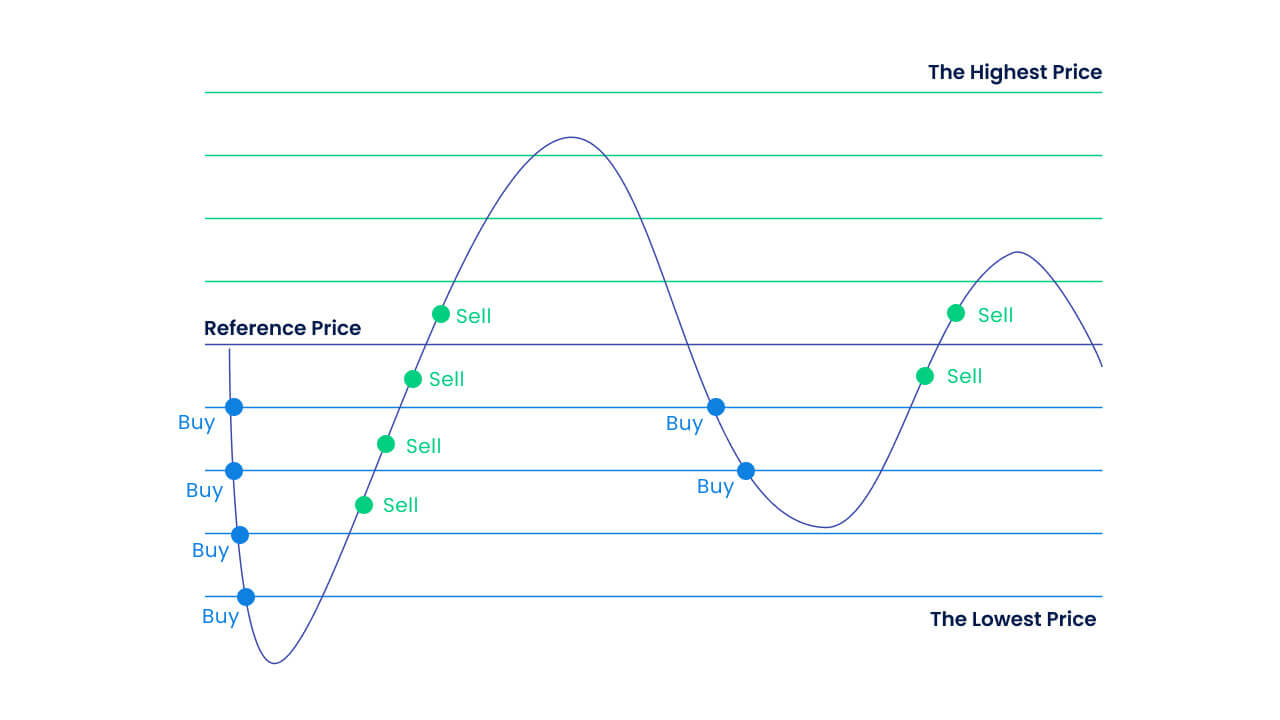
A grid bot represents a systematic approach to cryptocurrency trading that capitalizes on market volatility. These automated systems operate by placing a series of limit buy and sell orders at incrementally increasing and decreasing prices within a predefined range, creating a "grid" of orders. The fundamental objective is to profit from market fluctuations by continuously buying low and selling high as prices oscillate across the grid lines. This can be done on a platform such as 3commas.
Directional grid strategies
Grid strategies are categorized based on expected market direction and how orders are distributed across the price range. Each approach is optimized for specific market conditions.
Neutral grid strategy
The neutral grid is designed for sideways or range-bound markets where no clear trend exists. This strategy places buy orders below the current price and sell orders above it, positioning the bot to profit from volatility within a defined range. As price moves up and down within this range, the bot systematically buys at lower grid levels and sells at higher ones.
This approach is most effective when an asset demonstrates consistent volatility but lacks directional momentum. The neutral grid thrives on oscillation, capturing small profits with each price swing across grid lines. However, it faces significant risk if price breaks out of the established range in either direction, potentially leaving the trader with an unfavorable position.
Long grid (bullish strategy)
The long grid is primarily used for spot trading in bullish markets where an upward trend is expected. This strategy involves holding a base asset and aggressively buying dips within the range to sell them as price recovers. The objective is to accumulate more of the quoted currency while price trends upward.
In a long grid configuration, the bot maintains a bullish bias, ensuring that as price rises, the portfolio benefits from both the grid's trading profits and the underlying appreciation of the asset. This strategy works best when a trader expects overall upward momentum but anticipates volatility along the way. The risk lies in sustained downward movement, which can result in accumulating assets at progressively lower prices without the anticipated recovery.
Short grid (bearish strategy)
The short grid is deployed in futures or margin trading environments during bearish markets. This strategy takes short positions at higher prices and buys back (closes shorts) at lower prices within the grid, profiting from decline.
By systematically selling high and covering low, the short grid capitalizes on downward price momentum while still capturing profits from temporary upward retracements within the overall bearish trend. This approach requires access to leverage or margin facilities and carries the inherent risks of short selling, including potentially unlimited losses if price moves sharply upward.
Reverse grid strategy
A variant of the short grid, the reverse grid is specifically optimized for downtrending markets. The bot automatically sells at lower grid levels and buys back at higher grid levels, maximizing profit as price falls. This counter-intuitive setup inverts the traditional grid logic to align with bearish momentum.
The reverse grid is particularly effective when a trader has strong conviction about sustained downward movement but expects volatility during the descent. Like the short grid, it requires margin trading capabilities and carries significant risk if market sentiment shifts bullish.
Grid interval approaches
The method of dividing the price range determines the type of grid interval used, which fundamentally affects trading frequency and profitability per trade.
Arithmetic arid
An arithmetic grid uses equal price intervals, meaning the difference between each grid line is a fixed amount. For example, if trading Bitcoin, an arithmetic grid might place orders every $100 across the range.
This approach is straightforward to configure and works well in lower-volatility or tighter-range markets where price movements are relatively consistent. The fixed-price intervals ensure predictable spacing between orders regardless of the current price level. However, arithmetic grids can become less effective in highly volatile markets or with assets experiencing significant price swings, as the fixed intervals may not adapt proportionally to percentage-based price movements.
Geometric grid
A geometric grid uses equal percentage intervals, meaning the difference between each grid line is a fixed percentage rather than a fixed price amount. For instance, orders might be placed at 1% intervals across the range.
This approach adapts better to highly volatile assets and trending markets because the distance between orders widens proportionally as price increases. A 1% move represents a larger absolute price change at $50,000 than at $5,000, and geometric grids automatically account for this scaling. This makes geometric grids particularly suitable for cryptocurrencies, which often experience percentage-based volatility rather than fixed-price movements.
The geometric approach maintains consistent risk-reward ratios across the entire price range, as each trade represents the same percentage profit regardless of absolute price level. This scaling characteristic makes geometric grids more robust across diverse market conditions and price levels.