
AI, AR, VR, Avatars
Higgsfield’s $400 Million Raise Shows How AI Is Lowering the Cost of Creative Power
18 Aug 2026

Higgsfield has raised $400 million in Series B funding at a $5.4 billion valuation, as AI-generated video moves rapidly into advertising, brand content and professional media production.
The company says it has reached more than 30 million users across 238 countries and territories and $700 million in annualised revenue. It also reports that its technology is now used for visual production by 390 Fortune 500 companies.
The significance is not simply the size of the funding round. It is what the technology represents: the falling cost of creative production and the widening ability of individuals and small teams to compete with much larger organisations.
AI is reducing the cost of entry

High-quality advertising has traditionally depended on capital.
Professional cameras, studios, editing suites, production teams and specialist talent made sophisticated video expensive to produce.
Generative AI is changing that structure.
Platforms such as Higgsfield allow creators and businesses to produce cinematic video, product campaigns and social content with far fewer physical resources.
This does not eliminate the need for skill. It changes the type of skill that matters.
When production becomes easier, competitive advantage moves towards ideas, speed, judgement and distribution.
A small business that could not previously afford a major campaign can now create visual content that would once have required a much larger budget.
That shift has economic consequences.
Smaller teams can compete with larger organisations
One of the most important effects of AI is leverage.
A single creator or small team can now perform tasks that previously required several specialists.
Higgsfield's growing use among agencies and brands reflects this transition. The company says its platform is being used by enterprises across advertising, fashion, retail, technology, financial services and other sectors.
For entrepreneurs, this could reduce one of the biggest disadvantages they face: the cost of looking professional.
A startup no longer necessarily needs the same production budget as an established company to create high-quality visual marketing.
It still needs a strong product, a clear message and effective distribution.
But AI is reducing the capital required to compete for attention.
From software users to economic participants
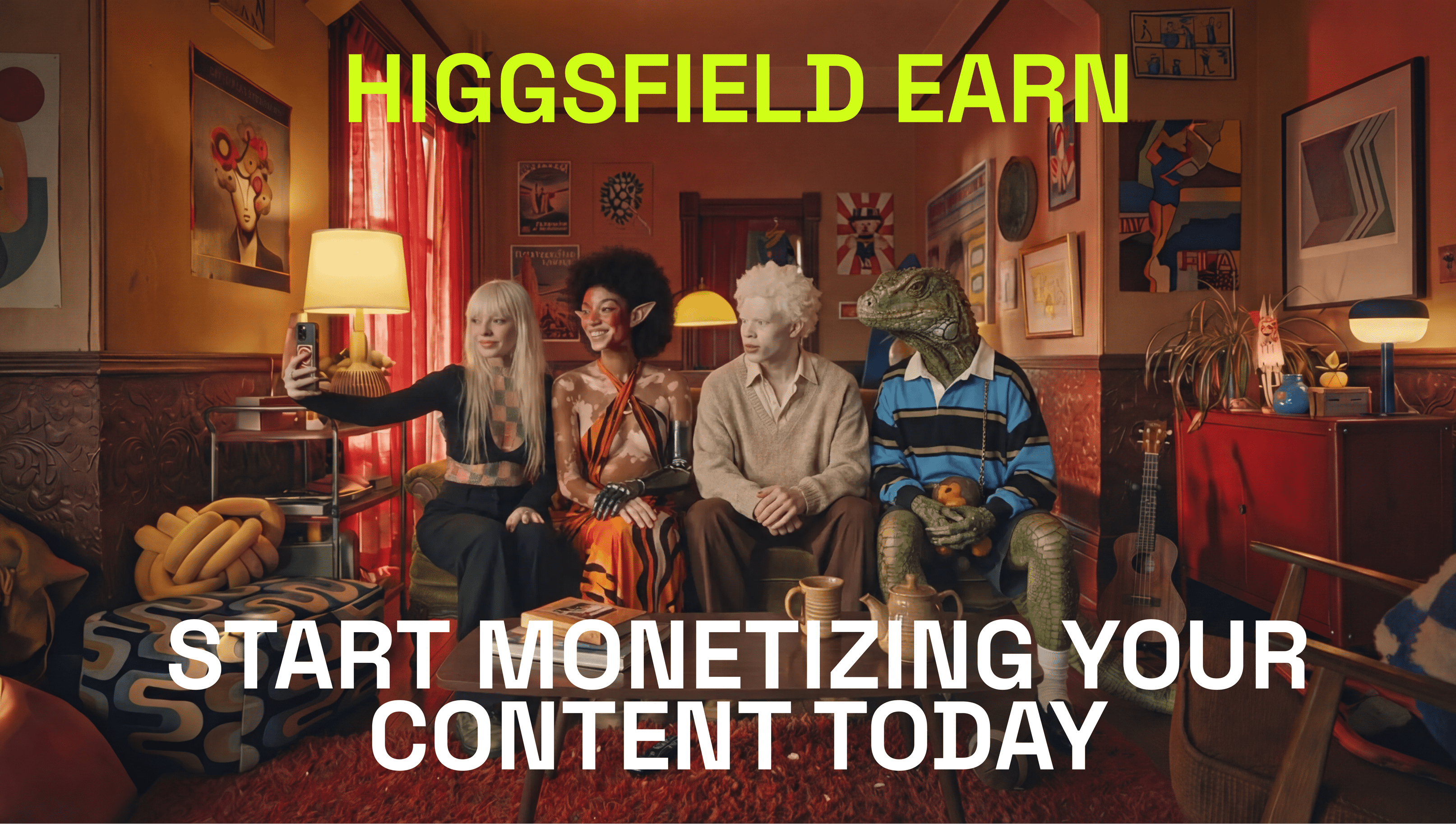
Higgsfield is also experimenting with a model that connects creators directly with commercial work.
Through Higgsfield Earn, the company says it has worked with more than 10,000 verified creators and paid out over $1 million.
The programme links AI-assisted content creation with opportunities involving brands, agencies and other organisations.
That matters because the future of AI will not be defined only by who can use the tools.
It will also be defined by who can capture the economic value created by them.
If AI platforms can help individuals move from consuming software to selling creative output, they could create new forms of independent digital work.
The opportunity is especially significant for creators who previously lacked access to traditional production infrastructure or professional networks.
More access also means more competition
Lower barriers create opportunity, but they also create abundance.
If millions of people can produce professional-looking content, the market becomes more competitive.
The value of simply being able to generate a polished video will decline.
What becomes more valuable is the ability to differentiate.
That may come from a stronger brand, deeper knowledge of a niche, better storytelling, faster execution or a closer relationship with an audience.
AI therefore does not remove competition.
It changes where competition happens.
Instead of competing primarily on access to expensive tools, individuals increasingly compete on ideas, judgement and execution.
AI as an economic equaliser
Higgsfield's $400 million funding round shows why investors are paying close attention to AI video.
The technology is not only improving the quality of generated content.
It is reducing the cost of production, increasing the speed of experimentation and giving more people access to capabilities once controlled by large organisations.
That does not guarantee equal outcomes.
Large companies still have advantages in capital, distribution, data and brand recognition.
But the gap between what an individual can produce and what an institution can produce is narrowing.
That is one of the most important economic effects of generative AI.
The future of creative work may be less dependent on owning expensive infrastructure and more dependent on knowing how to direct intelligent systems effectively.
Higgsfield is betting that this transition will reshape advertising.
The larger implication is that AI could reshape who gets to participate in the digital economy at all.
Sources
- Higgsfield / PR Newswire – Series B announcement, 17 August 2026
https://www.prnewswire.com/news-releases/higgsfield-raises-400-million-series-b-financing-at-5-4-billion-valuation-with-annualized-revenue-reaching-700-million-302852430.html - Financial Times – Higgsfield valued at $5.4bn
https://www.ft.com/content/719c8108-f4ae-466b-80f4-96f26558d642 - Higgsfield – Creator and company information
https://higgsfield.ai/about - Higgsfield Earn – Creator programme
https://higgsfield.ai/earn - Cryptopolitan – Higgsfield raises $400 million
https://www.cryptopolitan.com/higgsfield-400m-goldman-intel-ai-video/


