
business resources
Honeypot in Crypto Explained
25 Feb 2026

You find a token early. The chart looks clean, volume is climbing, and a few wallets have already made 10x. You buy in. The price keeps going up.
Then you try to sell, and nothing happens. The transaction fails every time. You're stuck holding a coin you can never get out of, and the people who set it up just walked away with your money.
That's a crypto honeypot. It's one of the most common scams running on decentralized exchanges right now, and it works because it looks exactly like a legitimate opportunity until the moment it doesn't.
What Is a Honeypot in Crypto?
A honeypot is a malicious token or smart contract that allows users to buy, but prevents them from selling.
The term comes from cybersecurity: something designed to look attractive and lure victims in, only to trap them once they interact with it.
In crypto, the scam works like this:
- The scammer deploys a token.
- Hidden code inside the smart contract restricts who can sell.
- Only specific wallet addresses (controlled by the scammer) are allowed to execute sell transactions.
- Everyone else is locked in.
From the outside, everything looks normal:
- The token has a name and logo.
- There’s often a website and Telegram group.
- The liquidity pool exists.
- The chart shows real buy activity.
The price rises because buyers keep entering, but regular holders can’t sell.
When the scammer decides the liquidity is sufficient, they sell their tokens (or pull liquidity), the price collapses, and everyone else is left holding worthless tokens they cannot move.
What makes honeypot crypto scams particularly nasty is how normal they look from the outside. The toke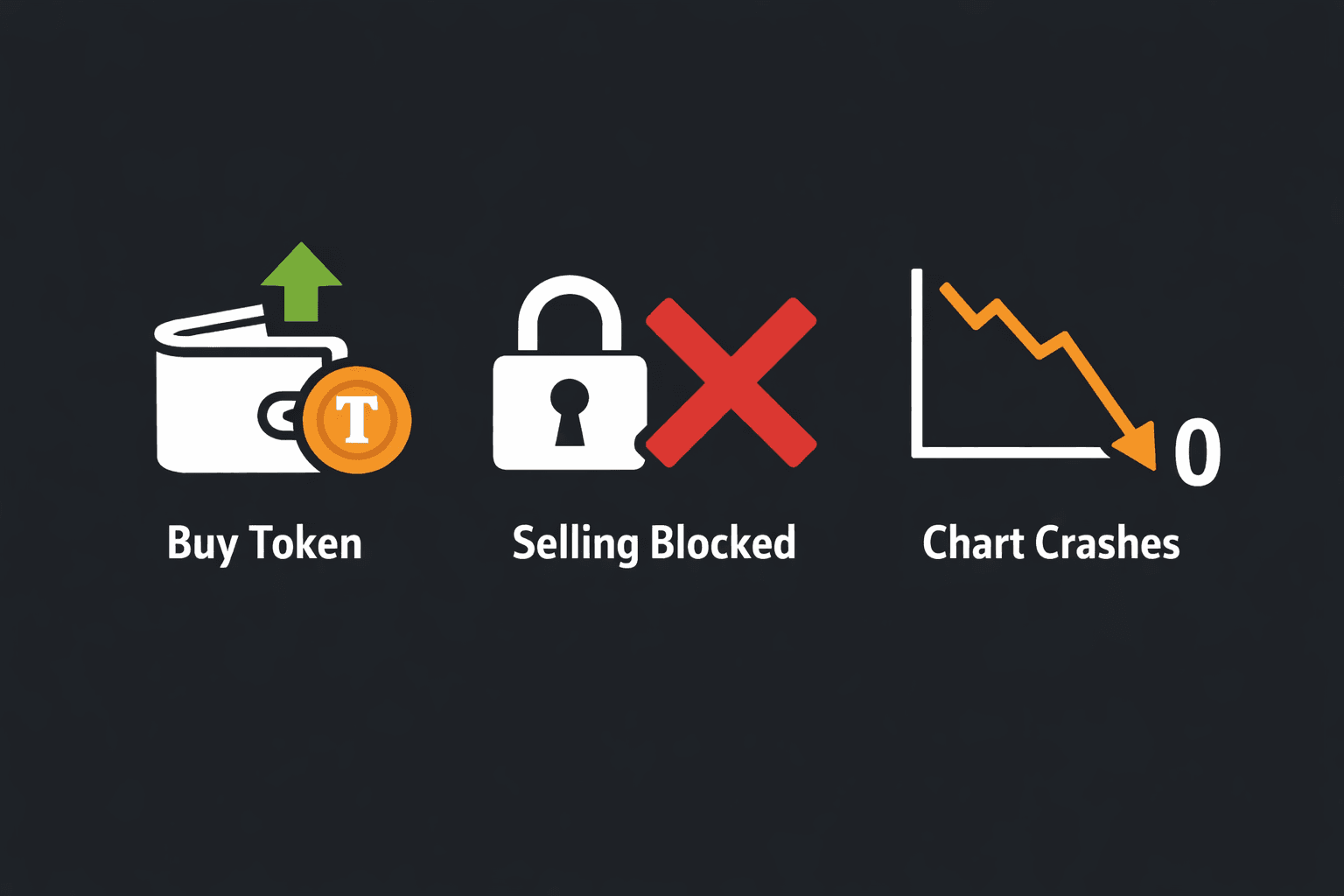 n has a name, a logo, sometimes even a website and a Telegram group. The chart shows real buy activity. The liquidity pool exists. Nothing looks wrong until you try to sell.
How a Honeypot Scheme Works Step by Step
Understanding the mechanics makes honeypots much easier to spot.
1. The Contract Is Deployed With Hidden Restrictions
The scammer writes (or copies) a smart contract and inserts a hidden sell restriction.
This is usually embedded in the transfer function or enforced through a modifier that checks wallet addresses.
The code is often:
- Obfuscated
- Poorly documented
- Hidden behind misleading function names
2. Liquidity Is Added
The token is listed on a DEX like Uniswap or PancakeSwap. Initial liquidity is seeded to make trading possible.
The scammer may generate early buys themselves to create upward price movement and make the chart look organic.
3. Promotion Begins
The contract address is shared in crypto groups and on social media. Bots may simulate trading volume. Fake excitement builds.
Early buyers see momentum and pile in.
4. The Trap Fills
Because normal holders can’t sell, price pressure is one-sided. The chart looks like a breakout. More buyers enter.
5. The Exit
When liquidity is high enough, the scammer:
- Sells their entire allocation, or
- Pulls liquidity from the pool.
The price crashes instantly.
All remaining holders are trapped with unsellable tokens.
How to Spot a Honeypot Token Before You Buy
Honeypots leave detectable signals if you know what to look for.
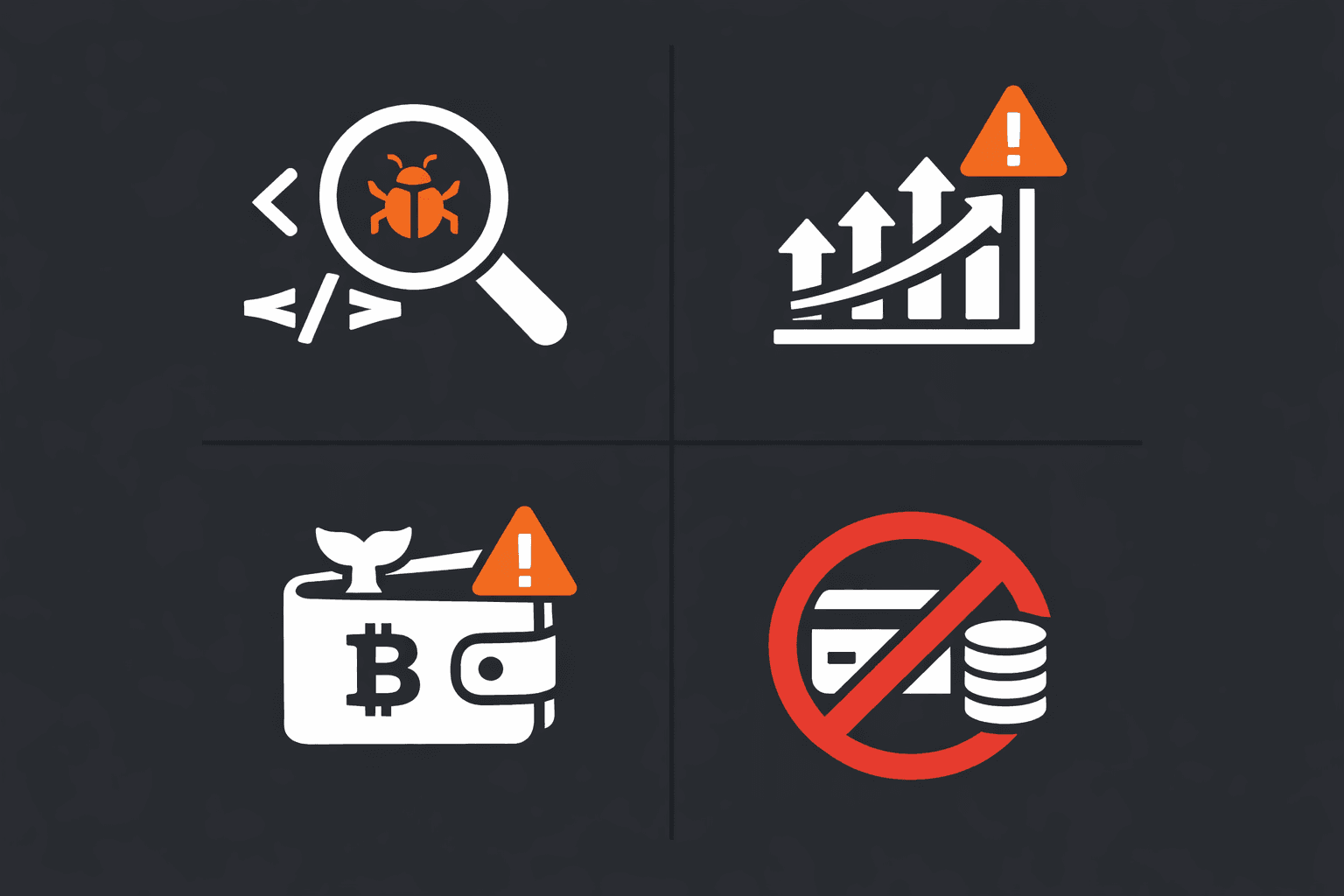
Run the contract through a honeypot checker. Tools like Honeypot.is, let you paste a token contract address and test whether the token is actually sellable.
The tool simulates a buy and sell transaction and tells you whether the sell goes through. This takes less than a minute and should be standard practice before buying any new token.
Check the sell transactions on-chain. Go to a blockchain explorer like Etherscan or BscScan and look at the transaction history for the token. If you see hundreds of buy transactions and almost no sales from regular wallets, that's a serious warning sign. In a legitimate token, you'd expect a mix of buys and sells from different addresses.
Look at who holds the token. If one or two wallets hold a large percentage of the supply and haven't sold despite significant price appreciation, that's worth questioning. Scammers often hold the majority of supply so they can dump it all at once.
Scan the Contract
You don’t need to read Solidity to spot danger.
Paste the contract into:
- Token Sniffer
- De.Fi Scanner
- Other contract analysis tools
These scanners flag:
- Transfer restrictions
- Blacklist functions
- Suspicious ownership privileges
- Hidden tax manipulation
Be Wary of Zero Sell History
A brand new token with 200 buys and zero sells in its first hour isn’t “early alpha.”
It’s almost certainly a trap.
Why Honeypot Scams Are Hard to Catch in Real Time
Even experienced traders get caught by honeypot scams because the scammers keep improving their methods.
Some honeypots don't block selling immediately. They let early buyers sell to build trust and create a convincing trade history. The restriction activates later, once enough liquidity has built up. By the time regular buyers figure out they're stuck, the scammer is already gone.
Others use tax-based restrictions instead of outright sell blocks. They set the sell tax at 99%, so technically you can sell, but you receive almost nothing back. These are harder for basic checkers to catch because the sell transaction doesn't fail outright.
This is where using reliable web3 security tools before interacting with any unknown token makes a real difference. Modern security tools scan contract code for known malicious patterns, check token permissions, and flag suspicious behavior before you approve a transaction. They won't catch every single honeypot variant, but they catch the vast majority of them, including many that manual checks miss.
The scam landscape on decentralized exchanges moves fast. New honeypot variants show up regularly, and no single manual check is enough on its own. Layering your checks, on-chain data, contract scanners, and real-time browser tools, gives you a much better chance of catching a honey pot scam before it catches you.
What to Do If You're Already in a Honeypot
If your sell transactions are failing on a token you hold, here's what to check first.
1. Adjust Slippage
Try adjusting the slippage tolerance in your DEX settings. Some legitimate tokens with high volatility or high taxes require higher slippage to execute. If bumping slippage to 15 or 20% still doesn't work, that's a strong indicator you're in a honeypot.
2. Verify Using Tools
Check the token on a honeypot checker and a blockchain explorer.
If the checker confirms it's a honeypot and the on-chain data shows no sell transactions from regular wallets, you likely already know the answer.
Unfortunately, if the contract genuinely blocks selling, there's no technical workaround. The restriction exists at the smart contract level, and you can't override it from your wallet. The funds are effectively frozen.
The practical lesson here is that the time to check for a honeypot is before you buy, not after. Once you're in, your options are very limited.
Final Thoughts
Honeypot crypto scams succeed because they exploit the same instinct that drives legitimate trading: the fear of missing a move. The pressure to buy quickly before a token takes off is exactly what scammers rely on. It works because these tokens genuinely look like real opportunities, right up until they aren’t.
The hard truth is that once you're inside a honeypot, there’s usually no way out. The damage is already done. That’s why your only real defense is what you do before you buy, not after.
Spending just two minutes to run a contract through a checker, review the sell history, and confirm that regular wallets can actually exit is often enough to avoid the overwhelming majority of these scams. The opportunity will always feel urgent. The checks are fast. Build them into every trade, and honeypot scams become far less of a threat.


