
business resources
How Asad Saddique Used SEO Acquisitions Instead of Link Building to Win
18 Feb 2026

If you work in SEO, you know the pain. It’s Tuesday morning. You have a spreadsheet of 500 "prospects."
You are about to send a template email that begins with "I really loved your recent post about..." (which you haven't read), hoping that maybe, just maybe, one webmaster will take pity on you and give you a backlink.
It’s grueling and inefficient, and frankly, above all, a terrible use of time.
This is the story of how shifting from a "builder" mindset to a "buyer" mindset allowed him to dominate competitive niches like hoverboards, and how you can apply this "SEO M&A" strategy to your own portfolio.
The Step-by-Step SEO Acquisition Strategy That Asad Used to Replace Link Building

Asad Saddique, the founder behind the iSwegway phenomenon and the digital agency Raddal, looked at this standard industry practice and decided to opt out entirely. He didn't build a link-building team and instead treated SEO as an asset acquisition game.
Strategy 1: The "Bolt-On" (The 301 Redirect)
This is the most aggressive tactic in the playbook, and it’s likely how iSwegway grabbed market share so violently in 2015.
The concept is simple:
Identify a relevant site that is shutting down or the owner has lost interest in. Maybe it’s a "tech gadget review" blog that hasn't posted in two years.
Acquire the domain.
Redirect (301) that domain to your main money site (or a specific category page).
When you do this correctly, you aren't just forwarding traffic. You are telling Google: "Hey, you know all that trust and authority you gave to https://www.google.com/search?q=OldGadgetBlog.com? It lives here now."
Suddenly, your brand new Shopify store isn't starting from zero. It’s inheriting the "link juice" of a veteran site.
How to Execute This Safely:
Relevance is King: Do not buy a dog grooming site and redirect it to a hoverboard store. Google isn't stupid. The topical relevance must be a near-perfect match.
Redirect to Relevant Pages: Don't just dump everything to your homepage. If the old site had a great page about "battery safety," redirect that specific URL to your "battery safety" page.
Check the History: Use tools like Wayback Machine. If the site was used for spam or gambling in the past, it’s radioactive. Do not touch it.
Strategy 2: The "Satellite" Network
In the e-commerce world, search engine result pages (SERPs) are real estate. There are only ten spots on the first page. If you own iSwegway.com, you take up one spot. That leaves nine spots for your competitors to talk trash about you or undercut your prices.
But what if you owned three of the other spots?
By acquiring smaller review sites or informational blogs in the niche and keeping them independent, you control the narrative.
Spot 1: Your main store (selling the product).
Spot 3: A review blog you own (reviewing the product favorably).
Spot 5: A safety guide site you own (educating the customer).
This is "Monopoly" logic. While trying to win, you are simultaneously trying to crowd everyone else off the board.

The Actionable Play For You:
Search for "best [your product] guide" or "how to [your service]." Look past the big guys (Forbes, Wirecutter) and find the small, ugly blogs on page 2 or 3. Reach out to the owner. Ask if they’re open to selling.
Often, these are hobbyists who are bored and would happily take a few thousand dollars to hand over the keys. Keep the site running, improve the content, and place a banner ad for your main business.
Strategy 3: The Authority Roll-Up (Content + Brand Consolidation)
This is where Saddique moves from tactical SEO wins to long-term dominance.
Buying domains for links is powerful. Owning SERP real estate is smarter. But consolidating authority into a single, undeniable brand is what makes competitors irrelevant.
Once iSwegway had traction, Asad didn’t want to manage a messy web of disconnected sites forever. He wanted Google to see one brand as the definitive entity in the space.
So instead of endlessly redirecting or running satellites indefinitely, he selectively absorbed the best-performing assets into the core brand.
Here’s how it works.
Rather than 301-ing an entire site immediately, he would:
Identify the highest-performing pages on an acquired site
Rewrite, expand, and improve them
Publish them on the main domain as authoritative cornerstone content
Then retire or selectively redirect the old URLs
✓Google already trusts the content.
✓Users already engage with it.
✓You’re simply giving that value a stronger, more permanent home.
The "Buy vs. Build" Calculus
Let’s look at the math that most SEOs ignore.
To get a high-quality link (DR 50+) today, you are looking at high costs. You either pay an agency $300-$500 per link, or you spend 20 hours of manpower on outreach to get one "yes."
Now, imagine you need 20 of those links to move the needle for your new e-commerce store. That’s $10,000 or hundreds of hours of work. And the result? You have 20 links pointing to a domain that is still fresh, still in the "sandbox," and still untrusted by Google.
Asad Saddique recognized this inefficiency.
Instead of spending $10,000 hoping for links, he would look for a dormant blog, a defunct competitor, or a neglected hobbyist site that already had those links.
If a blog has been around for five years, has a clean history, and has 500 referring domains, it is a goldmine. Buying that site for $2,000 is an arbitrage opportunity because you are buying five years of trust that Google has already indexed.
How to Start "Shopping" for SEO (A Checklist)
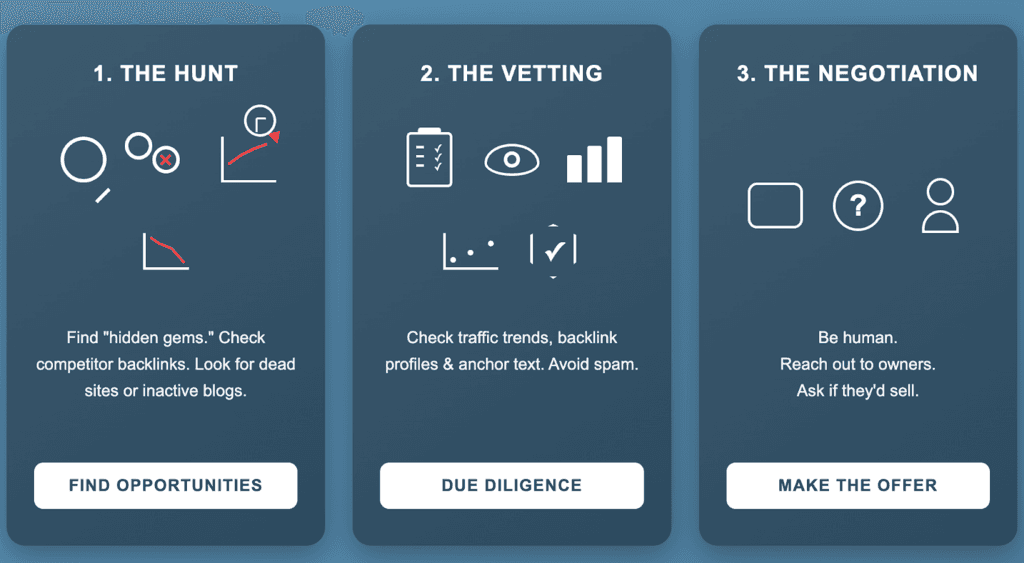
You don't need $19 million to do this. You can start small. Here is the process for adopting the Saddique acquisition mindset:
1. The Hunt Don't use GoDaddy auctions (too competitive). Look for "hidden gems."
Use a tool like Ahrefs or Semrush to look at the backlink profiles of your competitors. See where their links come from.
Are any of those linking sites dead? Do they return a 404 error?
Check niche marketplaces like Flippa (but be careful) or even better, direct outreach to bloggers who haven't posted in 6+ months.
2. The Vetting (Due Diligence) Before you wire money, play detective.
Traffic Trend: look for a steady line or a slow decline. Avoid sites with sudden, massive drops (usually means a Google penalty).
Link Profile: Are the links from real sites, or spammy directories in Russia? You want real, contextual links.
Anchor Text: If the anchor text is 90% "cheap viagra" or "buy hoverboard," run away. You want natural phrasing.
3. The Negotiation Don't sound like a corporate raider. Sound like a human. "Hey, I stumbled across your blog about electric scooters. noticed you haven't updated it in a while. I'm looking for a project to take over—would you be open to chatting about selling it?"
The Mental Shift
The reason Asad Saddique scaled to $19M while others were fighting for scraps wasn't just because he worked hard. It was because he identified where the leverage was.
Writing a guest post for a stranger's blog is low leverage. You do the work, they own the asset. Buying the blog is high leverage. You spend the money, you own the asset.
It requires a shift in how you view your marketing budget. Stop asking "How much does it cost to get a link?" and start asking "How much does it cost to buy the authority I need?"
It’s risky? Sure. You might buy a lemon. But in the high-speed world of e-commerce, the biggest risk is moving too slow. Asad bet on speed, he bet on ownership, and he bet that buying the infrastructure was smarter than renting it.
After all, the scoreboard suggests he was right.


