


business resources
How Businesses Can Start Using AI in Their Marketing
01 Oct 2026

Every marketing team has more work than hours: audiences to segment, competitors to track, emails to draft, and a support inbox that never quite empties. AI has moved into that gap fast, faster than most business owners have had time to sort out which parts of it are worth the switch.
The teams getting real value out of it right now picked a single job with a genuine volume problem too many messages, too many data points, too many pages to check by hand, and let AI take that specific weight off. Judgment about brand voice and strategy stayed with a person. Below are 10 places where AI is already doing real work, and where it still needs a person.
10 Ways AI Is Helping Marketers and Marketing
These are the jobs that separate teams already getting hours back this quarter from teams still doing everything the slow way.
Audience Targeting
Sorting an audience by hand means pulling CRM exports and guessing which fields actually predict who buys. AI models do that sorting continuously, adjusting segments as behavior shifts, rather than freezing them at last quarter's snapshot.
It has become the single most-used AI application in B2B marketing, and for a reason. Act-On Software and Ascend2's State of B2B Marketing Automation 2025 survey found AI Audience Identification is the most-used AI feature among B2B marketing teams, chosen by 43% of respondents, ahead of AI-driven reporting and AI personalization. A business picking a starting point could do worse than the feature most people already trust.
Use AI to Spot Trends and Test New Designs
AI helps print-on-demand companies spot emerging design trends and test them before committing to a marketing campaign. By analyzing search queries, social media posts, and marketplace listings, a team can identify themes gaining attention and turn them into product ideas. SurveyMonkey reports that 40% of marketers use AI for research, including product, market, brand, and customer insights.
A brand could create three designs inspired by a promising theme and list them through Printful, which produces each item after a customer orders it. Early sales can then show which design deserves more ad spend, without requiring the brand to buy inventory for every idea. A person still needs to judge whether the trend suits the audience and check that the artwork does not copy another creator’s work.
Lead Generation
By the time a prospect fills out a form, they've often already used AI to compare several competitors and narrow the list before ever reaching out. That changes what it means to generate a lead: showing up during the research phase matters as much as capturing the form fill at the end.
6sense's 2025 B2B Buyer Experience Report, based on a survey of more than 4,000 buyers, found people are now contacting sellers 6 to 7 weeks sooner than before, part of a broader compression in the buying cycle the report ties in part to AI accelerating buyers' own research. A lead-gen program built around waiting for the form submission is chasing a moment that keeps arriving earlier and earlier.
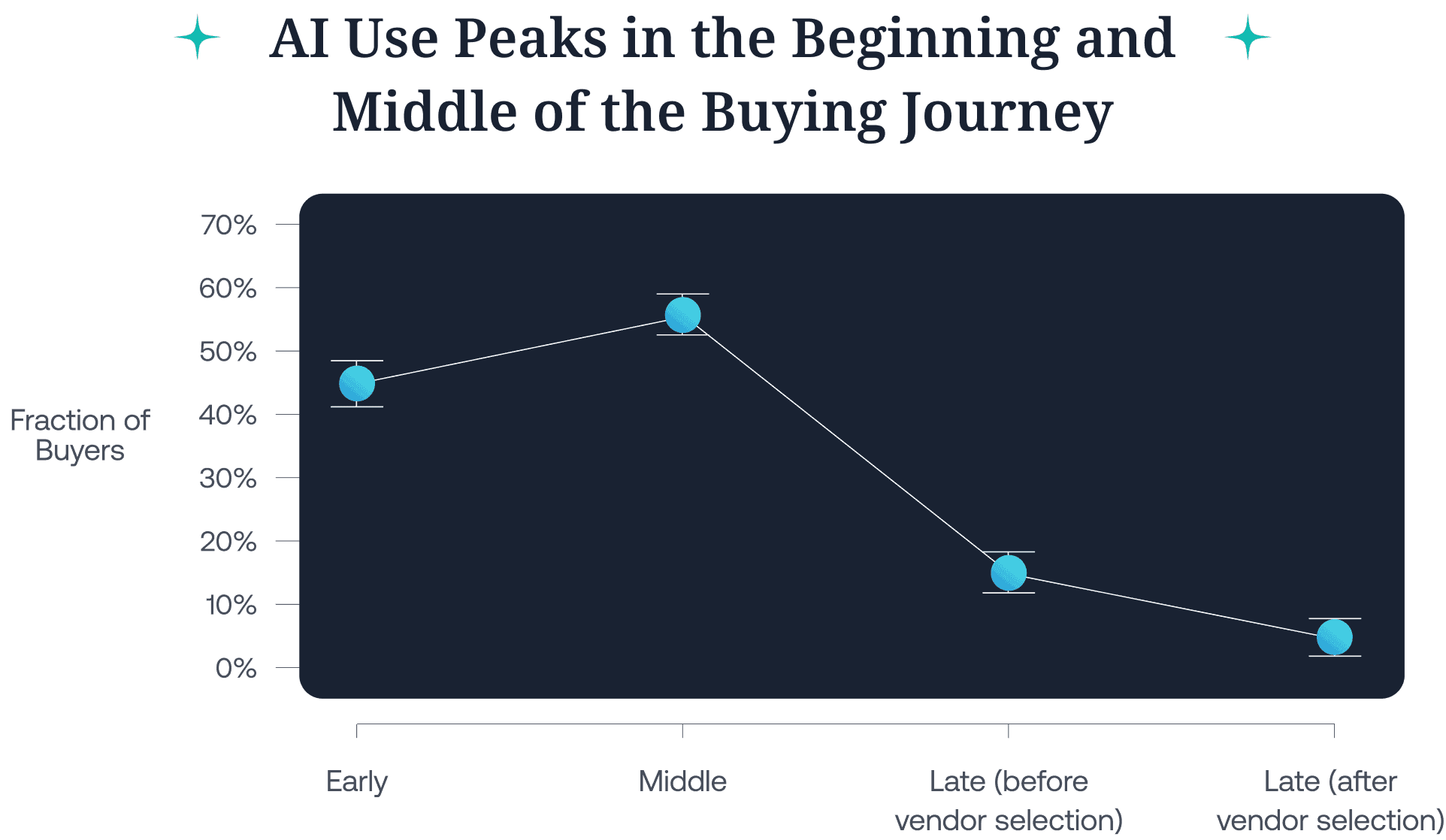
The same shift shows up on the other side of the hiring desk too. Candidates who apply to jobs using AI are running the exact same pattern, researching and narrowing options before a recruiter ever sees a name come through.
Personalization
Personalization used to mean a first name in the subject line and a product recommendation bolted onto the bottom of an email. AI changed the economics of doing it properly: a small team can build dozens of message variants from a single brief instead of writing each by hand. Video can follow the same model, with personalized video content that adapts messages to different audiences without requiring a separate production process for each variation.
The payoff for doing it well shows up in the numbers. HubSpot's 2026 State of Marketing report, based on responses from more than 1,500 marketers, found 93.2% say personalized or segmented campaigns produced more leads or purchases. AI is what makes that kind of segmentation affordable for a team without a dozen people building variants by hand.
Search Engine Optimization
SEO's job has quietly expanded. Ranking a page in Google's organic results still matters, but a growing share of buyers now see an AI-generated answer before they see a list of blue links, and that answer either cites a business or it doesn't.
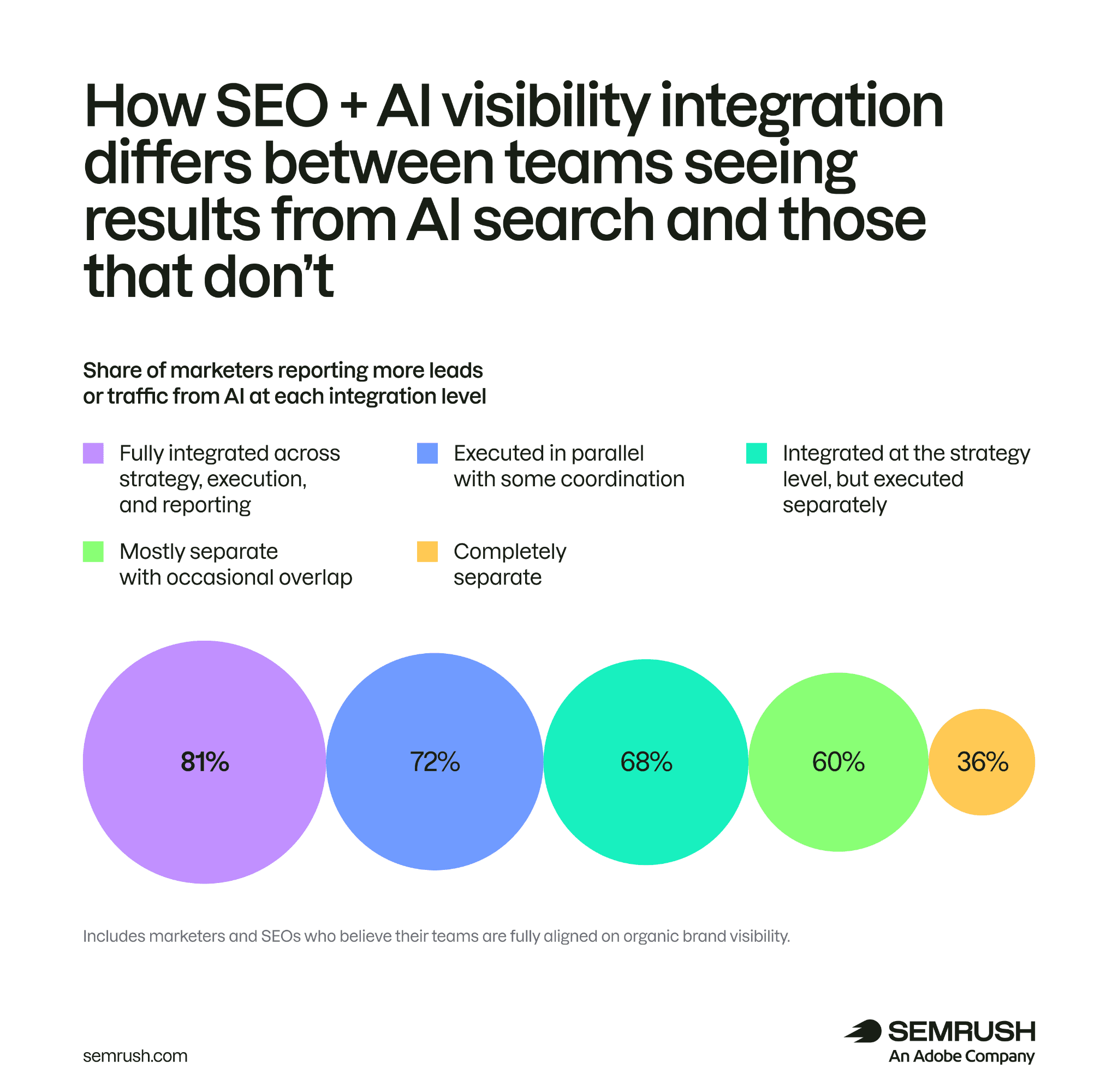
Treating SEO and AI visibility as a single workflow appears to matter more than keeping them apart. Semrush's 2026 AI Visibility Index found that among organizations fully integrating SEO and AI visibility into a single workflow, 81% reported increased traffic or leads from AI platforms, compared with 36% at organizations managing them separately. Splitting the work in half seems to cost more than the extra headcount saves.
Social Media Listening
A brand mentioned across thousands of posts a day used to mean either hiring a team to skim or accepting that most of the conversation would go unseen. AI listening tools now read that entire volume continuously, flagging a spike in sentiment or a sudden cluster of complaints before a person would ever spot the pattern by scrolling.
What AI still can't do is decide which spike actually matters. A viral joke about a product and a genuine safety complaint can produce a similar-looking spike in volume, and only someone with brand context can tell the difference fast enough to respond well. The tool surfaces the signal, and a person still has to read it.
Teams now plan and schedule a week of posts across every major platform from one calendar, and tools like PostFast can run through an AI assistant connector, so scheduling happens in a chat window instead of a dashboard.
Email Marketing
Email is one of the oldest marketing channels, and one of the fastest to adopt AI, largely because the format rewards testing small variations against each other. Subject lines, send times, and copy blocks are all things AI can draft and test faster than a person switching between spreadsheets and a template editor.
Litmus's State of Email 2025 report, based on a survey of nearly 700 marketing professionals, found 49% now use generative AI to write static email copy. That's already close to half the field, which suggests the businesses still writing every send from a blank page are giving up time their competitors have already gotten back. However, even the most optimized AI campaigns fail if domain authentication is neglected, making an enterprise DMARC management platform essential for keeping emails out of spam
Chatbots
A chatbot used to mean a rigid decision tree that broke the moment a customer phrased a question slightly differently than the script expected. The newer generation reads intent rather than matching keywords, which is why marketers are starting to trust it with more than just a fallback FAQ page. This becomes especially useful in a WhatsApp automation tool, where AI can understand customer intent, answer common questions, trigger relevant workflows, and hand conversations over to a human agent when needed.
Salesforce's 10th Edition State of Marketing report, based on responses from nearly 4,500 marketers, found that 81% would trust AI to respond to customers to scale their efforts, though many said scattered data holds them back from giving the AI a complete picture. The technology is ready before most companies' data is.
Customer Support
Customers hate repeating themselves, and until recently, that's exactly what most support systems forced them to do every time a conversation moved from chat to email to a phone call. AI agents for customer support that retain context across those channels are changing what a genuinely good support interaction looks like.
Zendesk's 2026 CX Trends report, based on responses from more than 11,000 consumers and CX leaders, found 83% of CX leaders say memory-rich AI agents are key to delivering truly personalized customer journeys. A support team that still starts every new channel from scratch is asking customers to do work the software should be doing.
Content Generation
Content generation gets the most attention of any AI marketing use case, and also the most skepticism, usually from people who've seen a flat, generic first draft and assumed that's the ceiling. The honest use case is narrower than writing the piece outright: it removes the grunt work around a draft a person still shapes.
Using Framer templates gives businesses and creators a strong starting point with conversion-focused layouts, flexible CMS structures, and reusable sections that can be customized for different projects.
Visual branding is seeing a similar shift. Instead of spending days creating and refining initial concepts, businesses can use an AI logo generator to quickly explore different logo styles, color palettes, and brand directions based on a short prompt.
Where to Start
Don't start with the flashiest tool on this list. Start with whichever job already eats the most hours in a normal week, sorting an audience, drafting email variants, or working through a support inbox that never clears. That's where AI removes a real bottleneck instead of adding a tool nobody asked for.
The businesses getting the most out of this shift aren't running AI everywhere at once. They picked a single job with a genuine volume problem, let AI take that specific weight off, and kept a person in charge of anything that needs judgment about brand, tone, or a customer's actual situation. Pick the task on this list that is draining the most time right now, and give AI that job first.


