
business resources
How Do Brands Lower EPR Packaging Fees? Cut Grams, Not Graphics
25 Sept 2026

Oregon and Colorado already send brands real EPR invoices, California’s programme follows, and more states have passed packaging laws of their own, so any national food brand now has cash on the line. The Product Stewardship Institute keeps a 2026 U.S. packaging law summary of who is live and who is next. The math is simple: units sold in the state × grams of packaging × that state’s material rate. Trim one gram and it disappears from every invoice. This playbook maps the active laws, shows you how to measure and shed grams fast, and hands you a 30-60-90-day plan plus a savings calculator.
How an EPR packaging fee is calculated
The fee equation in plain language
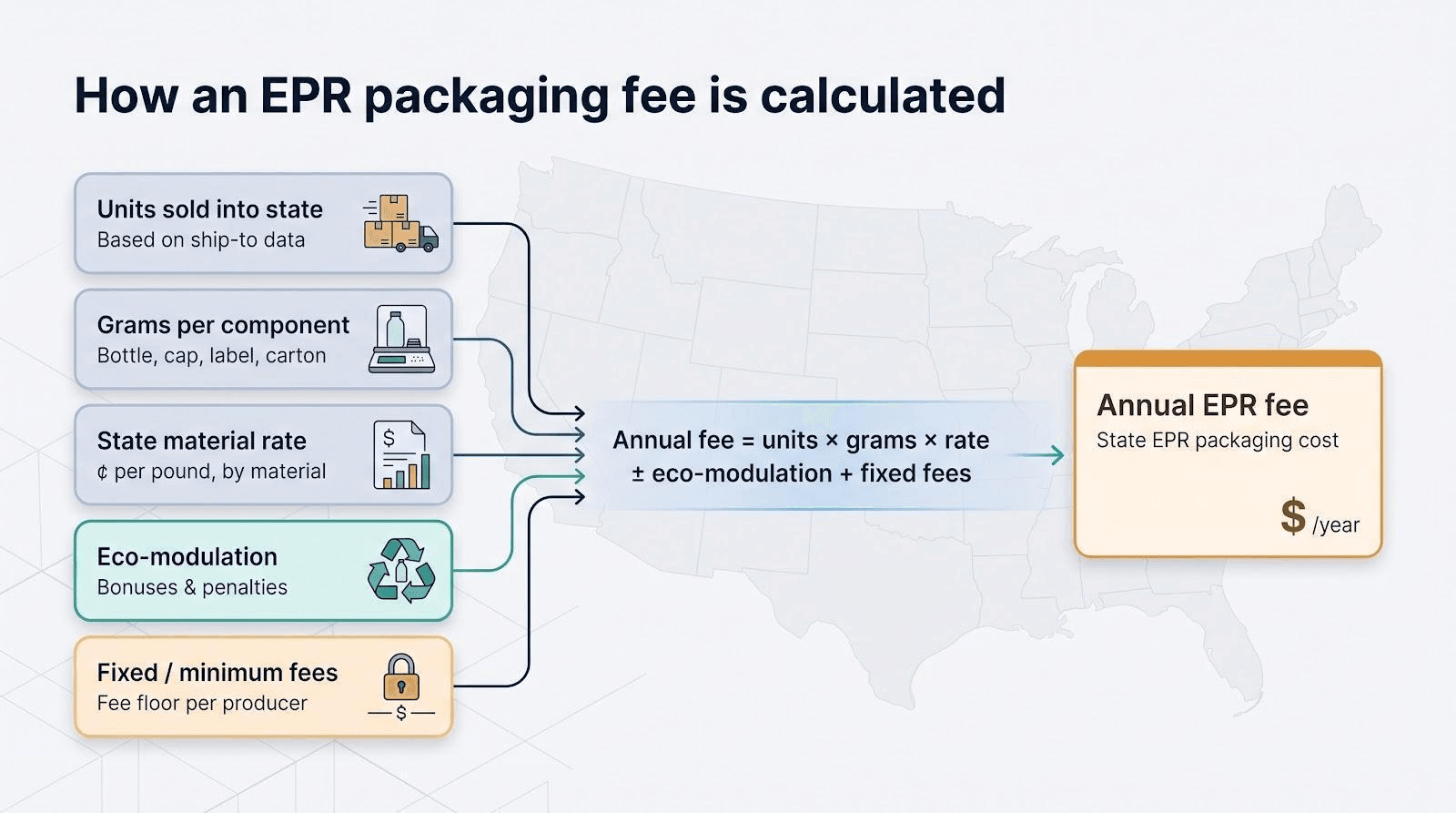
Annual fee = units sold into the state × grams per component × state material rate ± eco-modulation + fixed charges
- Units sold in the state – Use ship-to data, not production volume.
- Exact grams – Weigh every bottle, cap, label, and carton; each gram ends up on the invoice.
- Material rate – States publish tables in cents per pound. In 2026 Oregon charges 8 ¢/lb for paperboard and $1.02/lb for plastic laminates, while Colorado lists the same paperboard at 8 ¢/lb but laminates at 74 ¢/lb, according to the Circular Action Alliance’s 2026 Oregon fee schedule and Colorado dues schedule.
- Eco-modulation – Bonuses for readily recycled formats or post-consumer resin, maluses for disruptive materials.
- Fixed or minimum fees – Even the smallest producer pays something, so light-weighting alone may not beat the floor.
Put real numbers through the line and the math proves the point. Slice one gram from a million laminate pouches and you eliminate roughly 2 205 lb of material, or about $2 250 in Oregon and $1 630 in Colorado before eco-mods and admin fees.
Why New York still matters, even inside the formula
Albany has not passed its Packaging Reduction and Recycling Infrastructure Act, yet the city still pays to collect and process every piece of packaging that producers do not fund. If you already calculate grams for Oregon or Colorado, feeding those same data into a future New York rate table is almost free work.
Key takeaway: The five variables never change, only the numbers do. Get the data right once and you can drop any state’s rates into the spreadsheet without rebuilding the model.
Why cutting grams travels across states
Weight sits at the top of every formula, so one gram removed from a package disappears from every state invoice; no legal fine print needed.
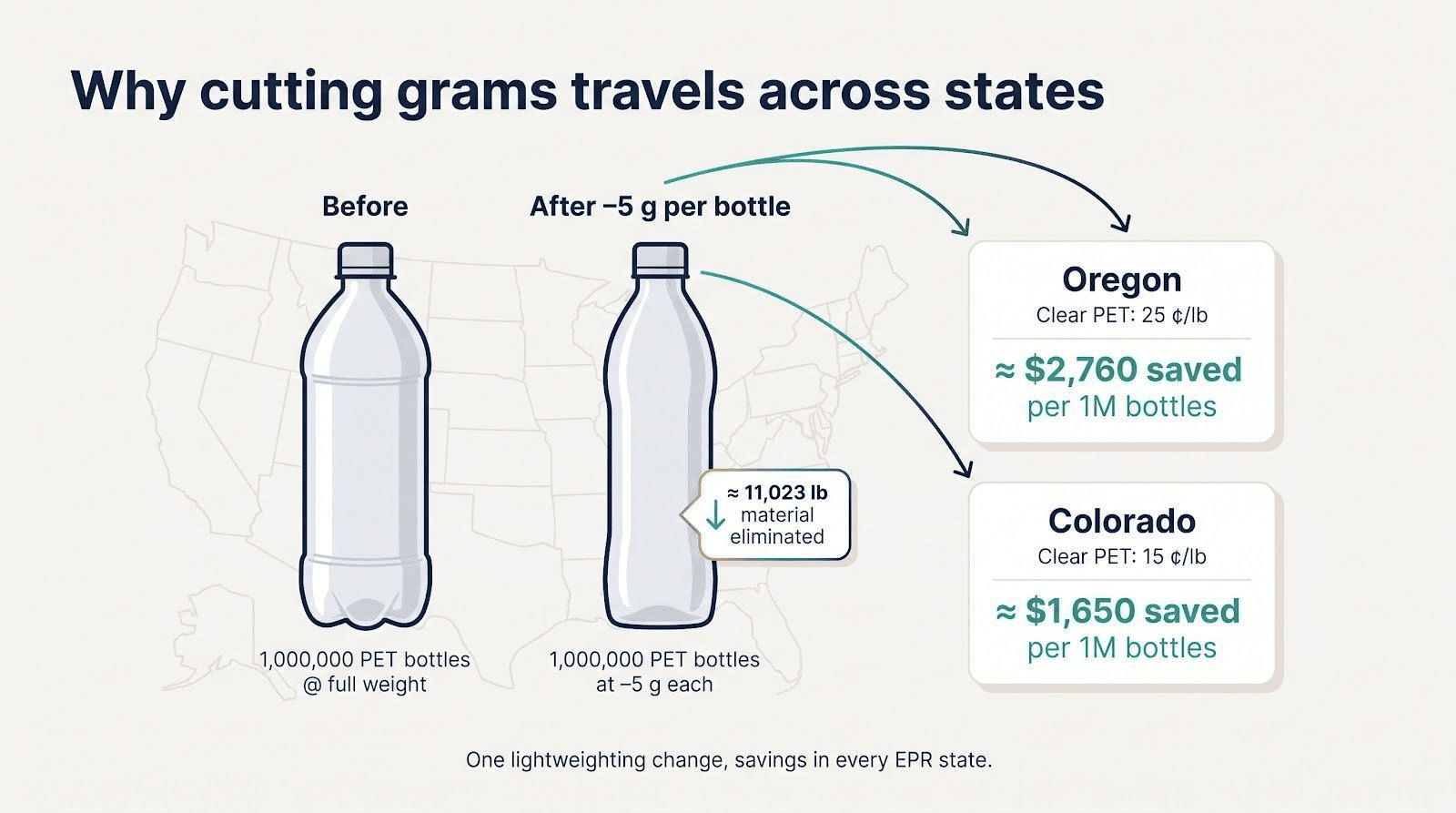
Take a million PET bottles as an illustration. Drop five grams per bottle and you eliminate roughly 11 023 lb of material. Using the 2026 base rates, that equates to:
- ≈ $2 760 in Oregon (25 ¢/lb for clear PET)
- ≈ $1 650 in Colorado (15 ¢/lb for clear PET)
Because weight multiplies every other variable, this saving holds even if eco-modulation or minimum fees differ by state. That portability makes lightweighting the quickest, least controversial lever; it skips debates over recyclability tiers, PCR thresholds, or color penalties and instead focuses on trimming grams.
Note: smaller producers may still pay flat minimums, so confirm you sit above those floors before counting the full benefit.
Rates still matter: a gram of laminate costs more than a gram of paperboard
Lightweighting crosses borders, but the material you keep still drives the bill. Oregon and Colorado publish separate rate tables, so the same gram can be cheap in one state and pricey in the next.
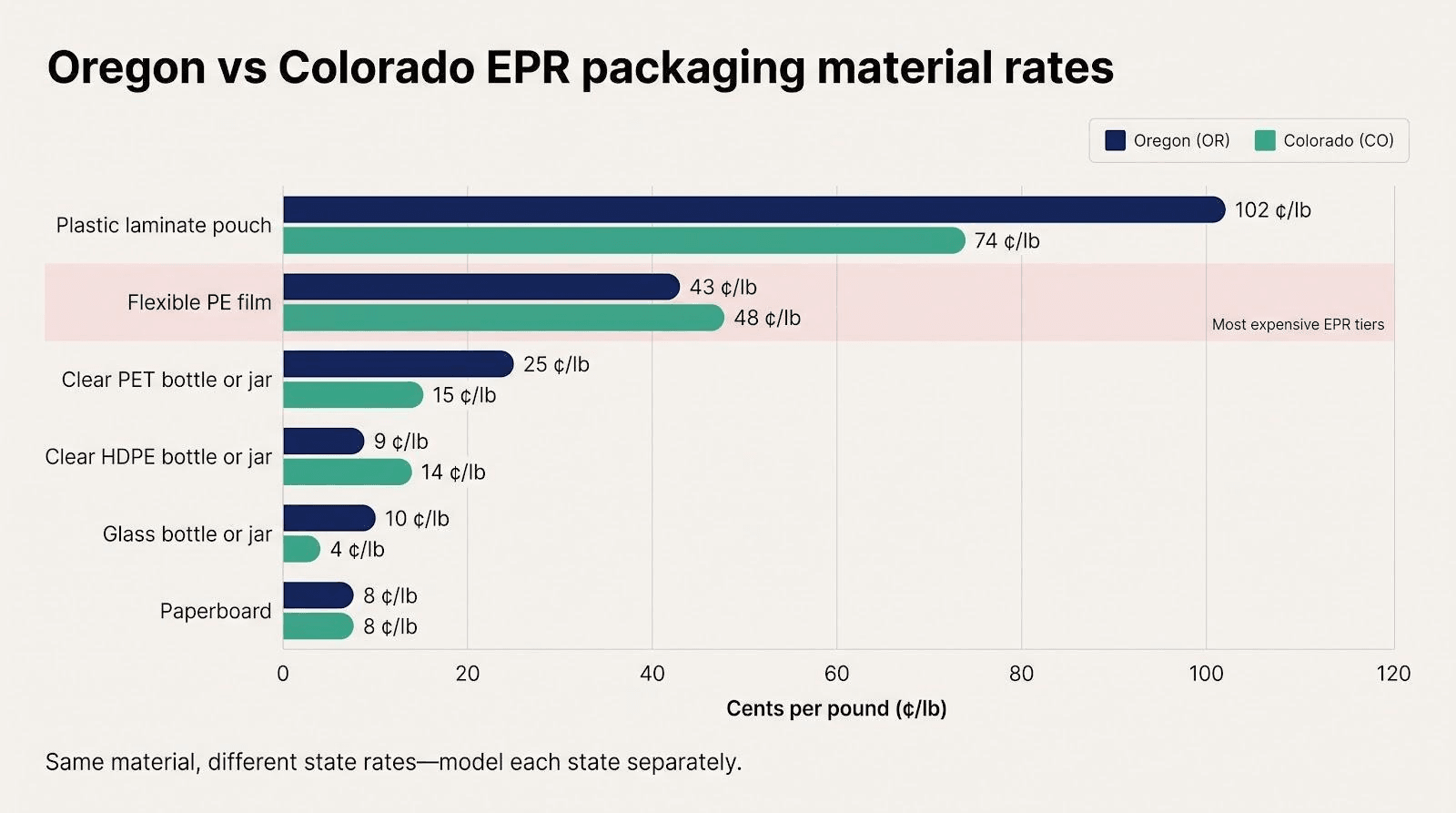
| Material and format (2026) | Oregon rate ¢/lb | Colorado rate ¢/lb |
| Paperboard | 8 | 8 |
| Clear PET bottle or jar | 25 | 15 |
| Clear HDPE bottle or jar | 9 | 14 |
| Flexible PE film | 43 | 48 |
| Plastic laminate pouch | 102 | 74 |
| Glass bottle or jar | 10 | 4 |
Sources: Circular Action Alliance 2026 Oregon Fee Schedule and 2026 Colorado Producer Dues Schedule.
Why the table matters
Shrink a 12-oz sauce jar from 180 g of glass to 30 g of clear PET. In Oregon the fee falls from about 4.0 ¢ to 1.65 ¢ per unit; in Colorado it drops from 1.6 ¢ to 1.0 ¢. Switch to clear HDPE instead and Oregon drops further (9 ¢/lb), while Colorado barely moves (14 ¢/lb against 15). The lesson: always model by state before approving artwork.
Beware the “paper solves everything” shortcut
Paperboard carries low per-pound rates, but add a grease or foil barrier and it lands in “poly-coated” or “laminate” tiers that can cost as much as plastic film: Oregon prices polycoated paperboard at 48 ¢/lb, six times plain paperboard. Check the final spec, including coatings, inks, and adhesives, before you promise savings.
Takeaway: Grams set the floor, material rates set the ceiling. Combine both in the calculator before you cut tooling.
Three quick wins before any redesign
1. Fix scope and state-sales allocation (fastest win, zero capital)
Most ERP systems track where goods ship from, not where they land. That mismatch can overstate exposure in small, low-fee states and hide it in large, high-fee ones.
- Export the past 12 months of invoices, pivot by destination ZIP, and roll those ZIPs up to state codes.
- Drop the numbers into your fee model and compare them with the “all production” baseline. At the 2026 Packaging Recycling Summit, Charlotte Ashcraft of Just Born Quality Confections called EPR “really a packaging data problem”: the company had no single source of packaging data across several hundred SKUs, so it audited the portfolio first and now models dues as volume multiplied by weight per case before it files with CAA.
- Save the pivot tables, shipping logs, and a short memo that explains the change. Keep the evidence in case either programme asks for it.
Most teams finish the cleanup within a week, with no plant trials, no tooling, and no food-safety risk, which is why it tops the quick-win list.
2. Replace estimated weights (low cost, high certainty)
Supplier spec sheets quote targets, not reality. Grab a calibrated gram scale, separate every part of three random samples per SKU, and record the heaviest reading. Check each programme’s reporting guidance for whether it wants the maximum observed weight or an average, and note which one you used.
Suppose a top-selling pouch is booked at 4.9 g on the spec sheet but weighs 4.3 g on the scale. That is an overstatement of roughly 12 percent, and it inflates every state invoice until someone corrects the record. Replacing estimates with facts removes the extra grams from every future invoice, with no tooling and no artwork. As Ashcraft put it at the summit: “if your inputs are wrong, your model doesn’t matter, your formulas don’t matter, your outputs are wrong, and so are your fees.”
Document each measurement with a date, photo, and lot code. Those records satisfy auditors and set a verified baseline for any future lightweighting project.
3. Remove unnecessary components (quick win, minimal risk)
Ask one question of every part a consumer throws away: does it protect the product or the shopper? If not, it is paid weight.
Take a Brooklyn seltzer brand that deletes a one-gram shrink band from its 500 mL PET bottle. At 2026 rates (clear PET: 25 ¢/lb OR, 15 ¢/lb CO) it saves about $550 in Oregon and $330 in Colorado per million units, with no tooling change: an artwork amendment and a short distribution test.
Apply the same test to insert cards, redundant seals, oversized neck sleeves, and pallet corner boards that never leave your DC. Document the trial results with photos, transit logs, and customer-service tickets so auditors see why the component disappeared.
Because every state multiplies grams by its own rate schedule, a gram you delete once stays deleted everywhere. That makes component removal the cleanest step after data correction and verified weights.
Redesign playbooks by format
Flexible snack or coffee pouch
Stand-up pouches ship flat, look premium on shelf, and protect aroma, yet their multilayer build lands in the most expensive EPR tier.
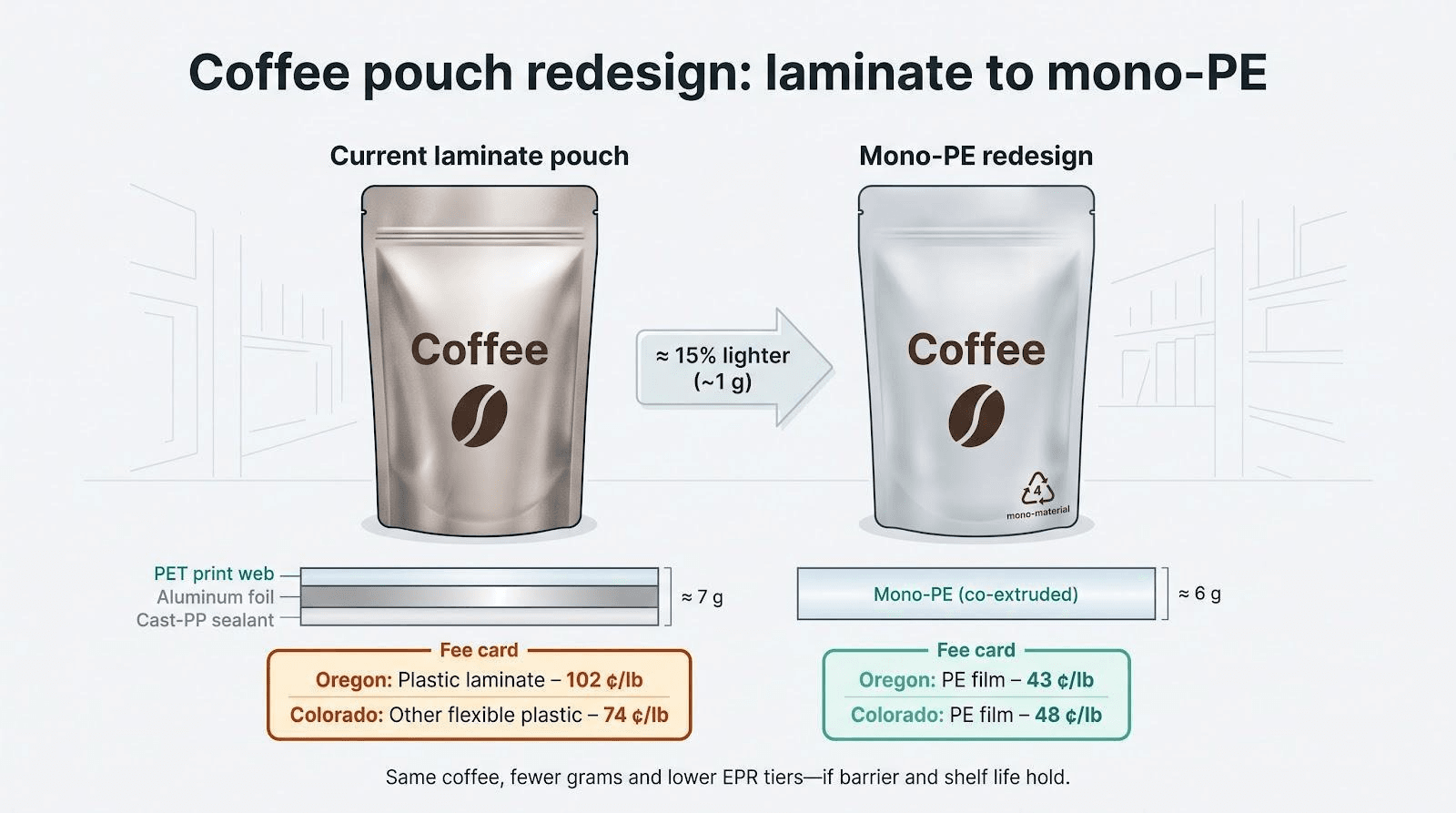
| Specification | Typical current design | Lower-fee redesign |
| Layers | PET print web / aluminum foil / cast-PP sealant | Co-extruded mono-PE |
| Empty weight (12 oz coffee) | ≈ 7 g (illustrative) | ≈ 6 g (illustrative) |
| 2026 Oregon category | Plastic laminate - 102 ¢/lb | PE film - 43 ¢/lb |
| 2026 Colorado category | Other flexible plastic - 74 ¢/lb | PE film - 48 ¢/lb |
Zenpack’s PPWR guide on moving coffee pouches from multi-layer laminates to mono-material walks through exactly this conversion: a mono-PE structure with an ultra-thin EVOH or SiOx coating in place of the aluminium foil, or a mono-PP structure with internal metallisation, built to hold standard coffee shelf-life targets. On the 7 g format modelled here, the foil layer is the weight you are removing.
The guide also covers the PPWR rule that inks, adhesives, and functional barriers must stay under 5 percent of total pack mass, and the adhesive choices that keep the pouch recyclable, so engineers can rebuild the stack rather than guess at it. Zenpack’s wider hub of sustainable packaging solutions organises the same work into three pillars, EPR compliance, plastic elimination, and circular structural engineering, and opens with a one-to-two-week material and fee audit run with rePurpose Global, so teams can roll the coffee-pouch playbook into bottle, tray, and shipper redesigns without restarting the math.
Guardrails:
- Mono-PE needs a thicker layer or extra EVOH to keep oxygen below 1 percent for a 12-week shelf life. Run ASTM F2714 tests before launch.
- Heat-seal windows tighten; confirm your form-fill-seal jaws can hold the new spec without burning.
- If oxygen sensitivity is non-negotiable, a lighter laminate with metallized PET (≈ 6 g) cuts weight and keeps the barrier intact, though it remains in a high-fee tier.
Key takeaway: A pouch can shed both grams and rate, but only when barrier, seal integrity, and shelf life hold up in real trials.
Sauce, beverage, or condiment container
Glass feels premium and tolerates hot-fill, yet its weight multiplies even a modest fee. For illustration, take a 12-oz pasta-sauce jar at ≈ 227 g of glass. Oregon charges 10 ¢/lb for glass; Colorado 4 ¢/lb. The EPR line item works out to about 5.0 ¢ in Oregon and 2.0 ¢ in Colorado per jar.
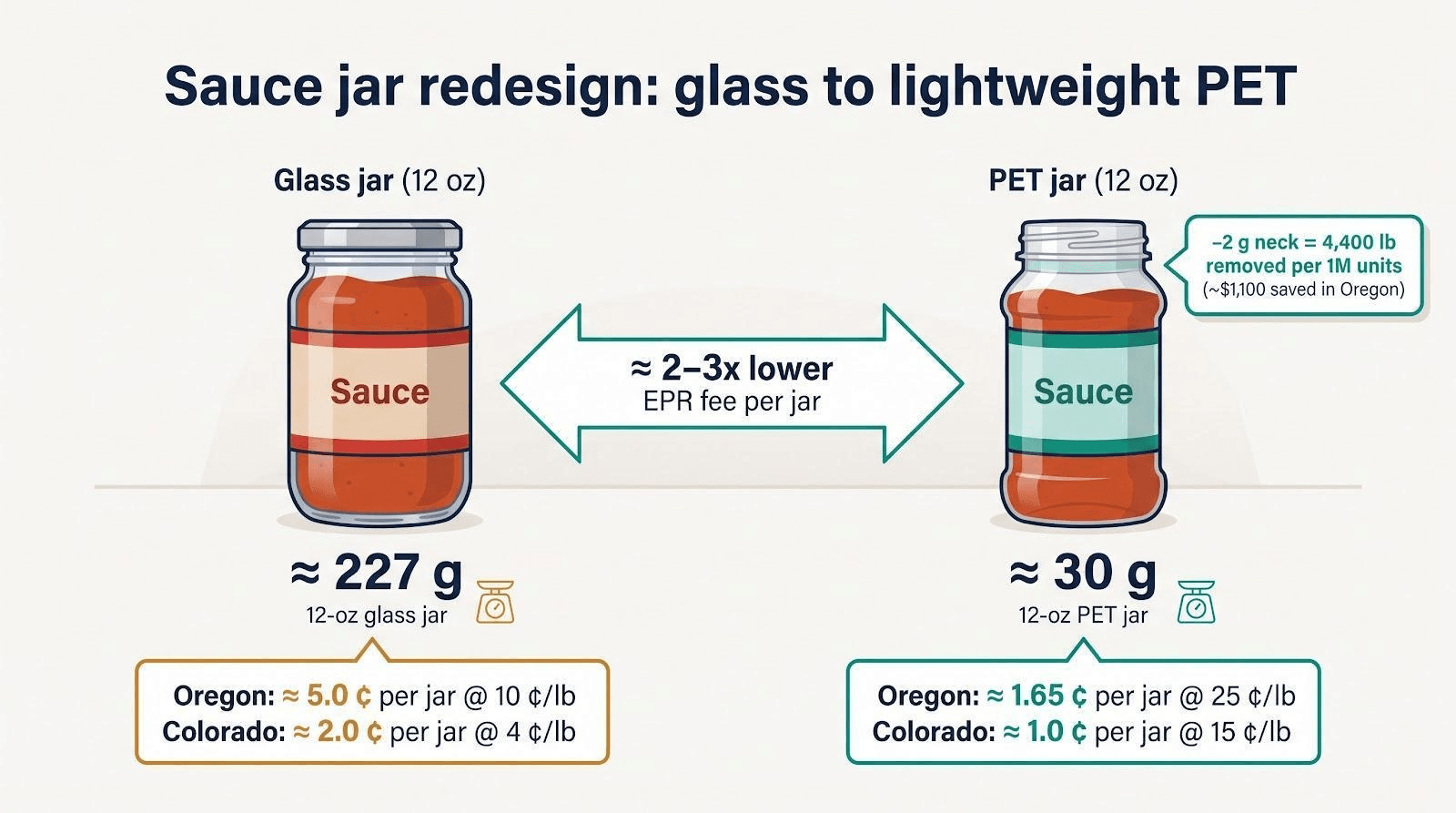
A clear PET jar of the same volume comes in at ≈ 30 g. Even at higher rates (25 ¢/lb in Oregon and 15 ¢/lb in Colorado), the lighter jar costs roughly 1.65 ¢ in Oregon and 1.0 ¢ in Colorado per unit. Weight wins by a factor of two to three.
Lightweighting PET trims the bill further. Shaving 2 g off the neck on a million-unit run removes 4 400 lb of plastic, worth about $1 100 in Oregon. It also cuts freight and warehouse costs that never appear on the EPR invoice.
Guardrails:
- PET softens above 75 °C; hot-fill sauces need heat-set PET plus tunnel cooling.
- Barrier coating or multilayer PET may push the jar into a higher fee tier; check the rate table before ordering molds.
- If your line can’t shift to PET, a thinner glass jar with a lightweight twist-off lid and a direct-print label saves mass without re-qualifying the hot-fill tunnel.
Bottom line: review the full landed cost, but for room-temperature or cold-fill products, a light PET jar usually beats heavyweight glass even under higher per-pound rates.
Frozen or prepared-food tray
Take a black PET tray for a single-serve frozen meal at ≈ 18 g. Colorado lists pigmented PET trays and other rigid PET at 50 ¢/lb, but clear PET in the same formats at 17 ¢/lb. Oregon does not split thermoformed PET by colour: trays sit at 57 ¢/lb either way.
Switching to clear PET keeps weight and tooling the same and, in Colorado, moves the tray into the 17 ¢/lb tier. On a million meals that single colour change trims about $13 100 in Colorado before eco-mods and admin fees. In Oregon it changes nothing, which is exactly why you model each state before you commit.
Other options:
- PP tray (≈ 14 g) – cuts weight 22 percent, yet PP rates and weak curb-side acceptance often offset the gain.
- Coated fibre tray (≈ 10 g) – rides the low paperboard rate but may shift into a laminated-paper tier if the grease barrier cannot separate cleanly, erasing most of the fee advantage.
Always run freezer-to-microwave tests: minus-18 °C storage, 1 000 W reheat, and ASTM D5486 seal-peel checks. Leaks or soggy edges that appear after six months in storage undo any EPR saving through product returns and brand damage.
Takeaway: Change pigment first. It costs pennies, works on current tooling, and delivers immediate rate relief in the states that price colour. Explore resin or fibre swaps only after the colour fix passes shelf-life and seal-integrity tests.
E-commerce food shipment
Meal-kit packaging often outweighs the food. HelloFresh’s 2022 sustainability report put average packaging at about 134 g per meal, including primary ingredient packs and the outer shipper, so a multi-meal order carries notable mass.
Start with the carton. Moving from a 32 ECT double-wall to a 29 ECT single-wall shipper can trim about 100 g if the lighter box still passes ISTA 3A drops, cutting Oregon corrugated fees by roughly 1.8 ¢ per box at the 8 ¢/lb 2026 rate.
Rethink insulation. Replacing an EPS shell (200 g) with a fluted PET liner (100 g) halves the weight but remains in a mid-tier rigid-plastic category. Molded-pulp pads (~120 g) ride the low paperboard rate, yet they need a poly moisture film that can move them into a laminated-paper tier. Run ASTM D3103 thermal-chamber tests before switching; spoiled food costs more than any fee.
Shrink the refrigerant. Oregon prices a one-pound water gel pack at the mixed-film rate (43 ¢/lb). A half-pound phase-change sheet delivers the same chill curve, saving freight and about 64 ¢ in material fees per three-pack shipment.
Classify transport packaging correctly. Oregon’s schedule lists tertiary corrugated and pallet wrap as their own non-consumer categories, so do not lump them in with consumer packaging. Document any take-back loop with photos, bills of lading, and end-market receipts before you claim anything for it.
Result: right-sized cartons, lighter liners, and leaner gel packs can cut a large share of a shipment’s EPR exposure while lowering dimensional-weight freight bills your finance team sees this quarter.
NYC caselets: preparing before New York enacts a law
Why city brands should move before Albany does
New York’s Packaging Reduction and Recycling Infrastructure Act has not passed, yet the pressure has not gone away: the city still funds the collection and processing of the packaging producers put on its shelves, and the bill keeps coming back to the floor. If your granola bars already sell in Portland or Denver, you are paying those states’ invoices today, so building the same data set for your home market is low-cost insurance.
Re:Dish: reuse works when the loop is tight
Re:Dish, an Unreasonable Impact company, runs the reusable food and beverage dishware programme at Barclays’ New York City, Wilmington, and Whippany campuses. Barclays reports that the programme removes hundreds of thousands of single-use items a year from its waste stream. Reusables sidestep per-unit EPR fees after the initial purchase, but only while the containers keep coming back: every bowl that walks out the door is paid weight, and every extra mile in the wash loop is cost. The lesson for packaged-food brands: reuse collapses fees only when the return loop is tight and user friction stays low.
What the early filers learned
Brands that already file in Oregon and Colorado tend to report the same three lessons:
- Reporting by measured weight forced them to buy gram-accurate scales before any design change.
- The first gram they removed was usually a decorative shrink sleeve or redundant seal.
- Packaging engineers now model three states, Oregon, Colorado, and a hypothetical New York fee, before green-lighting artwork.
Municipal policy connection
The city’s food and climate strategy already treats packaging and reuse as a municipal lever. Brands that get into the pilots that follow gain test beds, data, and a public reference before the state law returns to the floor.
Bottom line: treat New York as “next, not if.” Collect grams, model fees, and test redesigns now; when Albany votes again you will file data you already trust instead of scrambling overnight.
The 30-60-90-day plan
Days 0–30: establish the baseline
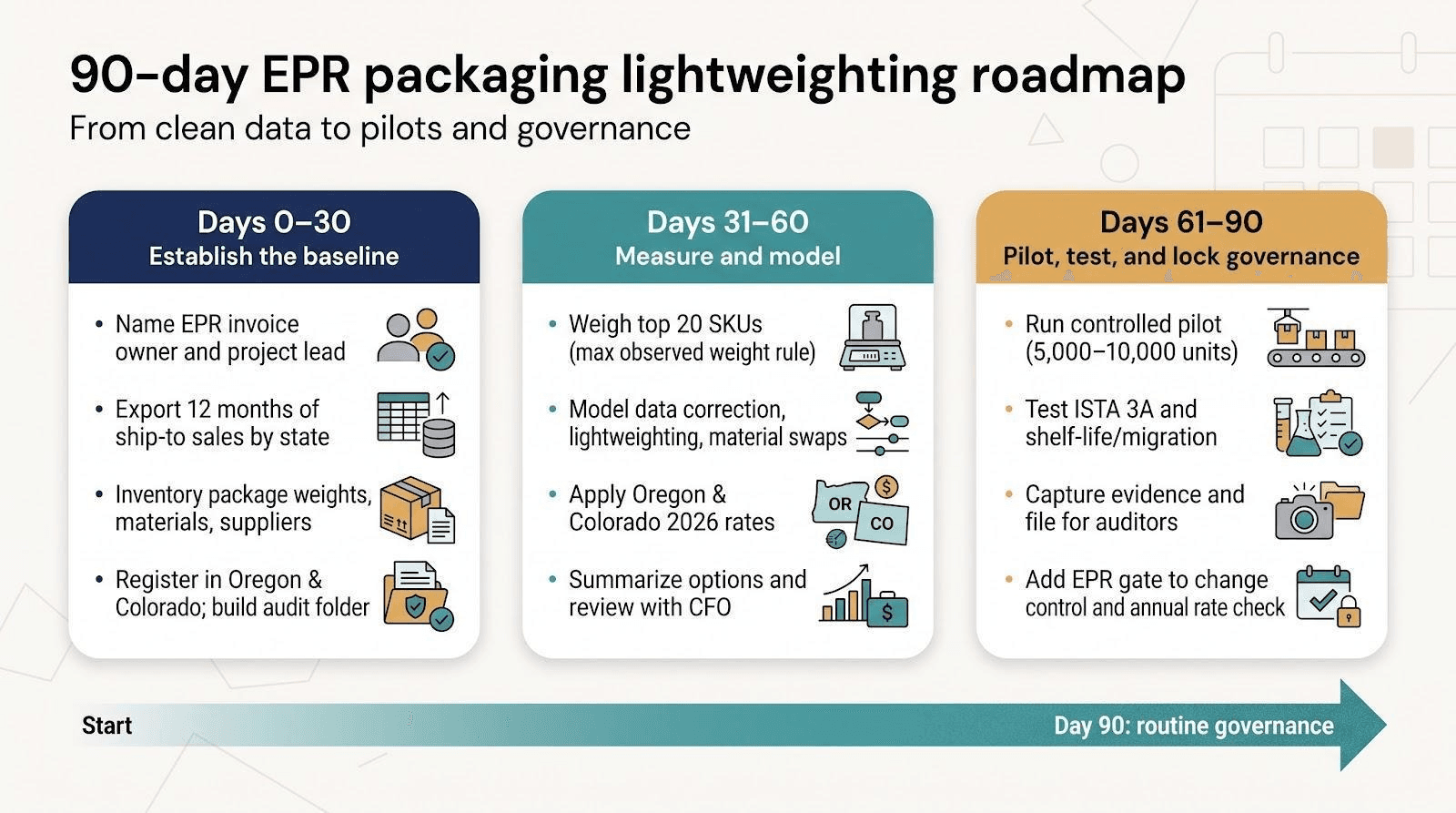
Name the owners. Appoint one executive to sign the EPR invoice and one project manager to answer every packaging question. Without clear leads, deadlines slip.
Pull the sales truth. Export 12 months of ship-to data from your ERP, aggregate by state, and drop the figures into the fee model. Just Born’s advice from the 2026 Packaging Recycling Summit applies here: “Don’t strive for perfection. Just start.”
Inventory the package files. From your PLM or BOM system, collect weights, material codes, and supplier names for every component. Flag blanks in red; missing grams today become surprise dollars tomorrow.
Register where fees are live.
- Oregon: register with Circular Action Alliance if you have not already. The first supply-data filing (2024 data) was due 31 March 2025, CAA has charged fees since 1 July 2025, and Oregon DEQ treats failure to register as a Class 1 violation with fines of up to $25,000 per day.
- Colorado: register through CAA’s producer portal; 2026 dues follow the published Colorado dues schedule.
- Review CalRecycle’s SB 54 producer guidance (permanent regulations approved 1 May 2026) so the data you gather now match California’s fields when its reporting opens.
Build the audit folder. Create a cloud directory for sales exports, supplier declarations, scale photos, and email approvals, so any later audit request is a file share, not a scramble.
Finish these steps in the first month and you replace guesswork with numbers, setting up every saving that follows.
Days 31–60: measure and model
With sales and component data in hand, the next 30 days turn numbers into options.
First, weigh the 20 SKUs that drive 80 percent of your EPR spend. Record the heaviest value from three samples per production line, and note whether each state wants the maximum or the average.
Next, model three scenarios for each high-cost component:
- Data correction only: replace estimates with verified grams.
- Lightweighting: trim one, three, and five grams without changing material.
- Material swap: test clear PET versus pigmented PET, mono-PE versus laminate, or 30 percent PCR versus virgin resin.
Apply Oregon and Colorado 2026 rates to every scenario so finance sees the multi-state impact. Include resin price, freight savings, and any tooling quote to show total landed cost, not just the EPR line. Finance signs off faster when the freight line sits next to the fee line.
Summarise each option in a traffic-light table: green (low risk), yellow (testing needed), red (food-safety concern). Schedule a 15-minute review with the CFO before day 60; a quick verbal go-ahead now keeps redesign work moving in week 12.
Days 61–90: pilot, test, and lock governance
With a shortlist approved, move one green-light concept from spreadsheet to shop floor.
Run a controlled pilot. Produce 5 000–10 000 units, enough to fill a standard production shift yet small enough to scrap if the design fails. Ship samples through the normal distribution loop and test to ISTA 3A parcel protocol for drop, vibration, and compression performance. For food, add accelerated shelf-life or migration tests per your HACCP plan.
Collect evidence. Photograph every test, log weights and defects, and file the report in the audit folder you opened on day 30. Either programme can ask for this documentation later.
Seal the change. Before marketing approves artwork, route the package through change control with a new “EPR gate.” No file moves forward without updated grams, material codes, supplier declarations, and an internal sign-off noting which state rate tables were modelled.
Create a living calendar. Add an annual reminder, 30 days after CAA publishes new Oregon and Colorado rates, to re-pull sales data, re-weigh a sample, and refresh the calculator. EPR fees change every year; your process should, too.
Hit these milestones by day 90 and lightweighting shifts from special project to routine governance.
Calculate ROI beyond the EPR invoice
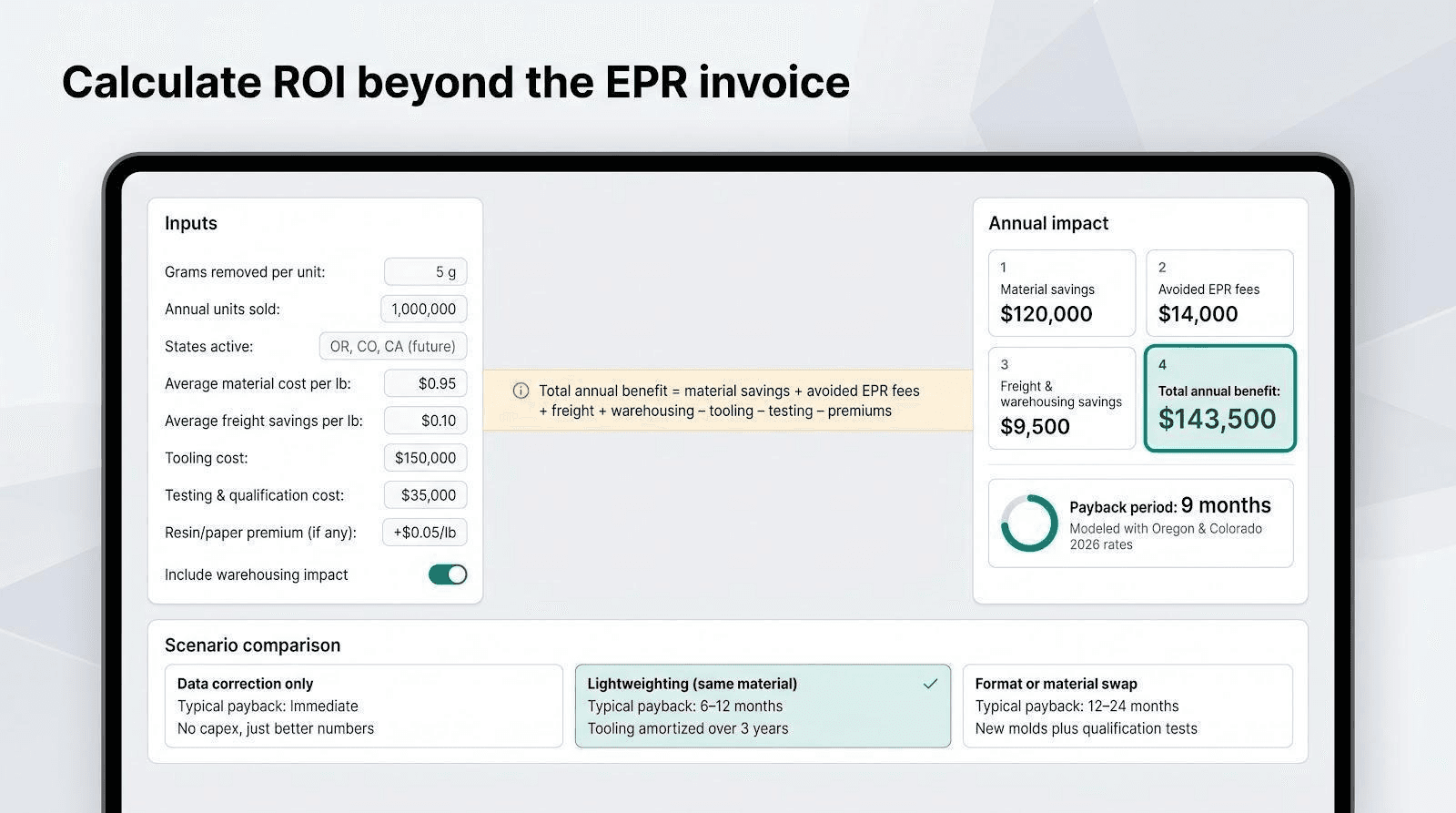
Lightweighting rarely saves money in only one column. Strip five grams from a PET bottle and you trim EPR fees, resin spend, freight, and even warehouse slotting because more units fit a pallet. If you count only the fee, the project may look small; count every cash flow and the return leaps.
Base equation
Total annual benefit = material savings + avoided EPR fees + freight + warehousing – tooling – testing – any new premium for resin or components
Three common scenarios
| Scenario | Typical payback* | Why it differs |
| Data correction only | Immediate | No cap-ex, just better numbers |
| Lightweighting (same material) | 6–12 months | Tooling amortised over three years |
| Format or material swap | 12–24 months | New moulds plus qualification tests |
*Typical ranges packaging engineers quote; check them against your own tooling and testing quotes.
Run a sensitivity check
Model high and low cases for:
- Annual sales volume (±15 percent)
- State sales mix (best and worst two-state combos)
- Fee schedules (+10 percent yearly inflation)
- Resin price swings (last five-year min/max)
- Tooling life (3 vs. 5 years)
Green-light a redesign only when fee savings hold across major markets, the package still protects the food, and total landed cost meets the company’s hurdle rate. Present that blended return, and finance sees a margin play, not a “nickel chase.”
Pitfalls and greenwashing traps
Even well-intentioned redesigns can backfire. Watch for these four common mistakes, all visible in the 2026 Oregon and Colorado schedules.
- Cosmetic tweaks masquerading as reductions. Shrinking a label or trimming ink weight leaves grams unchanged, so Oregon still counts the full mass.
- Paper solves everything. A paper canister with a foil grease barrier falls into polycoated paperboard at 20 ¢/lb in Colorado, two and a half times the 8 ¢/lb paperboard rate, and at 48 ¢/lb in Oregon, six times.
- One-state optimization. Clear PET earns a bonus in Colorado but pays 25 ¢/lb in Oregon. Model at least both live tables before approving artwork.
- Under-reporting small SKUs. Oregon DEQ treats failure to register as a Class 1 violation with fines of up to $25,000 per day, so a missed SKU is not a rounding error.
Treat these as guardrails. If a redesign cannot pass all four tests, it is not ready for production.
Frequently asked questions
1. How do brands lower EPR packaging fees?
Correct state sales, verify gram weights, delete unnecessary components, and model material swaps against each state’s 2026 rate table before you touch tooling.
2. Are packaging EPR fees always based on weight?
Weight is the base in both live U.S. programmes. Each state then layers on fixed charges plus bonuses or maluses for recyclability and recycled content, so the same gram can carry a different rate in each table.
3. Does one gram really matter?
Yes. Removing one gram from one million clear PET bottles eliminates about 2 205 lb, worth about $550 in Oregon (25 ¢/lb) and $330 in Colorado (15 ¢/lb) at 2026 rates.
4. Will switching from plastic to paper automatically lower fees?
Not if the paper is coated or heavier. Colorado charges 20 ¢/lb for polycoated paperboard against 15 ¢/lb for clear PET bottles, and Oregon charges 48 ¢/lb for polycoated paperboard against 25 ¢/lb for clear PET.


