
Trading Strategies & Tech
How Does Funding Pips Work? Accounts, Rules, Payouts and Risks
13 Aug 2026

How Does Funding Pips Work? Accounts, Rules, Payouts and Risks
Funding Pips is a retail funded-trader programme that offers simulated trading accounts under predefined performance and risk rules. Traders can purchase an evaluation or select its direct-access Zero model. Those who satisfy the applicable conditions may become eligible for performance-based rewards.
Despite terms such as “funded” and “Master Account,” Funding Pips states that all accounts operate in a simulated environment and that no trades are executed in live financial markets.
This review explains the current model without recommending or endorsing the provider. For background on the sector, read Tradersdna’s guide to what a prop firm is and how funded accounts work.
Important: Funding Pips can change its products, prices, leverage and trading rules. Check its official terms immediately before purchasing an account.
Key takeaways
- Funding Pips currently advertises 2 Step Pro, 2 Step, 1 Step and Zero programmes.
- Evaluation models require traders to meet objectives without breaking risk limits.
- Zero provides direct access to a simulated Master Account without an evaluation.
- Funding Pips describes programme fees as service fees—not deposits or investments.
- Passing an evaluation does not make the participant an employee or guarantee a reward.
- Drawdown, consistency, strategy and payout rules matter more than the advertised account size.
What is Funding Pips?
Funding Pips is a challenge-based trading platform. Participants pay for access to a simulated account and trade under the company’s rules.
Its programmes broadly follow two routes:
Evaluation route
The trader purchases a one-stage or two-stage evaluation, attempts to meet the relevant profit objectives and must remain within all loss and conduct rules. Successful completion can lead to a Master Account, subject to verification and the programme agreement.
Direct-access route
FundingPips Zero has no evaluation stage. The trader begins with a simulated Master Account but faces its own drawdown, consistency, activity and reward requirements.
The important distinction is that “Master Account” does not necessarily mean a live brokerage account containing the advertised balance. Funding Pips explicitly describes its accounts as demo accounts operating in a simulated environment.
Traders should also understand what qualifying for an account actually means. See What Is a Funded Trader? Accounts, Profit Splits and Responsibilities.
How does Funding Pips work?
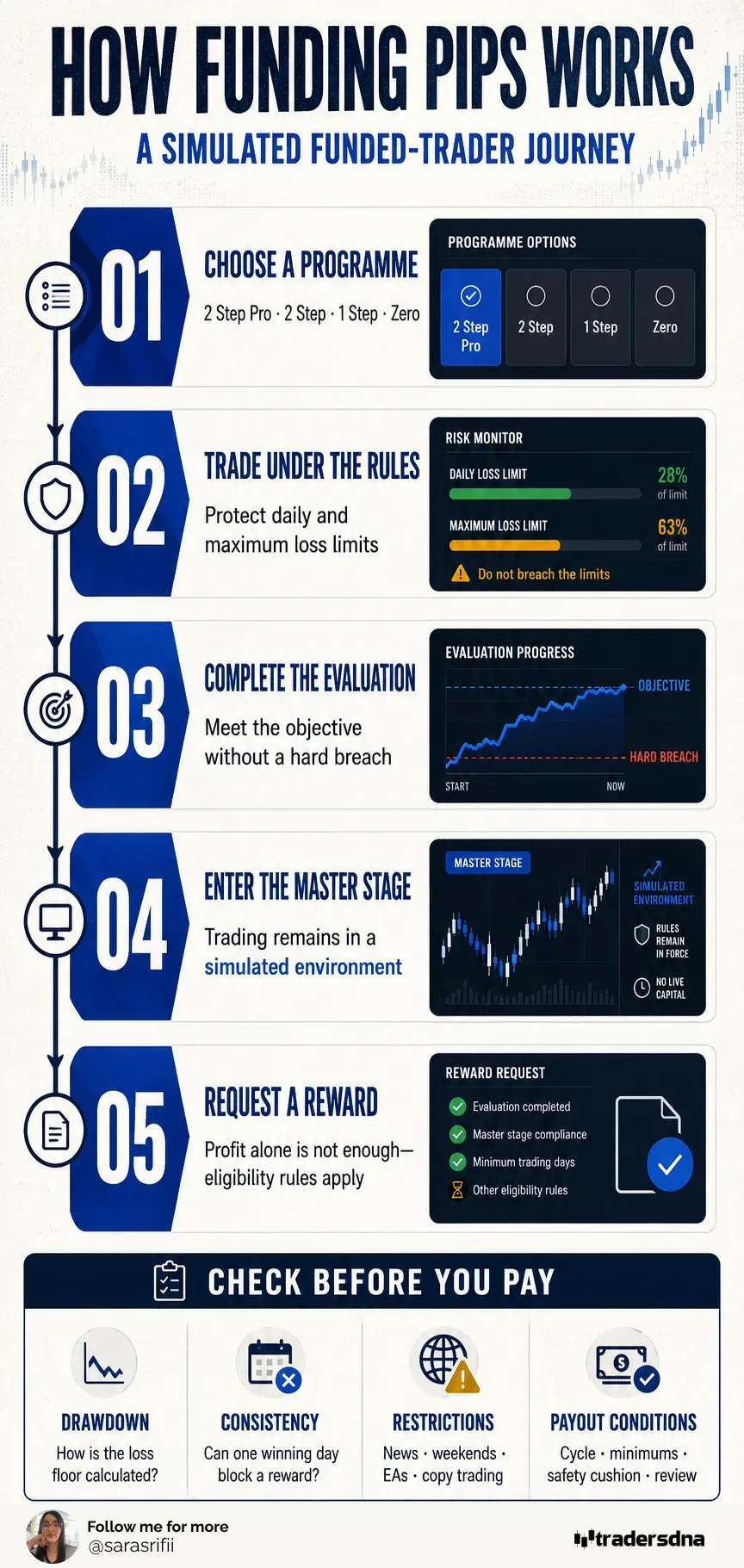
The general process is:
- Choose a programme: Select an evaluation structure, account size and available trading platform.
- Pay the programme fee: Funding Pips describes this as a service fee rather than client capital or an investment.
- Trade under the rules: The trader must respect loss limits, strategy restrictions and activity conditions.
- Complete the evaluation: Where an evaluation applies, the trader must reach its objectives without a hard breach.
- Pass verification: Funding Pips may require identity and compliance checks.
- Enter the Master stage: The trader receives access to the applicable simulated reward account.
- Meet reward conditions: A profitable balance alone does not establish payout eligibility.
- Request a reward: Funding Pips reviews the account against the applicable terms.
A trader can therefore pass an evaluation but later lose the Master Account by breaching its separate rules.
Funding Pips account models
Funding Pips currently lists four principal product routes:
| Model | General structure | Main consideration |
|---|---|---|
| 2 Step Pro | Two evaluation stages before the Master stage | Compare both targets with the available drawdown |
| 2 Step | Two-stage evaluation | Check how rules change after passing |
| 1 Step | One evaluation stage | Faster route may come with different risk conditions |
| Zero | No evaluation; direct simulated Master Account access | Strict trailing-loss and reward conditions |
The company may change available sizes, objectives, fees and promotions.
The model selected before the first trade can shape every later decision. Tradersdma’s guide, The Choice You Make Before Your First Trade at a Prop Firm, explains why target-to-drawdown ratios and account structure matter.
How FundingPips Zero works
Zero is the most direct model because it has no evaluation. As of 13 August 2026, its official help page lists account sizes from $5,000 to $200,000 and a 95% reward split on a biweekly cycle.
However, direct access does not mean unrestricted trading.
Its published principal limits include:
| Zero rule | Published condition |
|---|---|
| Daily loss limit | 3% |
| Maximum trailing loss | 5% |
| Maximum open risk | 1% of starting account size |
| Profitable days | Seven within each rolling 30-day period |
| Consistency score | Largest winning day no more than 15% of total profit |
| Inactivity | Hard breach after 30 days without a completed trade |
| Reward cycle | Every 14 calendar days, subject to eligibility |
| Advertised reward split | 95% |
The daily loss calculation uses the higher of the opening balance or opening equity. Floating and realised losses count, and the limit resets at 00:00 platform time, stated as UTC+3.
The trailing-loss floor follows the highest recorded equity until the account reaches 5% profit. It then locks at the original starting balance. Funding Pips states that this floor does not reset after a reward.
Zero reward conditions
Reaching a profitable balance does not automatically permit a withdrawal. The official rules currently require all of the following:
- A consistency score of 15% or lower
- Seven profitable trading days in the relevant period
- A 3% safety cushion that is not eligible for reward
- A largest loss that does not exceed the largest win
- An account in good standing
A profitable day must produce net closed profit equal to at least 0.25% of the starting Master Account size.
These conditions make the displayed split only one part of the payout calculation.
Funding Pips trading rules
Rules vary by programme, but several conduct standards apply broadly.
Maximum-loss rules
A trader must monitor account equity, not only closed results. Funding Pips states that touching a prohibited loss threshold even momentarily can constitute a breach, regardless of whether the trade later recovers.
Prohibited strategies
The company lists practices including latency arbitrage, server exploitation, tick scalping, opposite-account trading, account churning and certain forms of coordinated trading as prohibited.
Its current policy also prohibits:
- Copying between accounts belonging to different users
- Inbound copying from an external signal provider
- Third-party account management
- Misrepresenting the account’s actual trader
Automated trading
Third-party expert advisers are generally permitted only as trade or risk-management tools. Funding Pips says traders using their own fully automated EA may be asked to prove ownership through source code, development history or an explanation of its logic.
Exceptions exist for particular products. Traders should check the rule attached to the exact account rather than assume one automation policy applies everywhere.
IP addresses, VPNs and account access
Funding Pips monitors IP activity to verify account ownership. Its policy currently states that:
- The account’s regional access pattern should remain consistent.
- A trader travelling may be asked to provide location evidence.
- Multiple devices can be used within the same city.
- VPN and VPS connections are not permitted.
- Account access by another person may trigger investigation or termination.
News and weekend trading
These rules depend on the programme.
On Zero, Funding Pips prohibits opening, closing or holding an affected position from ten minutes before until ten minutes after designated high-impact news. Weekend holding is also prohibited across instruments.
Other Funding Pips models may use different conditions.
How Funding Pips payouts work
Funding Pips calls payouts “rewards.” Eligibility depends on the account model, cycle, profit split and compliance with all applicable rules.
Before requesting a reward, confirm:
- The earliest request date
- Minimum profitable days
- Consistency requirement
- Minimum request amount
- Safety or drawdown cushion
- Effect on the remaining account buffer
- Identity and compliance checks
- Payment and conversion fees
- Whether any violation can invalidate profits
A high advertised profit split is not the same as a guaranteed payout. The trader must first create eligible profit, preserve the account and pass the provider’s review.
Traders should also calculate the account after the reward. Removing profit may leave less room above a loss threshold, making the same position size more dangerous.
For more context, see Tradersdna’s guide to funded-trader accounts, profit splits and responsibilities.
What are the main risks?
The accounts are simulated
Funding Pips states that all programme accounts are demo accounts and that orders are not executed in live markets. Participants are purchasing access to a service and potential contractual rewards—not receiving control of the advertised capital.
Rules can close a profitable account
A trader can show an overall profit and still breach a daily-loss, trailing-loss, open-risk, consistency or prohibited-strategy rule.
Fees can accumulate
Repeated evaluations, resets and other charges can turn a modest initial fee into a substantial total cost. Programme fees should never be funded with money required for living expenses or debt repayment.
Terms may change
Leverage, eligible strategies, news restrictions and reward conditions can change. Screenshots and third-party reviews may become outdated.
A large account is not a large risk allowance
The usable risk budget is determined by the loss threshold—not the nominal account balance. A simulated $100,000 account with a 5% maximum loss does not allow the trader to risk $100,000.
A reward is not guaranteed income
Passing once does not establish long-term profitability. Rewards remain dependent on performance, continued compliance and the company honouring the agreement.
Tradersdna’s 12 red flags to avoid when choosing a prop firm provides a broader provider-review checklist.
What to check before buying
- Read the rules for the exact model and account size.
- Save a dated copy of the terms shown at purchase.
- Confirm whether loss limits use balance, equity or the higher value.
- Calculate the target relative to available drawdown.
- Review news, weekend, automation and copy-trading restrictions.
- Understand every reward condition and the post-reward buffer.
- Add evaluation, reset, platform and transaction costs.
- Practise the complete rule set in a simulator first.
- Verify whether the programme is available in your jurisdiction.
- Treat marketing claims separately from the legal agreement.
Frequently asked questions
Is Funding Pips a traditional prop firm?
It operates as a retail funded-trader programme rather than a conventional proprietary trading employer. Participants purchase simulated evaluation or account services and may become eligible for rewards.
Does Funding Pips use real trading accounts?
Funding Pips states that all accounts it provides are demo accounts in a simulated trading environment and that no actual trades are executed in live markets.
Can traders withdraw the advertised account balance?
No. The advertised balance is a simulated account size. Eligible participants may request rewards calculated from trading performance under the applicable agreement.
Does Funding Pips allow news trading?
The answer depends on the product. Zero currently prohibits trading or holding affected positions during its restricted high-impact-news window. Other models may have different rules.
Is Funding Pips suitable for beginners?
A paid evaluation should not replace education and simulator practice. Beginners may be particularly vulnerable to repeated fees, oversized positions and misunderstood drawdown rules.
Final takeaway
Funding Pips offers several simulated funded-trader routes, ranging from two-stage evaluations to the direct-access Zero model. The relevant question is not simply how large the account appears or how high the advertised reward split is.
A trader should examine the effective drawdown, daily-loss calculation, consistency conditions, prohibited strategies, reward eligibility and full participation cost before paying.
Funding Pips may provide a structured performance test, but it does not provide guaranteed income, employment or control of the advertised capital.
Sources
- Funding Pips: Trading objectives
- Funding Pips: FundingPips Zero rules
- Funding Pips: Trading conduct and security standards
- Funding Pips: News trading and weekend holding
- Funding Pips: Rewards
- Funding Pips: Terms and conditions


