


resources
How Satellite Connectivity is Bridging the Digital Divide in Rural and Smart Communities
23 Jul 2026

You pack up your things for a mountain getaway.
The air is slightly humid due to rain, and everything looks greener and cleaner. You play your favorite playlist and get to the cozy little cottage by the mountains.
Now, you can't wait to enjoy working with a view, but the dancing dinosaur on the screen announces, "No Internet Connection."
You fanatically check your phone for service like it’s a walkie-talkie.
Within seconds, the paradise view feels like an alien land.
If this doesn’t feel worse, add failed digital payment, no Netflix, and no human interaction for the next week.
What a nightmare, right?
For millions of rural residents in the US, this is not a temporary situation; instead, it's a lifestyle.
The Cost of Offline Living
Most people will use the internet, get on social media platforms, and tell you to start a digital detox.
In some ways, it looks attractive.
I mean, why not?
But when “no internet” becomes the norm, you just can't help but get depressed.
This is the reality for millions of people living in rural communities. Without the internet, they also have to live without online payments and digital contact. From students to businesses, everyone falls behind because their access to the internet is limited.
Even worse, health emergencies mean waiting three hours for a doctor visit because telehealth is not an option.
So, digital detox for a day or two might sound like an adventure, but when there is no other option, you start feeling trapped.
The Internet Fix for Rural Areas
Now, when it comes to good internet, we instantly think about fiber optics, right?
Honestly, fiber is a great option for densely populated areas. The overall infrastructure is expensive; you will be literally cutting through rugged mountains, rocky deserts, and dense forests.
And for what? Just a small town of 400 people?
But does this mean rural areas are bound to stay in darkness?
The answer is no.
To solve this issue, we have an internet structure up in the skies.
Yes, I am talking about satellite internet. Currently, satellite internet providers are racing against time and each other to offer the fastest internet services to residents.
For the longest time, satellite internet was seen as the last resort, something to fall back on when other options failed. Speed was slow, latency was high, and the bill was too much.
Now there is a silent revolution in the satellite internet world that has completely changed this situation. This revolution is turning isolated small towns into thriving smart communities.
Let's look at the way satellite internet is slowly bridging the gap between rural areas and smart communities.
The Power Shift and The Arrival Of LEO, HAPS, And D2D
Satellite connectivity is suddenly better than ever, but do you wonder why?
Well, to understand this in detail, you need to know three important changes in satellite technology.
- The Low Earth Orbiting satellites
- High-Altitude Pseudo-Satellites (HAPS)
- Direct-to-Device (D2D)
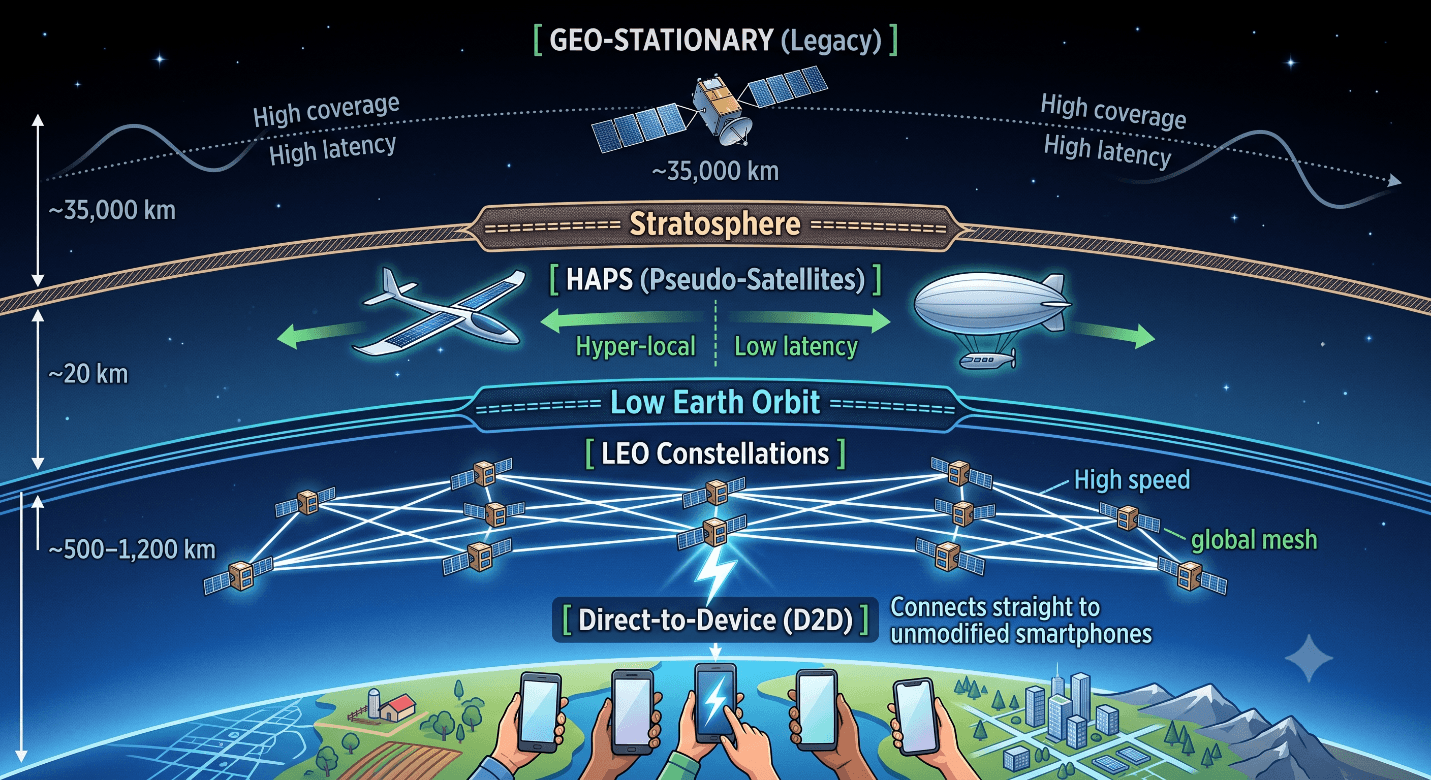
GEO Satellites
Satellite internet relied heavily on Geostationary (GEO) satellites. These satellites were orbiting Earth at about 35,000 km in space. Since the distance is a lot, the latency was higher. So, satellite internet was too slow for calls, video streaming, or tech work.
LEO Satellites
But then came the LEO satellite. These satellites were spinning 500 to 1,200 km above the Earth. The distance was shorter, the latency was less, the speed was higher, and that also means connectivity is seamless.
High-Altitude Pseudo-Satellites (HAPS)
The High-Altitude Pseudo-Satellites (HAPS) are not in outer space; instead, they just float at nearly 20 km above us using solar drones, blimps, and balloons.
They work as temporary cell towers, so if a natural disaster ends up destroying the infrastructure on the ground, HAPS are launched for seamless internet.
Direct-to-Device (D2D)
Previously, satellite internet meant a giant dish installed on the roof. Now, D2D allows the normal smartphone to connect directly to the satellite in space. This means you can be in a thick forest, but your smartphone will still have stable internet.
The Power of Satellite Transforming the Rural Communities
Now that satellite internet is becoming affordable and accessible for rural communities, it is transforming these areas faster than ever.
Here is where you can truly notice the impact:
Virtual Classrooms
Students from small towns and villages are finally getting the same education as everyone else through digital textbooks, online classes, and virtual field trips. This means that zip code and money are no longer impacting the future of kids.
Telehealth
In remote areas, health specialists and advanced hospitals are a rare sight. Now, with telehealth services, patients can avail video checkups from the best specialists regardless of their location.
Community Backhaul
Previously, every roof needed a dish to enjoy satellite internet. With advanced technology, you just need one big dish installed in a central building. This will ensure coverage for the whole neighborhood, and that too at a much lower cost.
Creating Smart Communities in Rural Areas
Satellite internet works like the brain of a community. It connects things and people and streamlines processes. It is reducing efforts and making rural areas safer for all.
Here are some of the ways lifestyle in rural areas is becoming better:
AgTech
Tech-based agriculture is becoming the lifeline of rural areas. Today, farmers are using the internet for everything. Their crop cultivation is run on data analysis. Their tractors are automated. From soil sensors to smart water systems and even drones, they are now using high-tech equipment to save water and grow organic crops.
Eco Safety
Thanks to the internet, farmers are now able to reduce waste. Thanks to remote sensors, farmers are detecting water pipe leakage, electric grid failure, and adjusting their seed cycle based on climate updates, i.e. wildfires, flash floods, and rain.
Handling Natural Disasters
Usually, natural disasters are unstoppable. They have a huge impact, and there is no way to reduce their impact. However, thanks to weather safety protocols powered by the internet, communities have a much better contingency plan in case of a natural disaster.
The Future of Satellite Internet
The global future of satellite internet is brighter than ever. In just a few years, we will see more satellite internet brands coming to light. This will further reduce the price of satellite internet plans.
As for infrastructure, instead of choosing one type of connectivity, we will move toward a hybrid horizon. This ultimate network will help users enjoy better speed and more reliability regardless of their location.
Simply put, advanced satellite networks will be everywhere in no time. This will remove physical barriers while making sure rural and isolated communities get to enjoy the same digital power as metropolitan city residents.
FAQ’s
What do you mean by digital divide and why is it important?
The digital divide is a term used to explain the difference in opportunity due to internet speed. it is important because when the digital divide is wider, it literally reduces opportunities for communities, be it related to jobs, education, or healthcare.
Why is modern satellite internet faster than the older internet?
Modern (LEO) satellites orbit closer to Earth, which reduces the signal delay so anyone can enjoy high-speed, seamless internet performance and connectivity.
Can I use my regular smartphone to connect to a satellite?
Yes, via D2D Direct-to-Device technology, you can easily use your smartphone to text, call, or browse the web using satellite internet.


