
business resources
How Strategic Placemaking Can Enhance the Commercial Performance of Shopping Centers
12 Aug 2026

Over four million shoppers visit open-air retail properties every day, pushing developers to rethink how physical space drives commercial success. Traditional leasing models no longer guarantee long-term asset value in a shifting retail market driven by experiential expectations. Modern consumers demand environments that offer genuine community connection rather than basic rows of concrete storefronts.
Property developers must understand how spatial design directly influences commercial viability, foot traffic volume, and long-term tenant retention. Ignoring pedestrian flow often leads to stagnant leasing performance and declining visitor numbers during competitive retail seasons. Crafting engaging environments requires deliberate investments in multi-level architecture and landscape design.
The Economics of Modern Retail Performance
Retail real estate performance metrics highlight remarkably low multitenant vacancies hovering between 4.5% and 4.7% for open-air centers. When vacancy rates drop this low, asset appreciation relies heavily on maximizing the productivity of existing square footage. Developers are actively scaling store footprints down to prioritize high-yield physical placemaking and productivity.
This physical recalibration directly influences tenant revenue and overall asset valuation across competitive urban and suburban markets. Properties that embrace thoughtful spatial design experience tangible financial returns, higher rents, and sustained tenant loyalty. Financial institutions and institutional asset managers now evaluate retail assets based on their experiential infrastructure rather than square footage alone.
Enhancing Foot Traffic Through Spatial Design
Advanced zone flow analytics demonstrate that pedestrian connectivity dictates how long visitors stay on-site. This dwell time determines revenue growth, so it cannot be ignored.
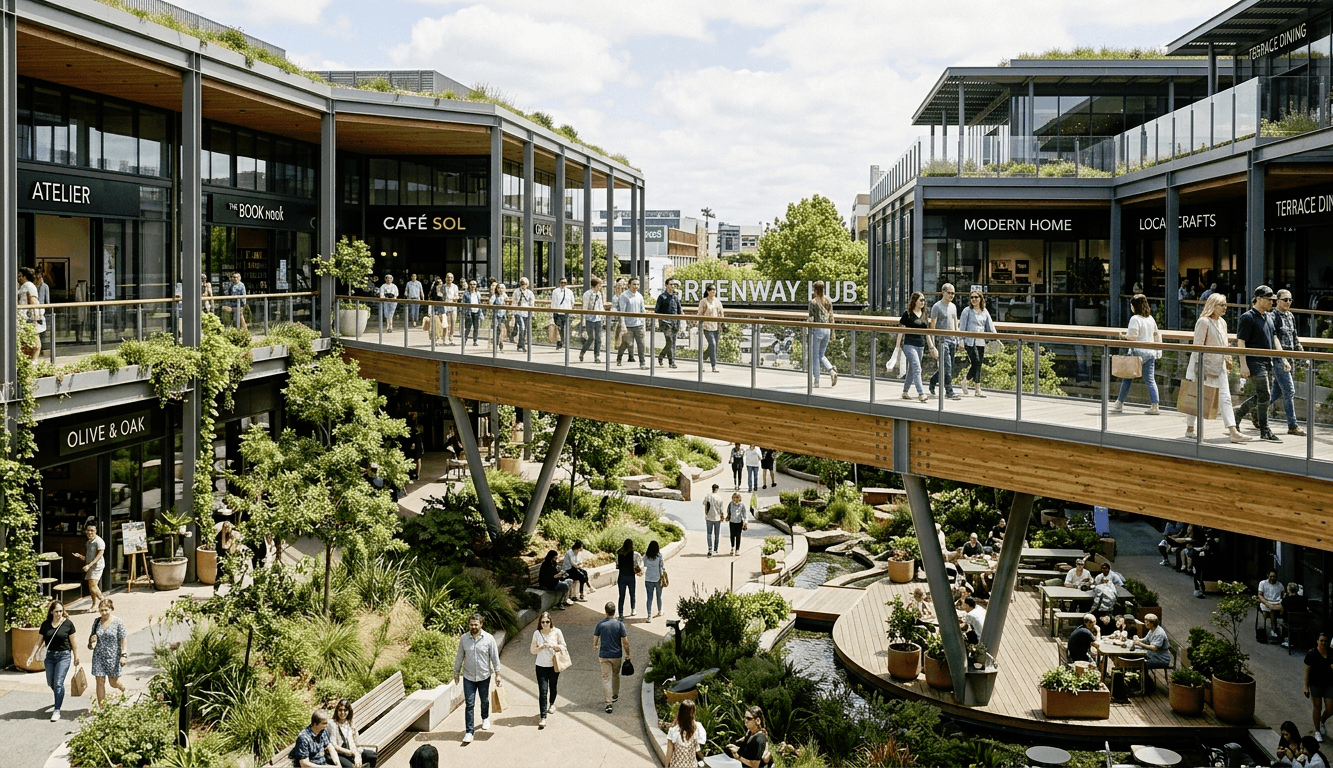
Integrating commercial development bridges across complex retail terrain ensures seamless pedestrian movement between parking zones and primary storefronts. Successful properties rely on specific spatial strategies to maintain high visitor engagement without creating artificial friction points.
- Optimized pedestrian pathways reduce congestion bottlenecks during peak weekend shopping hours
- Integrated green landscaping softens harsh architectural concrete and asphalt surfaces
- Central gathering plazas encourage spontaneous social interactions among diverse visitor demographics
These physical improvements alter the rhythm of visitor movement across the entire commercial property. When people navigate a development effortlessly, their overall comfort and willingness to explore secondary retail zones improves significantly. Landlords who invest in connective infrastructure capture higher lease rates and lower tenant turnover over multi-year lease cycles.
Dwell Time and Experiential Amenities
Average dwell times track directly with basket size across modern open-air developments. Every minute a customer spends lingering in a thoughtfully designed public plaza increases their likelihood of making an additional retail purchase. Asset managers are responding by embedding experiential amenities into their core capital expenditure plans.
Physical asset transformations require careful balancing of hardscape features, native plantings, and public seating zones. Retailers benefit immensely when landlords invest in public spaces that invite prolonged, stress-free customer stays. Comfortable design elements, from shaded seating areas to carefully selected cotton bath rugs in suitable hospitality and wellness spaces, can help create a more welcoming environment.
Overcoming Topography and Spatial Barriers
Challenging site topographies often discourage pedestrian exploration in large commercial developments. Installing elevated walkways and structural connectors solves multi-level accessibility problems while adding distinct architectural character. Developers use these engineering solutions to unite disparate retail zones and encourage fluid customer movement.
Overcoming physical disconnects ensures that every square foot of retail space remains accessible and commercially viable. Shoppers reward properties that eliminate navigation friction by spending more time and money on-site. So, while retailers might be focused on tech’s potential to improve their operations, they can’t neglect the physical aspects either.
Future-Proofing Commercial Retail Assets
Property owners must continuously evaluate their physical infrastructure to stay competitive in the current real estate landscape. Strategic investments in placemaking turn ordinary shopping centers into vibrant, resilient community hubs that withstand economic fluctuations. You can explore our blog to find more posts on all manner of business topics and talking points.


