
business resources
How to Budget for AI Search Work Without Overbuying
17 Sept 2026

Most AI search retainers are priced as a flat monthly fee before anyone has checked what the business actually needs. That is backwards. A small site with a strong press history and a large site with no independent footprint at all can have the same AI visibility problem and need completely different budgets to fix it.
AI search spend splits into four buckets: audit and baseline, on-site structural work, off-site citation building, and ongoing monitoring. Two of those are largely one-off. Two genuinely recur. Knowing which is which, before signing anything, is what stops a business paying for a 12-month retainer when the real gap could be closed with a two-week fix and a lighter ongoing spend.
Key Takeaways
- Audit and baseline is a one-off. It scopes the problem before any money commits to a monthly plan.
- On-site structural work is mostly one-off too. Fix it once, maintain it lightly.
- Off-site citation building is the bucket that actually recurs, because third-party corroboration has to be earned continuously, not built once.
- The right shape of spend depends on the business, not a standard package. A thin citation footprint needs a different budget to a weak website.
- Scope first, commit second. An audit tells you which buckets need money before a retainer decides it for you.
The Four Buckets in Every AI Search Budget
Strip any AI search or AEO proposal down and the spend falls into four categories. Vendors bundle them differently, but the categories themselves do not change.
Bucket | One-off or recurring | What it buys |
| Audit and baseline | One-off | A read on crawler access, current citation rate and where the gaps sit |
| On-site structural work | Mostly one-off | Schema, page structure, consistent entity information |
| Off-site citation building | Recurring | Third-party mentions, reviews, editorial coverage and directory presence |
| Ongoing monitoring | Recurring, lean | Tracking whether citations hold, drop or turn out inaccurate |
Audit and Baseline: The One-Off Everyone Needs
Every engagement should start here, and it should be priced and sold as a standalone deliverable, not folded into month one of a retainer. A proper audit checks whether AI crawlers can actually reach the site, establishes a baseline citation rate across a set of realistic buyer prompts, and identifies which of the other three buckets the business actually needs.
This step does not repeat monthly. Once the baseline is established and the technical gaps are named, the audit has done its job. Paying for it again every month, dressed up as "ongoing optimisation," is the first sign a retainer has been priced without reference to the business it is meant to serve.
On-Site Structural Work: Mostly a One-Off, With Light Upkeep
On-site work covers schema markup, clear page structure, consistent descriptions of what the business does, and making sure important information sits in the visible page rather than behind a script an AI crawler cannot read. None of this needs monthly re-doing once it is built correctly.
There is a small recurring tail: new pages need the same structure applied, and a rebrand or a pricing change needs the site updated to match. But that is maintenance, not a programme. A business with a small, well-built site can often close this bucket in a matter of weeks and never need to fund it again at any real scale.
Off-Site Citation Building: The Bucket That Actually Recurs
This is where a genuine retainer earns its cost, and it is also the bucket buyers most often mis-price, because it looks like content work and gets budgeted like content work. It is not. AI-generated answers draw on trade coverage, reviews, directories, expert commentary and other independent sources, not only the business's own website. That footprint has to be built and then kept current, because a competitor's fresh mention this quarter can displace a citation that was solid last quarter.
A one-off spend cannot buy a durable position here. Editorial relationships need maintaining, new reviews need encouragement, and directory listings need checking for accuracy. This is the bucket that genuinely justifies a monthly line item, and it is also the one buyers should scrutinise hardest, because "citation building" can mean anything from a single directory submission to a structured monthly programme.
Ongoing Monitoring: Lean but Continuous
Monitoring tracks whether the business is still being named, whether the description AI systems give is accurate, and whether a citation that existed last month has quietly disappeared. It should cost far less than the citation-building bucket it sits alongside. If a monitoring line item costs close to what the citation programme costs, something in the proposal is priced wrong.
Why the Same Four Buckets Produce Very Different Budgets
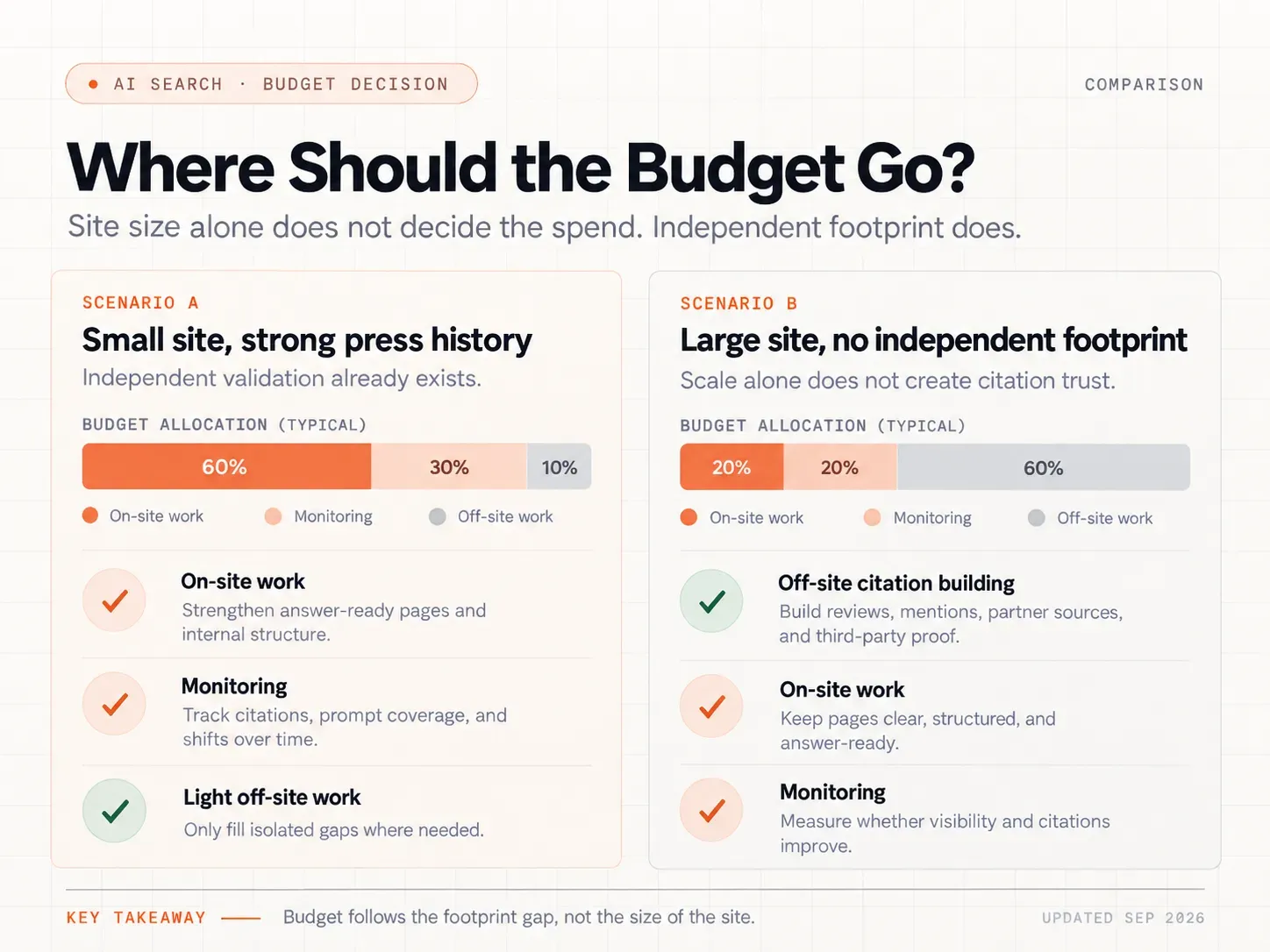
A business with a small site and a strong existing press history has often already solved the off-site problem without knowing it. Its budget should load onto on-site structure and monitoring, with a light citation-building spend layered on top.
A large site with no independent third-party footprint at all has the opposite problem. Its on-site work may already be in reasonable shape. Its budget needs to load onto off-site citation building, because that is the bucket with nothing built yet to draw on.
Buying the same retainer shape for both businesses means one of them pays for on-site work it does not need, and the other pays for on-site work while the actual gap, its thin third-party footprint, goes unfunded.
Water2Water: When the Site Is Fine but the Footprint Is Thin
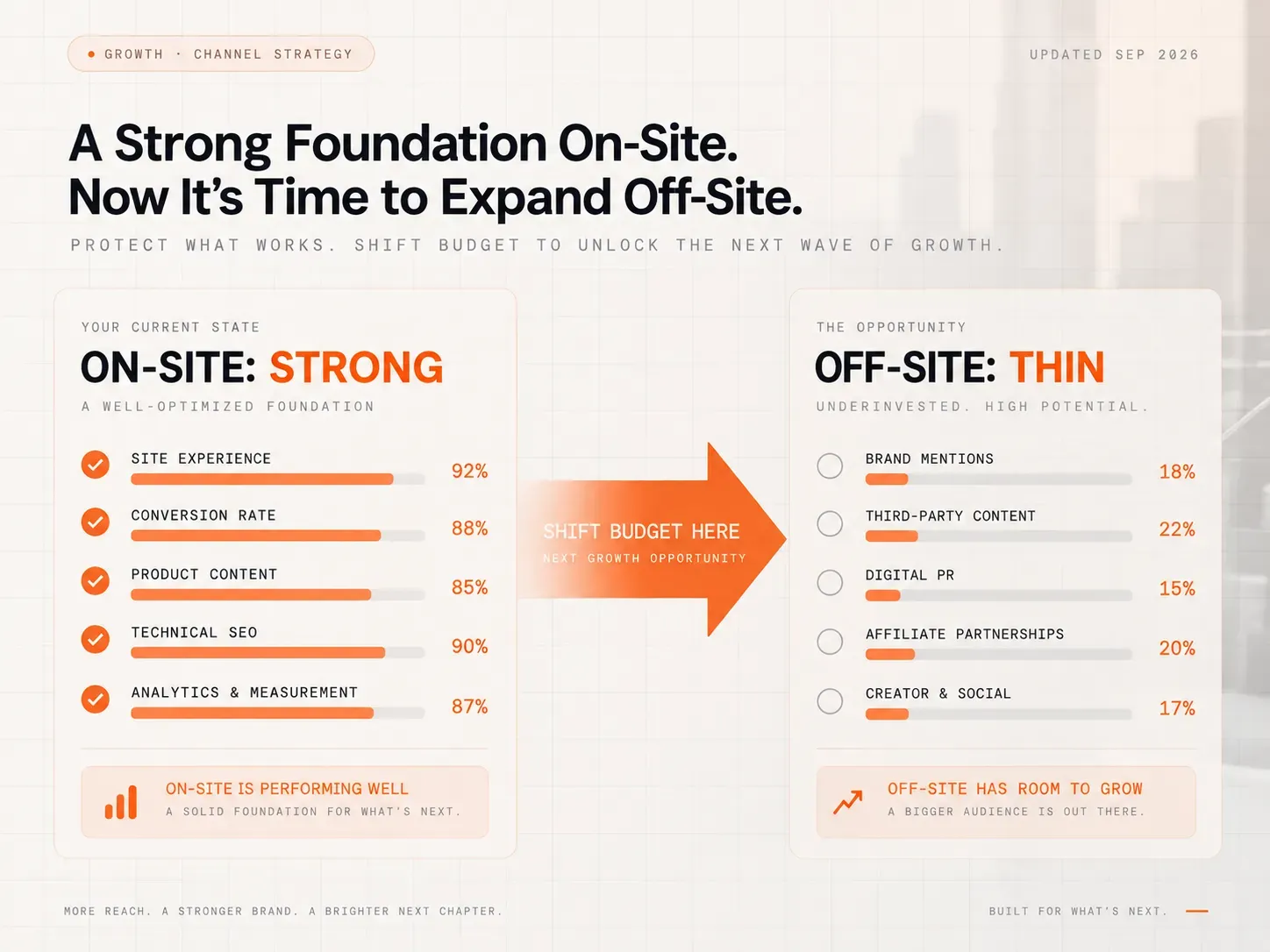
Water2Water, a family-run water treatment business in Western Australia, is a useful working example precisely because its website was never the problem. The site was clear, the service pages made sense, and the structural work an audit usually flags was largely already in order.
Its independent citation footprint was a different story. Reviews, directory listings and third-party mentions were thin, which meant AI-generated answers had little to draw on beyond the business's own site when a buyer asked about water treatment providers in the area. For a business in this position, more on-site pages would not have moved the needle. The gap sat entirely in the off-site bucket, so that is where the budget had to go.
The lesson generalises. An audit that only checks the website will miss this kind of gap entirely, because the website was never where the problem lived.
Compare Quotes Against a Published Benchmark Before You Sign
Once the four buckets are understood, a quote becomes far easier to read. A proposal that charges retainer rates for what is really a one-off audit, or that prices monitoring at the same level as citation building, is a proposal built around a template rather than the business in front of it. Before signing anything, it is worth checking a quote against what AEO services cost in Australia, so the buckets in front of a buyer can be compared against a published range rather than taken on trust.
Scope the Audit First, Commit to the Retainer Second
The sequencing matters as much as the pricing. An audit is a fixed, bounded piece of work with a clear deliverable: a baseline, a list of gaps, and a recommendation on where the budget should concentrate. A retainer is an ongoing commitment that should follow from that recommendation, not precede it.
Buying the retainer first means committing to a shape of spend before anyone has checked whether that shape fits. It also removes the buyer's leverage. Once a 12-month retainer is signed, there is little incentive for a vendor to report back that the business only needed a two-week fix.
When a Monthly Retainer Is Actually Justified
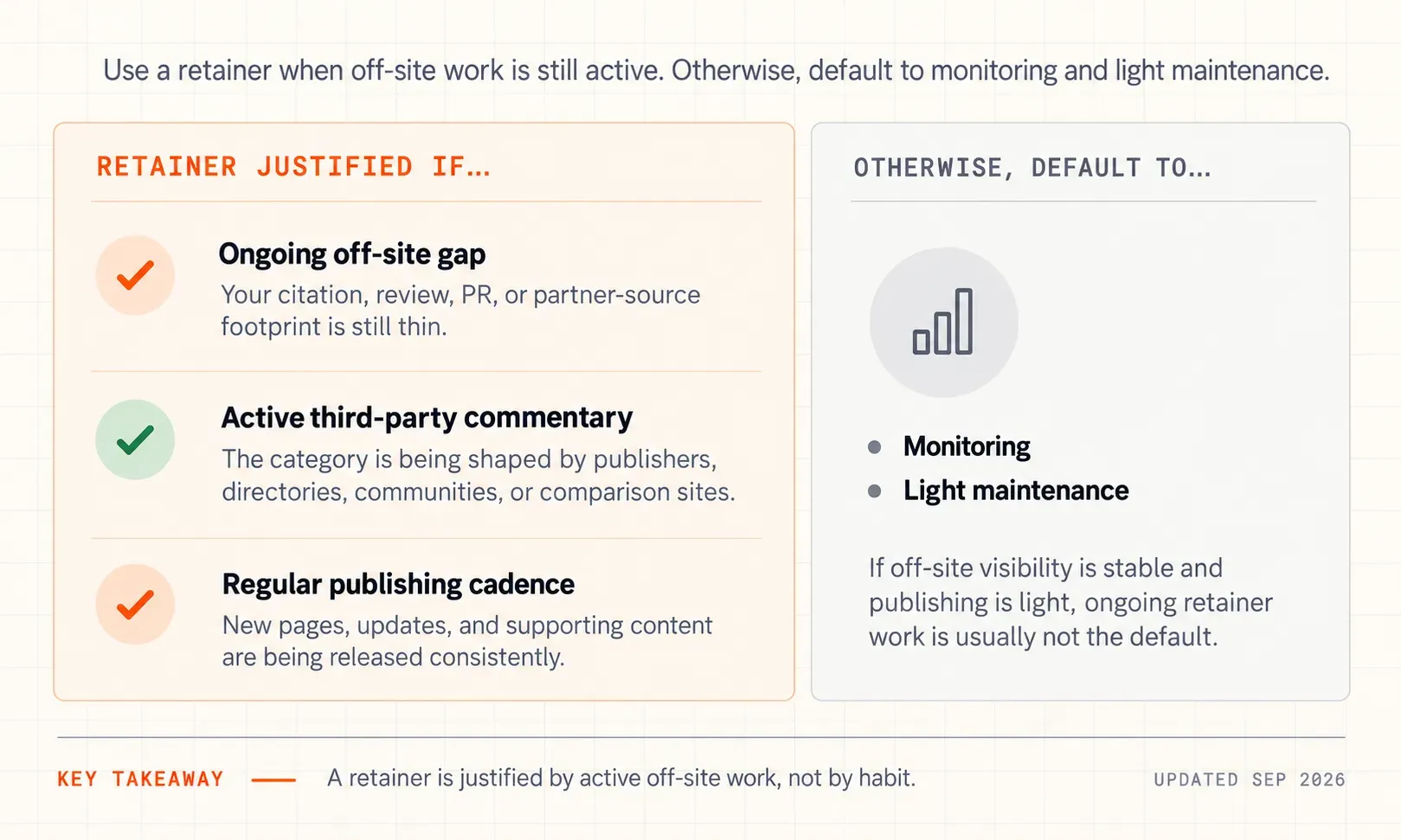
A retainer earns its place once the audit shows a genuine, ongoing off-site gap, such as Water2Water's thin independent footprint, where earning citations is a continuous job rather than a fixed one. It also holds up where a business competes in a category with active third-party commentary, meaning competitors are being mentioned and reviewed regularly and the business needs a standing presence to keep pace. A third case is a business publishing content on a genuine monthly cadence that needs matching structural and citation work each time.
Outside those conditions, a retainer is usually paying for idle capacity. A business with a strong existing footprint and an occasional content update needs monitoring and light maintenance, not a full monthly programme.
Final Thoughts
AI search budgets go wrong when a standard retainer gets applied to a problem it was never sized for. Splitting the spend into audit, on-site work, off-site citation building and monitoring, and checking which of those genuinely recur for a given business, is what keeps the budget matched to the actual gap. Scope first. Commit second.
The pattern is not unique to AI search. Businessabc has previously reported on how forgotten AI subscriptions inflate business budgets, where the same root cause applies: spend that was never checked against actual need keeps renewing on its own.
FAQs on Budgeting for AI Search Work
Is the audit really a one-off cost?
Yes, for a given point in time. It should be repeated after a major change, such as a rebrand or a significant site rebuild, but it is not a monthly line item.
What if my site already has strong on-page SEO?
Strong SEO does not guarantee AI citation. The audit still matters, because it checks the off-site footprint separately from the site itself, and that is often where the real gap sits.
How long before off-site citation building shows results?
Third-party mentions take time to be indexed, corroborated and picked up by AI systems. Expect a programme measured in months, not weeks, before the citation rate moves.
Should the retainer be sized to the industry or to the individual business?
To the business. Two competitors in the same industry can have very different existing footprints, and the budget should follow the gap the audit finds, not a category average.
Can a business do the on-site work itself and only pay for off-site help?
Often, yes. On-site structural work is well suited to an internal team or developer working from a clear brief. Off-site citation building usually benefits from external relationships and editorial reach that take longer to build in-house.


