
business resources
How to Build a Campus Fiber Network: A Practical Guide for Modern Enterprises
24 Mar 2026

As digital transformation accelerates across industries, campus networks are under increasing pressure to deliver higher bandwidth, lower latency, and simplified management. Traditional Ethernet architectures, built on multi-layer copper cabling, often struggle to meet these demands due to complexity, limited scalability, and rising operational costs.
A campus fiber network, especially one based on Passive Optical LAN (POL), offers a more efficient and future-ready alternative. This guide walks through the key considerations, architecture design, and deployment practices, with a focus on implementing a VSOL Campus POL Solution in real-world scenarios.
Why Fiber is Replacing Traditional Campus Networks
Before diving into deployment, it is important to understand why fiber is becoming the preferred medium in campus environments such as universities, industrial parks, hospitals, and enterprise headquarters.
Fiber networks provide:
- Higher bandwidth capacity to support cloud applications, 4K video, and large data transfers
- Long-distance transmission without signal degradation, reducing the need for intermediate equipment
- Improved reliability due to immunity to electromagnetic interference
- Lower total cost of ownership through reduced power consumption and simplified infrastructure
These advantages make fiber particularly suitable for large-scale, high-density campus environments.
Understanding POL Architecture
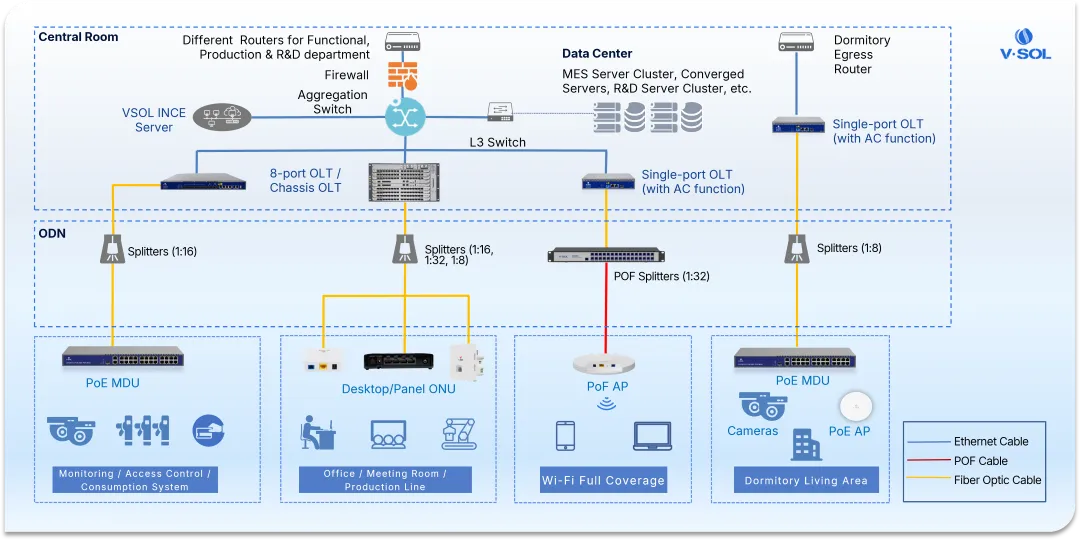
At the core of a campus fiber network is the Passive Optical LAN architecture. Unlike traditional three-tier Ethernet networks, POL simplifies the structure into a two-tier model.
Key Components
A typical VSOL POL Solution includes:
- OLT (Optical Line Terminal): Located in the central equipment room, responsible for traffic aggregation and service control
- ODN (Optical Distribution Network): Passive splitters and fiber cables that distribute signals without requiring power
- ONU (Optical Network Unit): Deployed near end users to provide wired and wireless access
- Enterprise Routers and AC Controllers: Handle routing, security policies, and wireless management
This architecture removes the need for aggregation switches and multiple telecom rooms, significantly reducing complexity.
Step 1: Define Network Requirements
A successful campus fiber network starts with clear planning. Different environments have different priorities.
Key Questions to Address
- What is the expected number of users and devices?
- What applications will dominate traffic patterns?
- What are the requirements for wireless coverage and roaming?
- Are there specific security or isolation requirements between departments?
For example, a manufacturing campus may prioritize low latency and real-time data transmission, while a university may require seamless Wi-Fi roaming and high-density access.
Step 2: Design the Network Architecture
Once requirements are defined, the next step is to design a scalable and efficient architecture.
Topology Planning
A well-designed POL network typically follows a centralized topology:
- Deploy OLTs in a central data room
- Use passive splitters to distribute fiber to different buildings or floors
- Place ONUs close to end users for flexible access
This approach reduces the number of active devices and simplifies maintenance.
Fiber Planning
- Use single-mode fiber for long-distance and future scalability
- Plan splitter ratios carefully to balance cost and performance
- Reserve fiber capacity for future expansion
VSOL’s OLT and ONU portfolio supports flexible deployment, allowing network designers to adapt to different campus layouts.
Step 3: Select the Right Equipment
Choosing appropriate hardware is critical to ensure performance and long-term reliability.
OLT Selection
VSOL OLTs are designed for enterprise and campus scenarios, offering:
- High port density for large-scale deployments
- Support for GPON and XG-PON technologies
- Advanced QoS and traffic management
ONU Deployment
ONUs act as the access layer and should match user requirements:
- Desktop ONUs for office environments
- PoE-enabled ONUs for IP phones and cameras
- Wi-Fi integrated ONUs for wireless coverage
Router and Wireless Integration
Enterprise routers and wireless controllers are essential for:
- Traffic routing and policy enforcement
- VLAN segmentation and security isolation
- Seamless Wi-Fi roaming across the campus
VSOL routers and AC solutions integrate smoothly with POL networks, enabling unified management.
Step 4: Implement Structured Cabling
Fiber deployment is more than just running cables. It requires structured planning to ensure reliability and scalability.
Best Practices
- Use standardized cabling paths and labeling systems
- Protect fiber with proper conduits and routing
- Minimize bends and physical stress on cables
- Ensure redundancy for critical links
Compared to copper, fiber cabling is lighter and occupies less space, making it easier to manage in large campuses.
Step 5: Enable Unified Network Management
One of the major advantages of a modern campus fiber network is centralized management.
Intelligent Management Platforms
A solution like VSOL INCE enables:
- Unified management of OLTs, ONUs, and switches
- Real-time monitoring and fault detection
- Remote configuration and firmware upgrades
For wireless networks, VSOL AC controllers provide centralized control of APs, ensuring consistent performance and seamless roaming.
This unified approach reduces operational complexity and improves troubleshooting efficiency.
Step 6: Ensure Security and Service Isolation
Campus networks often serve multiple departments or tenants, making security a critical concern.
Key Strategies
- Use VLANs to isolate different services such as office, production, and guest networks
- Implement access control policies at the router level
- Enable encryption and authentication mechanisms
- Monitor traffic for anomalies
POL architecture inherently supports logical isolation while maintaining a shared physical infrastructure.
Step 7: Plan for Future Expansion
A well-designed campus fiber network should not only meet current needs but also accommodate future growth.
Scalability Considerations
- Reserve OLT ports for future users
- Use higher-capacity fiber where possible
- Ensure compatibility with next-generation technologies like XGS-PON
VSOL POL solutions are designed with scalability in mind, allowing seamless upgrades without major infrastructure changes.
Real-World Application Scenarios
Campus fiber networks are widely used across different industries:
- Enterprise campuses: Support digital offices, video conferencing, and cloud applications
- Industrial parks: Enable real-time monitoring and automation systems
- Educational institutions: Provide high-density Wi-Fi and e-learning platforms
- Healthcare facilities: Ensure reliable connectivity for medical systems and data
In each scenario, POL architecture simplifies deployment while improving performance and reliability.
Conclusion
Building a campus fiber network is no longer just a technical upgrade. It is a strategic investment in long-term digital infrastructure. By adopting a POL-based approach, organizations can simplify network architecture, reduce operational costs, and deliver high-performance connectivity.
A well-planned deployment, supported by solutions like the VSOL POL Solution, ensures that campus networks are not only efficient today but also ready for future demands.


