
business resources
How to choose the best local listing management software for multi-location brands
19 May 2026

Online listings are the digital storefronts of the modern era. From “near me” searches to verifying business hours and reading reviews, these touchpoints are the primary drivers of foot traffic and conversions.
Birdeye’s State of AI Search 2026 report found that 80% of brands were cited at least once in AI-generated answers, highlighting how critical accurate business information and structured content have become for online visibility.
Multi-location brands face real challenges in maintaining consistency across platforms. Internal multi-location teams and stakeholders struggle with outdated data and inconsistent service details, which confuse customers and reduce visibility in high-intent searches.
Effective listing management requires a balance of centralized control and localized flexibility. This guide outlines the framework for evaluating enterprise solutions that build a truly scalable listing strategy.
Why does listing management break down at scale?
Handling a handful of locations manually is doable. But the moment you cross into dozens or hundreds, the cracks start showing, and they compound fast.
Here's where things typically start to break down:
- Data drifts across platforms: NAP (Name, Address, Phone) data slowly loses synchronization across directories, a problem customers often notice before the brand.
- Duplicate listings multiply: Multiple entries for the same location split your authority and quietly drag down your visibility.
- Updates move too slowly: Delayed synchronization of holiday hours or branch moves results in missed opportunities and customer frustration.
- Governance fragmentation: When updates are scattered across departments, brand consistency becomes a best-case scenario rather than a standard.
- Analytics gaps: Without location-level data, you are flying blind on which listings are actually driving calls, visits, and conversions.
None of these problems announce themselves. They build quietly in the background, and by the time the impact shows up in rankings or customer complaints, the damage has already been done.
6 critical features to evaluate in any listing management software
Choosing the right software requires focusing on features that address enterprise-level complexity.
1. Centralized listing control
A reliable listing management software should provide a single dashboard to manage all locations, allowing teams to update business details, categories, and attributes across directories in one place. This ensures consistency across every listing and reduces the need for scattered manual updates.
2. Real-time synchronization across directories
Updates should reflect across search engines, maps, and directories within minutes, not hours or days. Real-time synchronization helps prevent mismatches and ensures customers always see the most accurate details for each location.
3. Duplicate suppression and data accuracy
The platform must automatically detect, merge, or suppress duplicate listings to maintain a single source of truth for each location. It should also standardize business data formats to ensure consistent information across all platforms.
4. Enterprise-scale automation
Multi-location brands need the ability to make changes across hundreds of listings at once. Bulk editing, scheduled updates, and automation for recurring changes help reduce manual effort while maintaining uniformity across locations.
5. Integration with core business systems
Listing management software should integrate with CRM systems, location databases, and internal platforms. This ensures that updates made within core systems are reflected across listings, keeping data aligned without duplication.
6. Performance insights at the location level
Beyond managing listings, the platform should track key metrics, including impressions, clicks, calls, and directions requests. These insights help teams evaluate performance at the location level and identify opportunities for improvement.
These capabilities define how effectively a platform can support multi-location listing management without adding operational complexity.
3 questions to ask before you buy
Before committing to a platform, pressure-test it with these:
- Can it genuinely handle the complexity of hundreds or thousands of locations, or does it start to strain past a certain point?
- How fast do updates actually propagate? Ask for real timelines, not marketing language.
- Does it give central teams control without locking out local managers who need flexibility?
Why Birdeye is built for multi-location listing management
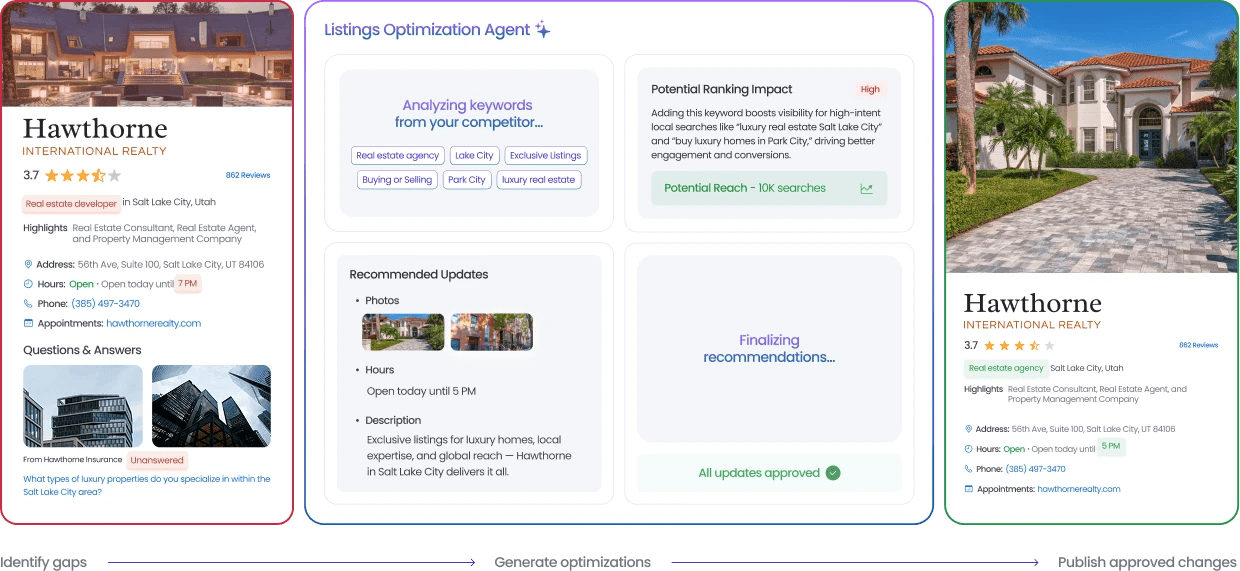
Many listing management tools offer basic synchronization, but fewer platforms support real-time updates, governance controls, and automation at enterprise scale.
Birdeye Listings AI is an enterprise-grade software built for multi-location brands managing hundreds to thousands of locations. It helps maintain accurate, consistent, and high-performing listings across key discovery channels.
Teams can manage and optimize business information from a centralized dashboard across platforms such as Google Business Profile, Apple Business Connect, Yelp, Facebook, and other high-visibility directories.
Listings AI uses an agent-driven model where AI agents continuously monitor listings to detect issues in real time. Based on predefined brand guidelines, these agents can recommend or apply updates, helping multi-location businesses maintain accuracy across locations while reducing manual effort.
Key capabilities:
Listings optimization agent
Continuously monitors listings across major platforms to identify missing details, inconsistencies, and optimization opportunities. It provides actionable recommendations and can execute updates within approval workflows while maintaining brand standards.
Local keyword and visibility insights
Uses location data and search signals to identify high-impact keywords and attributes that influence local discovery, improving search visibility and profile completeness.
Duplicate suppression
Detects and removes duplicate listings across directories, ensuring consistent and accurate business information for every location.
Listings analytics and performance tracking
Provides real-time insights into impressions, traffic, calls, and engagement, helping teams measure and improve performance at the location level.
Focus on high-impact platforms
Prioritizes the directories customers actively use, ensuring accuracy and optimization where they directly impact discovery and engagement.
Enterprise integrations
Connects with 3,000+ systems, including platforms like Salesforce, Microsoft Dynamics 365, and Adobe, keeping listings data aligned with core business operations.
Why Birdeye stands out
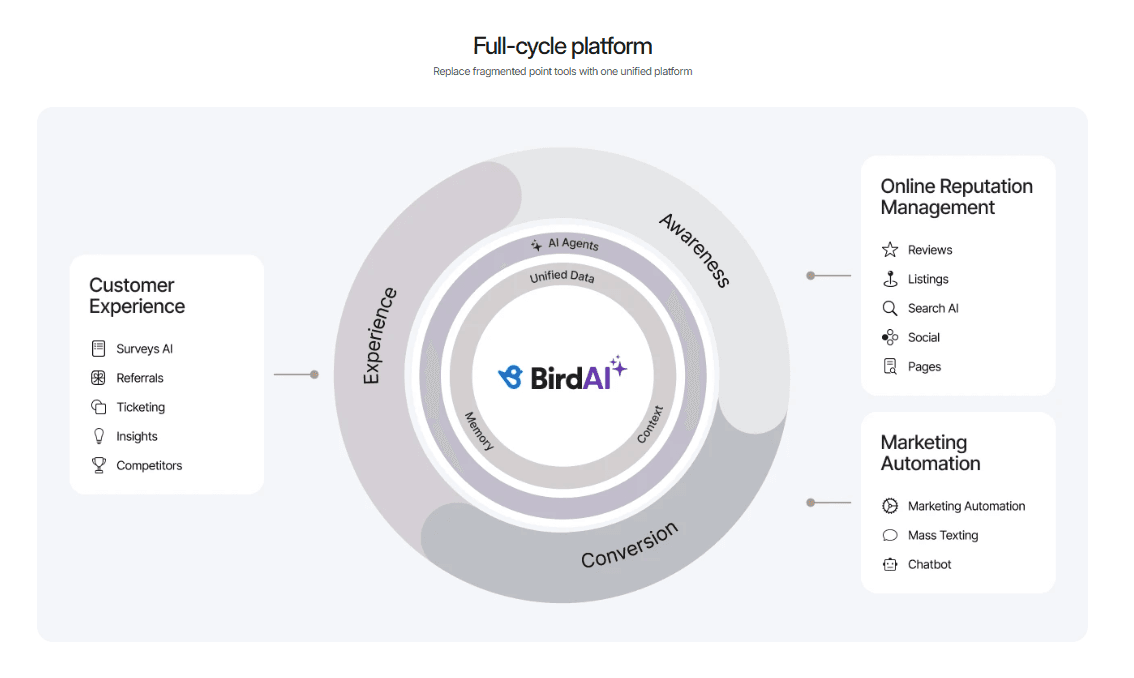
Birdeye goes beyond traditional listings tools by delivering a complete, agentic approach to local marketing. As the leading agentic marketing platform for multi-location brands, it manages the entire marketing process by continuously improving visibility and performance across every location.
Its approach is built on three core pillars:
Consolidate
Brings listings, customer data, and location insights into one unified platform with 3,000+ integrations, reducing reliance on disconnected tools.
Think
Uses BirdAI to deliver smarter-than-generic AI insights with built-in brand voice and compliance controls, plus location-level memory for personalized recommendations at every location.
Act
Deploys AI agents, including the Listings Optimization Agent, to optimize listings in minutes, scale actions across every location, and keep teams in control with humans in the loop.
Enterprise-ready governance and compliance
Birdeye is purpose-built for the complexity of multi-location brands. With Role-Based Access Control (RBAC) and tiered approval workflows, enterprise teams can maintain strict brand governance while still allowing local managers to handle region-specific updates. It is also SOC 2 Type II certified, ensuring strong security, data protection, and compliance standards for enterprise environments.
Why it fits multi-location brands
This approach helps enterprise brands move away from manual, reactive listing management toward continuous, AI-driven optimization. Birdeye is built to handle the operational complexity of hundreds to thousands of locations while improving consistency, visibility, and customer engagement across every touchpoint.
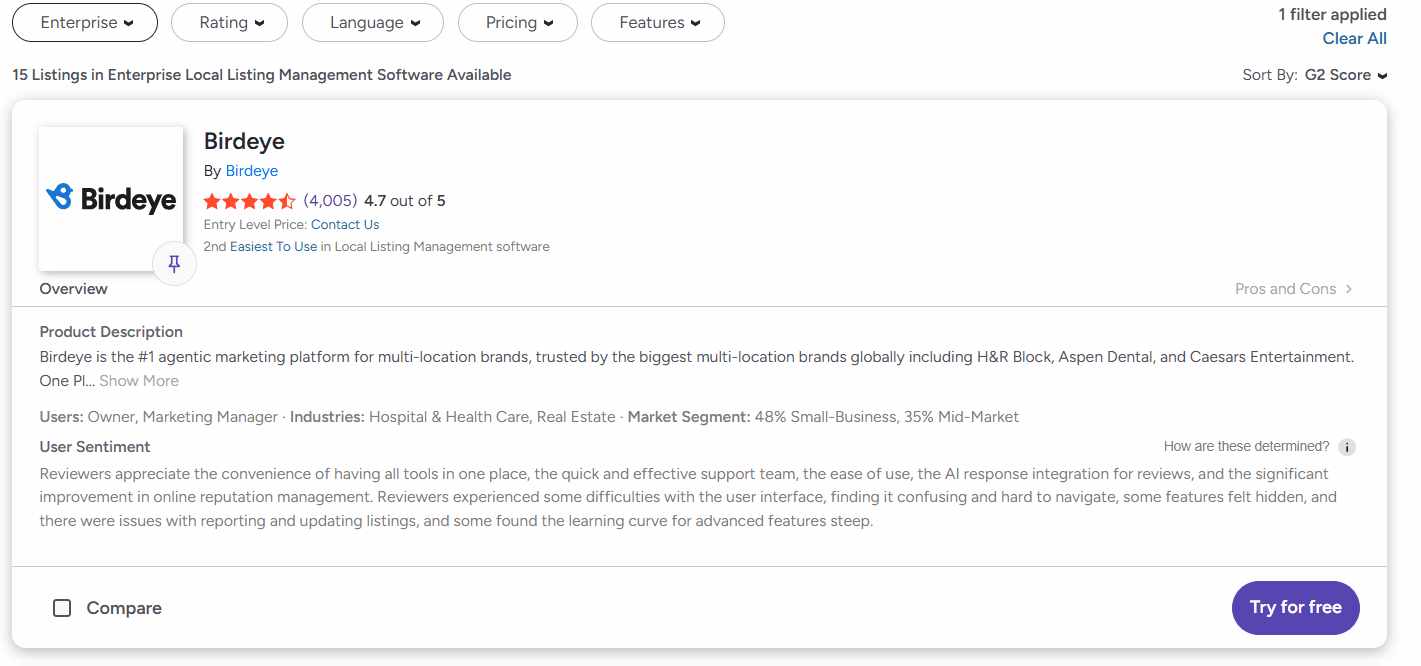
As per G2, Birdeye is the #1 Enterprise Local Listing Management Software, with a 4.7/5 rating from 4,000+ reviews, reinforcing its leadership in the category.
Conclusion
Local search success depends on how consistently your business information is maintained across every discovery channel. When automation and governance work together, fragmented listings turn into a more organized and reliable system. This helps reduce operational effort while improving visibility across key customer touchpoints. The end goal is simple: ensure your brand remains accurate, visible, and easy to trust whenever customers are searching.
Share

Ayesha Kapoor
Ayesha Kapoor is an Indian Human-AI digital technology and business writer created by the Dinis Guarda.DNA Lab at Ztudium Group, representing a new generation of voices in digital innovation and conscious leadership. Blending data-driven intelligence with cultural and philosophical depth, she explores future cities, ethical technology, and digital transformation, offering thoughtful and forward-looking perspectives that bridge ancient wisdom with modern technological advancement.


