


Trading Strategies & Tech, resources
How to Scale Your Brand’s Video Content Without Scaling Your Team
28 Jul 2026

The Content Volume Problem Is Getting Worse, Not Better
Every platform your brand needs to maintain a presence on is demanding more video content than it demanded twelve months ago. TikTok’s algorithm rewards daily posting. Instagram Reels requires consistent output to maintain reach. YouTube Shorts has become a meaningful traffic source that cannot be ignored. LinkedIn video outperforms text posts for B2B brands.
And each platform has its own format requirements, audience expectations, and optimal content style. For marketing teams that have not fundamentally changed how they produce content, the result is a choice between burning out the team or accepting underperformance on platforms they cannot staff adequately.
Why Hiring More People Is Not the Answer
The instinct when content demand increases is to hire — another video editor, another content coordinator, another social media manager. This approach has a ceiling: headcount scales linearly while content demand scales exponentially, and the overhead of managing a larger team introduces coordination costs that reduce the efficiency gains you were trying to capture. The brands that are winning the content volume game in 2025 are not the ones with the largest teams. They are the ones that have built AI-powered production systems that allow small teams to produce at large-team volume.

The AI UGC Video Ads Generator within Pollo AI is one of the core tools enabling this shift. By using photorealistic AI avatars to produce authentic-feeling product review and testimonial content, it removes the most time-intensive element of UGC-style video production — coordinating with human creators — while maintaining the authentic, conversational quality that makes UGC content perform well in organic and paid environments. Multiple versions can be generated simultaneously, finished videos are ready in minutes, and output is natively formatted for the short-form platforms where content volume demands are highest.
The Three Production Systems Every Scaling Brand Needs
The brands that successfully scale content production without proportionally scaling headcount typically operate three distinct production systems simultaneously: a performance creative system for paid advertising, an organic content system for platform presence, and a product content system for e-commerce assets. Each system has different quality requirements, production cadences, and distribution channels — and each benefits from AI tools in different ways.
The performance creative system is where AI UGC content has the most immediate impact. Paid social advertising requires a constant supply of fresh creative variations — most brands running serious paid social operations need fifteen to thirty new creative assets per month to maintain testing velocity and prevent creative fatigue. Producing this volume with traditional methods is expensive and slow. AI avatar-based content production makes it practical for a small team to maintain this testing cadence without a proportional increase in production costs.
Building Your AI-Powered Content Production System
Step 1 — Audit Your Current Content Production Bottlenecks
Before adding any new tool, identify precisely where your current production process loses the most time. For most marketing teams, the primary bottlenecks are creative briefing and script development, talent coordination and scheduling, post-production editing and formatting, and platform-specific optimization. Different AI tools address different bottlenecks — knowing which bottlenecks cost you the most time helps you prioritize which capabilities to implement first.
Step 2 — Implement AI UGC Production for Your Performance Creative

Start with your paid social creative system, where the ROI of faster, higher-volume production is most directly measurable. Use the AI UGC Video Ads Generator in Pollo AI to establish a systematic creative production workflow: define your avatar personas, develop your script templates based on customer language research, generate your first testing batch, and establish the performance metrics that will guide your creative iteration.
Step 3 — Add Supplementary Content Production for Organic Channels
Once your performance creative system is running efficiently, extend AI production capabilities to your organic content channels. For content repurposing — converting blog posts, product descriptions, and marketing copy into video format for organic distribution — Vidnoz AI’s AI production wizard offers a structured workflow that processes existing text content and generates narrated video outputs.
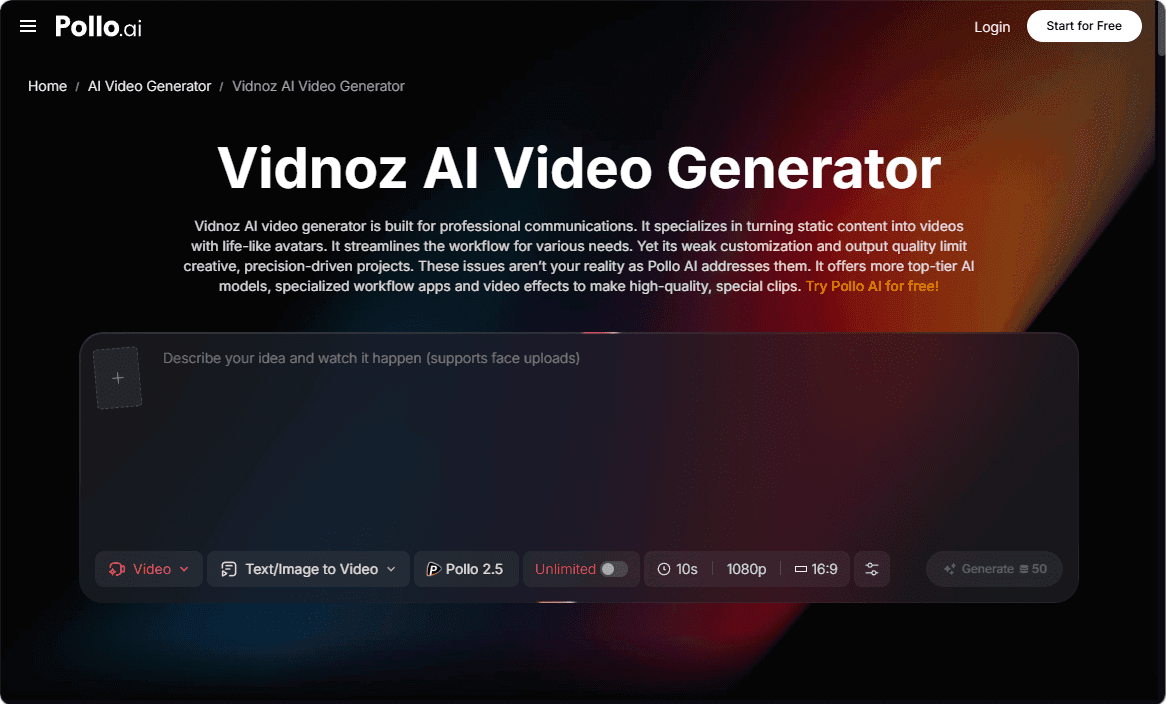
Its voice cloning capability can maintain audio consistency across a content series, and its template library speeds up the formatting layer of production. Keep in mind that Vidnoz AI‘s output quality and customization depth have limitations for high-precision creative requirements — for those applications, Pollo AI’s advanced model capabilities are the more capable option.
Step 4 — Establish a Content Calendar That Reflects Your New Production Capacity
Once your AI production systems are operational, rebuild your content calendar to reflect your actual production capacity rather than your legacy capacity. Most teams find that their effective content output increases by a factor of three to five when AI production tools are properly integrated — which means your content calendar can be significantly more ambitious than it was under traditional production constraints.
Step 5 — Build Quality Control Processes That Scale With Volume
Higher production volume requires more systematic quality control, not less. Develop a standardized review checklist for AI-generated content that covers brand voice alignment, factual accuracy, platform formatting compliance, and output quality thresholds. Assign clear ownership for each quality control step and establish turnaround time standards that allow you to maintain publishing cadence without sacrificing review rigor.
What Scaling Teams Are Getting Wrong About AI Content Tools
The most common mistake marketing teams make when implementing AI video tools is treating them as a replacement for creative strategy rather than a production accelerator. AI tools can produce content at scale, but they cannot determine which messages resonate with which audiences, which hooks stop the scroll, or which benefit angles drive purchase decisions. Those are strategic and analytical questions that require human judgment and data interpretation. The teams that get the most value from AI production tools are the ones that invest more time in creative strategy — not less — because they have recaptured the time that was previously consumed by production logistics.
A related mistake is failing to establish clear performance benchmarks before scaling AI content production. If you do not know what good looks like for your specific audience and product category, producing more content faster will not improve your results — it will just accelerate your spending on underperforming creative. Establish your performance benchmarks during your initial testing phase, before you scale production volume.
Conclusion: The Scaling Problem Has an AI Solution
The content volume demands of modern multi-platform marketing are not going to decrease. The brands that figure out how to meet those demands without proportionally scaling headcount and production costs will have a structural competitive advantage that compounds over time.
AI-powered content production — anchored by tools like the AI UGC Video Ads Generator in Pollo AI for performance creative and supplemented by complementary tools for organic content production — is the practical solution to the scaling problem that most marketing teams are currently struggling with. Build the system, establish the processes, and let your team focus on the strategic work that actually requires human judgment.


