


How to Start a Business With No Money: A Practical Step-by-Step Guide
05 Aug 2026

Can you really start a business with no money?
Yes but “no money” normally means no meaningful upfront investment, not zero financial responsibility forever. A founder can validate demand, make an offer and sometimes collect the first payment using an existing phone, internet connection, skills, relationships and free software. Once the business begins operating, legal obligations and operating costs may follow.
The most realistic zero-budget businesses begin with customer-funded work. You sell a result, take a deposit or secure a pre-order, then use that income to cover delivery. This is easier with services, digital products, brokerage, teaching, local labour and made-to-order products than with restaurants, physical retail, regulated care, manufacturing or inventory-heavy ecommerce.
If you are still deciding what to launch, explore these small business ideas in 2026, organised around realistic skills, costs and business models.
The no-money business model
| Stage | What you use | What you avoid | Evidence required |
|---|---|---|---|
| Validate | Time, conversations and a simple offer | Logo packages, paid ads and inventory | Customers describe the problem and agree to a next step |
| Sell | Direct outreach, referrals and a deposit | Building a full website before demand | A signed agreement, paid pilot or pre-order |
| Deliver | Existing skills, free tools and manual work | Complex automation and premature hiring | A completed result and customer feedback |
| Reinvest | Revenue from early customers | Personal debt for untested demand | Repeat sales, referrals or measurable retention |
Businesses that are easiest to start without capital
The best starting point is usually a narrow service that solves an urgent problem for a customer you can already reach. These models can often begin without inventory, rented premises or custom technology:
- Professional services: Bookkeeping support, virtual assistance, copywriting, design, research or operations help
- Local services: Cleaning, organising, pet care, lawn care, mobile detailing, errands or basic home services
- Teaching and coaching: Tutoring, language lessons, career preparation, software training or small-group classes
- Creative production: Photography, short-form video editing, content repurposing or event support
- Brokerage and coordination: Finding suppliers, matching customers with providers or managing projects for a fee
- Digital products: Templates, guides, worksheets or small courses—after validating demand manually
- Pre-order products: Made-to-order food, crafts, clothing or gifts where payment arrives before production
Avoid choosing an idea only because it sounds inexpensive. The stronger test is whether you can name ten likely customers, explain the result in one sentence and deliver the first version with resources you already control.
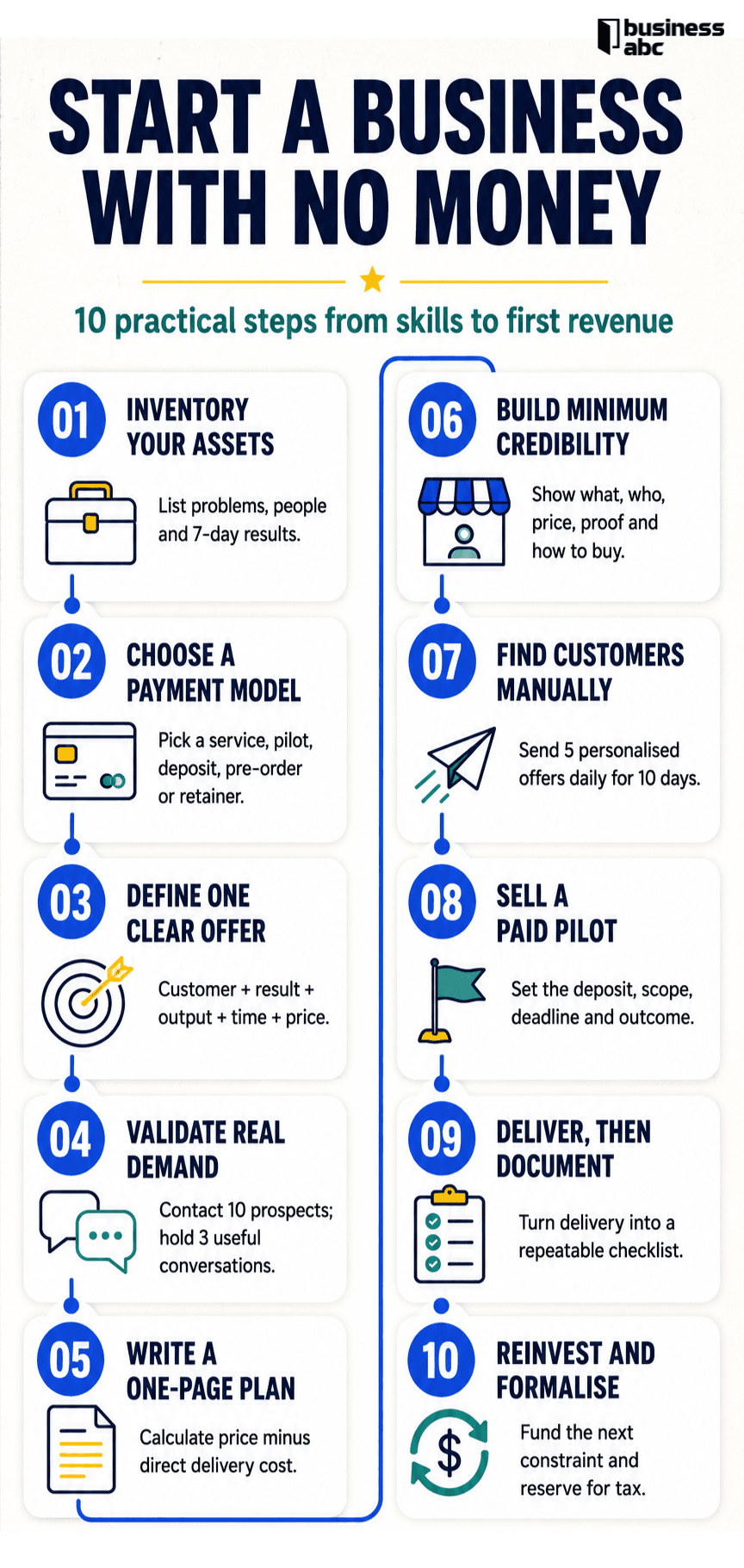
Step 1: Inventory what you already have
Start with assets, not aspirations. List your skills, work experience, tools, transport, spare time, licences, community connections and access to potential customers. A laptop is useful, but an existing reputation or trusted relationship can be more valuable.
Do this now: Create three lists: problems you can solve, people you can reach and results you can deliver within seven days.
Step 2: Choose a customer-funded business model
A service-first model is normally the fastest route because the customer pays for your time and expertise. Other low-cash options include deposits, retainers, pre-orders, commissions, subscriptions, consignment and revenue-sharing. Do not begin with inventory unless customers have already committed to buying it.
Do this now: Pick one payment model: fixed-fee service, paid pilot, deposit, pre-order or monthly retainer.
Step 3: Define one customer, one problem and one offer
“I help small businesses with marketing” is too broad. A strong early offer identifies the buyer, painful problem, concrete output, delivery time and price. For example: “I turn one founder interview into ten LinkedIn posts within five days for $350.”
Do this now: Write your offer in this format: I help [customer] achieve [result] by delivering [output] within [time] for [price].
Step 4: Validate demand before building
Speak directly with potential customers. Ask how they currently handle the problem, what it costs them, what they have already tried and what would make them switch. Compliments are not validation. A booked call, letter of intent, deposit, pre-order or paid pilot is stronger evidence.
Do this now: Contact ten prospects and aim for three detailed conversations before creating a website or purchasing tools.
Step 5: Write a one-page business plan
A no-money startup still needs basic economics. Record the customer, offer, sales channel, delivery process, price, variable cost, weekly capacity and immediate risks. Estimate how many sales you need to cover unavoidable expenses and replace a chosen amount of personal income.
Do this now: Create a one-page plan and calculate contribution per sale: price minus the direct cost of delivering that sale.
Step 6: Create a minimum credible presence for free
You do not need a sophisticated brand. Use a clear business name, professional email, one-page description, sample or portfolio evidence, payment method and simple agreement. A well-written profile or document can be enough to close the first customer.
Do this now: Build only the assets required to answer: What do you do, who is it for, what does it cost, why should I trust you and how do I buy?
Step 7: Find the first customers manually
Start with warm contacts, former colleagues, local groups, professional communities, direct outreach and referral partners. Personalised conversations outperform broad unpaid posting when the business is new. Describe the customer’s problem and proposed result rather than sending a generic introduction.
Do this now: Send five personalised offers per day for ten working days and track replies, calls, objections and sales.
Step 8: Sell a paid pilot, not unlimited free work
A paid pilot lowers risk for both sides while proving whether the customer values the result. Keep the scope, timeline and success measure precise. If you need proof, create one small sample or conduct a short diagnostic, but avoid weeks of unpaid delivery.
Do this now: Offer a tightly scoped first engagement with a deposit, delivery date, revision limit and defined outcome.
Step 9: Deliver manually and document the process
Do not automate a process that has not worked manually. Deliver the first jobs yourself, note every step, measure the time required and record recurring customer questions. Ask for permission before using results, quotes or client materials in marketing.
Do this now: After delivery, write a checklist covering intake, production, quality control, handover, payment and follow-up.
Step 10: Reinvest revenue and formalise at the right time
Use early revenue to remove the next constraint: required registration, insurance, a domain, better equipment, software or specialist support. Formalisation should not be postponed when the law, a contract, liability risk, tax rules or an industry licence requires it.
Do this now: Keep business income separate, reserve money for taxes and prioritise spending that increases capacity, quality or customer acquisition.
What may still cost money
A zero-budget launch does not cancel legal or operational obligations. Requirements depend on the business structure, location and industry. The SBA notes that some founders operating under their own legal name may not need to register immediately, while LLCs, corporations, partnerships and businesses using a DBA commonly face state or local filings. SBA guidance says state registration is often below $300, but the amount varies.
| Possible cost | When it may apply | How to control it |
|---|---|---|
| Registration or DBA | Entity formation or trading under a name other than your legal name | Check state, county and city requirements before paying a filing service |
| Licences and permits | Regulated activities, locations, food, transport, care, construction and other industries | Search official state and local sites; do not rely on generic checklists |
| Insurance | Customer contracts, professional liability, vehicles, property, employees or higher-risk work | Start with the coverage required by law or contract and obtain several quotes |
| Tax and bookkeeping | Once income begins, and sometimes before depending on the entity | Track every payment and expense from day one; reserve cash for tax |
| Payment processing | Cards, marketplaces and invoicing platforms | Price fees into the offer or use lower-cost payment methods where appropriate |
| Equipment or materials | When existing tools cannot safely or professionally deliver the work | Rent, borrow, buy used, take deposits or schedule purchases after payment clears |
EIN WARNING An Employer Identification Number is free when obtained directly from the IRS. Do not pay a third-party website simply to submit the application. If you are forming an LLC, partnership, corporation or other legal entity, complete the state formation first; the IRS warns that applying for the EIN before legal formation may delay processing. |
How to fund a business when you have no savings
Funding should follow evidence, not replace it. Before seeking debt or investors, ask whether the business can be financed by the customer or by a partner who directly benefits from the sale.
- Customer deposits: Collect part of the project fee before work begins. Use a written scope and refund policy.
- Pre-orders: Sell a defined product before producing it. State the delivery date and risks clearly.
- Retainers or subscriptions: Exchange recurring access or delivery for predictable monthly revenue.
- Supplier terms or consignment: Negotiate payment after sale or place goods with a seller without transferring ownership immediately.
- Revenue-share partnerships: A partner supplies distribution, equipment or fulfilment in exchange for an agreed share.
- Competitions and targeted grants: Apply only when the eligibility and use of funds match the business. Federal grants are opportunity-specific, and many are not designed as general startup cash.
- Microloans or community lenders: Consider after validating demand and understanding repayment. Debt turns an uncertain business outcome into a fixed obligation.
Do not build a plan around winning a grant. Grants.gov requires applicants to check the legal eligibility in each funding opportunity, and applying to an ineligible programme wastes time. Treat grants as targeted funding for qualifying work, not the default way to launch an ordinary small business.
A practical 30-day launch plan
| Period | Objective | Actions | Evidence |
|---|---|---|---|
| Days 1–3 | Select the offer | Inventory assets; choose one customer and problem; write one result-based offer | One clear offer and a list of 20 prospects |
| Days 4–10 | Validate | Run ten conversations; record language, urgency, alternatives and objections | Three qualified prospects or a reason to change direction |
| Days 11–17 | Sell | Send personalised outreach; ask for referrals; offer a defined paid pilot | One paid pilot, deposit or pre-order |
| Days 18–24 | Deliver | Complete the work manually; communicate progress; measure time and cost | Customer receives the promised result |
| Days 25–30 | Improve | Collect feedback; request a testimonial; document delivery; reinvest revenue | A revised offer and a repeatable checklist |
Free support and resources for US founders
The SBA and its resource partners offer free or low-cost counselling and training. Depending on location and eligibility, founders can use Small Business Development Centers, SCORE mentors, Women’s Business Centers, Veterans Business Outreach Centers and SBA district offices. SCORE states that its mentoring is free for the life of the business.
- Use a mentor to pressure-test the offer, pricing and cash-flow assumptions—not to outsource the decision.
- Bring specific evidence: customer notes, proposed pricing, expected costs and current obstacles.
- Confirm legal and tax questions with the appropriate government agency or qualified professional.
Common mistakes when starting without money
- Waiting for a perfect brand: Customers pay for a useful result, not an elaborate launch identity.
- Building before selling: A website, app or inventory does not prove that anyone will buy.
- Offering everything: A narrow offer is easier to explain, price, sell and deliver.
- Working for free too long: Free samples should reduce uncertainty, not replace a paid engagement.
- Ignoring taxes and licences: Low revenue does not automatically remove compliance obligations.
- Taking debt before validation: Debt must be repaid even when demand does not appear.
- Using personal accounts indefinitely: Mixed finances make bookkeeping, tax preparation and performance analysis harder.
- Buying automation too early: Manual delivery reveals what the process actually requires.
Frequently asked questions
What business can I start with no money?
Service businesses are usually the most realistic because they can be delivered with existing skills and tools. Examples include tutoring, virtual assistance, cleaning, content services, bookkeeping support, pet care and project coordination. Choose based on accessible customers and a problem they already pay to solve.
Can I start a business without registering it?
Sometimes. SBA guidance notes that a person operating under their legal name may not need to register in some circumstances. Requirements change with location, business structure, trading name and industry. Check state and local rules before trading.
Do I need an LLC to start a business?
Not every business must begin as an LLC. Entity choice affects liability, tax, administration and fundraising. A sole proprietorship may be simpler, but it does not create the same legal separation. Consider the risks and obtain professional advice where needed.
Can I get an EIN for free?
Yes. The IRS provides EINs free through its official application process. Avoid websites charging a fee merely to obtain one on your behalf.
How can I advertise a new business for free?
Begin with direct outreach, referrals, useful participation in relevant communities, local partnerships and proof from completed work. Organic social media can support this, but posting without direct conversations rarely creates predictable early sales.
Are there government grants to start any small business?
No general grant is guaranteed for every startup. Grants are tied to specific programmes, applicants and permitted uses. Read the full eligibility and application instructions before investing time in an application.
Should I quit my job before starting?
Usually not before demand is proven and personal finances can absorb uncertainty. A staged launch can protect cash flow while you test the offer, subject to employment agreements, conflicts of interest and time constraints.
When should I spend money on the business?
Spend when the purchase is legally required, reduces a material risk, enables a confirmed sale or removes a measured delivery constraint. Avoid spending primarily to feel more established.
Final checklist
- I can name the customer and the urgent problem.
- My offer states the outcome, scope, timeline and price.
- I have spoken with at least ten potential customers.
- I know which evidence would make me continue, change or stop.
- I can deliver the first version using resources already available.
- I have checked registration, licence, insurance and tax requirements.
- I have a written payment and delivery agreement.
- I will keep records and reserve part of revenue for taxes.
- I know exactly how the first revenue will be reinvested.
Final takeaway
Starting a business with no money is not about avoiding every cost. It is about changing the order of operations: identify a real problem, sell a narrow solution, collect evidence and revenue, deliver manually, then invest. This protects scarce cash and forces the business to earn the right to become more complex.
The strongest first milestone is not a registered name, polished logo or large audience. It is a customer who understands the offer, agrees to the terms and pays for a result you can deliver responsibly.


