
Businesses
How to Use the AI Global Regulations Atlas: A Step-by-Step Guide
05 Nov 2026

Learn how to use the AI Global Regulations Atlas by Dinis Guarda: search a country, recolour the world map, run the exposure check, read the timeline and filter the directory of 109 jurisdictions.
The AI Global Regulations Atlas is an interactive tool from Businessabc and the Ztudium group, created by Dinis Guarda. It tracks 1,170 AI laws, bills, decrees, guidelines and national strategies across 109 countries and jurisdictions, mapped by regulatory model, status and maturity. This guide walks through each part of the Atlas in the order most people will want to use it.
Open the Atlas: businessabc.net/page/ai-global-regulations-atlas
How the Atlas Is Laid Out
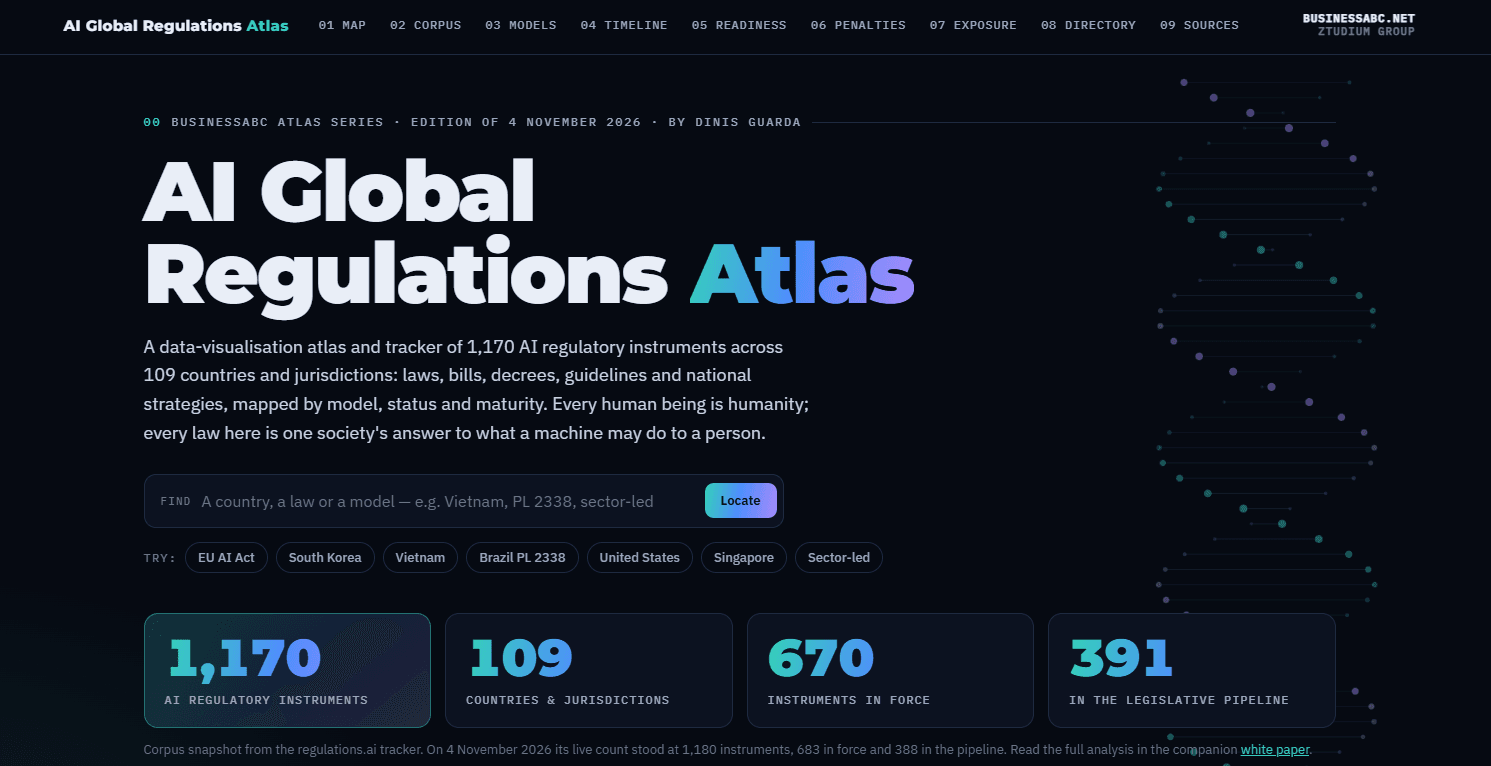
The Atlas is a single scrolling page. A menu bar at the top jumps to each of nine numbered sections:
- Map: the world map of AI law
- Corpus: the 1,170 instruments by type, status and year
- Models: the six regulatory models
- Timeline: milestones and deadlines, 2019 to 2028
- Readiness: responsible-AI and preparedness rankings
- Penalties: maximum fines compared
- Exposure: the exposure check
- Directory: all 109 jurisdictions in a sortable table
- Sources: method and links
Four headline figures sit at the top of the page: 1,170 instruments, 109 countries and jurisdictions, 670 in force and 391 in the legislative pipeline. These come from a snapshot of the regulations.ai tracker, whose live count on 4 November 2026 stood at 1,180 instruments, so small differences are expected.
Step 1: Find a Country, Law or Model
The quickest way in is the Find box at the top of the page.
- Type a country, a law or a model, such as "Vietnam", "PL 2338" or "sector-led". Suggestions appear as you type.
- Select Locate.
- The page scrolls to the map and opens that jurisdiction's profile. If the search matches a model rather than a country, the map filters to that model instead.
Under the box, the Try shortcuts give one-click examples: EU AI Act, South Korea, Vietnam, Brazil PL 2338, United States, Singapore and Sector-led.
Step 2: Read the World Map
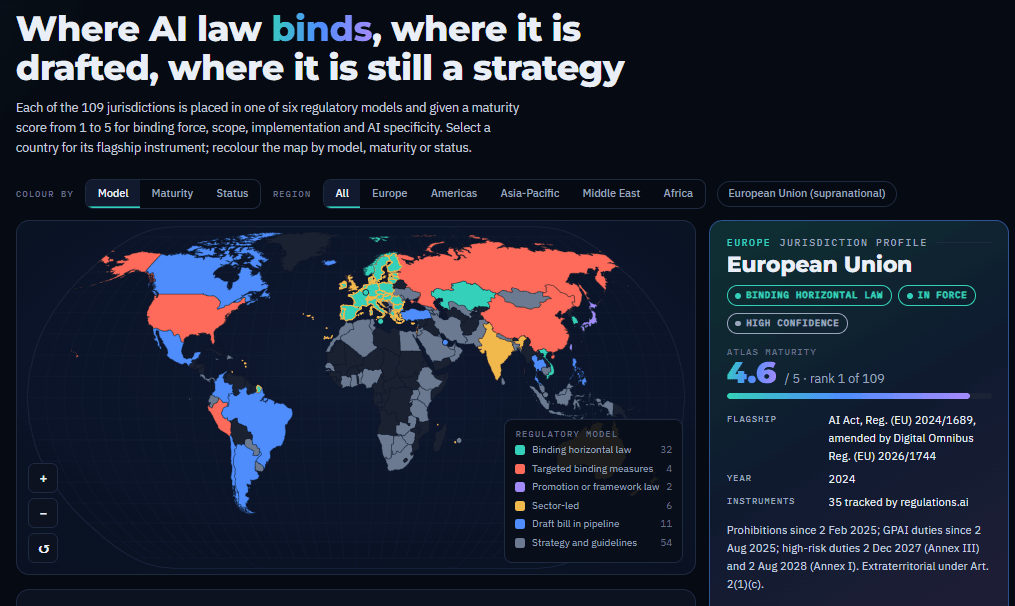
The map places each of the 109 jurisdictions in one of six regulatory models and gives each a maturity score from 1 to 5, based on binding force, scope, implementation and AI specificity.
Recolour the map. Under Colour by, choose:
- Model, to see the regulatory approach of each country
- Maturity, to see the 1 to 5 score as a colour scale
- Status, to see whether the flagship instrument is in force, in the pipeline, or strategy and guidance
Narrow the region. Under Region, choose All, Europe, Americas, Asia-Pacific, Middle East or Africa.
Move around. Use + and − to zoom, and ↺ to reset the view. Hover over a country for a quick tooltip.
Open a profile. Select any country to load its Jurisdiction profile beside the map. It shows:
- Its regulatory model, status and confidence rating
- Its Atlas maturity score out of 5, and its rank out of 109
- Its flagship instrument and the year
- The number of instruments tracked for it
- A short note, and for EU member states a line confirming that the EU AI Act applies directly
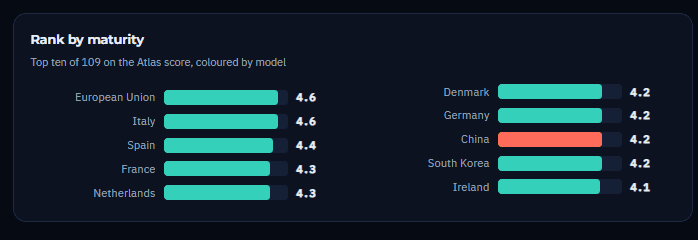
The European Union (supranational) button loads the EU's own profile. Below the map, Rank by maturity lists the top ten of 109, coloured by model.
Filter by model from the legend. When the map is coloured by Model, select a model in the legend to isolate it. Select it again to clear the filter.
Step 3: Understand the Six Regulatory Models
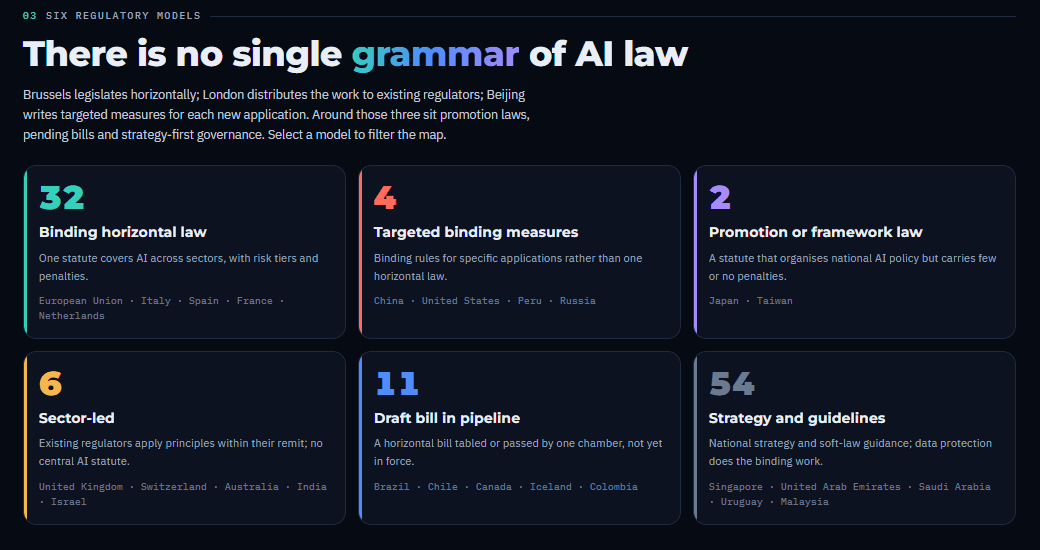
The Models section explains the colours. Select a model card to filter the map to it.
- Binding horizontal law: one statute covers AI across sectors, with risk tiers and penalties.
- Targeted binding measures: binding rules for specific applications rather than one horizontal law.
- Promotion or framework law: a statute that organises national AI policy but carries few or no penalties.
- Sector-led: existing regulators apply principles within their remit; there is no central AI statute.
- Draft bill in pipeline: a horizontal bill tabled or passed by one chamber, not yet in force.
- Strategy and guidelines: national strategy and soft-law guidance, with data protection doing the binding work.
Knowing the model tells a team what kind of obligation to expect before it reads any legal text.
Step 4: Check the Corpus
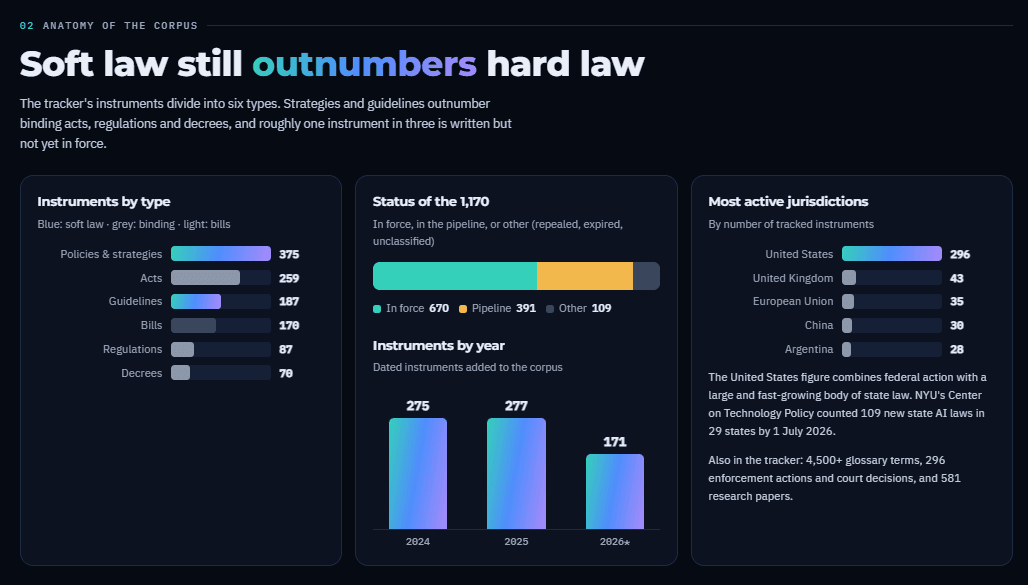
The Corpus section shows what the 1,170 instruments are made of:
- Instruments by type: policies and strategies (375), acts (259), guidelines (187), bills (170), regulations (87) and decrees (70)
- Status of the 1,170: 670 in force, 391 in the pipeline and the remainder in other states
- Instruments by year: dated instruments added to the corpus, 2024 to 2026
- Most active jurisdictions: ranked by number of tracked instruments
Read the counts with care. A high number is not the same as strict rules: the United States combines federal action with a large body of state law, yet has no binding federal AI statute.
Step 5: Run the Exposure Check
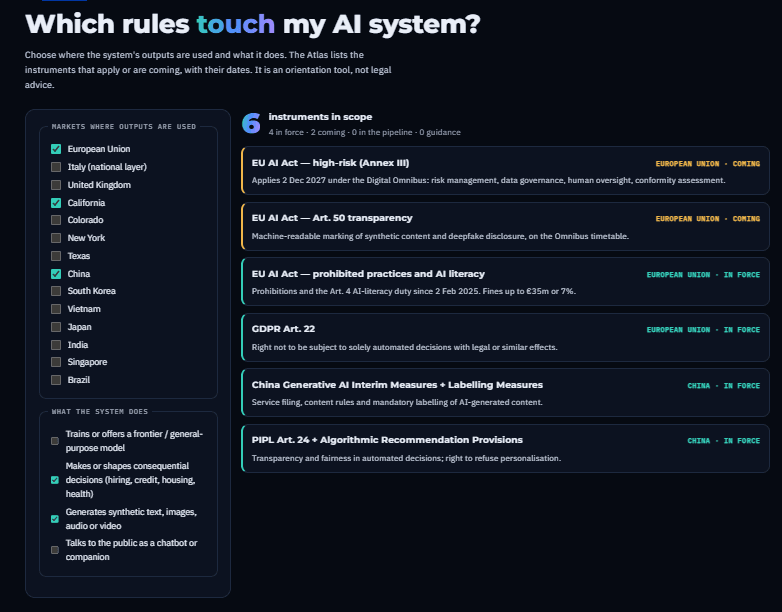
The exposure check answers the most practical question: which rules touch my AI system? It updates instantly, with no button to press.
Choose the markets. Under Markets where outputs are used, tick every market that applies. The options are European Union, Italy (national layer), United Kingdom, California, Colorado, New York, Texas, China, South Korea, Vietnam, Japan, India, Singapore and Brazil.
Choose what the system does. Under What the system does, tick every activity that applies:
- Trains or offers a frontier / general-purpose model
- Makes or shapes consequential decisions (hiring, credit, housing, health)
- Generates synthetic text, images, audio or video
- Talks to the public as a chatbot or companion
Read the results. A counter shows how many instruments in scope match, split into in force, coming, in the pipeline and guidance. Each result card gives the instrument name, the market, its status and a short summary of the duty. Cards are colour-coded by status: in force, coming, pipeline or guidance.
Some instruments, such as the EU AI Act's prohibited practices, apply to every activity, so they appear whenever the market is ticked. The check starts with the EU, California and China, and with synthetic-content generation and consequential decisions, already selected. Untick them to start from a blank slate.
Note: the exposure check is an orientation tool, not legal advice.
Step 6: Follow the Timeline
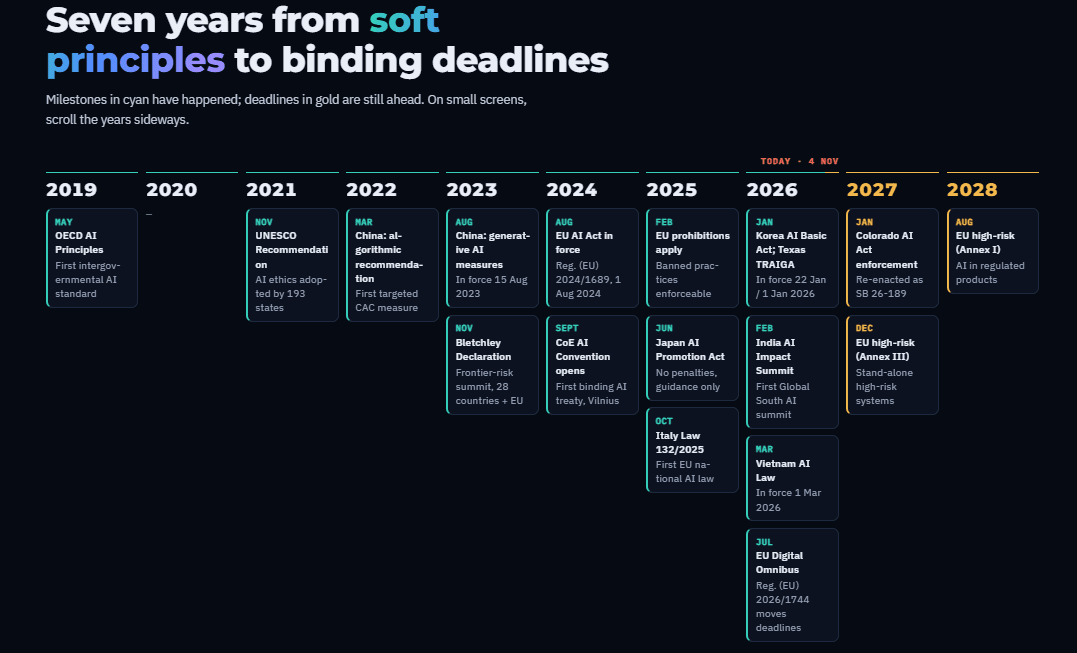
The Timeline runs year by year from 2019 to 2028. A Today · 4 Nov marker sits in 2026. Milestones in cyan have happened; deadlines in gold are still ahead. On a phone, scroll sideways to move between years.
Key dates to find include the EU AI Act in force (1 August 2024), the Korea AI Basic Act (22 January 2026), Vietnam's AI Law (1 March 2026), the EU Digital Omnibus (July 2026), Colorado AI Act enforcement (January 2027), and EU high-risk obligations for Annex III systems (December 2027) and Annex I systems (August 2028).
Step 7: Compare Readiness and Penalties
Readiness. This section shows the top ten of the Global Index on Responsible AI 2026 (a global average near 35 out of 100) and of the IMF AI Preparedness Index, which scores 174 economies from 0 to 1. Six circular gauges below summarise global findings, such as the share of Global South frameworks that are non-binding.
Penalties. A bar chart compares maximum fines for the most serious breach, converted to euros at approximate November 2026 rates and drawn on a logarithmic scale. It covers the EU AI Act (€35 million or 7% of turnover), EU GDPR, UK GDPR, Brazil's PL 2338 bill, Qatar, the UAE, Singapore's PDPA, Kuwait, the South Korea AI Basic Act (KRW 30 million, paused) and Japan (no penalties). Percentage-of-turnover caps apply when higher.
Step 8: Use the Directory
The Directory lists all 109 jurisdictions in one table.
- Search by country name or instrument.
- Use the Region and Model drop-downs to narrow the list.
- Select a column heading to sort by it, and select it again to reverse the order. The columns are Jurisdiction, Region, Model, Maturity, Status, Year, Flagship instrument and Confidence. The table opens sorted by Maturity, highest first.
- Select any row to jump back to the map, with that country's profile open.
The Confidence column shows how directly a classification rests on primary or high-quality secondary sources. Check lower-confidence entries against official texts first.
A Simple Workflow for Teams
- Use Find or the map to open the profile of each market that matters.
- Run each AI system through the exposure check.
- Note deadlines from the timeline and add them to the product roadmap.
- Use the penalty chart to decide where to focus first.
- Use the directory to shortlist or compare markets.
- Confirm every finding in the official text of the instrument.
What to Keep in Mind
Instrument totals, types and statuses come from the regulations.ai tracker. Responsibility scores come from GIRAI 2026, readiness scores from the IMF AI Preparedness Index, and investment, incident and trust figures from the Stanford HAI AI Index 2026. The model, maturity score and confidence rating are the Atlas's own editorial judgements as of 4 November 2026, shown with their sources so that users can check them. The Atlas is not legal advice, so always consult the official text of an instrument and qualified counsel.
Sources
- AI Global Regulations Atlas (interactive tool), Businessabc
- AI Global Regulations Atlas: Mapping the Law of Intelligence, Dinis Guarda, Businessabc, 4 November 2026
- regulations.ai, global AI regulation tracker
- Global Index on Responsible AI, 2026 edition
- IMF AI Preparedness Index (World Bank Data360)
- Stanford HAI, AI Index Report 2026
Share

Sara Srifi
Sara is a Software Engineering and Business student with a passion for astronomy, cultural studies, and human-centered storytelling. She explores the quiet intersections between science, identity, and imagination, reflecting on how space, art, and society shape the way we understand ourselves and the world around us. Her writing draws on curiosity and lived experience to bridge disciplines and spark dialogue across cultures.


