
business resources
How WooCommerce Stores Can Simplify Complex Product Configuration
28 Sept 2026

Selling customizable products online can create valuable opportunities for e-commerce businesses. Customers increasingly expect to have control over what they buy, from colours and materials to dimensions, components, and additional features. For businesses, however, offering this level of flexibility can make the online buying process considerably more complex.
A product with only a few options can usually be managed through standard product variations. But as the number of possible combinations grows, businesses can face more complicated pricing, compatibility issues, customer questions, and order-management challenges.
This is where product configuration can make a difference.
Instead of asking customers to navigate long lists of options and work out combinations themselves, businesses can use structured configuration experiences to guide customers through the process. The goal is not simply to offer more choices, but to make those choices easier to understand, manage, and purchase.
Why Complex Product Configuration Is Difficult to Manage Online
Customization can be a strong selling point, but it also introduces complexity on both sides of an e-commerce transaction.
A customer might want to configure a sofa by selecting its dimensions, fabric, colour, leg style, and additional components. A manufacturer might need buyers to specify materials, technical specifications, components, and quantities.
When all of these choices are presented through basic dropdown menus or separate product variations, the experience can quickly become difficult to follow.
Too Many Choices Can Overwhelm Customers
Giving customers more options does not automatically create a better shopping experience.
When shoppers are presented with dozens of combinations at once, they may struggle to understand which options work together or which choices are most appropriate for their needs.
This can create decision fatigue and make the buying process feel more complicated than necessary.
A well-designed configuration experience can instead organize options into logical steps, allowing customers to focus on one decision at a time.
Product Variations Can Become Difficult to Manage
WooCommerce provides different ways for businesses to manage product options and configurations. Variable products can be useful when customers need to choose between related attributes, while more complex products may require multiple components to be managed separately.
Businesses can refer to WooCommerce's documentation on configurable products when considering how different product structures can be handled.
The challenge becomes greater when businesses have to manage pricing, inventory, compatibility, and product information across a large number of possible combinations.
For the store owner, the issue is therefore not only how customers select a product. It is also how those selections are captured and processed after the order is placed.
What a Product Configurator Changes
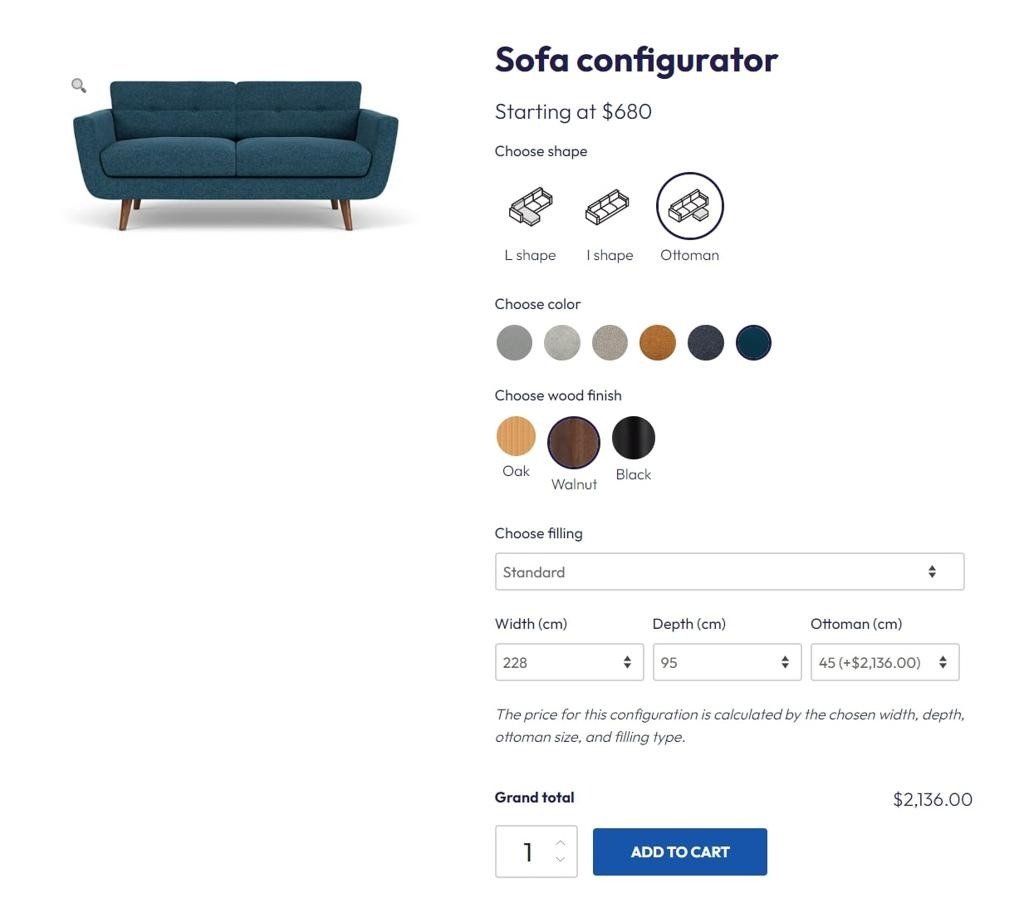
A product configurator gives customers a more structured way to build or customize a product.
Instead of presenting every possible option at once, the experience can guide customers through a sequence such as:
Choose → Customize → Visualize → Review → Buy
This approach can make complex products easier to understand while giving businesses greater control over what customers can select.
A configurator can also apply rules to the available options. If one selection affects another, the system can adjust the available choices accordingly.
For example, selecting a particular sofa frame might limit the available cushion configurations. A customer does not need to understand the technical reason behind the restriction; they simply see the options that are compatible with their current selection.
That can make customization feel much more intuitive.
How WooCommerce Stores Can Simplify Product Configuration
1. Organize Product Options Into Clear Steps
One of the simplest ways to improve customization is to organize product choices into a logical sequence.
Instead of presenting every option on one screen, businesses can group related decisions together.
A furniture store, for example, might guide customers through:
- Product type
- Dimensions
- Material
- Colour
- Components
- Accessories
- Final review
This structure gives customers a clearer path through the buying process.
It can also help businesses present product information in a way that reflects how customers naturally make purchasing decisions.
2. Show Customers the Product as They Customize It
Text and dropdown menus can tell customers what they are selecting, but visual feedback can help them understand what those choices actually mean.
This is particularly useful for products where appearance, size, or configuration has a major influence on the buying decision.
A customer choosing furniture, for example, may want to see how a different fabric, colour, or configuration changes the final product.
Product visualization can provide that feedback while the customer is making their selections.
For businesses exploring 3D and augmented reality as part of their e-commerce strategy, Shopify's guide to 3D commerce provides an overview of how these technologies can give shoppers additional ways to interact with products online.
The technology does not need to be complicated simply for the sake of appearing innovative. The objective should be to give customers useful visual information at the point where they need it.
3. Keep Pricing Connected to Product Choices
Customization often affects the final price.
A basic product may have one price, while premium materials, larger dimensions, additional components, or upgraded features can increase the total.
If these calculations are handled manually, customers may have to submit an inquiry and wait for the business to confirm the final price.
A structured configuration experience can instead connect product choices with pricing rules.
For example:
Base product + premium material + additional component = updated total price
WooCommerce's configurable product documentation demonstrates how configurable products can use different components and pricing structures.
For business owners, the benefit goes beyond convenience. Clear pricing during configuration can reduce uncertainty for customers and reduce the amount of manual work required from sales teams.
4. Prevent Customers From Choosing Incompatible Options
Not every product option works with every other option.
This is particularly important for businesses selling technical, modular, or highly customizable products.
A customer might select a component that is unavailable with their chosen base product. If the website allows the combination, someone from the business may eventually have to contact the customer and correct the order.
Configuration rules can help prevent this situation.
For example:
If A is selected → B becomes unavailable.
This type of logic allows the system to guide customers toward valid combinations while reducing the risk of incorrect orders.
It can be particularly useful for manufacturers, furniture companies, kitchen businesses, and other companies where products have many possible configurations.
5. Connect Configuration With the Checkout Process
A product configuration experience should not feel disconnected from the rest of the online store.
Once a customer has finished configuring a product, the selected options should ideally move naturally into the cart and checkout process.
The journey should feel like one continuous experience:
Configure → Review → Add to Cart → Checkout
This is important because customization can involve many individual decisions. Asking customers to repeat those choices at checkout creates unnecessary friction.
For businesses, keeping configuration connected to the purchasing process can also make order information easier to manage.
The more structured the information captured during configuration, the easier it can be for teams to understand what the customer actually ordered.
Choosing a Product Configurator for WooCommerce
For businesses already using WooCommerce, choosing a product configurator for woocommerce should involve more than comparing the number of customization features available.
Store owners should consider how the solution handles product rules, pricing, visualization, mobile usability, and integration with the existing sales process.
Consider Product Complexity
Start by looking at how complicated the products actually are.
Ask:
- How many options does each product have?
- How many combinations are possible?
- Do some options affect others?
- Does customization change the price?
- Does inventory need to be tracked at component level?
- Do customers need to see a visual representation of their choices?
A simple product with two or three options may not require an advanced configuration system.
A product with hundreds or thousands of possible combinations is a different situation.
Consider the Customer Experience
A configurator should simplify customization rather than create another layer of complexity.
Store owners should look for an experience that offers:
- Clear navigation
- Logical configuration steps
- Visual feedback where useful
- Straightforward instructions
- Fast loading
- Mobile compatibility
- An easy final review
Customers should always understand what they are selecting and how those selections affect the finished product.
Consider Business Operations
The customer-facing experience is only one part of the decision.
Businesses should also consider what happens after an order is placed.
Configuration information may need to support:
- Order processing
- Inventory management
- Production
- Fulfillment
- Sales teams
- Customer support
A solution that looks impressive on the front end but creates additional manual work behind the scenes may not solve the underlying business problem.
Which WooCommerce Businesses Can Benefit From Product Configuration?
Product configuration can be useful across several types of e-commerce businesses.
Furniture and Interior Brands
Furniture often involves combinations of dimensions, materials, colours, finishes, components, and layouts.
A structured configuration experience can help customers explore those options without having to contact a salesperson for every variation.
Custom Manufacturers
Manufacturers can use configuration to help customers specify products according to their requirements.
This can be especially useful when products contain technical specifications or component dependencies.
Home Improvement Businesses
Businesses selling kitchens, cabinets, flooring, lighting, doors, windows, and similar products can benefit from giving customers a clearer way to build and visualize their selections.
Personalized Consumer Products
Product configuration can also support personalization for products where customers select colours, materials, accessories, sizes, or other features.
B2B E-Commerce
Configuration is not limited to consumer shopping.
B2B buyers may also need to select technical specifications, components, quantities, and compatible options before placing an order.
For these businesses, simplifying configuration can reduce the amount of manual interaction required during the sales process.
The Business Benefits Go Beyond Customer Experience
A better configuration experience can affect more than the customer-facing side of an online store.
Fewer Manual Questions
Customers can find answers through the configuration process instead of contacting sales or customer support for every possible combination.
More Consistent Orders
Structured selections can reduce misunderstandings about what a customer intended to purchase.
More Efficient Sales Processes
Sales teams can spend less time explaining basic product combinations and more time handling higher-value customer conversations.
Better Product Data
When configuration choices are captured systematically, businesses can have a clearer record of what was selected.
More Scalable Customization
This may be one of the most important benefits for growing businesses.
Companies may want to offer customers more flexibility without increasing their manual workload at the same rate.
A well-designed configuration system can help businesses manage greater product complexity while keeping the buying process structured.
Avoid Making Customization More Complicated
Adding customization technology does not automatically improve an e-commerce store.
In fact, businesses can make the experience worse if they add too many choices, unnecessary steps, or complicated interfaces.
Common problems include:
- Showing too many options at once
- Using technical language customers do not understand
- Creating excessive configuration steps
- Making the experience difficult to use on mobile devices
- Providing little or no visual feedback
- Separating configuration from checkout
- Making pages slow to load
The goal should not be to give customers as many decisions as possible.
The goal is to make the necessary decisions easier to make.
That distinction is important when designing any product customization experience.
From Product Configuration to a Better E-Commerce Experience
Product configuration is ultimately one part of a broader digital customer experience.
Even the most effective configurator cannot replace clear product descriptions, useful photography, transparent pricing, customer reviews, straightforward navigation, and a reliable checkout process.
Businesses should also consider what happens after the sale. Order communication, fulfillment, delivery, and customer support all contribute to how customers experience a brand.
This is where product configuration can become part of a larger digital transformation strategy rather than simply another feature added to an online store.
The objective is to connect the different parts of the customer journey so that the experience feels consistent from product discovery through purchase and fulfillment.
Businesses exploring broader approaches to digital transformation in business can also look at how technology is changing processes beyond the storefront itself.
Final Thoughts
For WooCommerce businesses selling products with many possible combinations, the challenge is not simply offering customization. It is making that customization easy to understand, easy to manage, and easy to buy.
Product configuration can help businesses organize complex choices, provide clearer product information, connect selections with pricing, prevent incompatible combinations, and create a smoother path to checkout.
The right approach will depend on the product and the business. A store selling a simple product with a few variations may only need basic WooCommerce functionality. Businesses selling highly customizable furniture, manufactured products, home improvement products, or other complex items may require a more advanced configuration experience.
Ultimately, successful product configuration should serve both sides of the transaction: customers get a clearer way to build what they want, while businesses gain a more structured way to manage complexity.
For growing e-commerce businesses, that balance can be an important part of creating a digital shopping experience that is easier to scale.
Share

Ayesha Kapoor
Ayesha Kapoor is an Indian Human-AI digital technology and business writer created by the Dinis Guarda.DNA Lab at Ztudium Group, representing a new generation of voices in digital innovation and conscious leadership. Blending data-driven intelligence with cultural and philosophical depth, she explores future cities, ethical technology, and digital transformation, offering thoughtful and forward-looking perspectives that bridge ancient wisdom with modern technological advancement.


