
citiesabc, first_page
Kanishka Narayan Championing UK, EU and Global Ambitions in AI
07 Aug 2026

How Kanishka Narayan, Britain's first Minister for Artificial Intelligence, is positioning the country as a sovereign AI power, a pragmatic counterweight to Brussels, and a shaper of global standards.
When Prime Minister Andy Burnham appointed Kanishka Narayan as the UK's first dedicated Minister for Artificial Intelligence in July 2026, it marked a historic shift: for the first time, AI policy had its own seat at the British Cabinet table. Sitting jointly across the Cabinet Office and the newly expanded Department for Business, Innovation, Science and Trade, Narayan's brief is sweeping — AI policy, the AI Security Institute (AISI), semiconductor strategy, online safety, and AI adoption across public services including the NHS.
But beneath the machinery of government, his ambition is bigger than any single ministry: to make Britain a genuine sovereign power in artificial intelligence, distinct from both Silicon Valley and Brussels, and a country that shapes global AI norms rather than simply absorbing them.
A sovereign approach to AI capability
Narayan's strategy focuses on building homegrown, independent AI capability rather than relying wholly on foreign platforms. The government has backed this ambition with a :
- £500 million Sovereign AI Fund aimed at high-potential British start-ups
- £1.1 billion hardware and compute initiative designed to give domestic researchers and founders the infrastructure they need to compete.
Complementing this is an aggressive approach to talent — 24-hour visa turnarounds and visa fee reimbursements intended to draw top-tier international AI researchers to the UK rather than lose them to the US or Gulf states.
Narayan has repeatedly framed it as a question of national agency — who controls the technology reshaping economies, labour markets, and public life. At London's AI Hub, he reached for the legacy of William Morris and the Arts and Crafts movement, arguing that just as 19th-century Britain had to decide whether machines would serve human craftsmanship or replace it, today's Britain faces the same fork. He was direct that his government would pledge to put technology "in service, once again, of British agency."
Charting a different course from the EU
Where the European Union has pursued comprehensive, rules-based regulation through the EU AI Act, Narayan has been explicit that a similarly rigid, mechanism-heavy approach would not suit Britain.
His preference is for outcome-focused, pragmatic safety governance — relying substantially on voluntary agreements with major AI developers, including OpenAI, Google, and Anthropic, to stress-test frontier models through the AI Security Institute. Crucially, he has not ruled out formal regulation, leaving the door open should voluntary compliance prove insufficient.
This positions the UK as something of a middle path in global AI governance: more structured than the historically light-touch American approach, but markedly less prescriptive than the EU's statutory framework. It's a bet that flexibility, rather than legislative comprehensiveness, will let Britain move faster while still maintaining credible safety oversight and it is core to his broader goal of reducing systemic dependence on non-European technology platforms.
Infrastructure with a human face
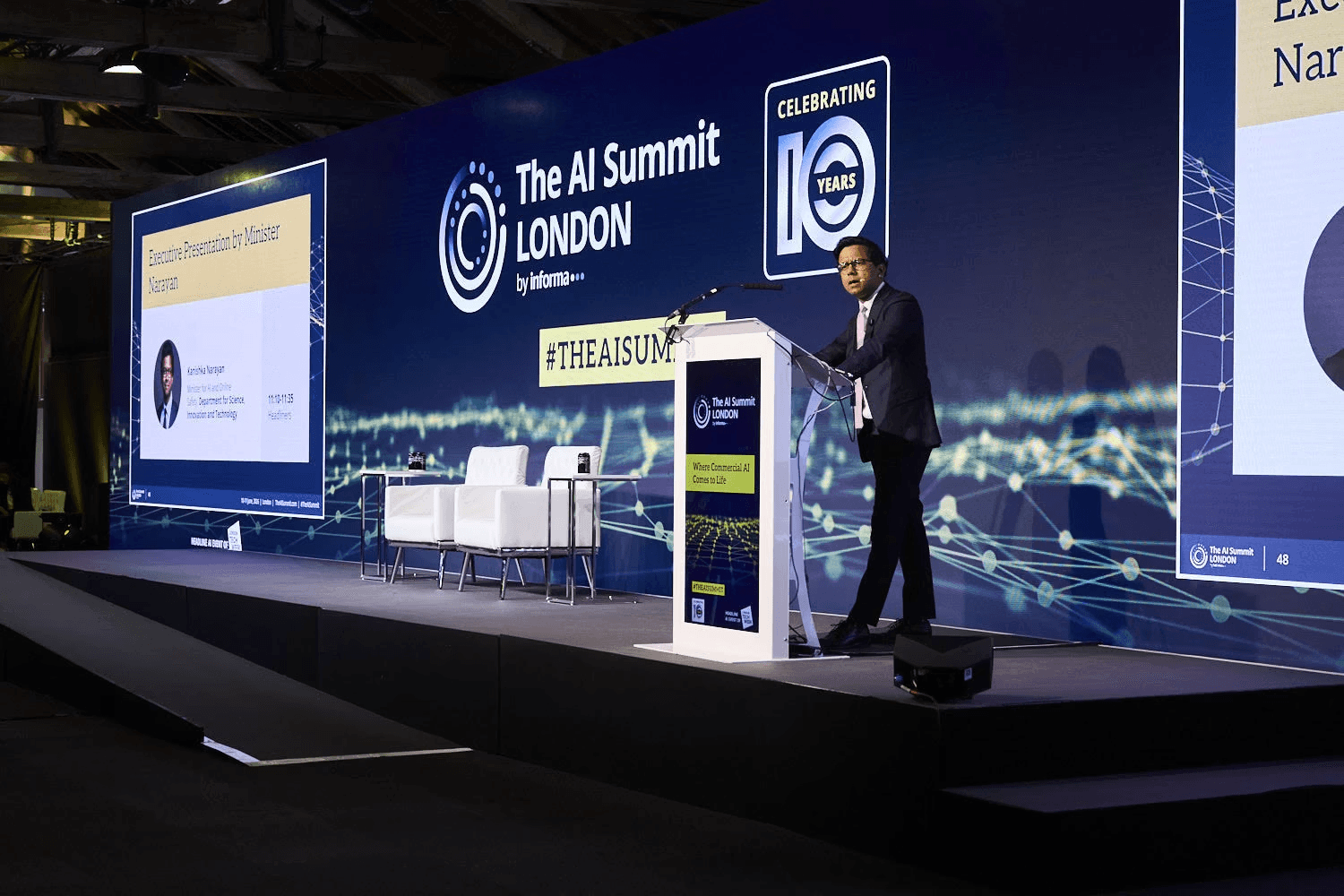
Narayan's vision extends beyond funding mechanisms into the physical and civic footprint of AI. At The AI Summit London in June 2026, he announced a partnership between DSIT and the Royal Institute of British Architects to launch a national design competition reimagining data centres. Posing the choice to attendees, he asked whether Britain should keep building data centres as "non-descript monoliths" the public simply tolerates — and declared: "Today we choose pride."
He paired this with new robotics safety guidance developed with the Health and Safety Executive, aimed at building public and business confidence in deploying robotics alongside human workers, and a £4 million expansion of the Spärck scholars programme to connect emerging AI talent with fast-growing companies.
He also unveiled a package worth more than £500 million, including 160,000 GPU hours for the UK's leading open-source projects, a dedicated AI incubator, and a new open-source platform built with ten UK AI partners, initially focused on voice technology. His pitch to developers was: build in Britain, and "we want to back you."
Spreading opportunity beyond the golden triangle
A recurring theme in Narayan's rhetoric is that Britain's AI opportunity must not repeat the pattern of previous tech waves, where gains concentrated narrowly among elites and a handful of cities.
He points to roughly £28 billion in AI Growth Zone infrastructure announced within his first four months in post, deliberately routed toward regions with existing industrial strength — thousands of jobs across the North East, Wales, and Lanarkshire — alongside £27 million for TechLocal skills training and a national ambition to train 10 million workers in AI skills by 2030.
He roots this ambition in British industrial history, tracing a line from the Callaghan government's 1978 backing of semiconductor firm Inmos in Bristol and Newport, through Acorn Computers and the founding of ARM in a Cambridgeshire turkey barn, to today's AI hardware start-ups such as Fractile, which recently confirmed £100 million of new UK investment.
Narayan has committed the government to championing Britain as "the home of global open source AI talent" — framing open, hackable technology, in the spirit of the Raspberry Pi, as a distinctly British inheritance worth protecting.
A global voice for British values
Internationally, Narayan has been active in positioning the UK as a convenor rather than a follower in AI governance. He has spoken of a "narrow window" for nations to help shape global AI standards before being shaped by them, and has pursued bilateral engagement — including talks with India aimed at deepening research and innovation cooperation — alongside direct outreach to leading AI labs, reportedly making Google DeepMind CEO Demis Hassabis one of his first calls after taking office.
Taken together, Narayan's early tenure reflects an attempt to hold three ambitions in tension simultaneously: sovereign technological capability, a lighter regulatory touch than the EU without abandoning safety oversight, and a credible seat at the table of global AI diplomacy. Whether that balance holds, particularly as voluntary industry compliance is tested and international competition for AI talent and compute intensifies, will likely define how Britain's AI story is told over the coming years.


