
resources
8 Leading AI Consulting Partners for Supply Chain Optimization in Manufacturing
03 Nov 2026

Volatile demand, tight labor, and razor-thin margins keep manufacturing supply chains on edge. One late pallet can idle a line and lock up millions in working capital. That risk is why many manufacturers call on AI consulting partners to modernize planning, forecasting, and execution. We compared eight standout firms—each experts in data engineering, predictive analytics, mathematical optimization, and GenAI—to see which one aligns with your tech stack, industry needs, and risk appetite so you can turn pilots into production value faster.
What AI-powered supply-chain optimization covers
Research shows seventy-two percent of manufacturers use AI in some form, yet only ten percent have scaled it across their operations. The missing link is joining five decision layers into a single learning loop:
- See what is happening now Streaming data from ERP, MES, WMS, and IoT systems lands in a governed lakehouse, giving planners a clean, real-time baseline.
- Predict what comes next Machine-learning models flag demand swings, lead-time spikes, and quality drift hours, or even weeks, before traditional reports surface the issue.
- Decide the best action Mathematical optimization weighs thousands of constraints (capacity, cost, carbon, and service) to recommend a feasible plan.
- Simulate the “what-if” Digital twins replay those decisions across plants, suppliers, and lanes so hidden ripple effects appear before they hit the floor.
- Guide people and systems to act GenAI copilots translate recommendations into plain language, while bounded agents push updates to planning hubs, warehouse tasks, or supplier portals and pause for human sign-off where policy requires it.
Most manufacturers already use one or two of these layers. Few have closed the loop so it learns, adapts, and proves value in real time. The eight partners you’ll meet next specialize in wiring those layers together, covering data engineering, optimization science, and change management to turn isolated pilots into lasting performance gains.
How we chose the eight partners
We started with twenty global and specialist consultancies highlighted in analyst reports, client case studies, partner news, and patent filings. A four-point eligibility test narrowed the field:
- Advise and implement (no software-only vendors)
- Documented AI work in manufacturing supply chains
- At least two public evidence types (for example, an analyst verdict plus a named outcome)
- U.S. or global delivery capacity
Twelve firms met those standards. We then applied eight weighted criteria:
| Criterion | Weight |
| Manufacturing and supply-chain depth | 20% |
| AI and optimization maturity | 15% |
| Documented outcomes | 15% |
| Platform and integration breadth | 15% |
| Proprietary IP and accelerators | 15% |
| Global delivery reach | 10% |
| Analyst and partner recognition | 5% |
| 2025–2026 progress momentum | 5% |
Depth in manufacturing, AI maturity, and measurable results carried the most weight. We ignored “number of AI projects delivered” because providers report that metric inconsistently.
Finally, we ordered the shortlist by buyer fit, not by raw score, so you can go straight to the partner whose strengths match your tech stack, risk tolerance, and growth plans.
With the ground rules set, the next sections map each firm’s capabilities to the five-layer AI stack outlined above.
Snapshot: Eight partners at a glance
All eight firms cover the five-layer AI stack, but they differ along three practical axes:
| Axis | Where each partner sits | Why it matters |
| Platform focus | • Microsoft-first: MCA Connect<br>• Multi-cloud / multi-ERP: Accenture, Deloitte, IBM, Capgemini, Infosys<br>• Hybrid accelerators: Bluecrux, Genpact | Indicates the integration effort with your current stack. |
| Service model | • Build-and-run: Accenture, IBM, MCA Connect<br>• Managed services for planning/control: Genpact<br>• Design-and-build focus: Bluecrux, Capgemini, Deloitte, Infosys | Defines who owns day-to-day KPIs after go-live. |
| Industry depth | • Life sciences & complex CPG: Bluecrux<br>• Discrete manufacturing: MCA Connect<br>• Engineering-led verticals: Capgemini<br>• Cross-industry scale: Accenture, Deloitte, Infosys, Genpact | Shows where each partner has repeatable playbooks and talent. |
Use these axes as a quick filter, and you’ll move faster when the partner’s natural strengths already match your tech landscape, operating model, and regulatory environment.
1. MCA Connect: best for Microsoft-centric manufacturers and distributors
Factories running Dynamics 365 and exploring Microsoft Fabric will find MCA Connect built for their stack.
MCA Connect website screenshot for Microsoft-centric manufacturers
Founded in Denver in 2002 and now a Grant Thornton US company, the firm follows one principle: focus beats breadth. MCA Connect describes itself as “100% supply chain, 100% Microsoft,” so its architects, developers, and data scientists work across Dynamics 365, Power Platform, Azure, and Fabric. Microsoft named it the 2024 US Business Applications Partner of the Year.
Its Fast Track for AI offer produces a one-week AI roadmap, and its industry agents (Smart Sourcing, Warehouse Advisor, Inventory Accuracy, Production Planning, and others) put that roadmap to work. Demand Genius adds AI and machine-learning forecasting, using a champion-versus-challenger model framework across lumpy, intermittent, erratic, and smooth sales patterns.
MCA Connect also ships repeatable IP: the Inspire Platform is a Fabric-based data and analytics platform integrated with Dynamics 365, with more than 60 pre-built dashboards and Copilot chat, and it consolidates data in six to eight weeks. Managed services keep the stack monitored after go-live.
For manufacturers still sizing the opportunity, the firm offers a practical guide to the benefits of AI in manufacturing, which cites research showing that advanced analytics can improve supply forecast accuracy by 20 to 60 percent.
Best fit. Organizations standardized on Dynamics 365, Azure, and Fabric get the most from MCA Connect’s Microsoft-only depth.
2. Accenture: best for global, multi-platform reinvention
Few providers match Accenture’s scale (more than 20,000 supply-chain specialists) and cross-industry track record. That depth matters when your network spans 20 countries, five ERPs, and a patchwork of MES and WMS versions.

Accenture supply chain and Industry X website screenshot
Recent programs highlight the reach:
- Microsoft Cloud Supply Chain. Accenture helped save hundreds of hours on data preparation and wired digital twins across 34 markets.
- Unilever. Site-level twins cut material waste by about 20 percent and freed extra capacity at several plants.
Accenture’s layered model speeds delivery:
- Strategy. Consultants target high-cash opportunities first.
- Engineering (Industry X). Teams wire sensors, MES connectors, and edge inference on the shop floor.
- Data & AI. Specialists tune forecasting, optimization, and GenAI copilots.
- Managed services. Global crews run planning hubs and control towers for continuous KPI lift.
Platform reach spans Azure, AWS, Google Cloud, SAP, Oracle, Blue Yonder, o9, and Kinaxis, which helps when SAP IBP must feed Microsoft Fabric yet surface decisions in Teams.
Watch-outs. Premium pricing travels with senior talent, so budget accordingly. Rigorous governance keeps work on track, but set crisp accountability early or a 50-slide RACI may slow momentum.
Choose Accenture when a board-level mandate calls for multi-region, multi-platform change and a partner ready to run the engine after go-live.
3. Deloitte: best for strategy, governance, and smart-factory transformation
Boards call Deloitte when every AI decision loop must be audited, explainable, and anchored in a repeatable operating model. Gartner named the firm a Leader in its 2026 Magic Quadrant for supply-chain strategy, planning, and operations consulting, confirming its ability to link C-suite vision with plant-floor execution.
Smart Factory teams deploy digital twins and computer-vision quality gates, while Supply Chain and Network Operations specialists tune demand, inventory, and logistics algorithms. The payoff is measurable: Deloitte’s 2025 Smart Manufacturing and Operations Survey found that manufacturers scaling these technologies report 10 to 20 percent improvements in production output and up to a 20 percent gain in employee productivity.
Physical AI marks the newest growth area. A March 2, 2026 expansion with NVIDIA brings edge robotics and industrial simulation into live production, narrowing the gap between predictive analytics and autonomous execution.
Choose Deloitte if you need a partner that can draft the governance playbook, design the AI stack, and still have engineers on site to calibrate a vision sensor. Set expectations on case transparency early; some flagship wins remain anonymized, so insist on named references that match your footprint and complexity.
4. IBM Consulting: best for risk-orchestrated, hybrid-cloud supply chains
Boards dealing with geopolitical shocks, commodity swings, or sudden quality scares often turn to IBM Consulting for risk-orchestrated resilience. The practice pairs watsonx AI with Red Hat OpenShift to build knowledge graphs that spot risk, run near-real-time simulations, and trigger agent workflows. An AI-powered risk-orchestration solution cuts decision cycle time by more than 95 percent, proactively surfacing emerging issues and providing end-to-end visibility across the network, according to IBM case studies.
IBM’s own “Client Zero” supply chain proves the approach scales. By running its multibillion-dollar hardware and cloud network as a living lab, IBM reports $160 million saved through lower inventory, optimized shipping, and time savings.
Hybrid cloud is the edge. Whether data sits in SAP HANA, Snowflake, or a mainframe, IBM wraps APIs around it and pushes intelligence to the location governance rules allow, which is critical for regulated sectors that balance on-prem kinetics with cloud analytics.
Watch-outs. IBM offerings often include IBM software, so ask for architecture choices if you need vendor neutrality. While IBM Research patents may hint at future value, focus on deliverables that land in the current fiscal cycle.
Choose IBM Consulting if resilience, explainability, and cross-cloud governance lead your agenda, and you want a partner that tests every idea on its own complex supply chain before rolling it out.
5. Capgemini: best for engineering-led IT/OT transformation
Capgemini shines where ERP upgrades, MES retrofits, and robotics rollouts meet. Its Intelligent Supply Chain Operations practice covers demand sensing, touchless planning, and cognitive procurement, while Intelligent Industry engineers wire sensors, PLCs, and vision systems so data flows from robot cell to forecasting model without manual intervention.
The results show. At Brose, re-platforming the supplier portal on SAP BTP cut manual effort by 80 percent, halved supplier-onboarding time, and trimmed support tickets by 20 percent. A multilingual Supplier GPT added in 2025 now handles routine queries, freeing staff for exceptions that matter.
Capgemini also layers AI agents over Blue Yonder or Kinaxis planners to build “autonomous supply chains.” Bentley Motors adopted that approach in 2026 to modernize data foundations and prep its factory for low-volume, high-variety EV production.
Watch-outs. Large programs may involve consultants, system integrators, and product engineers under different P&Ls. Before signing, name one accountable executive, set a shared backlog, and agree on a single success metric.
Choose Capgemini when you need engineering and supply-chain expertise delivered in one coordinated sprint, from shop-floor sensor to boardroom KPI.
6. Infosys: best for multi-ERP modernization and global delivery
Manufacturers wrestling with SAP, Oracle, and home-grown legacy systems turn to Infosys for large-scale cleanup. The firm pairs deep ERP skill with an AI-first accelerator stack:
- Topaz – GenAI services for text-to-SQL, demand-sensing prompts, and code generation
- EdgeVerve AI Next – optimization over order fulfillment and aftermarket parts
- Cobalt – cloud assets that lift data from scattered systems into a governed model
The numbers prove the value. A global CPG company improved 13-week forecast accuracy by six points to 71 percent and cut model runtime by 20 percent. Another client trimmed inventory carrying costs by $16 million a year while giving planners a 20× productivity lift through AI-assisted scenario building.
Scale helps. Blended onshore-nearshore-offshore teams work around the clock, handy when factories on three continents need the next model retrained before the morning shift.
Watch-outs. Large delivery pools can dilute local expertise. Lock in named architects, run a weekly issue burn-down, and define an escalation path before phase two.
Infosys makes sense when you need to harmonize multiple ERPs, modernize data pipelines, and roll out AI-enhanced planning without paying boutique-consultant rates.
7. Genpact: best for operations-led AI and managed services
Genpact stands out for turning redesigned planning processes into 24/7 managed services. Its Planning-as-a-Service model consolidates demand, supply, and inventory planning into a GenAI-powered workflow. AI Maestro handles root-cause analysis, while packaged agents run order promising, shortage recovery, and logistics exceptions.
The impact shows. For a global CPG manufacturer, Genpact lifted on-time-in-full (OTIF) performance by 12 percent over five years and cut inventory by 10 percent after centralizing the planning hub and taking over daily execution. An HFS Horizons case highlighted more than €85 million in savings from an integrated planning centre for a food-and-beverage major.
Technology choices stay pragmatic: Kinaxis or Blue Yonder planners sit on Microsoft or AWS data lakes, enriched by Celonis process mining and surfaced in ServiceNow workbenches. GSolution.ai templates speed deployment for mid-tier plants that can’t fund full custom builds.
Watch-outs. Genpact excels in planning, order, and aftermarket workflows but relies on partners for heavy engineering or factory automation. Some clients ask for tighter alignment between vision slides and frontline training, so lock KPIs into the contract.
Genpact suits manufacturers that want AI-driven planning and order workflows run as a managed service, freeing internal teams to focus on product launches instead of firefighting forecasts.
8. Bluecrux: best specialist for life sciences, CPG, and complex planning
Bluecrux may be smaller than the global SIs, but its impact in highly regulated, high-complexity chains is substantial. The Belgian consultancy aligns quality, supply, and commercial teams inside pharma and biotech networks where a single stock-out can halt treatment.

Bluecrux life sciences and complex planning website screenshot
Its Axon digital-twin platform mirrors every product, plant, and lane in a living model, then layers decision intelligence on top. Sanofi partnered with Bluecrux to implement Axon, creating a twin that provides end-to-end visibility from suppliers to manufacturing, distribution, and end customers.
Where others add software, Bluecrux builds it. Binocs schedules quality-control labs and advanced-therapy work cells; Helion (powered by Anaplan) plans commercial supply for fast-growing biotech brands. In 2026, Bluecrux released the Biotech Commercial Supply Planning Application on the Anaplan platform, turning that expertise into an off-the-shelf app any biotech can deploy in weeks instead of quarters.
Implementation stays hands-on: consultants refine planning rules on the shop floor one day and push code to the digital twin the next. In one case, a top-10 pharmaceutical company linked more than 130 contract manufacturers across 44 live sites, capturing over $2 million in cost avoidance and freeing more than 1,500 hours.
Watch-outs. Bluecrux focuses on process and planning, not full-stack IT or OT modernization. North American reach is expanding through an Astrix partnership, but coverage still leans toward Europe.
Choose Bluecrux when quality regulations, batch complexity, and dynamic demand break generic playbooks; its blend of consulting plus purpose-built software turns planning theory into actions your team can take tomorrow.
How to choose the right partner for your supply chain
Focus on four practical lenses: technology stack, service model, industry depth, and risk posture.
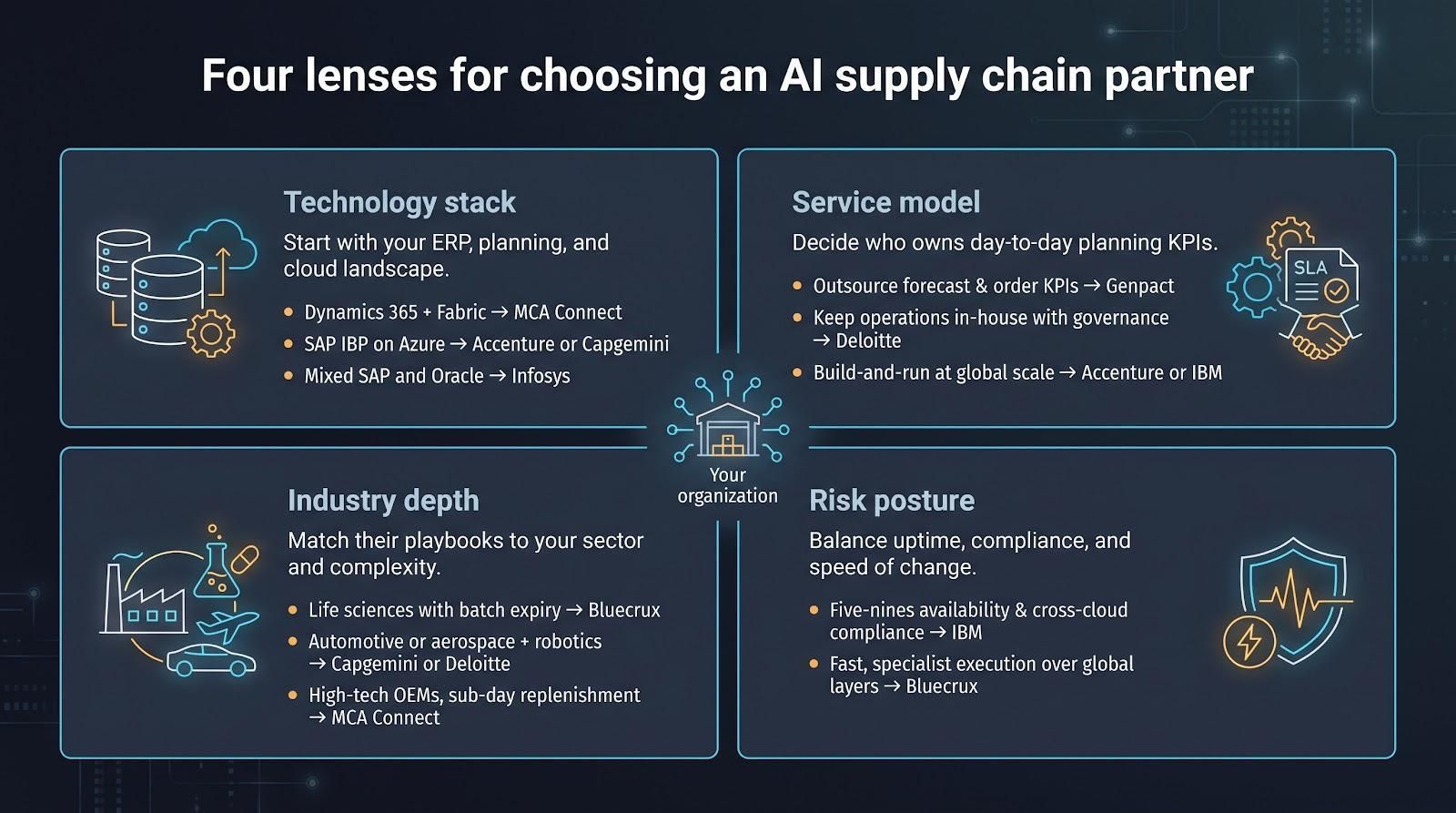
1. Technology stack.
- Dynamics 365 + Fabric → MCA Connect’s Microsoft-first approach cuts integration effort.
- SAP IBP on Azure → Accenture or Capgemini connect those worlds every day.
- Mixed SAP and Oracle estates → Infosys specializes in multi-ERP harmonization.
2. Service model.
- Outsource forecast accuracy and order KPIs → Genpact’s managed-service SLAs.
- Keep operations in-house with strong governance → Deloitte.
- Build-and-run at global scale → Accenture or IBM.
3. Industry depth.
- Life sciences with batch-expiry challenges → Bluecrux.
- Automotive or aerospace plants adding robotics and digital twins → Capgemini or Deloitte.
- Discrete and high-tech manufacturers on Dynamics 365 → MCA Connect’s Demand Genius and industry agents.
4. Risk posture.
- Five-nines availability and cross-cloud compliance → IBM’s hybrid-cloud orchestration.
- Fast, specialist execution over global governance layers → Bluecrux.
Overlay these lenses on the eight profiles above. When a partner matches at least three, you’ll usually see a pilot deliver measurable value within one quarter instead of a full year.
Ten questions to put every shortlisted partner on the spot
A friendly pitch is nice, but real due diligence comes from blunt questions. Use this ten-point stress test with every finalist:
- Which named clients match our industry, footprint, and tech stack, and can we speak with their line managers rather than only executive sponsors?
- What baseline KPIs will you commit to in the statement of work, and how soon (weeks or quarters) should we see measurable lift?
- Can you demo a working model on our anonymized data within the first 30 days?
- Who owns the forecasting code, optimization rules, and agent prompts after go-live?
- How will you track drift, bias, and data quality each week once we take over?
- Which roles stay onshore versus offshore, and what is the backfill plan if key people rotate out?
- How will you secure OT networks and legacy PLCs that pre-date modern cybersecurity standards?
- Where will training data, fine-tuned models, and simulation logs live (our tenant, your cloud, or a mix), and what is the retention period?
- What is the exit strategy if we bring operations back in-house in two years?
- What happens to support SLAs if we acquire a business on a different ERP next quarter?
A practical first-90-days roadmap
Executive approval is only the starting gun; value creation begins on day one. Use this six-step plan to turn signatures into measurable supply-chain gains in a single quarter.
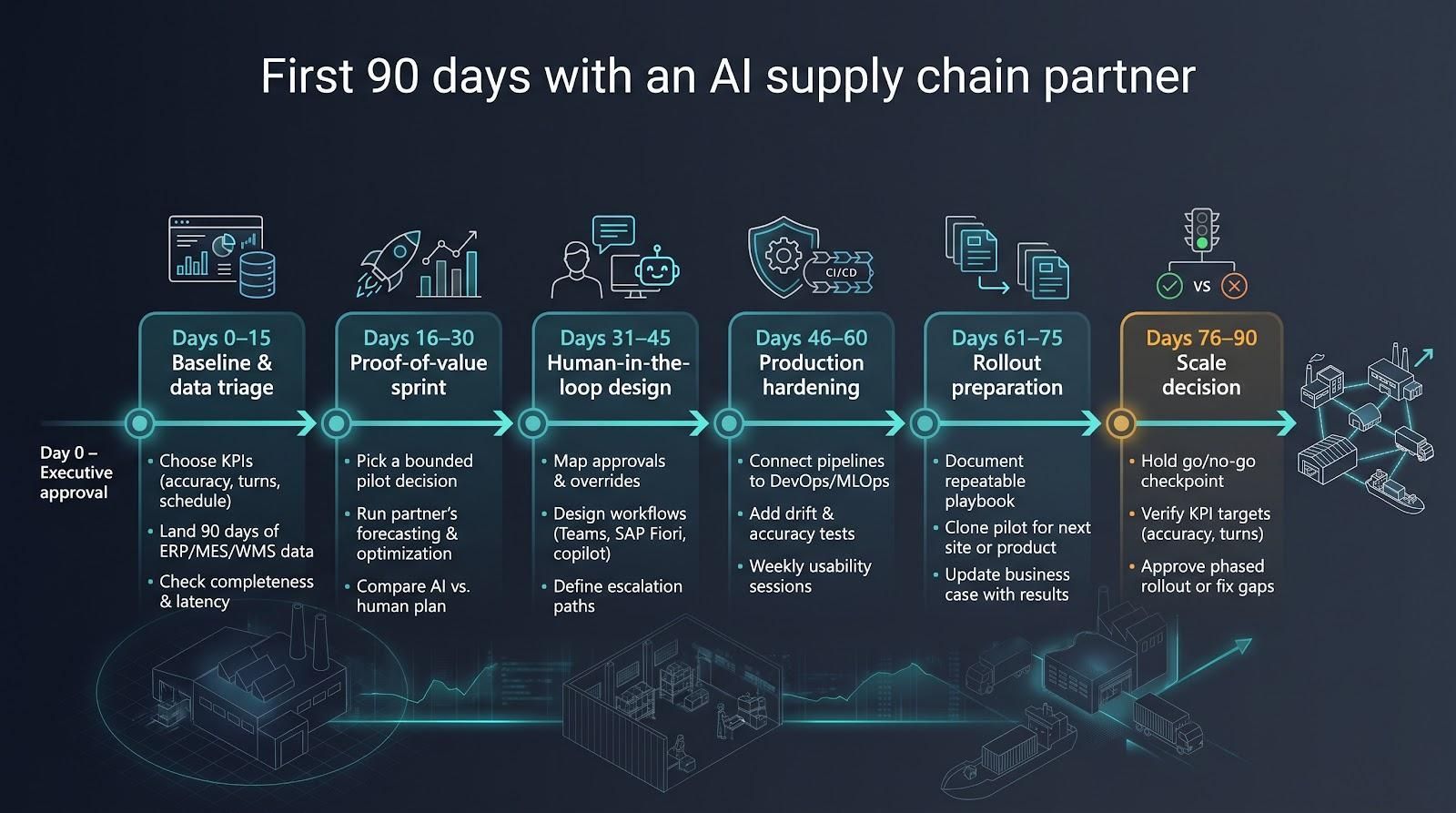
Days 0–15 | Baseline and data triage
- Select three target KPIs: forecast accuracy, inventory turns, and schedule adherence.
- Land 90 days of ERP, MES, and WMS data in a clean zone.
- Run completeness and latency checks so bad inputs don’t derail the model.
Days 16–30 | Proof-of-value sprint
- Pick one bounded decision (for example, replenishing a top-20 SKU at a pilot plant).
- Feed real data into the partner’s forecasting and optimization engine.
- Compare the AI plan with last month’s human plan, then wrap the deltas in a one-page business case.
Days 31–45 | Human-in-the-loop design
- Map who approves, overrides, or audits each AI recommendation.
- Build the workflow in your chosen UI, such as a Teams chatbot, SAP Fiori tile, or a lightweight GenAI copilot.
- Define escalation paths now to avoid late-night emergencies later.
Days 46–60 | Production hardening
- Connect data pipelines to the company’s DevOps or MLOps toolchain.
- Set automated tests for data drift and model accuracy, and agree on retraining thresholds.
- Schedule weekly sessions with planners to fix usability issues before they spread.
Days 61–75 | Rollout preparation
- Document repeatable steps: data mapping, model parameters, security settings, and training decks.
- Clone the pilot environment for a second site or product family.
- Update the business case with observed savings and productivity gains to reinforce C-suite confidence.
Days 76–90 | Scale decision
- Hold a go/no-go checkpoint with finance, IT, and operations.
- If targets are met (typically a 3–5-point accuracy lift or one extra inventory turn), approve phased rollout; otherwise, close gaps before adding complexity.
From copilots to governed orchestration: what’s next
GenAI chatbots stole headlines in 2023; by 2026 most planners keep one open on a side monitor. The frontier has already shifted to orchestrating thousands of micro-decisions with specialist agents, all under tight governance.
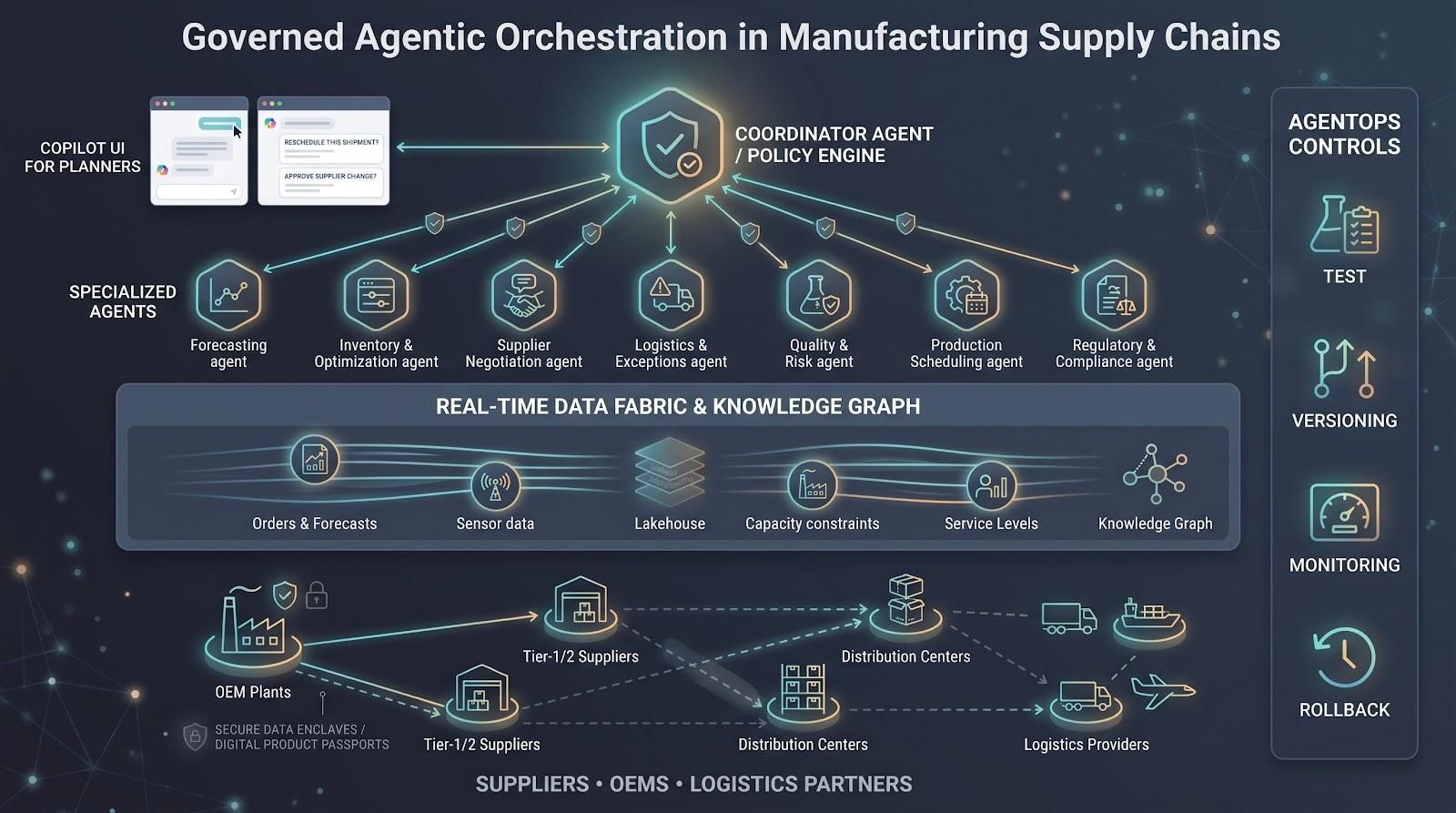
Microsoft, Accenture, and IBM now demo agentic systems where bots forecast, optimize, and negotiate with suppliers while a coordinator agent enforces policy and routes exceptions. Gartner lists agentic AI and physical AI among the top supply-chain technology trends for 2026.
Two factors will separate pilots from scaled programs:
- Real-time data fabric. Governed lakehouses such as Microsoft Fabric or SAP Datasphere must stream clean orders, sensor readings, and constraints into every agent at low latency, feeding both ML features and live knowledge graphs.
- AgentOps controls. Toolchains that version prompts, test for hallucinations, and roll back faulty agents, much like DevOps for code, are essential. Without that guardrail, smart agents can amplify the bullwhip instead of fixing it.
Looking three years out, expect multi-enterprise collaboration to rise. Digital product passports and secure data enclaves will let suppliers, OEMs, and logistics partners share just enough telemetry for joint optimization while keeping trade secrets safe.
In short, copilots will keep planners informed; governed orchestration will run the play. Partners already showing proof points in agent frameworks, data governance, and continuous assurance will move you from “talking about AI” to capturing value while people focus on growth and resilience.
FAQ
What does an AI consulting partner do?
These firms diagnose supply-chain bottlenecks, build data pipelines, train forecasting and optimization models, add GenAI copilots, and, if you choose, run the process under service-level agreements.
Which AI use cases pay back fastest in manufacturing?
Demand sensing, dynamic safety-stock setting, and slot-level production scheduling generate visible gains in revenue, cash, and service within one or two planning cycles.
How long does a first implementation take?
A focused proof of value usually runs 6–12 weeks. A multi-site rollout spans 9–18 months, depending on data hygiene, change management, and legacy complexity.
Will AI integrate with legacy ERP, MES, or SCADA systems?
Yes, provided data extraction is treated as a project in its own right. Most partners use lightweight APIs, message queues, or historian connectors to stream transactions and sensor data into a governed lakehouse.
What’s the difference between forecasting and demand sensing?
Forecasting projects long-term demand from historical patterns; demand sensing ingests near-real-time signals (orders, promotions, weather) to adjust those forecasts days or weeks sooner.
Is Microsoft Fabric useful for supply-chain AI?
Fabric’s lakehouse and event streams remove extensive pipeline plumbing. Real value still comes from the optimization models and human-in-the-loop design layered on top.
What are the main risks of agentic AI in supply chains?
Poor governance can amplify the bullwhip effect, trigger unapproved spend, or bias supplier selection. Mitigations include bounded prompts, policy engines, human-approval thresholds, and continuous prompt testing.
Which KPIs prove success?
Start with forecast accuracy, bias, inventory turns, service level, and planner productivity. Add scrap rate, capacity utilization, or expedite spend if your case focuses on cost rather than cash.
Closing insights
Supply-chain AI has moved past experimentation; it now relies on proven practices, accelerators, and managed services you can deploy today.
The eight partners profiled show that buyers have real choice, whether you need single-platform focus or multi-stack breadth, build-and-run operations or specialist depth, global reach or surgical expertise. Apply the four-lens framework, 90-day roadmap, and ten-question checklist to separate confident execution from polished slideware.
Start small, measure often, and expand only when improvements appear in inventory, service, or cash. Choose a partner that matches your data reality and risk posture, then hold them to the same KPI targets you expect from your own team.
Do that, and you'll build a resilient, data-driven supply chain that turns volatility into competitive advantage, one optimized decision at a time.
Sources and further reading
Key public references that support the claims in this article:
Analyst research
- HFS Horizons – Intelligent Supply Chain Services, 2025
- Gartner – Magic Quadrant for Supply Chain Strategy, Planning and Operations Consulting, 2026
- Everest Group – Supply Chain Management (SCM) BPS PEAK Matrix Assessment
Company publications
- Deloitte – 2025 Smart Manufacturing and Operations Survey
- MCA Connect – company announcement: MCA Connect is now a Grant Thornton US company
Share

Peyman Khosravani
Industry Expert & Contributor
Peyman Khosravani is a global blockchain and digital transformation expert with a passion for marketing, futuristic ideas, analytics insights, startup businesses, and effective communications. He has extensive experience in blockchain and DeFi projects and is committed to using technology to bring justice and fairness to society and promote freedom. Peyman has worked with international organisations to improve digital transformation strategies and data-gathering strategies that help identify customer touchpoints and sources of data that tell the story of what is happening. With his expertise in blockchain, digital transformation, marketing, analytics insights, startup businesses, and effective communications, Peyman is dedicated to helping businesses succeed in the digital age. He believes that technology can be used as a tool for positive change in the world.


