
business resources
Low Volume Injection Molding for Short-Run Production
18 Aug 2026

Low volume injection molding fills the gap between prototypes and full-scale production. A common industry range is roughly 100 to 10,000 molded parts, although the practical cutoff depends on part geometry, tooling, resin, and expected repeat orders.
This matters for OEM teams that already have working prototypes but now need hundreds or thousands of consistent production-grade parts. For projects at this stage, HingTung injection molding manufacturer support can cover DFM, mold development, molding, inspection, and repeat production under one manufacturing workflow.
What Is Low Volume Injection Molding?
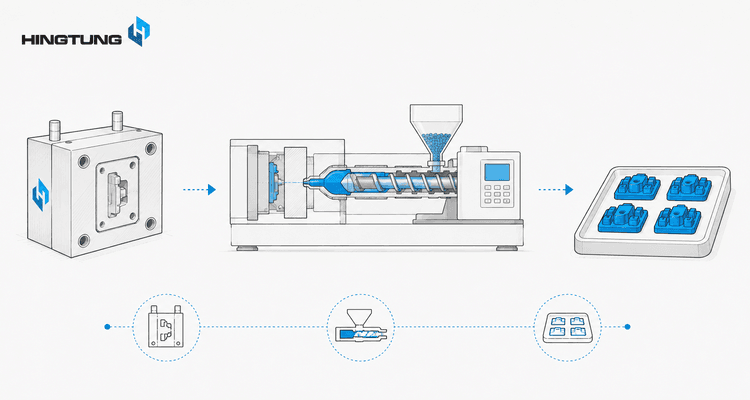
Low volume injection molding uses the same basic molding process as conventional production injection molding but applies tooling and production strategies suited to smaller quantities.
Low-volume programs are commonly associated with production quantities of approximately 100–10,000 units, although this range is only a general guideline. That range should be treated as a guideline rather than a strict rule because a simple housing and a complex engineering component can have very different tooling economics at the same quantity.
The main difference from traditional high-volume production is therefore not the molding principle. It is how much tooling investment and tool life are justified by the expected production volume.
What Is Short-Run Injection Molding?
Short-run injection molding appears frequently alongside low-volume molding because the two address similar production needs.
A short run usually refers to a limited production batch, while low-volume manufacturing can also include repeated smaller orders over time. For example, an OEM may need 500 or 1,000 parts for a product launch and then order additional batches as demand becomes clearer.
This distinction affects tooling decisions. A one-time run of 1,000 parts does not necessarily justify the same mold construction as a program that expects 1,000 parts every month.
When Does Low Volume Injection Molding Make Sense?
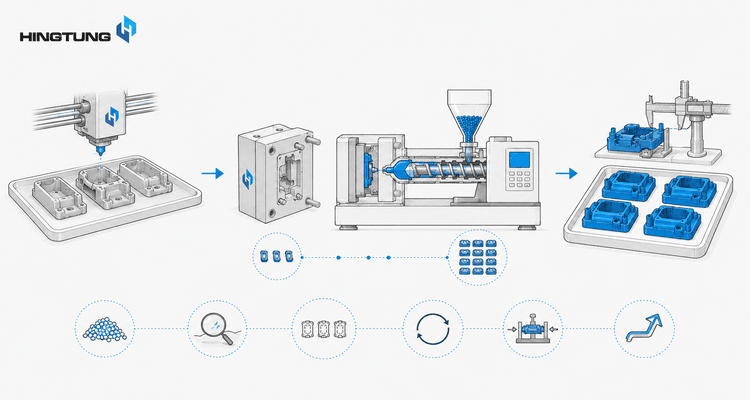
A common transition point comes when a team already has working 3D-printed parts but begins questioning the economics of producing several hundred or around 1,000 units.
At that stage, low volume plastic injection molding becomes worth comparing when the product needs:
- production-grade thermoplastic materials
- a molded surface rather than visible print layers
- greater part-to-part consistency
- faster repeated production
- realistic assembly and functional testing
- a path toward later production
The exact break-even quantity cannot be determined from quantity alone. Part size, complexity, material, mold construction, printing time, secondary operations, and future demand all affect the decision.
Low Volume Injection Molding vs 3D Printing
3D printing is usually attractive at the earliest stage because there is little tooling investment and designs can change quickly. Injection molding requires a mold, but the economics can improve once identical parts are needed repeatedly.
| Factor | 3D Printing | Low-Volume Injection Molding |
| Initial tooling | Little or none | Mold required |
| Design revisions | Easy | More costly after mold machining |
| Quantity | Very low quantities are attractive | Often considered from hundreds upward |
| Production material | Depends on printing process | Production thermoplastics available |
| Surface | May show process characteristics | Molded surface |
| Repeat production | Unit cost remains process-dependent | Better scaling after tooling |
| Future mass production | Separate process development may be needed | Closer to production molding |
At around 1,000 parts, the decision is often no longer based on quantity alone. Printing time, material, appearance, repeatability, and future demand can all shift the economics. Some users still considered MJF or print farms economical, while others began investigating injection molding because production time, material, appearance, and repeatability had become more important.
That is a more useful way to frame the decision than saying injection molding automatically becomes cheaper after a fixed number of pieces.
Tooling for Low-Volume Injection Molding
Tooling determines much of the initial investment in a low-volume molding program.
Low-volume projects may use aluminum, pre-hardened steel, or other tooling approaches depending on the required tool life, resin, geometry, and future production plan.
Aluminum vs Steel Tooling
| Tooling | Typical Advantage | Main Limitation |
| Aluminum | Faster machining and lower initial investment | Less wear-resistant for demanding production |
| Pre-hardened steel | Greater durability with moderate tooling investment | Higher machining effort |
| Production steel | Suitable for longer production life | Higher upfront investment |
Aluminum tooling is frequently associated with runs of hundreds to a few thousand parts, while steel becomes more attractive when production will continue or abrasive materials are used. These are general tendencies rather than fixed quantity limits.
For HingTung plastic injection molding projects, the initial mold can be reviewed against both the first production quantity and expected repeat demand. This helps avoid selecting a low-cost tool that later becomes unsuitable once the program begins to scale.
What Does Low-Volume Injection Molding Cost?
Low-volume injection molding cost consists of more than the molded part price.
The project normally includes:
tooling + molded parts + inspection + finishing or assembly + repeat production requirements
Tooling represents the main upfront difference from 3D printing. However, once the mold exists, the economics of producing additional identical parts can change significantly.
Published mold prices should be treated carefully because tooling cost varies substantially from one part to another. Real-world discussions mention prototype tooling from roughly $1,000 to several thousand dollars, but these are individual project quotations rather than reliable industry benchmarks.
Part size, cavities, steel selection, surface finish, tolerances, slides, lifters, inserts, and resin can change mold cost substantially.
For that reason, it is more useful to compare total project cost than to search for a universal cost per mold.
Materials for Low-Volume Plastic Injection Molding
Access to the actual production resin is one of the main advantages of moving from prototype processes into molding.
Low volume plastic molding can use common thermoplastics such as ABS, PP, PC, nylon, PBT, and other engineering materials when suitable for the part and tooling.
This matters because testing a molded production resin can reveal behavior that a prototype material cannot fully represent, including:
- shrinkage
- warpage
- snap-fit performance
- surface appearance
- dimensional stability
Material selection should therefore be based on the finished product rather than simply choosing the least expensive molding resin.
Design Guidelines for Short-Run Injection Molding
Low production quantity does not remove the normal rules of injection molding design.
Several common DFM starting points for molded parts include:
| Design Feature | Common Starting Guideline |
| Wall thickness | Approximately 1.0–4.0 mm |
| Draft | Around 1° or more on vertical surfaces |
| Inside corner radius | Around 0.5 mm or more |
| Rib thickness | Generally ≤60% of the base wall |
These should not be treated as universal specifications.
For example, acceptable wall thickness can vary substantially between PP, ABS, PC, PEEK, and glass-filled materials. Deep textures may require more draft, while thin-wall parts can require specialized gating and processing.
The value of these numbers is that they provide a starting point for DFM rather than a substitute for engineering review.
Quality Control for Small-Batch Production
Small batch plastic manufacturing still requires defined quality controls, especially when batches will be repeated.
The first molded parts should verify whether the mold, material, surface, dimensions, and functional features meet the agreed requirements. Critical-to-quality dimensions are especially important because assembly, sealing, fit, and mechanical performance often depend on only a limited number of features.
For repeat short runs, keeping approved samples and agreed inspection criteria gives both sides a clear reference for later batches. At HingTung, inspection can be integrated with tooling and molding rather than treated as a separate step after production, which is useful when a low-volume program develops into recurring orders.
FAQs
Is Low-Volume Injection Molding Only for Prototypes?
No. It is also used for bridge production, limited product launches, replacement components, market testing, and products whose normal annual demand is relatively small.
What Is the Minimum Wall Thickness for Injection Molding?
There is no universal minimum.
Although approximately 1.0–4.0 mm is often presented as a general molding range, the actual minimum depends on resin flow, part size, flow length, machine capability, gating, and mechanical requirements.
What Is Shot Volume in Injection Molding?
Shot volume is the amount of molten plastic delivered by the injection unit during a molding cycle.
It must be appropriately matched to the molded part, runner system, and available machine capacity to maintain stable filling and packing.
Is Low-Volume Manufacturing the Same as Short-Run Manufacturing?
They overlap, but they are not always used in exactly the same way.
Short-run manufacturing often describes a defined limited batch, while low-volume production may include multiple repeat batches produced over a longer period.
Conclusion
Low volume injection molding is most useful when a project requires production-quality molded parts but does not yet justify full-scale manufacturing. Production quantities may fall roughly within 100–10,000 parts, but tooling, material, design, cost, and future demand matter more than a fixed threshold.
For OEM teams moving from prototypes into short-run injection molding, HingTung can support DFM, mold manufacturing, injection molding, inspection, and subsequent repeat production. Using HingTung injection molding as part of a planned production path helps keep the first mold aligned with both current requirements and the project's likely next stage.


