


business resources
Morning Breakout Setups Traders Use Daily
06 Jul 2026

Ask experienced intraday traders what their most consistent edge is, and a large number will point to the same window: the first 30 minutes after a major session opens. Price is directional, volume is real, and the range that forms in that opening period often defines how the rest of the day plays out. The ORB trading strategy is built entirely around this observation. It is systematic, repeatable, and does not require predicting where the market will go, only recognizing when it has committed to a direction and joining it.
Why Session Opens Create Reliable Breakout Conditions
Markets are not equally active at all hours. Liquidity concentrates around session opens, when institutional desks come online, when orders accumulated overnight get filled, and when participants react to news that broke while they were asleep. This surge of activity compresses into a short window, and the resulting price movement is often cleaner and more directional than anything that happens mid-session.
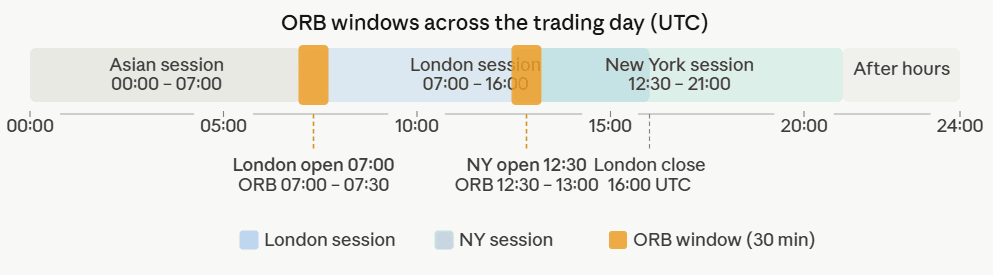
The London open at 07:00 UTC is the most important moment in the forex trading day. European banks, hedge funds, and market makers all switch on at roughly the same time. If there is a directional bias driven by overnight news or positioning, it tends to reveal itself in the first 30 to 45 minutes. The New York open at 12:30 UTC adds another layer of volume, particularly during the overlap with London between 12:30 and 16:00 UTC. This two-hour window produces the highest liquidity and the tightest spreads of the entire day.
The NYSE opening at 14:30 UTC matters for equity index traders. S&P 500 and Nasdaq futures often see their sharpest moves of the day in the first 30 minutes after US stocks start trading, which is why ORB is as popular with index traders as it is with forex traders.
How to Define and Trade the Opening Range
The setup starts before the session opens. You identify the instrument, check the higher timeframe bias, note any overnight news, and wait for the clock to reach the session open. From that moment, you observe rather than trade. For the next 15 to 30 minutes, you are watching price build the opening range: the high and the low of that initial window.
Once the range is established, the trade trigger is simple. A candle that closes clearly above the range high signals a long entry. A candle that closes clearly below the range low signals a short entry. The word "clearly" matters: the entire candle body needs to close outside the range, not just wick through it. A wick is noise. A body close is commitment.
Entry is placed at the open of the next candle after the breakout confirmation. Stop-loss goes at the midpoint of the opening range, giving the trade room to absorb minor pullbacks while keeping risk defined. Take-profit targets sit at 2x and 3x the stop distance. Many traders close half the position at the 2:1 target and move the stop to breakeven on the remainder, letting the second half run toward the 3:1 level.
Filters That Make the Setup More Reliable
The raw ORB signal is useful on its own, but adding two or three filters consistently improves the quality of trades taken. The goal is not to find more setups but to filter out the ones likely to fail.
The first filter is higher timeframe direction. If the daily chart shows a clear uptrend, take only long ORB signals during the session. Fading the larger trend on a 15-minute breakout is possible, but the probability drops and the risk of a sharp reversal increases. Aligning with the daily or four-hour trend means you are trading with the weight of institutional positioning rather than against it.
The second filter is volume. On instruments where reliable volume data is available, a breakout candle accompanied by significantly above-average volume confirms that real participants are driving the move, not just a thin-market spike. A breakout on low volume is the single most common precursor to a false breakout.
The third filter is the economic calendar. High-impact data releases during or just after the opening range window can blow out the range in both directions before settling into a trend. Trading the ORB around a major central bank announcement or employment report requires caution. Many experienced traders simply skip ORB on those days and wait for conditions to normalize.
Common Mistakes and How to Avoid Them
The mistakes that show up repeatedly in ORB trading are predictable. Knowing them in advance makes them easier to catch.
The table below summarizes the most common errors and their fixes:
Mistake | Why it happens | Fix |
| Entering on a wick, not a close | Impatience, fear of missing the move | Wait for full candle body close outside range |
| Trading against higher timeframe trend | Ignoring context, chasing any signal | Check daily/4H chart before session open |
| Skipping the stop-loss | Confidence in the setup | Place stop before entry, never after |
| Trading on high-impact news days | Not checking calendar | Review economic calendar every morning |
| Taking every signal regardless of spread | Not checking broker conditions | Verify spread is tight before entry |
The most damaging mistake is entering on a wick. It happens because price touches outside the range, the trader sees a potential breakout beginning, and opens the trade before the candle closes. The candle then pulls back inside the range and the stop gets hit. This is avoidable by a simple rule: the candle must close, not just touch.
Applying ORB Across Different Instruments
The setup adapts to different markets with small adjustments. For forex majors like EURUSD and GBPUSD, the London open ORB is the primary window. For gold, both London and New York opens produce reliable setups because both sessions drive strong participation in metals. For US equity indices, the NYSE open at 14:30 UTC is the primary window, and the opening range is usually defined using the first 15-minute candle.
One practical note on timing: some traders use a 15-minute opening range and others use 30 minutes. The difference matters less than consistency. Pick one timeframe, apply it to every session, and build a sample of at least 40 to 50 trades before drawing conclusions. Changing the range definition mid-experiment invalidates the data.
Conclusion
The ORB is one of the few intraday strategies that requires no prediction about where the market is going. It waits for the market to show its hand in the first 30 minutes of a session, then joins the move that has already started. That makes it systematic, repeatable, and possible to evaluate honestly over a large sample. The setup works across forex, gold, and equity indices. The session opens at London and New York provide the most reliable conditions. Apply the higher timeframe filter, confirm with volume where possible, skip high-impact news days, and size positions so a losing trade costs 1 to 2 percent of the account. The edge is real, but only survives with consistent execution.


