
citiesabc, first_page
Which Are the Most Diverse Cities in the US in 2026?
11 Aug 2026

This ranking is based on WalletHub’s February 2026 study of 501 US cities. Rather than treating diversity as race and ethnicity alone, the study compared cities across socioeconomic, cultural, economic, household and religious dimensions.
The results demonstrate that diversity is not restricted to America’s largest metropolitan centres. Several smaller communities, particularly those surrounding Washington, DC, rank ahead of New York, Los Angeles and Chicago when multiple forms of diversity are considered together.
Key takeaways
- Silver Spring, Maryland, ranks as the most diverse US city in the 2026 comparison.
- Maryland has three communities in the top four: Silver Spring, Gaithersburg and Germantown.
- Arlington, Texas, is the highest-ranked large city, followed by Houston and New York.
- Germantown leads the country specifically for racial and ethnic diversity.
- Gaithersburg is second nationally for both linguistic and educational-attainment diversity.
- “Most diverse” depends on the measurement used. A racial-diversity ranking can produce a different result from a multidimensional ranking.
- The 2026 study uses city-proper boundaries rather than entire metropolitan regions.
The most diverse US cities in 2026
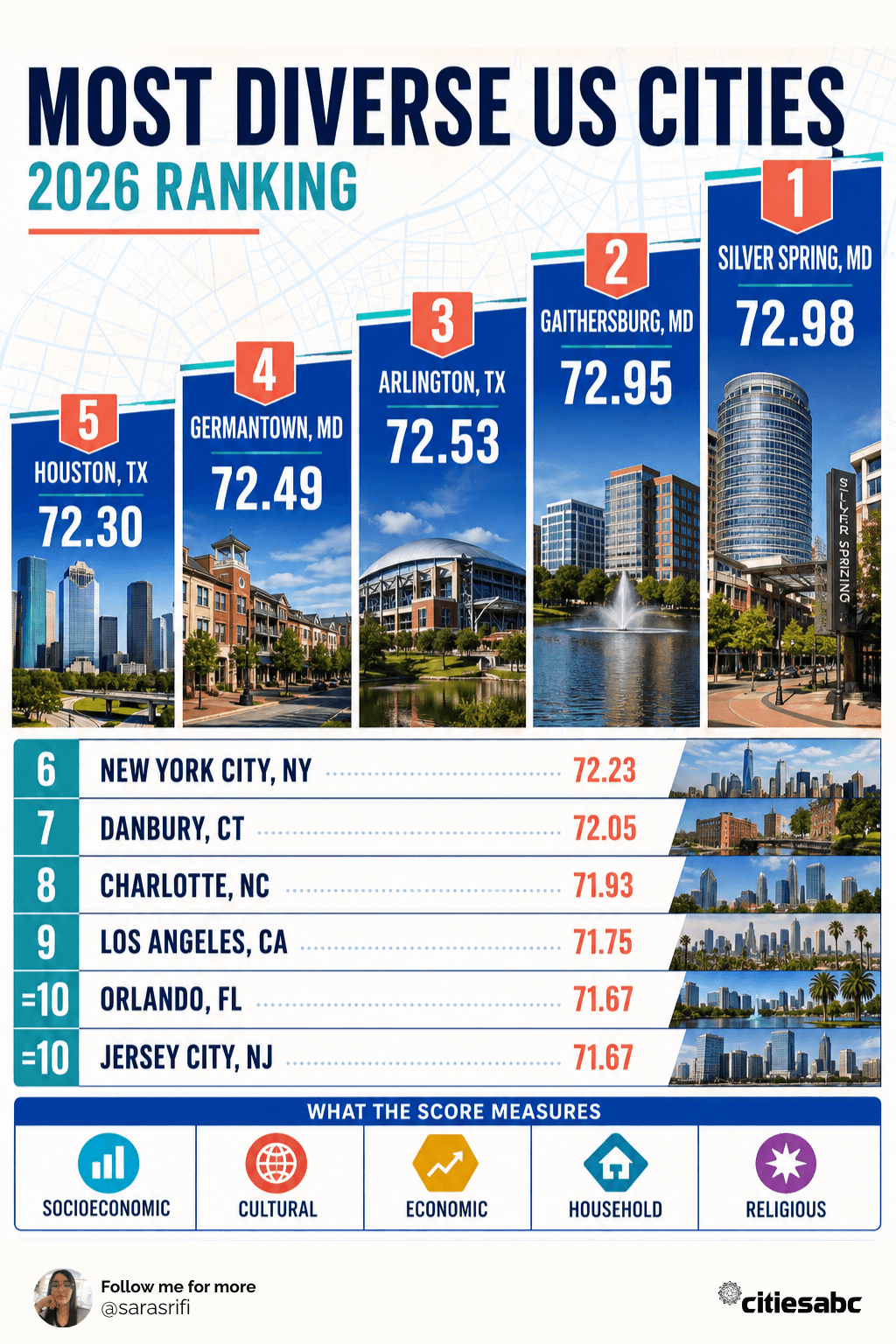
| Position | City | State | Diversity score | Size category |
|---|---|---|---|---|
| 1 | Silver Spring | Maryland | 72.98 | Small |
| 2 | Gaithersburg | Maryland | 72.95 | Small |
| 3 | Arlington | Texas | 72.53 | Large |
| 4 | Germantown | Maryland | 72.49 | Small |
| 5 | Houston | Texas | 72.30 | Large |
| 6 | New York City | New York | 72.23 | Large |
| 7 | Danbury | Connecticut | 72.05 | Small |
| 8 | Charlotte | North Carolina | 71.93 | Large |
| 9 | Los Angeles | California | 71.75 | Large |
| =10 | Orlando | Florida | 71.67 | Large |
| =10 | Jersey City | New Jersey | 71.67 | Midsize |
The positions above are ordered by the overall scores published in WalletHub’s 2026 city-size comparison. Orlando and Jersey City recorded the same published score.
How was city diversity measured?
The ranking compared 501 of America’s most populated cities, with no more than ten cities included from any single state.
Each city was evaluated across 13 metrics grouped into five equally weighted dimensions:
- Socioeconomic diversity: Differences in household income and educational attainment.
- Cultural diversity: Racial and ethnic background, languages and residents’ places of birth.
- Economic diversity: Industries, occupations and types of employment.
- Household diversity: Age, marital status, household composition and household size.
- Religious diversity: The distribution of religious affiliations and unaffiliated residents.
WalletHub applied a form of the Herfindahl-Hirschman Index, a concentration measure that can be adapted to evaluate how evenly people are distributed among categories. Each metric was graded on a 100-point scale before being combined into an overall score.
The source information was collected by WalletHub as of 29 January 2026 from the US Census Bureau and US Religion Census. However, the 2026 label refers to the publication and analysis year, not an assertion that every underlying observation was collected during 2026. Census demographic estimates necessarily cover earlier survey periods.
1. Silver Spring, Maryland
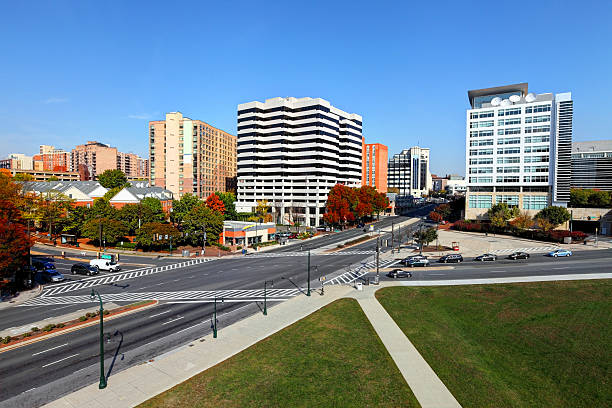
Silver Spring recorded the highest overall score in the 2026 study at 72.98.
Its result reflects strength across several types of diversity rather than dominance in only one category. Silver Spring ranked third nationally for educational-attainment diversity and first among the small cities included in the study.
The community forms part of Montgomery County and sits immediately north of Washington, DC. Its position within the capital region gives residents access to employment across government, healthcare, education, technology, hospitality and professional services.
Silver Spring also illustrates an important methodological point: population size alone does not determine diversity. A smaller community can rank ahead of a global city when its population is distributed more evenly across different income, education, cultural and household categories.
2. Gaithersburg, Maryland

Gaithersburg followed extremely closely with a score of 72.95—only 0.03 points behind Silver Spring at the displayed precision.
It ranked second nationally for educational-attainment diversity and second for linguistic diversity. This means its population is not concentrated within a single educational or language category.
Gaithersburg is also located in Montgomery County, reinforcing the region’s position as one of the country’s most multidimensional demographic centres.
Its economy is connected to biotechnology, healthcare, public administration, retail and professional services across the wider Washington metropolitan area. That mixture contributes to the economic side of the diversity calculation, while migration and international connections strengthen its cultural profile.
Because the difference between Silver Spring and Gaithersburg is extremely small, the ranking should not be interpreted as evidence that residents experience meaningfully different levels of diversity in everyday life.
3. Arlington, Texas

Arlington earned a score of 72.53 and ranked as the most diverse large city in the US.
Located between Dallas and Fort Worth, Arlington combines a sizeable population with a varied employment base and an ethnically diverse community. Its central position in the Dallas–Fort Worth region connects residents with employment in logistics, education, manufacturing, healthcare, hospitality and professional services.
Arlington also ranked fifth nationally for income diversity. That indicates the city contains a relatively broad distribution of household-income groups rather than being dominated by one economic bracket.
However, income diversity should not be confused with economic equality. A city can contain households at many income levels while still experiencing substantial inequality, housing pressure or uneven access to public services.
4. Germantown, Maryland
Germantown achieved an overall diversity score of 72.49 and ranked third among small cities.
It was the national leader for racial and ethnic diversity and placed fifth for linguistic diversity. Its high position therefore has a particularly strong cultural component.
The racial and ethnic metric considers how evenly residents are distributed among Hispanic or Latino, non-Hispanic White, Black, Asian and other racial or multiracial categories. A city receives a stronger result when several groups have meaningful population shares instead of one group overwhelmingly dominating.
Germantown’s position also contributes to an unusual geographical concentration: three of the four highest-scoring communities are located in Montgomery County, Maryland.
That concentration reflects the Washington region’s role as an international employment centre, alongside its federal institutions, universities, healthcare organisations, technology businesses and diplomatic connections.
5. Houston, Texas

Houston scored 72.30, making it the second-most diverse large city and fifth overall.
The city’s diversity is visible across its neighbourhoods, languages, industries and migration histories. Houston’s economy extends well beyond its longstanding energy sector to include healthcare, aerospace, logistics, manufacturing, construction and international trade.
This economic range matters because the methodology considers industry, occupational and worker-class diversity alongside cultural indicators.
Houston’s position also demonstrates why different rankings produce different answers. It may not lead every racial-diversity index, but it performs strongly when economic, household, socioeconomic and religious variety are considered together.
For readers comparing the character and scale of major American urban centres, Citiesabc’s guide to the largest cities in the US by population provides additional context.
6. New York City, New York
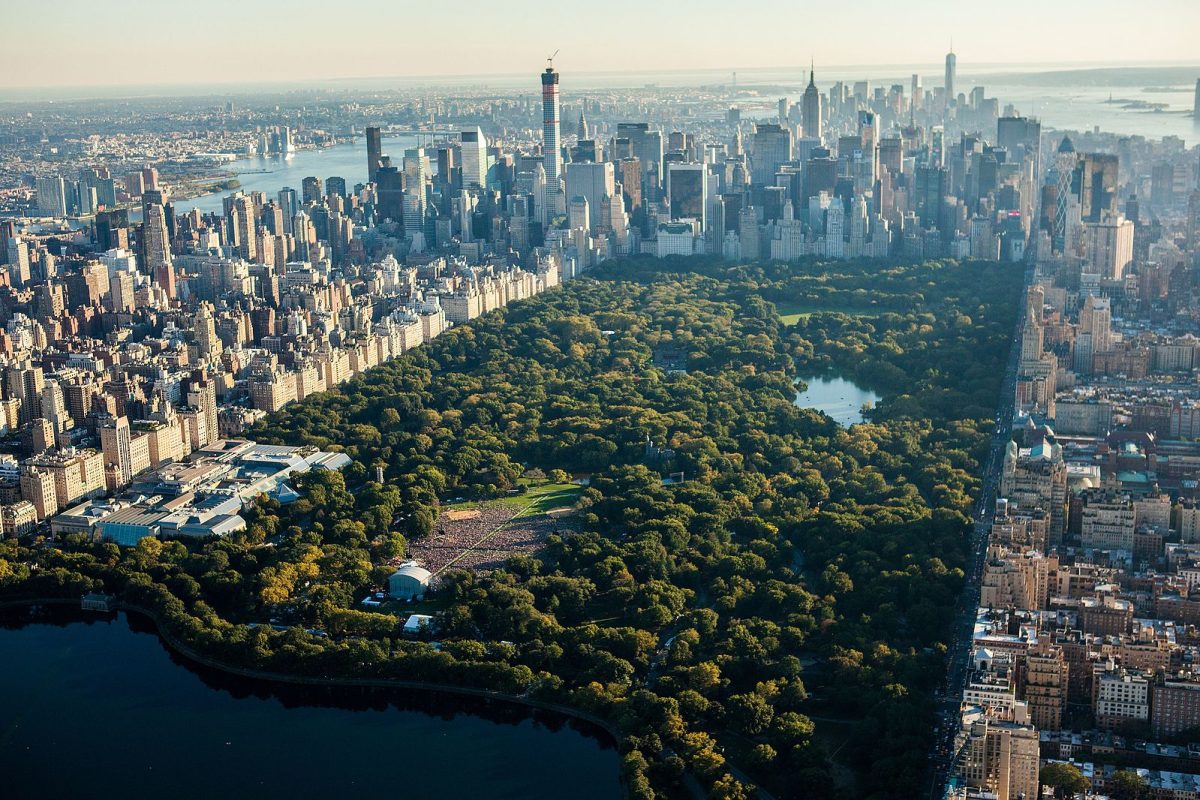
New York recorded a score of 72.23 and ranked as the third-most diverse large city.
As the largest city in the United States, New York contains extensive cultural and linguistic variation. Its neighbourhoods have been shaped by generations of domestic migration and immigration, while its economy spans finance, media, technology, tourism, healthcare, retail, education and the creative industries.
Yet New York does not automatically rank first simply because it contains an enormous number of communities.
Diversity indexes generally reward balance among groups, not just the absolute number of backgrounds represented. A smaller city with a more even distribution across the measured categories can therefore outrank a much larger city.
City boundaries matter as well. The ranking measures New York City itself, while other comparisons might study the wider metropolitan region or individual boroughs and reach different conclusions.
7. Danbury, Connecticut
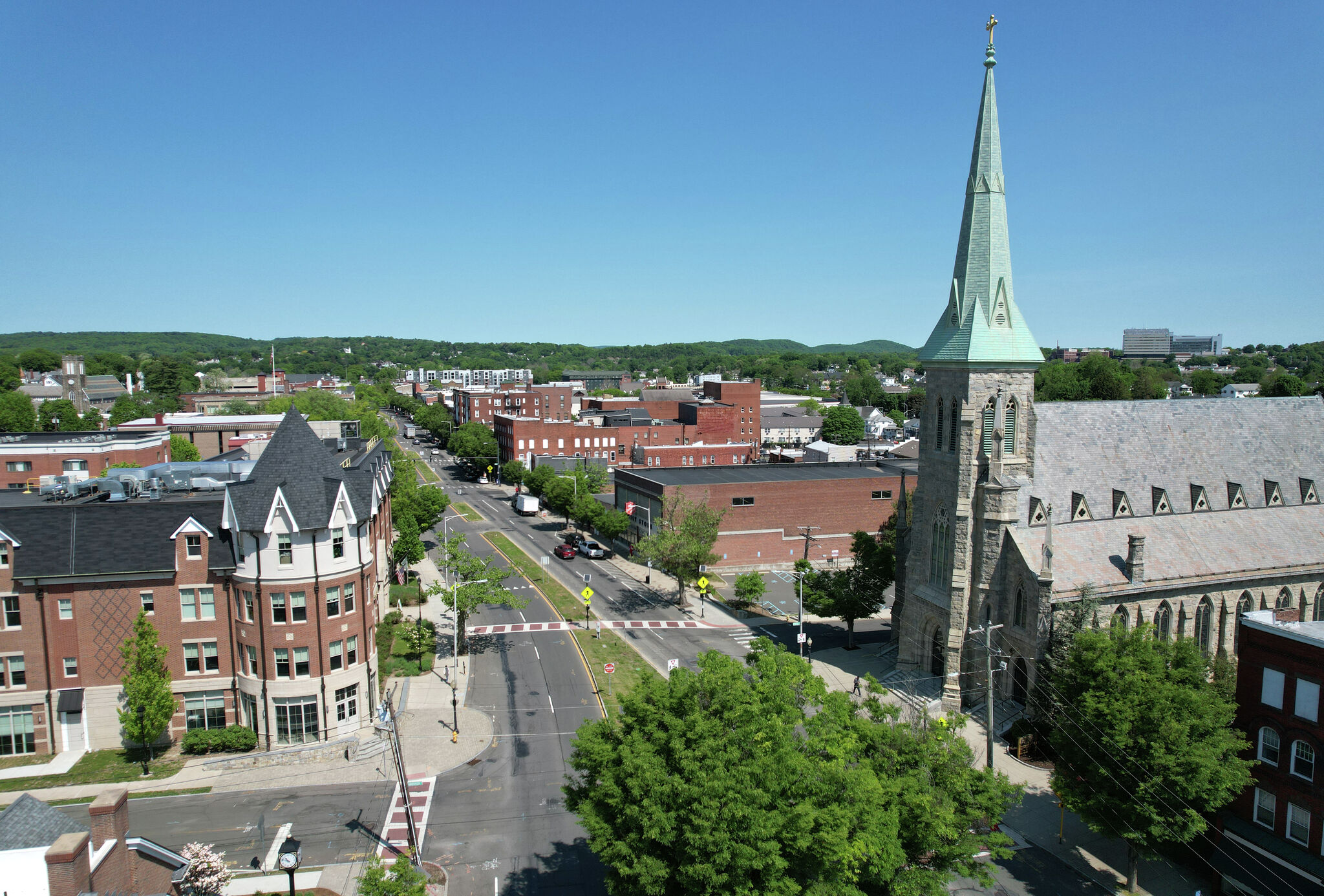
Danbury received a score of 72.05 and ranked fourth among small cities.
Located in western Connecticut, the city has been shaped by several migration periods and a varied regional economy. Its placement suggests a relatively broad mix across the cultural, economic, household and socioeconomic categories included in the study.
Danbury is another example of why lists focused only on globally recognised metropolitan centres can miss important urban patterns. Smaller regional employment centres often attract residents from numerous origins while supporting varied industries and household types.
Its presence in the top ten also reflects a wider Northeastern pattern. Connecticut, Maryland, New Jersey and New York all place communities near the top of the overall or city-size rankings.
8. Charlotte, North Carolina

Charlotte scored 71.93, ranking fourth among large cities and eighth overall.
The city’s growth as a banking, logistics, technology and professional-services centre has attracted residents from other US regions and overseas. Its population growth has also produced a wider mixture of ages, occupations, household arrangements and income levels.
Charlotte illustrates how economic expansion can contribute to demographic diversification. New industries create different types of employment, while population mobility introduces new languages, cultural practices and household profiles.
Growth alone does not guarantee inclusion, however. Housing affordability, transport access and the geographical distribution of opportunity determine whether different communities can participate equally in the city’s economy. Charlotte home prices and market trends give a concrete read on that first factor, showing how quickly the cost of entry is moving relative to incomes.
9. Los Angeles, California

Los Angeles recorded a score of 71.75 and ranked fifth among large cities.
Its cultural diversity is closely connected to migration across the Pacific and the Americas. The city also supports a highly varied economy incorporating entertainment, international trade, tourism, healthcare, manufacturing, fashion, technology and professional services.
Los Angeles demonstrates the difference between diversity and integration. A city may contain residents from numerous backgrounds while its neighbourhoods, schools, housing markets and employment opportunities remain unevenly distributed.
This distinction is important when interpreting any diversity ranking. The score describes variety within a population; it does not independently measure social mobility, discrimination, segregation, political representation or equal access to services.
Citiesabc’s broader guide to the diverse landscape of cities in the US explores how different urban environments and regional identities shape the country.
10. Orlando, Florida
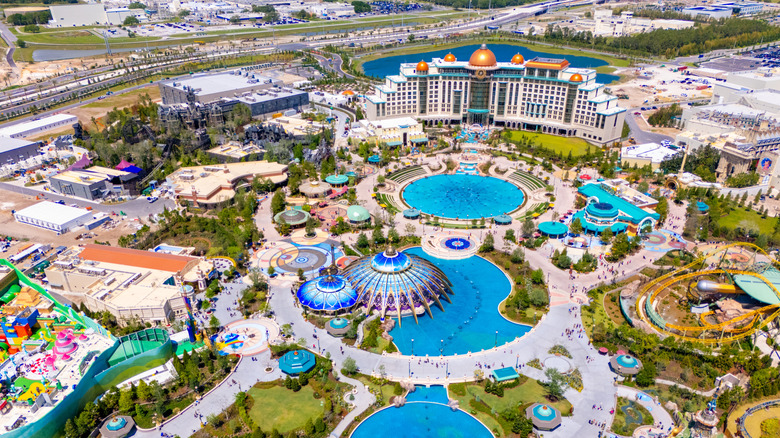
Orlando scored 71.67 and ranked sixth among large cities.
Although internationally associated with tourism, its urban economy also includes healthcare, aviation, education, technology, construction and professional services. Tourism itself supports a wide range of occupations and attracts workers from numerous cultural and linguistic backgrounds.
Orlando’s result comes from the combined methodology rather than a single standout statistic. Its mix of residents, employment sectors, household structures and religious communities contributes to its overall position.
The city is tied at the published score level with Jersey City. More precise underlying values could potentially separate the two, but those values were not displayed in the published city-size table.
10. Jersey City, New Jersey

Jersey City also received a score of 71.67 and ranked as the most diverse midsize city in the comparison.
Its most notable strengths were cultural. Jersey City ranked third nationally for racial and ethnic diversity and third for linguistic diversity.
Situated across the Hudson River from Manhattan, Jersey City has longstanding connections to migration, international business and the wider New York employment market. Its economy includes finance, professional services, retail, transport and hospitality.
The city’s position shows why separating results by population size is useful. Jersey City is smaller than New York but can display a more even distribution among certain racial, ethnic and language groups.
Which large US cities are the most diverse?
When the comparison is limited to cities with more than 300,000 residents, the ten highest-scoring large cities are:
- Arlington, Texas — 72.53
- Houston, Texas — 72.30
- New York City, New York — 72.23
- Charlotte, North Carolina — 71.93
- Los Angeles, California — 71.75
- Orlando, Florida — 71.67
- Dallas, Texas — 71.66
- Chicago, Illinois — 71.41
- Tampa, Florida — 71.39
- Long Beach, California — 71.32
Texas places three cities in this large-city top ten: Arlington, Houston and Dallas. Florida places Orlando and Tampa, while California is represented by Los Angeles and Long Beach.
Which cities are the most racially and ethnically diverse?
A ranking based specifically on racial and ethnic diversity produces a different result from the overall list.
According to the cultural component of WalletHub’s study, the leading cities for racial and ethnic diversity were:
- Germantown, Maryland
- Oakland, California
- Jersey City, New Jersey
- Federal Way, Washington
- Sacramento, California
A separate Simpson-style index based on recent American Community Survey estimates places Vallejo, California, and Federal Way, Washington, at the top among places with at least 50,000 residents. That index calculates the probability that two randomly selected residents belong to different racial or ethnic groups.
Neither approach is inherently the only correct one. They answer different questions:
- The WalletHub overall score asks which cities are diverse across numerous social, cultural, economic and household characteristics.
- A racial diversity index asks how evenly racial and ethnic groups are represented.
- A linguistic ranking asks how widely languages are distributed.
- A birthplace measure examines where residents were born.
Which US city is the most linguistically diverse?
San Jose, California, ranked first for linguistic diversity in WalletHub’s 2026 study.
Gaithersburg, Jersey City, Clifton and Germantown completed the top five.
The methodology divided languages into English, Spanish, other Indo-European languages, Asian and Pacific Island languages, and other languages. A higher score indicates a more even distribution among these broad language categories.
Linguistic diversity can shape how cities design schools, healthcare services, emergency communications, voting information and digital public services. It can also create commercial opportunities for multilingual media, customer support and culturally informed local businesses.
Why are several Maryland communities near the top?
Silver Spring, Gaithersburg and Germantown are all in Montgomery County, adjacent to Washington, DC.
Several overlapping factors can help explain this concentration:
- Access to federal, healthcare, education, science and technology employment
- Proximity to international organisations and diplomatic institutions
- Established immigrant communities and family networks
- Connections to the wider Washington metropolitan labour market
- A mixture of professional, service, public-sector and technical occupations
- Varied housing forms and household structures
The ranking does not prove that any one policy produced these outcomes. It identifies the demographic and economic distributions present in the source data.
Does a high diversity score mean a city is inclusive?
Not necessarily.
Diversity measures who lives in a city and how evenly residents are distributed among selected categories. Inclusion concerns whether those residents can participate meaningfully in the city’s institutions, economy and civic life.
A city can be statistically diverse while still experiencing:
- Residential or school segregation
- Unequal access to employment
- Income and wealth disparities
- Language barriers in public services
- Housing discrimination or displacement
- Unequal political representation
- Differences in health and environmental outcomes
A complete assessment should therefore consider both demographic diversity and measures of equity, belonging and access.
What should readers understand about the 2026 ranking?
The ranking is current to its February 2026 publication, but it is not a real-time census of every resident in 2026.
The underlying sources include Census estimates that aggregate survey responses from earlier periods. This is normal for local demographic analysis because reliable city-level statistics take time to collect, validate and publish.
The results should also be read with four limitations in mind:
- City boundaries vary: A compact city and a geographically expansive city are not directly identical units.
- Metro areas are excluded: Suburban communities are evaluated separately from their central cities.
- Scores depend on weighting: Changing the importance assigned to cultural or economic diversity would alter the order.
- Close scores should not be overinterpreted: Silver Spring and Gaithersburg are separated by only 0.03 points at the displayed precision.
The list is therefore best understood as a structured comparison, not a permanent or universal declaration of which city is “the most diverse.”
Frequently asked questions
What is the most diverse city in the US in 2026?
Silver Spring, Maryland, ranks first in WalletHub’s multidimensional 2026 study, with a score of 72.98. It is followed closely by Gaithersburg, Maryland, at 72.95.
What is the most diverse large city in America?
Arlington, Texas, is the highest-ranked city with more than 300,000 residents. Houston and New York follow.
What is the most racially diverse city in the US?
The answer depends on the population threshold and formula. Germantown, Maryland, leads WalletHub’s racial and ethnic metric, while a separate Census-based Simpson diversity index ranks Vallejo, California, first among places with at least 50,000 residents.
Is New York the most diverse city in America?
New York is exceptionally diverse in absolute scale, but it ranks sixth overall and third among large cities in this particular multidimensional comparison. Smaller cities can score more highly when their populations are more evenly distributed across the measured categories.
Why do diversity rankings disagree?
Rankings disagree because they measure different things. Some consider only race and ethnicity, while others include language, birthplace, income, education, occupation, age, household structure or religion.
Is diversity the same as inclusion?
No. Diversity describes population variety. Inclusion concerns participation, representation, access and whether different communities experience a genuine sense of belonging.
Final thoughts
The most diverse US cities in 2026 are not concentrated within one region or restricted to the country’s largest urban centres.
Silver Spring and Gaithersburg lead the overall comparison, while Arlington is the strongest-performing large city. Germantown stands out for racial and ethnic diversity, San Jose for language diversity and Jersey City for combining cultural diversity with a midsize urban population.
The wider lesson is that urban diversity is multidimensional. Race, language and birthplace remain essential, but cities are also shaped by differences in age, income, education, employment, household composition and religion.
A useful diversity ranking should make those choices transparent—and should never be mistaken for a complete measure of equality or inclusion.
Sources
- WalletHub — Most Diverse Cities in the US in 2026
- WalletHub — Most and Least Ethnically Diverse Cities in the US in 2026
- US Census Bureau — American Community Survey Data
- US Census Bureau — 2020 Census Racial and Ethnic Diversity
- US Census Bureau — Language Spoken at Home
- US Religion Census
- State Demographics — Most Racially Diverse Cities in America


