


resources-malaysia
Navigating the Globe: A Comprehensive Malaysia Map of the World
28 Nov 2025

Ever wonder about Malaysia's place in the grand scheme of things? It's more than just a country; it's a vital point on the globe connecting us to a much bigger picture. We're going to explore where Malaysia sits, what that means for its weather and time, and how it fits onto the world stage. Think of this as getting to know the Malaysia map of the world—not just as lines and colours, but as a key piece of a much larger global puzzle.
Key Takeaways
- You'll find Malaysia situated in the heart of Southeast Asia, at approximately 2° 30' North latitude and 112° 30' East longitude.
- Its equatorial position gives Malaysia a tropical climate, shaped by monsoon seasons and bringing us that familiar hot and humid weather all year round.
- The country's coordinates place it eight hours ahead of Greenwich Mean Time (GMT), so we're well into our evening when Europe is just having lunch.
- Major cities like Kuala Lumpur, located at 3° 10' North latitude and 101° 42' East longitude, are crucial reference points on any world map featuring Malaysia.
- Understanding Malaysia's global coordinates helps us appreciate its strategic role in regional geopolitics, historic trade routes, and vibrant cultural exchanges.
Understanding Malaysia's Global Position
So, where exactly is Malaysia on the big world map? It's a question that helps us get a handle on quite a lot, from our daily weather to how we connect with the rest of the world.
Malaysia's general spot is around 2 degrees 30 minutes North latitude and 112 degrees 30 minutes East longitude. This location places it right near the equator, which is a huge deal for its climate. Being this close means we get plenty of sunshine year-round, but it also means things stay pretty humid and warm most of the time. You won't find freezing winters or scorching summers here—just a consistently tropical vibe.
Latitude and Longitude Coordinates
Let's get a bit more specific. Since the country is spread out, different areas have slightly different coordinates. For instance, our capital, Kuala Lumpur, is located at about 3 degrees 10 minutes North latitude and 101 degrees 42 minutes East longitude. Over on the other side of the South China Sea, in Borneo, places like Kuching are around 1 degree 33 minutes North and 110 degrees 25 minutes East. These numbers aren't just for navigation; they tell a story about the local environment and how our time zone is set.
Time Zone Differences
Because of where Malaysia sits east of the Prime Meridian (that's the zero-degree line of longitude), we are ahead of Greenwich Mean Time (GMT). Specifically, Malaysia operates on Malaysia Standard Time (MST), which is GMT+8. This means when it's noon in London, it's already 8 PM here in Kuala Lumpur. This time difference is something to keep in mind for international calls, business meetings, and even catching global news as it breaks.
Influence on Climate Patterns
Malaysia's latitude is the primary reason for our weather. Being in the tropics means we experience a monsoon climate. There are typically two main monsoon seasons each year. The Southwest Monsoon, which usually hits around May to September, brings a fair bit of rain. Then there's the Northeast Monsoon, from November to March, which can bring heavy rainfall, especially to the East Coast of the peninsula. This consistent warmth and rainfall are what make the country so green and lush—supporting our incredible biodiversity.
The country's position near the equator and its surrounding seas play a massive role in its weather patterns, leading to a tropical climate that's warm and humid throughout the year with distinct rainy seasons influenced by monsoons. This consistent climate supports a rich biodiversity and affects daily life and agriculture.
Navigating the Malaysia Map of the World
When you look at Malaysia on a world map, it's useful to pinpoint its exact location to understand its influence. Malaysia sits at a crossroads, both geographically and culturally. Its coordinates, roughly 2°30' North latitude and 112°30' East longitude, place it squarely in Southeast Asia, a region known for its dynamic energy and connections.
Key Cities and Their Coordinates
Knowing the coordinates of major Malaysian cities helps us understand their positions relative to each other and the rest of the globe. For example, Kuala Lumpur, our bustling capital, is located at approximately 3°10' North latitude and 101°42' East longitude. Other significant urban centres each have their own unique spot on the map:
| City | Latitude | Longitude |
|---|---|---|
| Kuala Lumpur | 3°09' N | 101°41' E |
| George Town | 5°25' N | 100°20' E |
| Ipoh | 4°35' N | 101°05' E |
| Kuching | 1°33' N | 110°25' E |
| Kota Kinabalu | 6°00' N | 116°04' E |
Major Roads and Transportation Hubs
Malaysia's infrastructure is impressively designed to connect its diverse regions. Major highways, like the North-South Expressway, crisscross the peninsula, linking cities and towns seamlessly. Over on Borneo, while the landscape presents different challenges, key routes still connect the major population centres. Grasping these networks is key to understanding how people and goods move within the country and link up with international routes. You can get a good overview of these on a Malaysia Tourist Map.
Airports and Connectivity
Airports are our vital gateways, facilitating both domestic travel across the sea and international connections. Kuala Lumpur International Airport (KLIA) stands as the primary hub, handling a huge volume of flights daily. Other airports, such as those in Penang, Kota Kinabalu, and Kuching, also play crucial roles in connecting different parts of Malaysia and linking the nation to the wider world. This network is absolutely essential for our tourism, business, and cultural exchange.
Being aware of Malaysia's precise location and its major connection points helps us appreciate its role in global trade and travel. It's not just about seeing dots on a map; it's about understanding the flow of people, ideas, and commerce that radiate from this strategic part of the world.
Geographical Features on the World Map
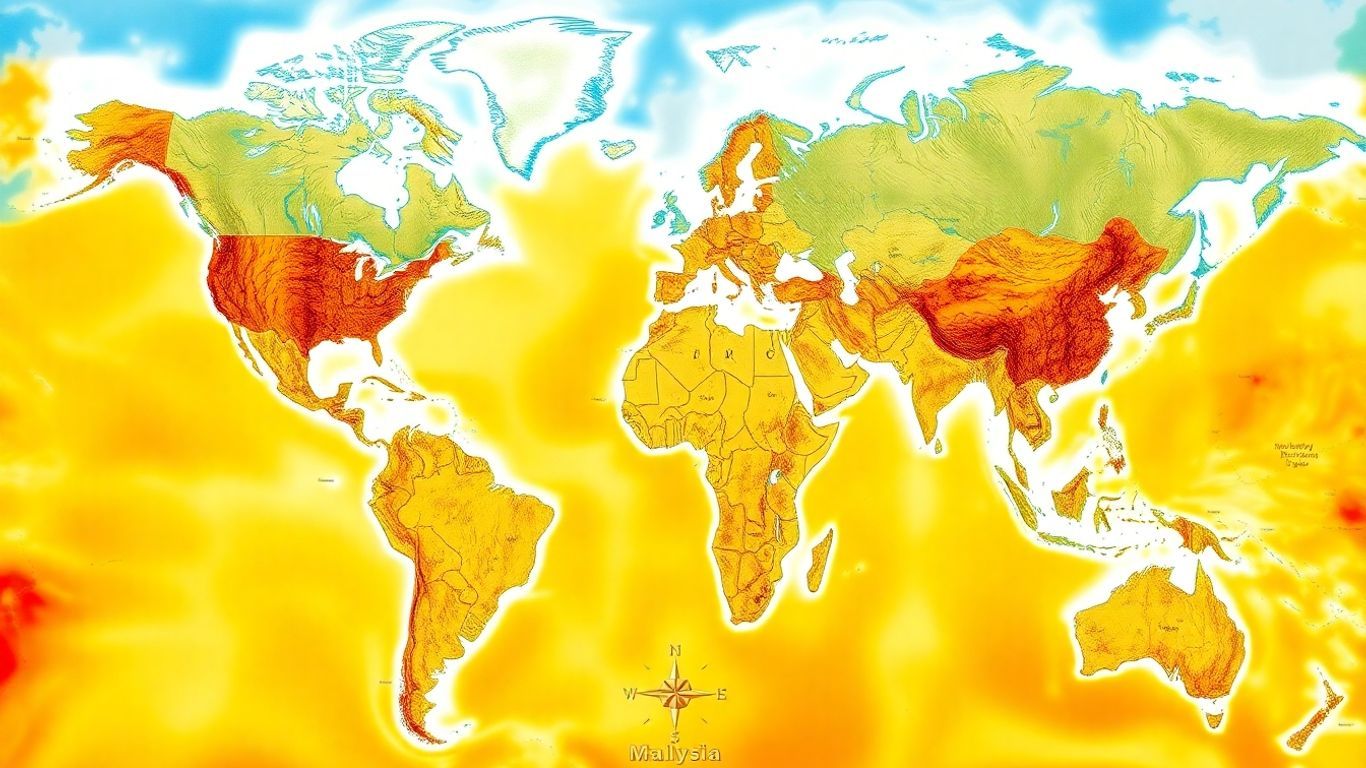
When we spot Malaysia on a world map, it's clear it isn't just a single landmass. It's actually two main regions separated by the South China Sea. You have Peninsular Malaysia, that long strip extending down from the Asian mainland, and then there's East Malaysia, which makes up part of the vast island of Borneo. These two areas have their own distinct characters and landscapes, even though they are one nation. The unique location of Malaysia straddling the equator is what gifts it a tropical climate all year round.
Peninsular Malaysia and Borneo
Peninsular Malaysia is where most of the population resides and where you'll find the capital, Kuala Lumpur. It shares a land border with Thailand to the north and looks out onto the South China Sea. Borneo, on the other hand, is a much larger island shared with Indonesia and Brunei. East Malaysia, which includes Sabah and Sarawak, is renowned for its dense, ancient rainforests and incredible biodiversity. It truly feels like a different world from the peninsula, with its own unique natural wonders and adventures.
Mountain Ranges and Highlands
While Malaysia might not be famous for towering, snow-capped peaks, it certainly has its share of highlands and mountain ranges. The Titiwangsa Mountains form the backbone of Peninsular Malaysia, offering cooler getaways like the Cameron Highlands and lush greenery. Over in Borneo, Mount Kinabalu in Sabah stands as the highest peak in Southeast Asia—a significant landmark for climbers and a powerful symbol of the state. These elevated areas are vital for local weather patterns and provide habitats for unique wildlife.
Coastal Areas and Islands
With such a long coastline, it's no surprise that Malaysia is blessed with beautiful coastal areas and countless islands. The west coast of the peninsula faces the Strait of Malacca, one of the busiest shipping lanes in the world. The east coast is home to idyllic islands like Redang and Tioman, famous for their pristine beaches and world-class diving spots. Borneo also boasts extensive coastlines, with many smaller islands scattered offshore. These coastal regions are vital for our fishing industry, tourism, and trade, connecting Malaysia to the wider world map and our maritime neighbours.
Malaysia's Role in Global Context
When you look at a world map, Malaysia really stands out as an interesting spot, especially when you consider how it connects with the rest of the globe. It's not just a place on the map; it's an active participant in several big global arenas.
Southeast Asian Geopolitics
First and foremost, Malaysia is located right in the heart of Southeast Asia. This region is incredibly important for global trade and is home to a diverse group of countries, each with its own interests. Malaysia's location means it's often at the centre of discussions about regional cooperation and stability. It's a founding and key member of ASEAN (the Association of Southeast Asian Nations), which works to keep things peaceful and promote collaboration among its members. Being in this strategic spot means Malaysia has a significant voice in regional security and economic development.
International Trade Routes
Just think about shipping lanes for a moment—a huge portion of the world's goods passes through the waters right next to Malaysia. The Strait of Malacca, for instance, is one of the busiest shipping channels on the planet. This strategic position puts Malaysia firmly on the map for global commerce, acting as a critical hub for moving goods between the Indian Ocean and the Pacific Ocean. This helps fuel Malaysia's economy and makes it a valuable partner for many countries looking to trade their products.
Here's a quick look at some of our major trade connections:
- Maritime Routes: Crucial for shipping oil and manufactured goods around the world.
- Air Cargo: Connecting Malaysian businesses to global markets with speed.
- Digital Networks: Facilitating international finance and real-time communication.
Malaysia is actively positioning itself as a central hub for international economic dialogues. The country is set to host important meetings between major global players, aiming to advance its own economic interests and its influence in worldwide trade. This proactive stance highlights Malaysia's growing importance in shaping global economic conversations and securing favourable trade relationships.
Cultural Exchange Hub
Malaysia itself is a vibrant tapestry of different cultures—Malay, Chinese, Indian, and numerous indigenous groups, plus influences from all over the world. This makes it a natural hub for cultural exchange. Here, people from different backgrounds live and work together, sharing traditions, food, and ideas every day. This diversity isn't just an internal strength; it makes Malaysia a welcoming place for international visitors and a forum where global cultures can meet and mingle. It’s a country where you can truly see how different parts of the world connect on a human level, making it a dynamic cultural crossroads.
Interactive Tools for Exploration
Exploring Malaysia's place in the world doesn't have to be a static experience of staring at a paper map. Thanks to modern technology, we have some pretty amazing ways to get a real feel for where things are and how they all connect. It’s like having a super-powered magnifying glass for the entire planet, right at your fingertips.
Digital Mapping Platforms
These days, you don't need a giant physical map rolled out across your floor. There are plenty of online map services that let you see the world from your computer or phone. What's great is that they're constantly updated, so you’re always looking at the most current information. These platforms are your gateway to seeing Malaysia in its global neighbourhood.
Zooming and Panning Features
This is where the fun really begins. Most digital maps allow you to zoom way in to see the fine details of a specific street, or zoom way out to get that big-picture, continental view. You can also 'pan'—which is just a fancy word for dragging the map around—to explore different areas. It feels like having a virtual globe that you can spin and inspect as you please.
Here’s a quick rundown of the common controls:
- Mouse Wheel/Scroll: Use this to zoom in and out. Super simple.
- Click and Drag: Hold down your mouse button and move it to shift the map around.
- Double-Click: This will often zoom in on the exact spot you clicked.
- Keyboard Arrows/WASD: Some map services let you use these keys to navigate, almost like you're playing a game.
- Reset Button: If you ever get lost or zoom in too far, there's usually a handy button to take you back to the default view.
Customizable Map Overlays
What makes these digital tools even more powerful is the ability to change what you see on the map. Curious about major shipping routes? Or perhaps you want to focus on different climate zones? You can often add or remove various layers of information. This lets you tailor the map to whatever you're interested in, whether it's trade flows, population density, or just the location of major cities.
These interactive features transform a simple map into a dynamic learning tool. Instead of just passively looking at a static image, you can actively engage with the geography, making it far easier to grasp complex relationships between places and understand how Malaysia fits into the larger global picture. It’s all about making the world feel more accessible and understandable.
Educational Value of a World Map
Fostering Global Awareness
Looking at a world map, especially one that highlights Malaysia's position, really helps you appreciate how interconnected everything is. It's not just about memorising where countries are; it's about understanding how an event in one part of the world can ripple out and affect another. This big-picture view is essential for making sense of global news and complex issues. When you see Malaysia on the map, you start thinking about its neighbours, its trade partners, and its role within Asia and the wider world. It helps make abstract concepts like international relations feel much more tangible.
Understanding Cultural Diversity
A world map is like a giant visual encyclopedia of humanity. It shows how different cultures have blossomed in different environments. For instance, when you see the vastness of Asia compared to the smaller landmasses of Europe, you begin to appreciate the incredible variety of traditions, languages, and ways of life that have emerged across the globe. It's a fantastic way to spark curiosity about other people and places.
Here's a quick glimpse at how the continents differ:
- Asia: The largest continent, home to diverse climates from tropical rainforests to frozen tundras, and a massive population with countless distinct cultures.
- Africa: Known for its vast savannas, deserts, and rich ancient history, with a wide array of languages and ethnic groups.
- Europe: Densely populated with a long history of cultural exchange, conflict, and technological development.
- North America: Features varied landscapes from arctic regions to deserts, with a dynamic mix of indigenous and immigrant cultures.
- South America: Famous for the Amazon rainforest, the Andes mountains, and its vibrant Latin cultures.
- Australia/Oceania: An island continent with unique wildlife and ancient indigenous cultures, surrounded by thousands of smaller islands.
- Antarctica: An ice-covered landmass, home to scientific research stations but no permanent human population.
Enhancing Geographical Knowledge
Beyond just learning country names, a world map helps you grasp fundamental geographical concepts. You learn about latitude and longitude, time zones, and how these factors influence climate and daily life. For example, knowing Malaysia's coordinates explains why we have our tropical weather. It also makes learning about physical geography—like mountain ranges or oceans—much easier when you can see them in context. It’s a practical tool for learning about the physical world we all share.
Using a map isn't just about looking at lines and colours; it's about building a mental model of our planet. When you can visualise where Malaysia is, you can better understand why certain weather patterns occur, why trade routes developed the way they did, and how different regions interact. It's a foundational step for anyone wanting to truly understand our world.
Wrapping It Up
So, we've taken a look at Malaysia's spot on the world map, its specific coordinates, and how its prime location gives us our signature tropical weather. It’s fascinating how a country's position can affect everything from its climate to its role in global conversations. Thinking about maps this way helps us see the bigger picture and how interconnected everything is, even when we're just focusing on one nation. It’s a great reminder that the world is a large and intriguing place, and knowing where things are is the first step to understanding it better.
Frequently Asked Questions
Where exactly is Malaysia on the world map?
Malaysia is located right in the heart of Southeast Asia. It's geographically unique, with one part on the Malay Peninsula (connected to mainland Asia) and the other on the northern part of Borneo island. Its position near the equator makes it a truly tropical country.
What are Malaysia's coordinates?
Generally, Malaysia is situated around 2 degrees North latitude and 112 degrees East longitude. This puts it just a little north of the equator and firmly in the Eastern Hemisphere.
How does Malaysia's location affect its weather?
Because Malaysia is so close to the equator, it enjoys a tropical climate. This means it's generally hot and humid all year round, with significant rainfall, particularly during the monsoon seasons which bring heavy showers.
What are some major cities in Malaysia and where are they?
Key cities include Kuala Lumpur, our nation's capital, on the west coast of Peninsular Malaysia. Other important hubs are George Town in Penang, Ipoh in Perak, and, over in East Malaysia, Kuching in Sarawak and Kota Kinabalu in Sabah.
Why is understanding Malaysia's place on a world map important?
Knowing where Malaysia is helps us appreciate its strategic role in Southeast Asia, its vital connections to international trade routes, and its status as a melting pot of cultures. It gives us a clearer picture of how countries connect and influence one another on a global scale.
Are there easy ways to explore Malaysia on a map?
Absolutely! You can use many online map tools that let you zoom in and out, pan around the map, and even add different layers of information like traffic or terrain. These digital maps make it simple and fun to discover places and learn about Malaysia's geography.


