


citiesabc, first_page
New Study Reveals How Climate Change Could Reshape Marine Food Webs Across the North Pacific
16 Nov 2026

Researchers at Hanyang University in South Korea have used carbon and nitrogen isotope analysis to reveal major regional differences in the microscopic organisms supporting marine food chains. Published in Science Advances, the findings could help scientists understand how ocean warming and changing nutrient supplies affect marine biodiversity.
16 November 2026 – Scientists at Hanyang University ERICA in South Korea have identified major differences in the microscopic food sources supporting marine ecosystems across the western North Pacific, providing new evidence of how ocean conditions influence the foundations of marine food webs.
The study, published in Science Advances on 18 September 2026, used a dual-isotope analysis technique to examine the diets of Calanus copepods, small marine crustaceans that transfer energy from microscopic organisms to fish, seabirds and other marine animals.
Researchers found that bacteria contributed substantially to the food sources supporting copepods in warmer tropical and subtropical waters, while marine microalgae accounted for a much greater share in northern regions, including the Bering Strait and southern Chukchi Sea.
In tropical and subtropical waters, nitrogen-fixing organisms and heterotrophic bacteria contributed approximately 19.6% and 30.6%, respectively, to the copepods' estimated basal diets. In the Pacific Arctic, dinoflagellates alone accounted for 54.4%, while eukaryotic microalgae represented approximately 80%.
The findings provide a new method for investigating how warming temperatures, changing ocean circulation and nutrient availability could influence the marine food chains supporting fisheries and biodiversity.
How Ocean Warming Changes the Foundations of Marine Ecosystems
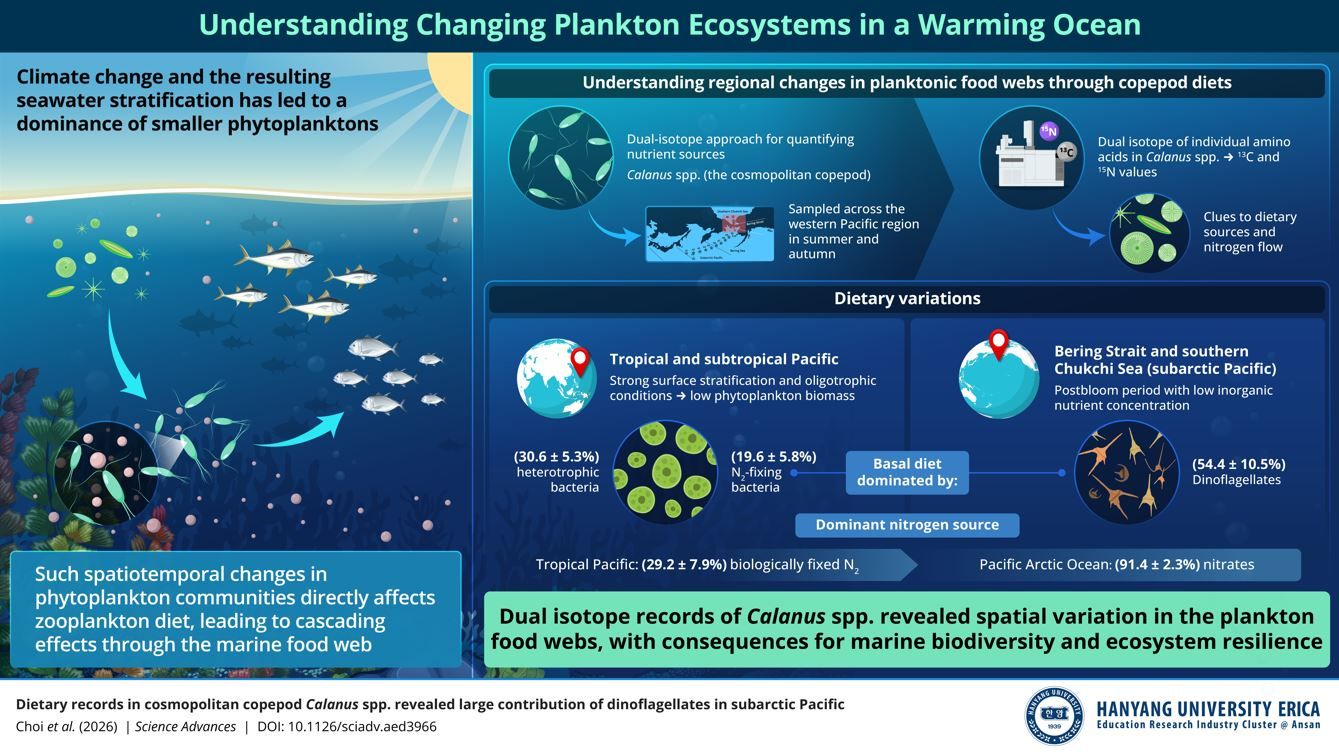
Climate change is affecting the physical and chemical conditions of oceans around the world, with rising temperatures influencing water circulation, nutrient distribution and the organisms that can thrive in different environments.
One important process is ocean stratification, which occurs when layers of seawater with different densities become less likely to mix.
As surface waters warm, stronger stratification can restrict the movement of nutrients from deeper waters towards the sunlit ocean surface.
These nutrients are necessary for phytoplankton, microscopic organisms that use sunlight to produce organic matter and form the foundation of many marine food webs.
Changes in nutrient availability can alter the composition of phytoplankton communities, favouring smaller organisms adapted to nutrient-poor conditions.
These changes can then influence zooplankton, which feed on microscopic organisms and provide food for larger marine animals.
Understanding which food sources contribute to zooplankton diets is therefore an important part of predicting how marine ecosystems may respond to changing environmental conditions.
However, measuring these contributions across large ocean regions has remained difficult because microscopic organisms interact through complex feeding relationships.
Researchers Use Copepods to Trace Marine Food Sources
The research team, led by Professor Kyung-Hoon Shin of Hanyang University's Department of Marine Science and Convergent Technology, investigated how food sources vary across the western North Pacific.
The scientists focused on Calanus species, a widely distributed group of copepods that play an important role in marine food chains.
These small crustaceans consume organisms or organic material originating from lower levels of the food web and are themselves eaten by fish and seabirds.
By examining their tissues, scientists can obtain information about the organisms and nutrients contributing to the food chain.
The researchers collected samples during summer and autumn from tropical and subtropical waters, the subarctic Pacific, the Bering Strait and the southern Chukchi Sea.
They then analysed carbon and nitrogen isotope ratios in amino acids extracted from copepod tissues.
Different organisms and nutrient sources leave identifiable chemical signatures, allowing researchers to estimate their contributions to the food resources supporting copepod growth.
Professor Shin explained that the objective was to measure how nutrient sources and primary-producer communities influence zooplankton diets and nitrogen transfer across the western North Pacific.
The team combined carbon and nitrogen isotope measurements to develop a more detailed understanding of the regional differences.
Bacteria Dominate More of the Food Supply in Warmer Waters
The analysis revealed substantial differences between tropical and northern marine environments.
In tropical and subtropical areas characterised by stronger surface stratification and relatively low phytoplankton biomass, the researchers identified larger contributions from bacterial food sources.
Nitrogen-fixing organisms accounted for an estimated 19.6 ± 5.8% of the basal diet, while heterotrophic bacteria contributed 30.6 ± 5.3%.
Nitrogen-fixing organisms can convert atmospheric nitrogen into forms that become available within marine ecosystems, providing an alternative nutrient pathway where other sources are limited.
Heterotrophic bacteria process organic matter and participate in the recycling of nutrients and carbon.
Their contribution to the copepods' estimated basal food sources indicates the importance of microbial pathways in warmer, nutrient-poor marine environments.
Further north, the estimated contributions from these bacterial sources declined.
Instead, eukaryotic microalgae, including diatoms and dinoflagellates, represented a larger share of the food sources supporting copepods.
This contrast illustrates how changes in nutrient availability and ocean conditions are associated with different patterns of energy transfer through marine food webs.
Dinoflagellates Account for More Than Half of Basal Diet in Pacific Arctic
The strongest contrast emerged in samples collected from the Bering Strait and southern Chukchi Sea.
In these northern waters, dinoflagellates contributed approximately 54.4 ± 10.5% of the copepods' estimated basal diet.
When combined with other eukaryotic microalgae, the contribution rose to approximately 80%.
Dinoflagellates are a diverse group of microscopic organisms found in marine and freshwater environments. Some produce energy through photosynthesis, while others obtain nutrients by consuming organic material or other organisms.
Their substantial contribution in the northern samples shows how the food resources supporting copepods differ across the ocean.
The research team also found a strong relationship between the dinoflagellate contribution estimated from carbon isotopes and the contribution of protists inferred from nitrogen isotope measurements.
This agreement helped support the researchers' interpretation of the chemical signatures.
Nitrogen Sources Also Differ Across the North Pacific
Alongside the copepods' food sources, the researchers examined the origins of nitrogen supporting marine microalgae.
Nitrogen is an important nutrient for phytoplankton growth, but its availability and chemical form vary considerably across ocean environments.
In tropical Pacific waters, biologically fixed nitrogen accounted for an estimated 29.2 ± 7.9% of the nitrogen supporting eukaryotic microalgae.
In the Pacific Arctic Ocean, nitrate was the dominant source, contributing approximately 91.4 ± 2.3%.
These findings show that different marine regions depend on distinct pathways for obtaining nutrients.
They also suggest that changes in ocean mixing and nutrient circulation could affect the composition of plankton communities.
Because plankton form the foundation of marine food chains, shifts in these communities may influence how energy and nutrients move towards larger animals.
What the Findings Mean for Marine Biodiversity and Climate Research
The study offers a new way to investigate ecological changes that can be difficult to observe directly.
By combining carbon and nitrogen isotope measurements, researchers can reconstruct the contributions of different microscopic food sources and identify regional patterns in marine food webs.
This approach could support future studies of how ocean warming, stronger stratification and changing nutrient supplies affect plankton communities.
It may also help researchers understand changes in the marine carbon and nitrogen cycles, which influence wider ocean ecosystem processes.
Professor Shin said the findings demonstrate the value of combining isotope measurements to investigate feeding relationships and nutrient pathways.
He also warned that changes in stratification and nutrient dynamics could have consequences for marine biodiversity and ecosystem resilience.
However, the research examined geographical differences observed across ocean regions. It did not directly measure how an individual food web changed over time as temperatures increased.
The findings therefore provide evidence of how marine food sources differ under contrasting environmental conditions and establish a method for investigating future climate-related changes.
For scientists studying marine ecosystems, the technique could help connect changes in microscopic organisms with wider questions about ocean productivity, fisheries and biodiversity.
About Hanyang University ERICA
Hanyang University ERICA, based in Ansan, South Korea, is a research-focused university campus established in 1979.
The institution conducts research across science, technology, engineering and environmental disciplines, including marine ecology and biogeochemical processes.
Professor Kyung-Hoon Shin is a researcher in marine science and directs the Global Science Research Center for Marine Material Cycle Processes.
His research focuses on marine food web structures, carbon and nitrogen cycles, and isotope-based techniques for studying environmental processes.
- Official website: https://www.hanyang.ac.kr/web/eng/erica-campus1
- Research paper: Dietary records in cosmopolitan copepod Calanus spp. revealed large contribution of dinoflagellates in subarctic Pacific
- Journal: Science Advances, Volume 12, Issue 38, 18 September 2026
- DOI: https://doi.org/10.1126/sciadv.aed3966


