
business resources
Profound vs. Scrunch: Which AEO tool to choose
11 Mar 2026

Scrunch and Profound are some of the most established platforms in the Answer Engine Optimization (AEO) space. Both help brands monitor and improve how they show up in AI-generated answers. Both serve enterprise customers. But they don't approach the problem the same way.
Scrunch leans toward actionable monitoring, rapid optimization, and automated content delivery to AI agents through its Agent Experience Platform (AXP). Profound leans toward deep analytics, prompt research data, and AI-powered content workflows.
This article compares the two across five dimensions, monitoring and data, optimization and content, enterprise readiness, vendor credibility, and pricing plans, so you can decide which one fits how your team works.
AI monitoring and data coverage
Monitoring is the baseline capability of any AEO tool and where most buyers start. Both Scrunch and Profound deliver strong coverage here, but the differences in LLM breadth per price tier, filtering granularity, and AI search volume methodology matter more than they might seem at first glance.
Criterion | Scrunch | Profound |
| LLMs tracked | 8 platforms: ChatGPT, Claude, Perplexity, Gemini, Meta AI, Google AI Mode, Google AI Overviews, Copilot (Grok coming soon). Core plan ($250/mo) includes ChatGPT, Perplexity, Google AIO, Copilot. Enterprise includes all 8+ | 10+ platforms: ChatGPT, Perplexity, Google AIO, Google AI Mode, Gemini, Copilot, Meta AI, Grok, DeepSeek, Claude, Amazon Rufus. Starter ($99/mo) = ChatGPT only. Growth ($399/mo) = ChatGPT, Perplexity, Google AIO. Full suite = Enterprise only |
| Brand presence tracking | Binary presence % across all tracked prompts + share of voice | Visibility score and share of voice |
| Placement/position tracking | Top (top 25%), middle (middle 50%), bottom (bottom 25%) of AI responses | Tracks position in AI answers |
| Sentiment analysis | Included on all plans | Included with keyword trend tracking |
| Citation tracking | Tracks brand, competitor, and third-party citations. Includes Influence Score (frequency × prompt breadth) | Claims 1B+ citations analyzed daily. Tracks citation authority |
| Competitive benchmarking | Share of voice, competitor gap analysis, automated suggested competitors | Competitive visibility comparison, Conversation Explorer for broader topic analysis |
| AI bot/agent traffic | Breaks traffic into retrieval, training, and indexing bots. Page-level detail with live feed | Agent Analytics via CDN log integration. Unlimited domains on all plans. AI crawler verification |
| AI referral traffic | Tracks website traffic from AI responses via GA4 integration | Attribution & Traffic Insights feature |
| Data filtering | Topic, persona, funnel stage, AI platform, country, branded/non-branded, tags, citation owner | Region, language, AI platform. Starter and Growth plans limited to 1 region and 1 language |
| AI search volume/trends | AI Search Trends: estimated volume across 1,500+ curated topics using privacy-compliant panel data. Topic-level by design---prompt-level volume isn't yet reliable enough industry-wide | Prompt Volumes: proprietary dataset claiming 400M+ conversations. Enterprise only. Uses panel data with synthetic enhancement. Some users have noted inconsistencies |
| Historical data | Up to 12 months in-platform; 90 days via API | All time on all plans. Stores screenshots for audit trails |
| Response data | Collects actual AI responses. The Responses API captures full text, citations, and brand presence per prompt | Captures front-end rendered answers (not API outputs). Stores full text and metadata |
The biggest practical difference here is how many AI platforms you can monitor at each price point. Scrunch's Core plan at $250/mo includes four LLMs, with all eight-plus available on Enterprise. Profound's Starter at $99/mo is limited to ChatGPT only, and even the Growth plan at $399/mo only adds Perplexity and Google AI Overviews. To get full multi-platform coverage comparable to Scrunch's, you need Profound's custom-priced Enterprise tier. For teams that need cross-platform visibility from day one, that's a significant gap.
Scrunch also offers notably granular filtering: you can slice data by persona, funnel stage, country, topic, AI platform, tags, branded/non-branded, and citation owner. This matters for teams that need to report on specific segments or business dimensions.
Profound's Starter and Growth plans are limited to a single region and language, which constrains international or multi-persona analysis. The filtering gap narrows at Enterprise level.
Both platforms offer AI search volume data, but they take fundamentally different approaches. Profound's Prompt Volumes dataset claims to cover 400M+ real user conversations and provides prompt-level volume estimates. But it's only available on the Enterprise plan, and some users have noted inconsistencies in the data.
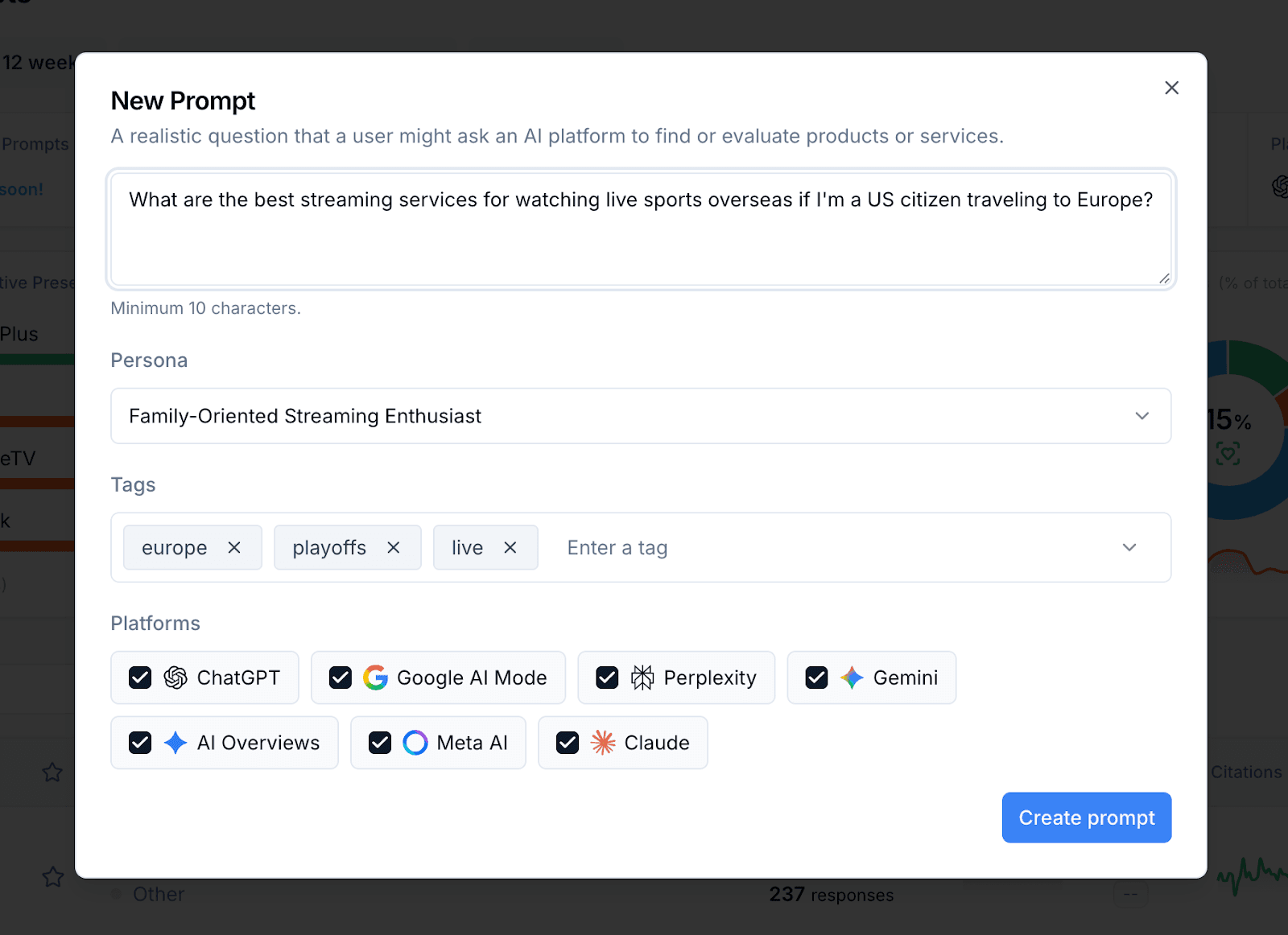
Adding a new prompt in Scrunch comes with sophisticated settings
Scrunch's AI Search Trends tracks estimated volume across 1,500+ curated topics using privacy-compliant panel data, deliberately staying at the topic level because prompt-level estimates aren't yet reliable enough industry-wide. This concern is echoed by other industry observers. Both approaches are directionally useful; neither should be treated as precise demand forecasting.
Optimization and content delivery
Monitoring tells you what's happening. Optimization is what you do about it. This is where Scrunch and Profound diverge most sharply, and where the choice between the two platforms becomes clearest.
Criterion | Scrunch | Profound |
| Site mapping | Site Maps: visual tree of website with per-page audit score, agent traffic, citations, and AI referrals. Drill into any page for performance by AI model, diagnostics (access, agent activity, search index status, human vs AI content experience), and which prompts cite it — plus prompts it should be winning but isn't. Up to 5,000 pages depending on plan | Not a core feature at this depth |
| Site auditing | Deep AI Audit diagnoses why a page underperforms: access controls, content delivery, and content quality with explanations and fixes. Auto-detects issues preventing AI agents from consuming content. Core plan: 5 audits/mo. Enterprise plan: full site audits | Technical Analysis runs page-level diagnostics (load times, rendering, blocking scripts). Produces a report for your engineering team to act on |
| Content optimization | Optimizer generates a customizable optimization plan per page: intent, target persona, suggested prompts, source pages. Non-AXP users get detailed recommendations. AXP users get a publish-ready AI-optimized page deployable with a click. Core plan: 1 page/mo. Enterprise plan: custom | Content Optimization on Growth (3 articles/mo) and Enterprise (custom). Uses templates built from millions of top-cited pages |
| Content delivery (AXP) | Agent Experience Platform sits at CDN level. Delivers an AI-optimized version at the edge. It strips out the superfluous code like Javascript and serves a token-light version of the page for AI to consume. The result is that it takes token count down by multiple orders of magnitude without changing the human web visitor experiencfe. Integrates with Akamai, AWS CloudFront, Cloudflare, Fastly, Vercel, WordPress | No equivalent feature. Approach is diagnostic: flags issues, produces reports, relies on your team to implement fixes |
| Content generation | It’s on the team’s product roadmap for 2026. | Agents feature generates articles in citation-driving formats (listicles, how-tos, comparisons). Drag-and-drop workflow builder. Growth plan: 3 articles/mo. Enterprise plan: custom |
| CDN integrations | Akamai, AWS CloudFront, Cloudflare, Fastly, Vercel, WordPress. HubSpot CMS, BigCommerce, Shopify, Squarespace, Uberflip, Webflow, Wix via Cloudflare proxy | Akamai, AWS, Cloudflare, Fastly, Google Cloud Platform, Netlify, Vercel, WordPress |
Scrunch offers a capability that no other AEO competitor does: Scrunch's Site Maps. It gives teams a bird's-eye view of what's working and what needs attention. But what makes Site Maps particularly powerful is that it's the entry point for an end-to-end workflow: spot an underperforming page, run a Deep AI Audit to diagnose the issue, generate optimized content with Optimizer, and deploy it directly to AI agents via AXP. All without leaving the platform. And AXP is the capability that only Scrunch and Adobe’s LLM Optimizer currently offer.
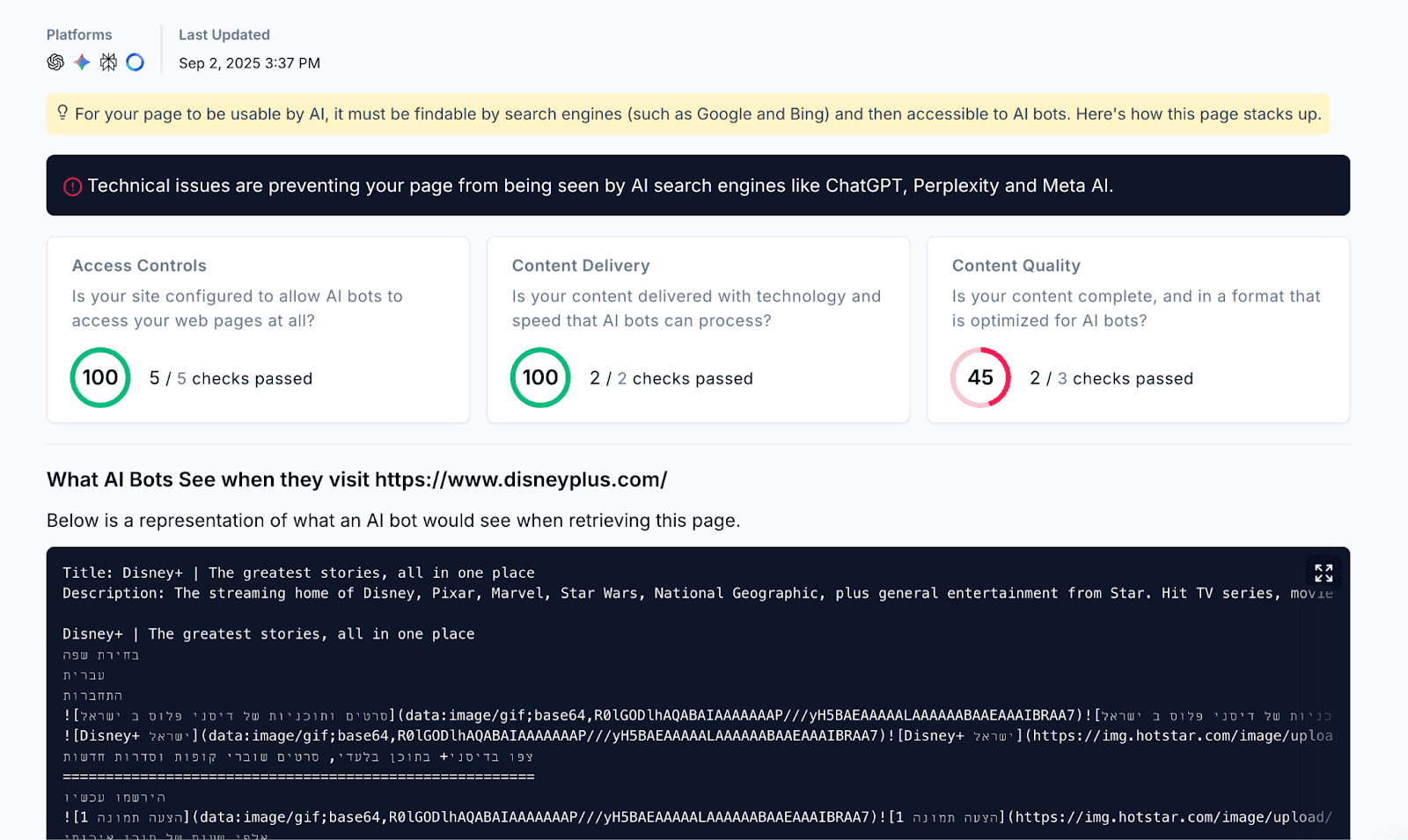
A page audit tool in Scrunch that detects common website issues
The single biggest difference between Scrunch and Profound is how they handle content delivery to AI agents.
Profound takes a diagnostic approach: its Technical Analysis feature identifies issues like slow load times or blocking scripts, then generates a report that your engineering team needs to act on. Scrunch's Agent Experience Platform (AXP) takes a fundamentally different approach: it sits at the CDN level and automatically serves AI-optimized, clean HTML to AI crawlers without touching the human visitor experience. For organizations that want to fix AI accessibility problems at the infrastructure level without rebuilding their website, AXP is a significant value add.
Profound offers automated content workflows with drag-and-drop and automated formats. But content generation is unavailable on Profound's Starter plan and capped at 3 articles/month on Growth, so meaningful access requires Enterprise pricing. Also, building content workflows that deliver great content is difficult and automated content production typically produces slop that requires significant editing.
Scrunch's content generation capabilities are more basic and still developing, though its content optimization (automated recommendations for improving existing pages) and site-level auditing are available from the Core plan.
Enterprise readiness and scale
Both Scrunch and Profound check the enterprise boxes. The real differences are in how they handle scale, integrations, and agency workflows.
Criterion | Scrunch | Profound |
| SOC 2 Type II | Yes | Yes |
| SSO | SAML and OAuth-based (Enterprise plan) | SAML/OIDC (Enterprise plan) |
| RBAC | Admin, Editor, Viewer, Guest roles with per-brand permissions | Role-based access control |
| HIPAA compliance | Not mentioned | Yes |
| GDPR/CCPA | Both | GDPR compliant |
| Multi-brand support | Multiple brand workspaces from a single account | Multiple companies tracked on Enterprise |
| Multi-region/language | Multi-domain, multi-region, all language localizations | Custom regions and languages on Enterprise plan. Starter/Growth plan limited to 1 region, 1 language |
| Performance at scale | Enterprise brands like Dell, Lenovo, and Akamai monitor millions of prompts and hundreds of thousands of pages | Enterprise clients, including Ramp, US Bank, and others. Claims millions of prompts analyzed daily |
| API | Query API (aggregated metrics) + Responses API (raw data). Prebuilt Looker Studio template. GA4 integration for AI referral tracking. Billing based on responses collected, not API calls | Enterprise only. MCP integration for Claude Desktop |
| CDN integrations | Akamai, AWS CloudFront, Cloudflare, Fastly, Vercel, WordPress. Plus proxy support for HubSpot CMS, BigCommerce, Shopify, Squarespace, Uberflip, Webflow, Wix | Akamai, AWS, Cloudflare, Fastly, GCP, Netlify, Vercel, WordPress. Plus Google Analytics |
| Onboarding speed | Many customers deployed on day one. Seamless setup | Must apply for access. Enterprise gets a dedicated specialist |
| Support | Email on Core. Email + Slack + dedicated account team on Enterprise | Email on Starter/Growth. Email + dedicated Slack + dedicated specialist on Enterprise |
| Agency features | Easy brand creation (~5 min), bulk CSV migration, unified multi-client workspace, prospecting licenses, up to 20% referral commission, dedicated agency team, co-marketing fund | Agency Mode with centralized client management, dedicated agency team, go-to-market support |
Both platforms meet enterprise security requirements: SOC 2 Type II certified, SSO and RBAC on Enterprise plans, GDPR compliant. Scrunch adds CCPA compliance; Profound adds HIPAA, which matters for healthcare and health-adjacent organizations.
At scale, both serve major enterprises. Scrunch works with Dell, Lenovo, Akamai, and other major enterprise companies while Profound counts Ramp, US Bank, and MongoDB among its customers. One operational difference worth noting: Scrunch deploys on day one for many customers, while Profound requires an application and review process.
Scrunch offers two APIs: Query (aggregated metrics) and Responses (raw data), plus a prebuilt Looker Studio template and GA4 integration for AI referral tracking. Billing is based on responses collected rather than API calls, which makes costs more predictable. Profound's API is Enterprise-only but includes an MCP integration for Claude Desktop.
Both platforms also serve agencies, but with different models. Scrunch's seamless brand creation lets agencies spin up a fully populated client environment in about five minutes, complete with prepopulated competitors, persona mapping, and topic generation. Bulk CSV migration, prospecting licenses, and a unified workspace make day-to-day operations streamlined, plus up to 20% referral commission and a co-marketing fund.
Profound's Agency Mode provides centralized client management and a dedicated agency team, though per-client workspace add-ons at $399/mo can scale costs quickly for multi-client agencies.
Vendor credibility and customer proof
Features matter, but so does the company behind them. In a category this young, you're both buying a tool and betting on a team's ability to keep building. Let’s look at funding, customer traction, published results, and what real users are saying about each platform on G2.
Criterion | Scrunch | Profound |
| Total funding | $26M (Mayfield, Decibel, Homebrew, GTM Capital). Most recent: $15M Series A, July 2025 | $155M (Khosla Ventures, Kleiner Perkins, Sequoia Capital, NVIDIA). Most recent: $96M Series C, February 2026 |
| G2 rating | 4.7/5 (55 reviews) | 4.6/5 (155 reviews) |
| Industry awards | G2 2026 Best Software Awards — Rookies of the Year (#16). Based on verified customer reviews and market data, not panel judges | G2 Winter 2026 AEO Leader designation |
| Customer base | 500+ companies including Fortune 500: Lenovo, Dell, Akamai, as well as Skims, Clerk, BairesDev, Hims, Penn State, NatWest, The Met, ADP, Paychex, Runpod | Fortune 500 focus. Named: Ramp, US Bank, Rippling, Indeed, MongoDB, Figma, Statsig, Xero, Hone, Airbyte, Plaid |
| Agency partners | Named agencies: New Breed+, DEPT, Within, Instrumental, Directive, Seer, Havas | Agencies use the platform (Zeno Group mentioned). Less prominently marketed |
| Published case studies with results | Runpod (4X growth in new paying customers per month), Stratabeat (260% AI visibility improvement), Tinybird, Big Leap, and others | Ramp (7x AI visibility increase), Hone (800% visibility boost), Statsig (full AEO visibility in <2 hours), Airbyte, and others |
| G2 review themes — positive | Ease of use, product velocity (constantly shipping features), actionable insights, responsive support, self-serve flexibility | Analytics depth, Conversation Explorer, customer support/partnership feel, useful for tracking and reporting |
| G2 review themes — negative | Limited historical data, some features still developing, pricing can be high for small agencies, some export limitations | Occasional platform glitches/stability issues, UI can be confusing, content workflows still generic, expensive for smaller teams, Prompt Volumes data can be inconsistent, onboarding could be smoother |
| Free trial | Yes — 7-day free trial | No self-serve trial. Must apply for access |
Profound has raised more funding than Scrunch. That signals significant R&D resources and long-term runway. Scrunch's $26M from Mayfield, Decibel, and others is also substantial for the AEO category. For enterprise buyers who weigh vendor financial stability heavily, both companies are well-capitalized.
Both platforms serve enterprise customers, including Fortune 500 companies. Scrunch works with Lenovo, Dell, Akamai, and 500+ other companies, with published case studies featuring specific, quantified results (Runpod’s 4X customer acquisition growth, Stratabeat’s 260% AI visibility boost). Scrunch also has a more visible agency ecosystem with named partners like DEPT, Seer, Havas, and Directive. Profound's case studies are also strong (Ramp's 7x visibility increase, Hone's 800% boost), and the platform counts US Bank, MongoDB, and Figma among its customers.
Scrunch was also recently named to G2's 2026 Best Software Awards as a Rookie of the Year (#16). The award is based on verified customer reviews and market data.
Scrunch holds a slightly higher G2 rating (4.7 vs 4.6), though Profound has more total reviews (155 vs 55). Across reviews, Scrunch users consistently highlight ease of use, fast feature shipping, and actionable insights. Profound users praise analytics depth and the Conversation Explorer.
On the negative side, Profound G2 reviews surface recurring themes around platform stability, a confusing UI, generic content workflows, and inconsistent Prompt Volumes data. Scrunch's negatives tend to focus on wanting more historical data and export options — less about core platform reliability and more about feature expansion.
Pricing and plans
Pricing in AEO tools can be deceptive. A lower sticker price doesn't mean much if the features you need are locked behind a higher tier. This section breaks down what each dollar actually buys at each plan level for Scrunch and Profound.
Criterion | Scrunch | Profound |
| Entry-level plan | Core: $250/mo. 125 prompts, 4 LLMs, 5 site audits/mo, 1 brand workspace, 5 user licenses | Starter: $99/mo (billed yearly, 2 months free). 50 prompts, ChatGPT only, 1 seat, 1 region, 1 language, email support. No content generation, no data exports, no API |
| Mid/Growth plan | Enterprise: custom pricing. Custom prompts, 9 LLMs, full site audits, custom workspaces, SSO, dedicated account team | Growth: $399/mo (billed yearly, 2 months free). 100 prompts, 3 LLMs, 3 seats, 6 optimized articles/mo, CSV/JSON exports. No API, no SSO |
| Enterprise plan | Custom | Custom. Up to 10+ LLMs, custom prompts, multiple companies, dedicated Slack, SSO/SAML + SOC 2, API access |
| Agency pricing | Agency Core: $500/mo. 250 prompts, 3 brand workspaces, 3 pitch workspaces, unlimited licenses, 4 LLMs | Agency plans exist but are less publicly documented. Agency Growth reportedly $99/mo base + $399/mo per active client workspace |
| Free trial | 7-day free trial | No self-serve free trial. Must apply for access |
| Pricing transparency | Published on website for both brand and agency plans | Starter and Growth published. Enterprise is custom |
| Prompts per dollar (entry tier) | 125 prompts for $250 = $2.00/prompt | 50 prompts for $99 = $1.98/prompt---but ChatGPT only, no auditing or optimization features included |
| Annual billing discount | Not specifically mentioned | 2 months free on annual billing (~17% discount) |
| API access | Available on Enterprise. Billing based on responses collected, not API calls | Enterprise only |
| Data exports | CSV, Excel, PDF on all plans. API on Enterprise | None on Starter. CSV/JSON on Growth. API on Enterprise |
At first glance, Profound's $99/mo Starter looks like a lower barrier to entry. But what you actually get for that price is limited: 50 prompts tracked on ChatGPT only, a single user seat, one region, one language, no data exports, and no content generation or optimization.
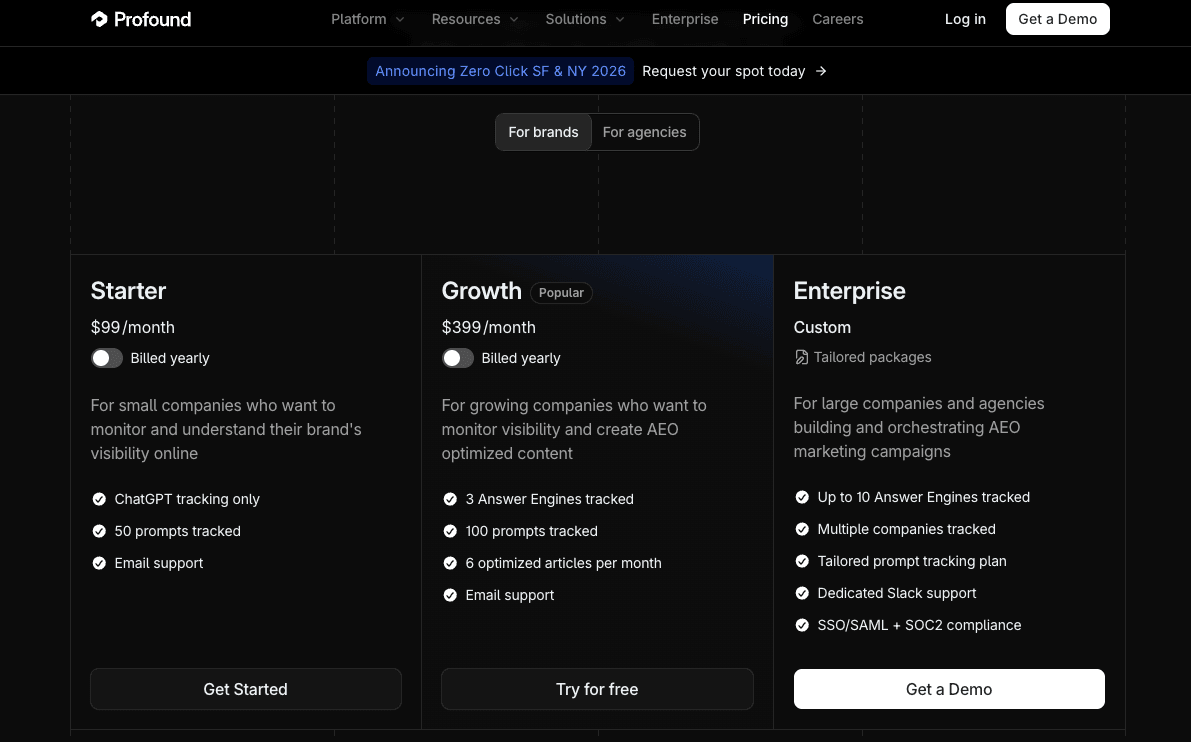
Profound’s pricing page for brands
Scrunch's Core plan at $250/mo is a higher absolute price, but it delivers 125 prompts across 4 AI platforms, 5 site audits per month, 5 user licenses, content optimization, and automated insights. For teams that need actionable, multi-platform monitoring from the start, Scrunch's entry point delivers significantly more functional value.
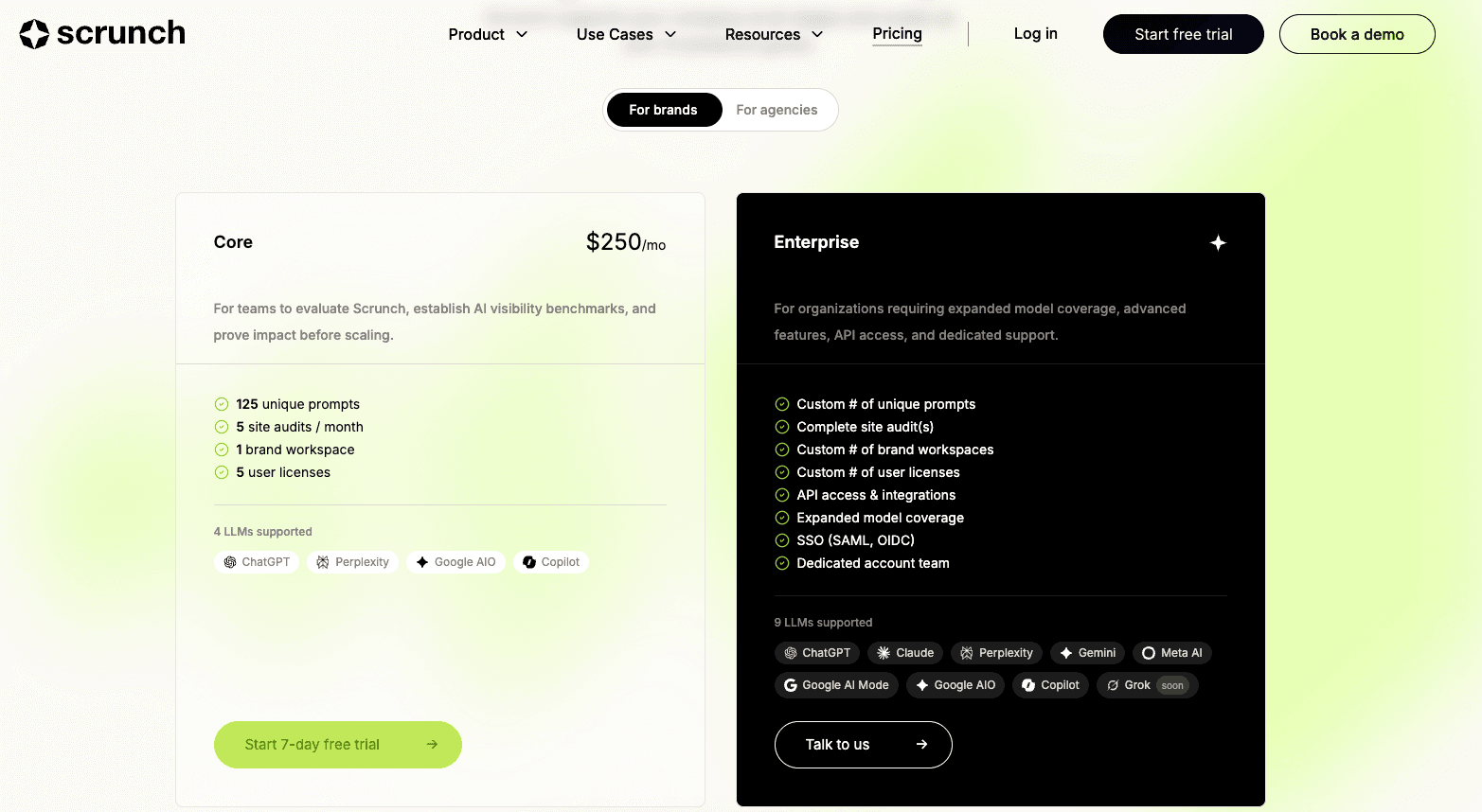
Scrunch’s pricing page for brands
The gap widens at the mid-tier. Profound's Growth plan at $399/mo gives you 100 prompts across 3 platforms and 6 articles/month, but still no API access, no SSO, and single-region/language tracking. To get full LLM coverage, API access, SSO, and multi-region support, you need Profound's custom-priced Enterprise tier. Scrunch's Enterprise plan is also custom-priced, but its Core plan already includes features — multi-LLM tracking, site auditing, content optimization, 5 seats — that Profound reserves for higher tiers.

Agencies can easily add a new client brand in Scrunch
For agencies, the pricing structures differ meaningfully. Scrunch's Agency Core at $500/mo includes 3 brand workspaces, 3 pitch workspaces, unlimited user licenses, and 250 prompts. Profound's agency model reportedly charges a base fee plus $399/mo per active client workspace, which scales quickly with multiple clients. Scrunch also offers a 7-day free trial for agencies to test the platform, while Profound requires an application process.
Which tool should you choose?
Both Scrunch and Profound are strong platforms, especially for enterprise companies. The right choice depends on your team's priorities and how you plan to operationalize AEO.
Choose Scrunch if you want to go beyond monitoring and actively optimize how AI agents consume your content. Scrunch's Agent Experience Platform (AXP) is one of the only technologies in the AEO space that automatically delivers AI-optimized content at the CDN level, without requiring engineering resources or website rebuilds. It's also the stronger fit if you need broad multi-LLM coverage without enterprise-only gating, site-level visibility into how every page performs in AI search, or agency-friendly workflows with easy onboarding and referral economics. Many customers are deployed and getting actionable insights on day one.
Choose Profound if your priority is proprietary AI search volume data for demand research and gap analysis, or if you're running AEO as a dedicated content program and need built-in content generation workflows. Profound is also the better fit if you require HIPAA compliance or need ChatGPT Shopping tracking for e-commerce.


