


resources-impakt
Purbashree by NEHHDC: A Government-Certified, Technology-Verified Supply Chain for Authentic Indian Handicrafts
31 Jul 2026

How NEHHDC is building institutional-grade traceability, artisan capacity, and sustainability standards into North East India's handloom and handicraft sector.
Purbashree is the retail and e-commerce brand of the North Eastern Handicrafts & Handlooms Development Corporation Ltd. (NEHHDC), a Government of India enterprise operating under the Ministry of Development of North Eastern Region (DoNER). Established in 1977 and now nearly five decades into its mandate, NEHHDC procures, produces, and markets handicraft and handloom products from artisans and weavers across India's eight northeastern states — Arunachal Pradesh, Assam, Manipur, Meghalaya, Mizoram, Nagaland, Sikkim and Tripura.
India is estimated to have approximately 3.5 million artisans and weavers nationally, with close to 1.8 million concentrated in the Northeast region alone. This represents a substantial, largely under-tapped production base for buyers seeking differentiated, traceable, and sustainably produced textile and craft products — one that NEHHDC is positioning to serve through formal certification, verification technology, and institutional-grade supply chain management.
For institutional buyers, retailers, export partners, and corporate procurement teams, Purbashree offers something the wider handicraft market often cannot: a government-backed, technology-verified supply chain with documented artisan sourcing, traceability infrastructure, and formal sustainability practices — positioning it as a credible sourcing partner rather than a curated marketplace of unverified vendors.
Government Certification as a Sourcing Standard
As a public sector undertaking under DoNER, NEHHDC's supply chain runs through its own registered network of artisans, cooperatives, and production centres, rather than through unaudited intermediaries. This structure gives corporate and institutional buyers a documented chain of custody and a single accountable entity for quality, compliance, and fulfilment — a standard not typically available when sourcing handicrafts through fragmented, informal channels.
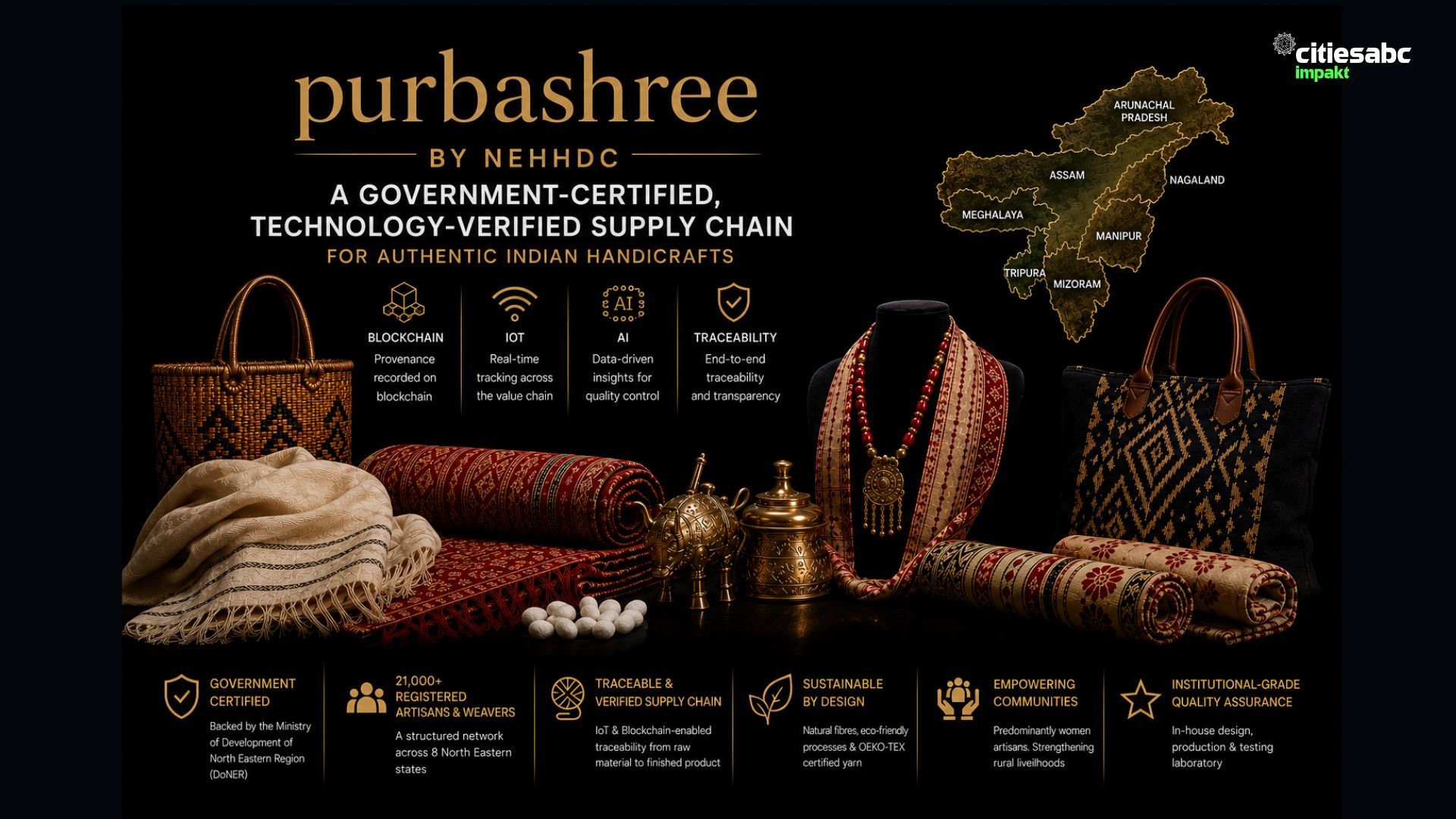
This accountability is reinforced by a set of formal government mandates that extend beyond NEHHDC's own charter. The corporation has been designated by the Ministry of Micro, Small & Medium Enterprises (MSME) as the Nodal Agency for implementing projects under the Scheme of Fund for Regeneration of Traditional Industries (SFURTI), and is a registered Training Partner with the National Skill Development Corporation (NSDC) under the Skill India programme.
It also acts as an implementing agency for the Office of the Development Commissioner, Handlooms and Handicrafts, running technical training, design development, and R&D activity on the Commissioner's behalf, and partners with TRIFED (Tribal Cooperative Marketing Development Federation of India), under the Ministry of Tribal Affairs, to support tribal artisans and suppliers across the region.
On the production side, NEHHDC operates its own in-house design-cum-production facility under the brand Nature's Weave, alongside a dedicated textile testing laboratory at Garchuk, Guwahati, for testing fibre, yarn, and fabric quality — giving institutional buyers an internal quality-assurance checkpoint rather than reliance on unverified third-party claims.
Physical distribution runs through Purbashree Emporia in Shillong, Guwahati, Kolkata, New Delhi, and Bangalore, a Sales Promotion Office in Chennai, and mobile retail units branded "Purbashree on Wheels" that extend market access into remote producing areas.
NEHHDC has also formalised design, technology, and marketing collaborations through more than 30 MoUs with institutions including IIM Shillong and NIFT Shillong, and maintains a multi-channel digital presence across Amazon, Flipkart, IndiaMART, TradeIndia, GoCoop, GeM (Government e-Marketplace), and Etsy — giving buyers several verified, government-linked procurement routes in addition to direct sourcing through NEHHDC.
Traceability infrastructure: Blockchain, IoT and AI
NEHHDC has invested in verification technology to move authenticity from a marketing claim to an auditable fact. The Corporation has commissioned an IoT and blockchain-based traceability solution, currently piloted across the Eri silk value chain, designed to record a product's provenance from raw material and yarn production through to the finished handloom item.
This sits within a broader digitalisation programme using Artificial Intelligence and IoT, combined with ERP-based inventory tracking and mapping, aimed at improving supply chain visibility, inventory accuracy, and quality control across NEHHDC's production network. The initiative has been presented at national platforms, including a showcase at the NE-Volution event at Pragati Maidan, New Delhi.
For B2B buyers, this infrastructure translates into a practical advantage: the ability to verify product origin and production standards at a level of granularity that supports compliance requirements, ESG reporting, and provenance-sensitive retail categories.
A structured, documented artisan network
NEHHDC's supply base is a registered, tracked network. As of the latest published figures, over 21,000 artisans and weavers are formally registered under NEHHDC across the region, supported by a network of more than 60 mobilising and networking partner organisations that extend market access, training, and financial inclusion support.
Capacity-building is treated as core infrastructure, not a peripheral CSR activity. NEHHDC runs skill-upgradation and entrepreneurship development programmes for its artisan base and has worked to resolve raw-material bottlenecks directly — for example, through its authorised Purbashree Yarn depot in Itanagar, Arunachal Pradesh, established to give weavers consistent access to certified Eri and Ahimsa silk yarn.
"Strengthening the supply chain for the region's artisans and ensuring easy access to quality yarn is fundamental for artisans and weavers to compete in national and international markets," said Shri Mara Kocho, Managing Director of NEHHDC, at the depot's inauguration.
This kind of upstream investment is directly relevant to buyers evaluating supply chain resilience and long-term production capacity, not just current product availability.
Sustainability and social impact as operating standards
Sustainability at NEHHDC is embedded in raw material sourcing and process, rather than applied as a marketing overlay. Core materials — Eri silk (produced through a non-violent process sometimes referred to as "Ahimsa silk"), bamboo, cane, and cotton — are inherently low-impact relative to industrial manufacturing. Purbashree Yarn is certified to international standards including OEKO-TEX Standard 100, providing buyers with an independently verifiable materials-safety benchmark.
NEHHDC has also formalised environmental practice at the production level through structured artisan training on waste reduction, eco-friendly materials, and energy-efficient methods, reinforced through initiatives such as its "Waste to Wealth" programme.
On the social impact side, NEHHDC's model channels commercial demand directly into artisan livelihoods across economically underserved regions of the Northeast, with a workforce that is predominantly female — making procurement through Purbashree a measurable contribution to rural livelihood generation and gender-inclusive economic participation, relevant to buyers with defined social procurement or ESG commitments.


