
business resources
Restaurant Billing Software in India 2026: What Actually Matters During Peak Hours (KOT, GST and Split Bills)
15 Sept 2026

In short: During peak hours, good restaurant billing software has to handle four things well: instant KOT (Kitchen Order Ticket) routing to the right kitchen station, table-wise running bills that never mix up orders, effortless split billing for group diners, and automatic GST calculation. Some of these are specialist POS capabilities and some are billing-and-compliance essentials, and knowing which tool covers which is what this guide is about. For fast GST billing, inventory, payments, and reporting, restaurant billing software from myBillBook starts at Rs.199/month.
Any restaurant owner will tell you that a system's real test isn't the quiet Tuesday afternoon. It's 8:45 PM on a Saturday, when every table is full, three groups are waiting, two delivery orders just pinged, and a table of eight wants separate bills.
That moment is when your billing setup either earns its place or exposes itself as a liability.
Most guides to restaurant billing software list the same generic features: GST invoicing, inventory, reports. All true, all necessary. What matters at peak hour is knowing which capabilities you actually need, and which tool provides them. This guide is organized around that pressure test: what breaks during peak hours in an Indian restaurant, and what to look for in the software that prevents it.
The KOT Problem: Where Peak-Hour Chaos Usually Starts
The Kitchen Order Ticket (KOT) is the single most important document in a restaurant that most billing guides barely explain. It's the note that tells the kitchen what to cook, for which table, with what modifications.
Get KOT wrong, and everything downstream fails.
What Goes Wrong With Manual or Weak KOT Systems
Picture the rush. A server takes an order verbally, scribbles it on a pad, walks to the kitchen, and hands it over. During peak hour, this breaks in predictable ways: handwriting the kitchen can't read, orders lost between table and kitchen, special instructions ("no onion, extra spicy") missed, and the wrong table getting the wrong dish.
Each error costs time the kitchen doesn't have at 9 PM. And a remade dish during a rush doesn't just delay one table. It cascades to every order behind it.
What Good KOT Handling Looks Like
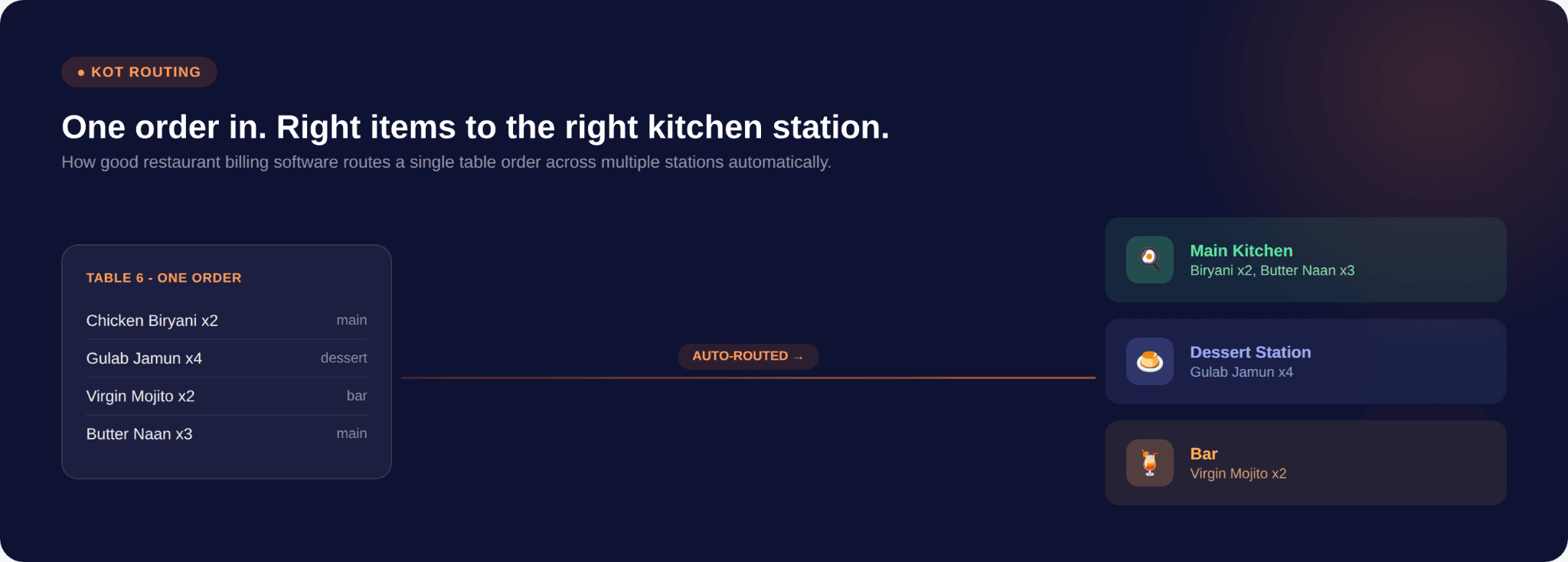
A dedicated restaurant POS with KOT support sends the order to the kitchen the instant it's placed, digitally, with every modification captured accurately. Stronger systems route different items to different stations automatically: the biryani to the main kitchen, the dessert to the dessert station, the mocktail to the bar, all from one order entry.
This routing matters more than it sounds. It means each station sees only what it needs to prepare, in the sequence it was ordered, without a server physically running between stations. If your restaurant runs a busy multi-station kitchen, KOT routing is a capability to prioritise and to confirm a tool offers before you buy.
The efficiency gain here connects to a broader truth about business operations: technology that streamlines internal processes delivers its biggest returns not on average days, but during peak load when manual systems collapse.
Table Management: Keeping Orders Straight When Every Table Is Full
The second peak-hour failure point is table confusion. When 15 tables are active and each has an evolving order, keeping them straight manually is nearly impossible.
The Running Bill Problem
Indian dine-in works on running bills. A table orders starters, then mains 20 minutes later, then dessert, then coffee. Each addition goes onto the same bill, which stays open until the guests leave.
During peak hour, with a dozen running bills open simultaneously, the failure modes multiply: items added to the wrong table, a table billed for another table's order, or an item served but never added to the bill, which is straight revenue loss.
How Table-Wise Billing Solves It
Restaurant software with table management treats each table as a separate, live billing unit. The server opens table 7, adds items as they're ordered, and the running total stays attached to that table until checkout. The strongest systems also handle the messy realities of real service: merging two tables when a group grows, splitting a table when a couple wants separate bills, and transferring an order when guests move seats. If dine-in with running tabs is central to your restaurant, table management is a feature to confirm a tool supports before committing.
Handling Multiple Order Channels at Once
Modern Indian restaurants don't just serve dine-in. During the same rush, they're fielding takeaway orders and delivery-app tickets. Software that can hold and manage multiple concurrent orders across channels keeps everything moving without one blocking another. This multi-billing capability is what separates a dedicated restaurant POS from a general billing tool, so it's worth testing directly if you run more than one channel at once.
Split Bills: The Peak-Hour Moment That Tests Every System
Group dining is central to Indian restaurant culture. And nothing exposes a weak setup faster than a table of eight asking to split the bill when they're ready to leave and the queue is building behind them.
Why Split Billing Is Harder Than It Looks
Splitting isn't always equal. Sometimes eight people split equally. Sometimes four couples each pay for what they ordered. Sometimes one person covers the alcohol and the rest split the food. Doing this manually, with a calculator, while other tables wait, is exactly the friction that ruins the end of a good meal.
And the payment side compounds it. In 2026, that group might pay across four different UPI apps, one card, and some cash, all against a single table bill.
What Smooth Split Billing Requires
Software with split-bill support needs to divide a bill flexibly, equally, by item, or by custom amounts, and then accept multiple payment modes against those splits without losing track of what's paid and what's pending. If group dining is a big part of your covers, dedicated split-bill functionality is a capability to look for specifically.
Where the billing backbone matters for everyone, though, is the payment side. The shift toward seamless, multi-mode payment systems has reshaped customer expectations across every industry, and restaurants feel it at checkout. A group that can each tap their own UPI app leaves happier than one waiting while a server does mental arithmetic. myBillBook supports multiple payment modes - cash, card, UPI, and wallets - with day-end reconciliation, so takings across every mode tally correctly at closing time.
GST for Restaurants: Getting the Rate Right Automatically
Here's something many restaurant owners get wrong: restaurant GST is not the same as retail GST. Applying the wrong rate is both a compliance risk and a pricing error.
The Restaurant GST Rules You Need to Know
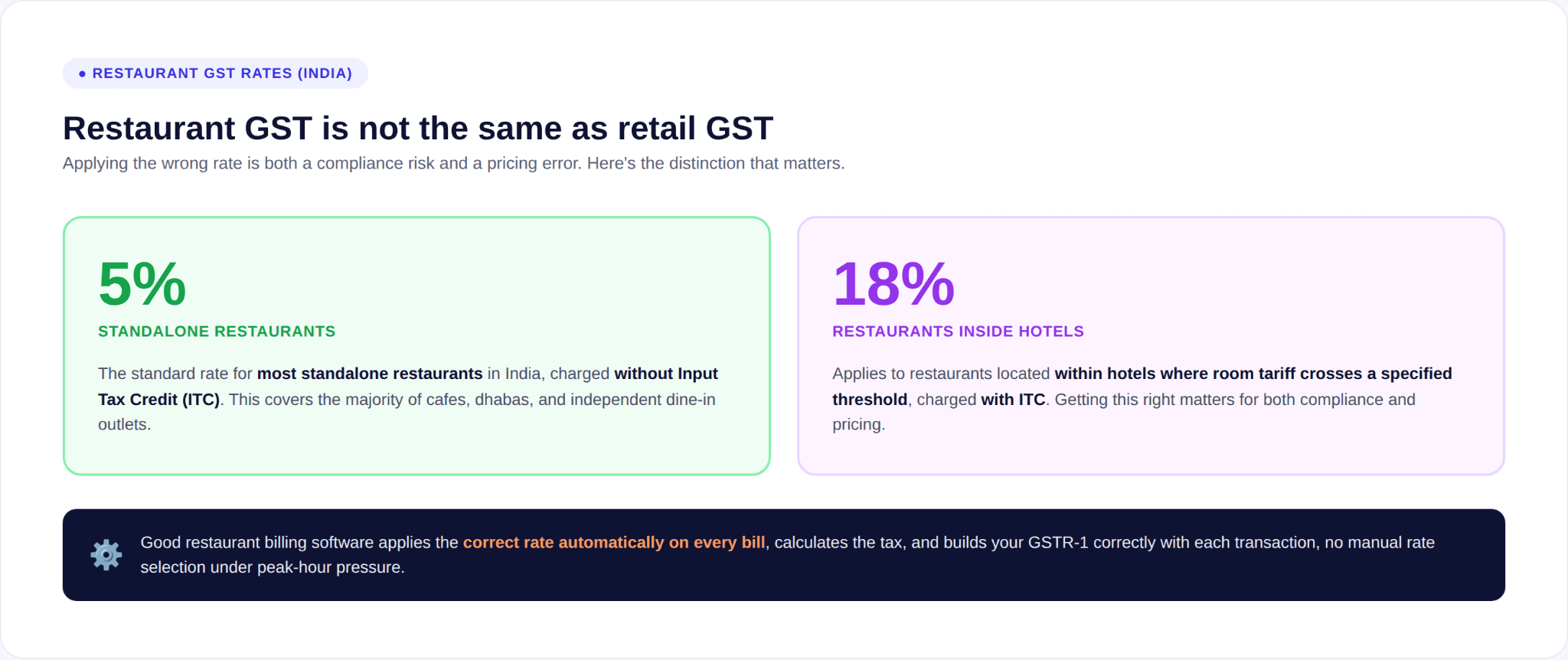
For most standalone restaurants in India, the GST rate is 5% without Input Tax Credit (ITC). Restaurants located within hotels where room tariff crosses a specified threshold charge 18% with ITC. Getting this distinction right on every bill matters for both compliance and correct pricing.
Manual billing makes this error-prone, especially when staff are rushing. Good billing software applies the correct rate automatically on every bill, calculates the tax, and stores the data for GST return filing. That means your GSTR-1 is being built correctly with every single bill, not reconstructed painfully at month-end.
Why Automatic GST Handling Matters at Scale
A busy restaurant generates hundreds of bills a day. At that volume, even a small manual error rate compounds into a real compliance problem by month-end. Automated GST calculation removes the error entirely, applying the right rate, capturing the tax, and keeping records audit-ready.
This is exactly where myBillBook is strong. It generates GST invoices with taxes and discounts applied automatically, auto-populates GSTIN and HSN/SAC details, produces daily GST summaries, and exports GST-ready reports, so restaurant owners stay compliant without turning tax season into a crisis.
Day-End Reconciliation Without the Headache
At closing time, the numbers have to match: total sales against cash in the drawer, UPI receipts, and card settlements. Doing this manually after a 12-hour service day is where mistakes happen. Software that auto-tallies cash, card, and UPI totals and flags variances instantly turns a 45-minute reconciliation into a 5-minute check. myBillBook's day-end reconciliation does exactly this, and it's the quiet feature owners come to value most.
Inventory and Kitchen Stock: The Profit Leak You Can't See
Billing software's job doesn't end at the bill. In a restaurant, every dish sold consumes ingredients, and tracking that consumption is where hidden profits are found or lost.
The Invisible Cost of Untracked Kitchen Stock
Food businesses lose money in ways that don't show up until month-end: over-ordering ingredients that spoil, running out of a key item mid-service, and portion inconsistencies that quietly erode margins. Without stock tracking linked to sales, none of this is visible until the loss is already taken.
This connects to a wider operational principle. Just as businesses are learning to rethink physical infrastructure and stockrooms as seriously as digital systems, restaurants that treat kitchen inventory as a tracked, data-driven asset rather than a guessing game consistently protect their margins better.
How Billing-Linked Inventory Helps
When your billing software tracks kitchen stock, every sale can inform your purchasing. You see which items are consumed fastest, which dishes are most ordered, and when to reorder before running out. myBillBook helps restaurants track stock for raw materials and finished items automatically, sends low-stock alerts, and generates reports on usage patterns, reducing both spoilage and stockouts.
The larger point: modern restaurant billing software functions less like a cash register and more like a lightweight operations platform, closer in spirit to the integrated modules of a business ERP system than to a simple invoice printer.
What to Look for When Choosing Restaurant Billing Software
Having walked through the peak-hour pressure points, here's the practical checklist for evaluating any restaurant billing software in India.
The Non-Negotiable Features
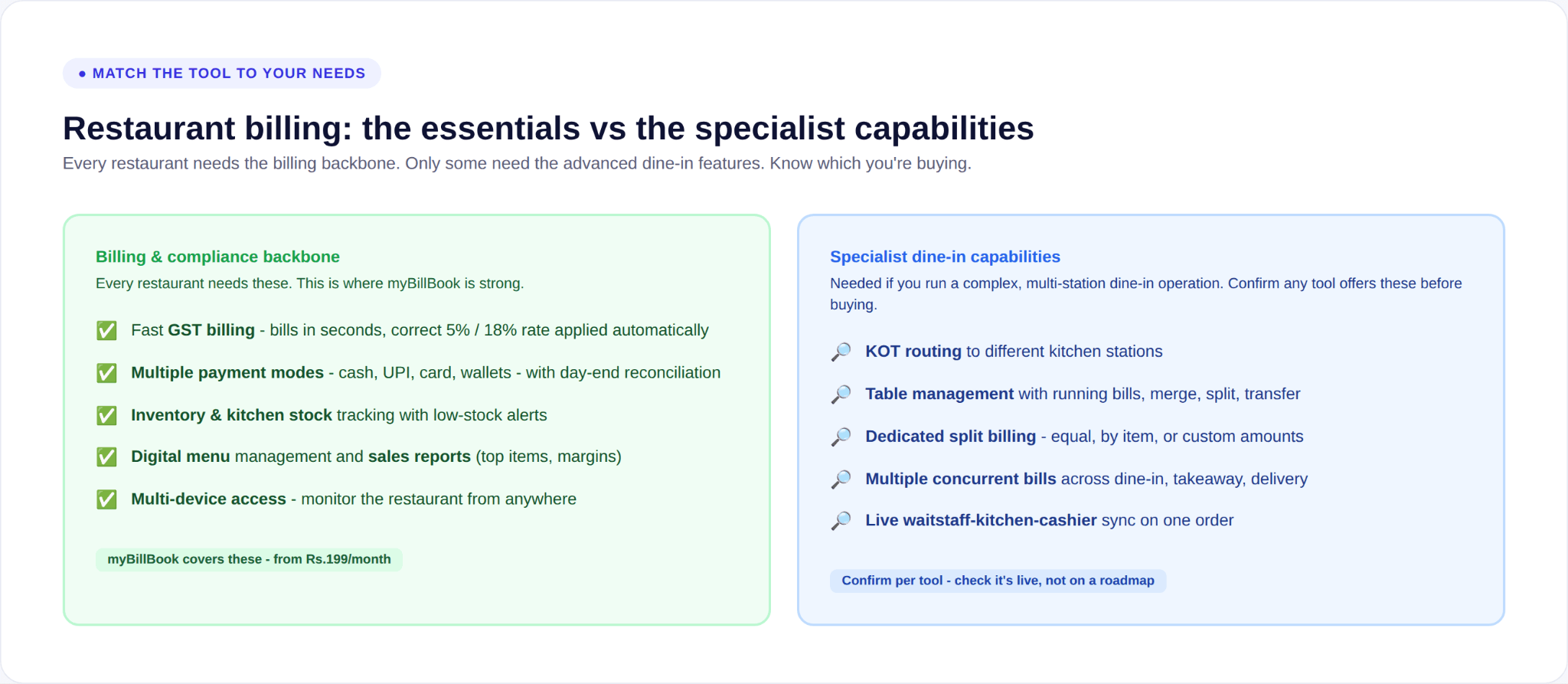
Fast GST billing with automatic restaurant-rate calculation (5% or 18% as applicable). Multiple payment modes with day-end reconciliation. Kitchen stock and ingredient tracking with low-stock alerts. Digital menu management. Sales reports across day, week, and month. Then, depending on how you operate, the specialist capabilities: KOT routing to kitchen stations, table management with running bills, and dedicated split billing. Match the tool to which of these your restaurant actually needs.
The Practical Evaluation Test
Don't evaluate restaurant billing software on a quiet demo. Evaluate it against your worst rush.
Ask the vendor to walk you through your real scenario: your typical order volume, your payment mix, your GST rates, and whichever of KOT, table management, or split billing you depend on. Confirm each capability you need is actually present today, not on a roadmap. If a tool covers your billing, GST, inventory, and payments cleanly and you don't run a complex multi-station dine-in operation, that may be all you need.
Beware, too, of automating a broken process. As the principle behind practical technology adoption reminds us, software applied to a chaotic workflow simply produces chaos faster. Fix the floor process, then let the software scale it.
The Cost Question
Restaurant billing software in India is more affordable than most owners expect. myBillBook's restaurant plans start at Rs.199/month, with the Diamond plan at Rs.291/month covering unlimited invoices, inventory management, and multi-device access. For a restaurant doing even modest daily covers, the software cost is a rounding error against the revenue it protects through faster billing and cleaner compliance.
Why myBillBook Works for Indian Restaurants
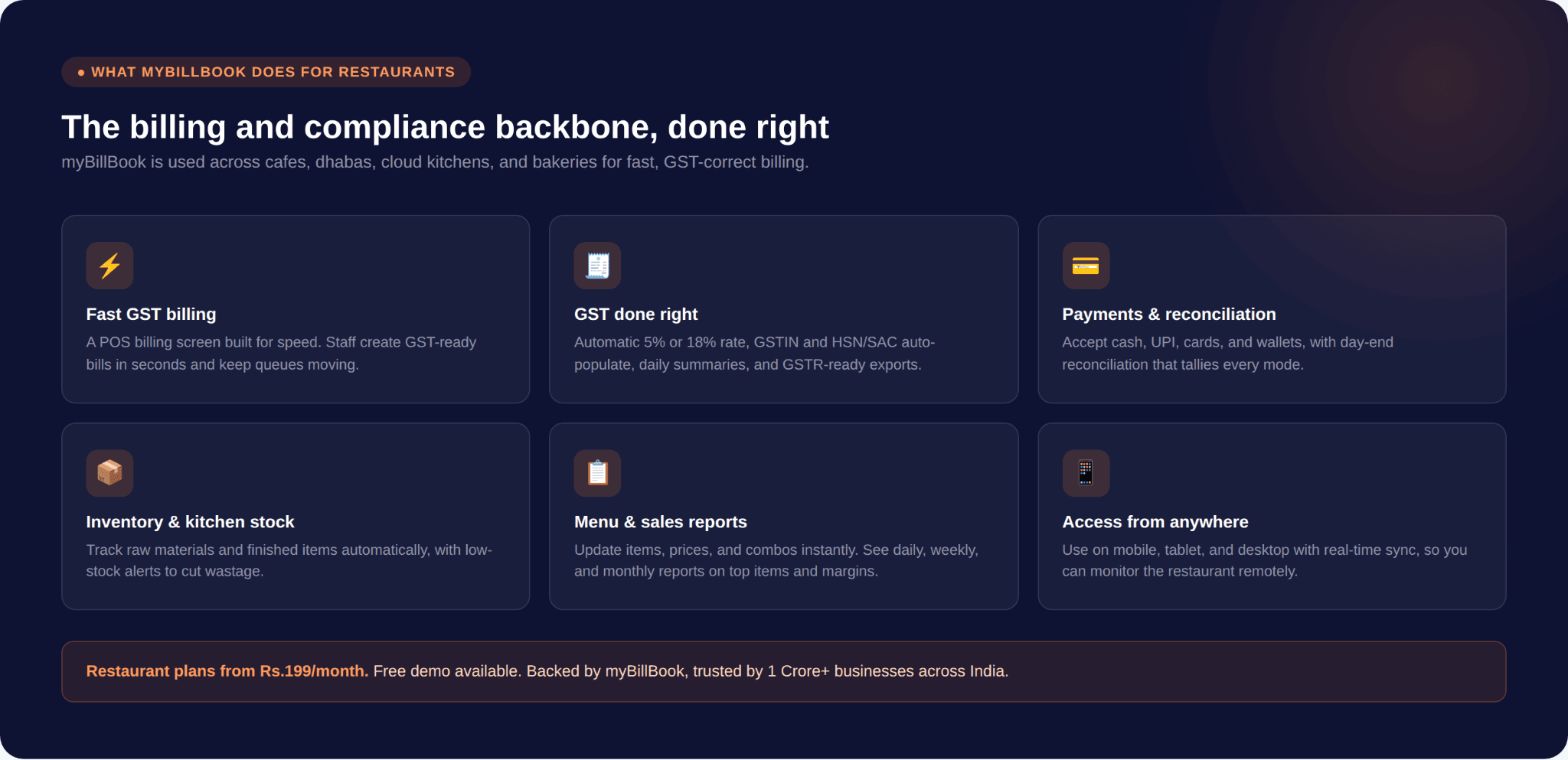
myBillBook is used across cafes, dhabas, cloud kitchens, bakeries, and multi-cuisine restaurants in India for the billing-and-compliance backbone of the business.
- Fast billing: A POS billing screen optimised for speed, so staff create GST-ready bills in seconds and keep queues moving during rush hour.
- GST done right: Automatic 5% or 18% rate application, GSTIN and HSN/SAC auto-populate, daily GST summaries, and export-ready reports.
- Payments: Accept cash, UPI, cards, and wallets, with day-end reconciliation that tallies every mode and flags variances.
- Inventory: Track raw materials and finished items automatically, with low-stock alerts to reduce shortages and wastage.
- Menu and reports: Update menu items, prices, and combos instantly, and view daily, weekly, and monthly sales reports showing top items and margins.
- Anywhere access: Use it on smartphone, tablet, and computer with real-time sync, so you can monitor the restaurant even when you're not at the counter.
Pricing: Restaurant plans start at Rs.199/month, with a free demo available. Backed by myBillBook, trusted by 1 Crore+ businesses across India.
Frequently Asked Questions
What is restaurant billing software?
Restaurant billing software is a cloud-based POS system that helps restaurants process GST-compliant invoices, accept payments, track inventory in real time, and generate sales reports. More advanced systems also manage table orders, generate Kitchen Order Tickets (KOT), and handle split bills. It replaces manual order pads and calculators with an automated billing-to-payment workflow, reducing errors and speeding up service.
How much does restaurant billing software cost in India?
myBillBook restaurant billing plans start at Rs.199/month. The Diamond plan at Rs.291/month covers unlimited invoices and inventory management, while higher tiers add desktop POS billing and multi-device access. This makes it one of the more affordable options for small and growing food businesses in India that need fast GST billing, inventory, and payment tracking.
What GST rate applies to restaurants in India?
Most standalone restaurants in India charge 5% GST without Input Tax Credit (ITC). Restaurants located within hotels where the room tariff exceeds a specified threshold charge 18% GST with ITC. Good restaurant billing software applies the correct rate automatically on every bill, removing the risk of manual error.
What is KOT in restaurant billing software?
KOT stands for Kitchen Order Ticket, the digital or printed note sent to the kitchen the moment an order is placed. It tells the kitchen what to prepare, for which table, with what modifications. A dedicated restaurant POS with KOT support sends these automatically and can route different items to different kitchen stations, reducing verbal miscommunication and speeding up food preparation. If KOT is essential to your kitchen, confirm a tool offers it before buying.
Which restaurant billing features should I confirm before buying?
Confirm the essentials first: automatic restaurant-rate GST, multiple payment modes with reconciliation, inventory tracking, and sales reports. Then confirm the specialist capabilities you specifically depend on, such as KOT routing, table management, or split billing, since not every tool offers all of these today. Match the software to how your restaurant actually operates.
Is restaurant billing software different from retail billing software?
Yes. Restaurant billing needs food-specific handling that retail software lacks: restaurant-rate GST (5% or 18%), ingredient-level inventory, and in advanced systems, KOT and table management. Using generic retail or accounting software for a restaurant forces workarounds that slow service during peak hours.
The Bottom Line
Restaurant billing software isn't judged on the quiet afternoon. It's judged at 9 PM on Saturday, when the floor is full, the kitchen is slammed, and the bills need to be fast, correct, and GST-compliant.
The right setup makes that moment routine: bills generate in seconds, GST calculates itself correctly on every one, payments reconcile cleanly at close, and your stock and sales data stay accurate. Match the specialist capabilities, KOT, table management, split billing, to whether your restaurant actually needs them.
For Indian restaurants, cafes, dhabas, and cloud kitchens that want fast GST billing, inventory tracking, payments, and reporting in one affordable system, myBillBook is built for exactly that backbone. Plans start at Rs.199/month, with a free demo to test it against your own numbers before you commit.


