
Small Business Ideas in 2026: 50 Realistic Businesses You Can Start
business ideas, good business ideas, unique business ideas, what business to start, businesses to start in 2026.
04 Aug 2026

Key takeaways
- The most realistic business idea is one you can validate with paying customers before committing to major fixed costs.
- Service businesses are usually faster and cheaper to test than inventory-heavy retail, restaurants or premises-based concepts.
- AI can reduce administrative work, but a defensible business still needs trust, specialist knowledge, distribution or local execution.
- Licensing, insurance, tax and employment requirements depend on the activity and location; check them before accepting work.
Why consider starting a small business in 2026?
The search for small business ideas in 2026 is taking place in an active formation market. The US Census Bureau recorded 531,423 seasonally adjusted business applications in June 2026, including 149,714 applications classified as high-propensity. Retail trade generated the largest industry total that month, while professional services, construction, administrative support, transportation and health-related services also attracted substantial application activity.
Those numbers do not mean every application becomes a sustainable company. They do show that entrepreneurship remains a major route into income generation and employer creation. The practical opportunity is not to chase a fashionable idea; it is to identify a customer problem, design a small paid test and learn before increasing fixed costs.
How the startup levels work
| Level | Indicative launch budget | What it usually covers |
| Micro | Under $500 | Basic software, domain, simple marketing or small supplies |
| Low | $500-$2,500 | Insurance, better equipment, initial inventory or professional tools |
| Moderate | $2,500-$10,000 | Specialist equipment, vehicle setup, permits, inventory or contractors |
| Higher | $10,000+ | Premises, commercial equipment, significant stock, vehicles or staff |
These are businessabc editorial planning bands, not guaranteed budgets. Actual costs vary by state, city, insurance, qualifications, equipment and whether the founder already owns essential tools.
How to choose from these 50 small business ideas
- Start with access: which customers can you reach without paying heavily for advertising?
- Match the model to your skills, credibility and willingness to obtain training or licences.
- Estimate both one-time costs and monthly costs before setting a price.
- Test demand with conversations, pre-orders, deposits or a small paid pilot.
- Prefer a narrow initial customer and problem over a vague offer for everyone.
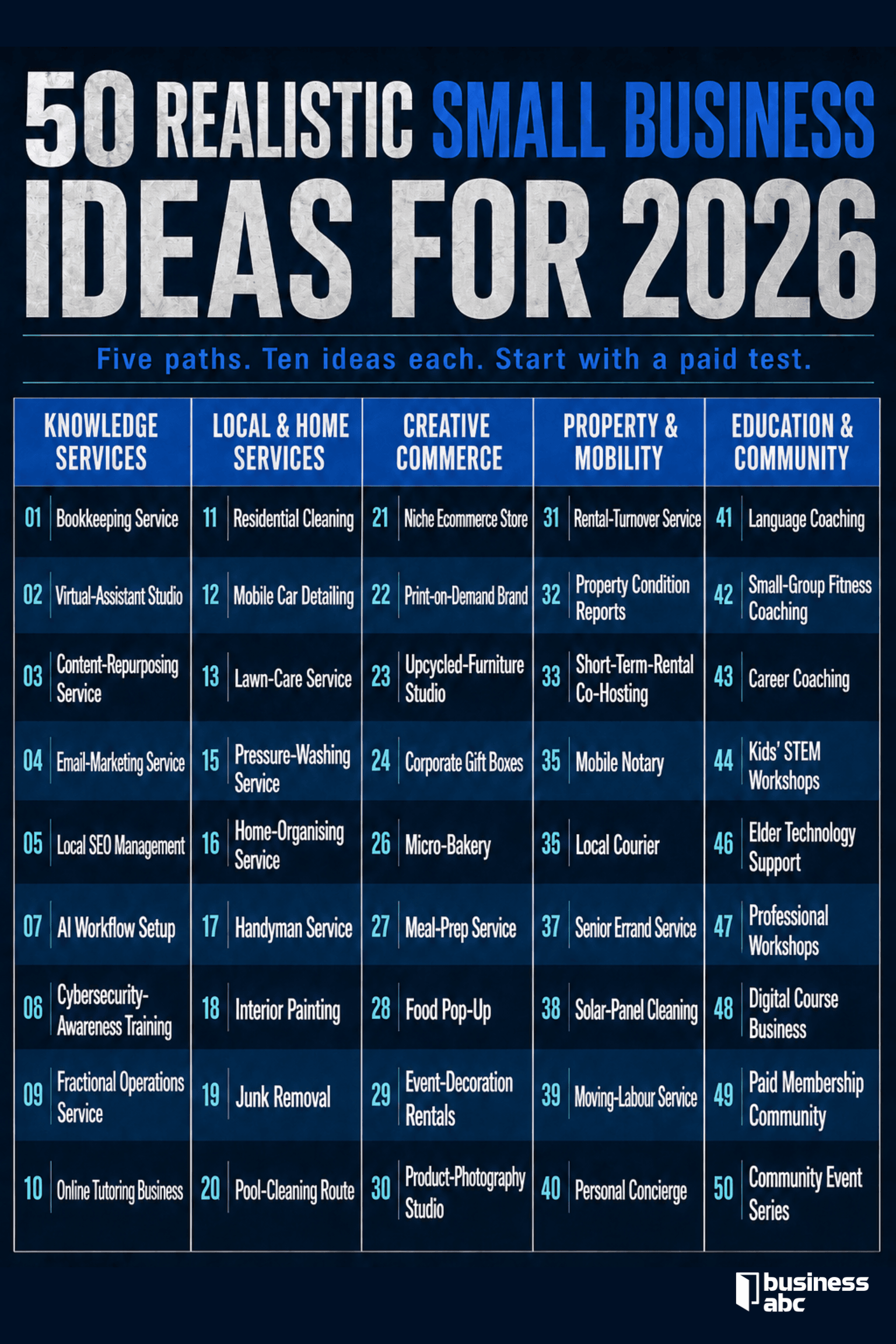
Service and knowledge businesses
1. Bookkeeping service
Startup level: Low | Revenue model: Monthly retainer | Best for: Detail-oriented founders with accounting knowledge
Small companies regularly need transaction categorisation, reconciliation and reporting support. A niche focus; such as agencies, trades or ecommerce, makes the offer easier to explain and systemise.
First validation step: Interview five owners about their current bookkeeping delays and offer one paid cleanup project.
Check before launch: Training may be necessary; do not market regulated accounting or tax services without the required credentials.
2. Virtual-assistant studio
Startup level: Micro | Revenue model: Hourly package or retainer | Best for: Organised operators
Begin with calendar, inbox, research or customer-support work, then specialise by industry. A small studio can later add vetted contractors and standard operating procedures.
First validation step: Sell a defined ten-hour pilot to one founder instead of advertising unlimited general assistance.
3. Content-repurposing service
Startup level: Micro | Revenue model: Monthly content package | Best for: Editors and social-media operators
Turn webinars, podcasts and interviews into clips, posts, newsletters and summaries. The value is editorial judgment and consistent distribution, not merely access to AI tools.
First validation step: Create a sample package from one prospect’s public long-form video and pitch the transformation.
4. Email-marketing service
Startup level: Micro | Revenue model: Project fee plus retainer | Best for: Writers with analytical skills
Help small businesses improve newsletters, welcome sequences, promotions and customer retention. Specialising in one platform or industry can shorten the sales cycle.
First validation step: Audit one local company’s signup journey and propose a three-email welcome sequence.
Check before launch: Follow consent, unsubscribe and applicable privacy requirements.
5. Local SEO and business-profile management
Startup level: Micro | Revenue model: Setup fee plus monthly retainer | Best for: Search and local-marketing specialists
Manage listings, service pages, reviews, local content and reporting for companies that depend on nearby customers. Results require accurate information and patient optimisation, not guaranteed rankings.
First validation step: Choose one trade in one city and audit ten profiles for obvious completeness problems.
6. AI workflow setup for small teams
Startup level: Low | Revenue model: Audit, implementation and support fee | Best for: Process-minded technologists
Map repetitive administrative work and configure approved AI, automation and knowledge tools. A strong offer emphasises governance, review and measurable time saved.
First validation step: Run a paid two-hour workflow audit before offering implementation.
Check before launch: Review data protection, confidentiality and vendor terms before processing client information.
7. Cybersecurity-awareness training
Startup level: Low | Revenue model: Workshop or annual programme | Best for: Security professionals and experienced trainers
Provide practical sessions on phishing, passwords, access control, device safety and incident reporting. This can serve SMEs that need better habits but do not have an internal security educator.
First validation step: Develop one 60-minute workshop for a specific sector and pilot it with a small team.
Check before launch: Keep claims within your qualifications; technical assessments may require specialist insurance and contracts.
8. No-code automation consultancy
Startup level: Low | Revenue model: Project fee and maintenance retainer | Best for: Logical builders who understand business processes
Connect forms, databases, CRM tools and notifications so teams perform less manual copying. The commercial value comes from reliable workflows and documentation.
First validation step: Automate one measurable task for a pilot client and calculate hours saved.
9. Fractional operations service
Startup level: Micro | Revenue model: Monthly retainer | Best for: Experienced project or operations managers
Support founder-led companies with planning, vendor coordination, dashboards and operating routines without joining full time. Credibility and a narrow target client are important.
First validation step: Offer a four-week operational reset with fixed deliverables.
10. Online tutoring business
Startup level: Micro | Revenue model: Hourly sessions or learning package | Best for: Teachers and subject specialists
Teach school subjects, languages, test preparation or professional skills through individual or small-group sessions. Group programmes can improve economics after the curriculum is proven.
First validation step: Recruit three learners for a paid four-session pilot.
Check before launch: Check safeguarding, background checks and education rules when working with minors.
Local and home-service businesses
11. Residential cleaning service
Startup level: Low | Revenue model: Per visit or recurring plan | Best for: Reliable operators comfortable with physical work
Recurring weekly or biweekly cleaning can create predictable revenue. Start with a narrow service area and a clear checklist before hiring.
First validation step: Pre-sell three recurring appointments within one neighbourhood.
Check before launch: Obtain appropriate insurance and follow chemical-safety requirements.
12. Mobile car-detailing service
Startup level: Moderate | Revenue model: Per vehicle and maintenance plan | Best for: Hands-on founders who can travel
Bring cleaning and detailing equipment to homes or workplaces. Packages can range from basic interior cleaning to premium paint-care services.
First validation step: Book a weekend pilot with five vehicles before buying advanced equipment.
Check before launch: Check water-use, wastewater, parking and insurance rules.
13. Lawn-care and seasonal yard service
Startup level: Moderate | Revenue model: Per visit or seasonal contract | Best for: Outdoor operators
Mowing, trimming, leaf removal and seasonal cleanup can produce recurring local routes. Route density matters as much as price.
First validation step: Secure five nearby customers and schedule them on the same day.
Check before launch: Check equipment safety, noise rules and pesticide licensing before offering chemical treatments.
14. Pet-waste removal service
Startup level: Low | Revenue model: Weekly subscription | Best for: Founders seeking a simple recurring local model
Regular yard cleanup is unglamorous but easy to explain and schedule. Dense neighbourhood routes can improve margins.
First validation step: Offer a founding-customer rate to ten pet owners in one area.
15. Pressure-washing service
Startup level: Moderate | Revenue model: Per project | Best for: Operators comfortable with equipment and exterior work
Clean driveways, patios, siding and selected commercial surfaces. Before-and-after evidence supports local marketing.
First validation step: Complete three discounted portfolio jobs and document the results.
Check before launch: Surface damage, water runoff, ladder work and insurance require careful procedures.
16. Home-organising service
Startup level: Low | Revenue model: Hourly or package fee | Best for: Empathetic, systematic organisers
Help households declutter, establish storage systems and prepare for moves. Trust, confidentiality and non-judgmental communication are central.
First validation step: Sell one fixed-price room reset and gather a testimonial with consent.
17. Handyman service
Startup level: Moderate | Revenue model: Hourly or task-based pricing | Best for: Skilled generalists
Handle small repairs, assembly, mounting and maintenance that larger contractors may not prioritise. A carefully defined service list prevents scope creep.
First validation step: Publish ten tasks you can complete safely and price three common packages.
Check before launch: Licensing thresholds vary; electrical, plumbing and structural work may require licensed trades.
18. Interior painting service
Startup level: Moderate | Revenue model: Room or project quote | Best for: Detail-oriented tradespeople
Interior painting has a clear result and can start with smaller rooms before expanding into whole properties. Preparation and reliability differentiate the service.
First validation step: Quote and complete one room using a written scope and colour confirmation.
Check before launch: Insurance, ventilation, lead-safe rules and worker safety may apply.
19. Junk-removal and donation pickup
Startup level: Higher | Revenue model: Volume-based job fee | Best for: Operators with transport and logistics ability
Remove unwanted household or office items, separating donation, recycling and disposal where possible. Disposal economics must be built into every quote.
First validation step: Partner with local donation and disposal facilities before taking bookings.
Check before launch: Vehicles, lifting, disposal fees and prohibited materials require clear policies.
20. Pool-cleaning route
Startup level: Moderate | Revenue model: Recurring maintenance plan | Best for: Outdoor technicians in suitable climates
Provide routine cleaning, water testing and equipment checks to a concentrated route of residential clients. Recurring schedules support predictable revenue.
First validation step: Shadow or train with an experienced operator and validate demand in one neighbourhood.
Check before launch: Chemical handling, certification and local rules may apply.
Creative, retail and food concepts
21. Niche ecommerce store
Startup level: Moderate | Revenue model: Product margin | Best for: Founders with sourcing and merchandising ability
Sell a tightly defined product range to a specific customer rather than launching a general store. Validate demand before placing large inventory orders.
First validation step: Build a landing page and collect pre-orders or qualified waitlist signups.
Check before launch: Account for returns, sales tax, product safety and fulfilment.
22. Print-on-demand brand
Startup level: Low | Revenue model: Product margin | Best for: Designers and audience builders
Test apparel, stationery or homeware designs without holding finished inventory. Brand point of view and distribution matter more than the printing technology.
First validation step: Launch five coherent designs to one existing community.
23. Upcycled-furniture studio
Startup level: Low | Revenue model: Per-item margin and custom commissions | Best for: Makers with restoration skills
Source overlooked pieces, repair and refinish them, then sell locally to avoid expensive shipping. Custom commissions can reduce inventory risk.
First validation step: Complete two pieces and list them with detailed process photos.
Check before launch: Use safe ventilation and procedures for finishes, dust and older materials.
24. Corporate gift-box service
Startup level: Moderate | Revenue model: Per box plus fulfilment fee | Best for: Curators and relationship builders
Assemble gifts for employee onboarding, events and client campaigns. Local or mission-led sourcing can create differentiation.
First validation step: Pitch one themed prototype to ten nearby employers.
Check before launch: Check food labelling, shipping and sales-tax requirements.
25. Small-batch candle business
Startup level: Moderate | Revenue model: Retail and wholesale margin | Best for: Product makers with brand discipline
A focused fragrance story and safe, consistent production are more defensible than a large undifferentiated range. Wholesale can follow direct customer validation.
First validation step: Test three scents at one local market before expanding inventory.
Check before launch: Conduct burn testing and follow labelling, insurance and product-safety requirements.
26. Micro-bakery
Startup level: Moderate | Revenue model: Per order, subscription or market sales | Best for: Skilled bakers
Sell a limited weekly menu through pre-orders, subscriptions or permitted local markets. A narrow schedule controls waste and production complexity.
First validation step: Run one prepaid weekend menu with capped quantities.
Check before launch: Cottage-food laws, allergen labelling and kitchen rules vary by location.
27. Meal-prep service
Startup level: Higher | Revenue model: Weekly subscription | Best for: Experienced food operators
Prepare repeatable meals for a defined audience such as busy professionals or sports communities. Menu discipline, food safety and delivery density determine viability.
First validation step: Pre-sell one weekly menu to ten customers before leasing space.
Check before launch: Commercial-kitchen, food-safety, labelling and delivery rules apply.
28. Food pop-up concept
Startup level: Higher | Revenue model: Per event and product margin | Best for: Chefs testing a restaurant idea
Use markets, residencies or event partnerships to test a focused menu before committing to permanent premises. Each event supplies real demand and operations data.
First validation step: Partner with one licensed venue for a prepaid limited menu.
Check before launch: Permits, commissary kitchens, insurance and food-safety rules are essential.
29. Event-decoration rental business
Startup level: Moderate | Revenue model: Rental package and setup fee | Best for: Creative operators with storage access
Rent reusable backdrops, table styling, signage structures and decor for weddings or business events. Standard packages reduce custom-production waste.
First validation step: Create one complete package and secure deposits for three events.
Check before launch: Use contracts covering damage, installation, venue restrictions and cancellation.
30. Product-photography studio
Startup level: Low | Revenue model: Per shoot or monthly package | Best for: Photographers and visual stylists
Create catalogue, marketplace and social images for small brands. A tabletop home studio can validate demand before investment in premises.
First validation step: Produce three sample sets for one chosen product category.
Property, mobility and practical support
31. Short-term-rental turnover service
Startup level: Moderate | Revenue model: Per turnover plus restocking fee | Best for: Reliable local coordinators
Coordinate cleaning, linen, consumables and photo documentation between guests. Speed and quality control are the product.
First validation step: Secure one property for a four-turnover trial.
Check before launch: Check local short-term-rental rules and use clear responsibility agreements.
32. Rental-property condition reports
Startup level: Low | Revenue model: Per inspection report | Best for: Detail-oriented local operators
Provide timestamped photo reports for remote owners before or after occupancy or repairs. Keep the service observational rather than presenting it as a regulated inspection.
First validation step: Create a sample report and offer it to five property managers.
Check before launch: Do not claim to provide licensed building, appraisal or legal inspections unless qualified.
33. Short-term-rental co-hosting
Startup level: Low | Revenue model: Percentage of revenue or monthly fee | Best for: Hospitality-focused operators
Manage guest messages, listings, vendors and operational standards for owners. A small local portfolio is easier to control than rapid geographic expansion.
First validation step: Offer one owner a 30-day management pilot.
Check before launch: Platform, tax and local hosting rules vary.
34. Mobile notary service
Startup level: Low | Revenue model: Per appointment within regulated fee rules | Best for: Accurate, mobile professionals
Travel to customers who need permitted documents notarised. Convenience and extended hours can differentiate the service.
First validation step: Complete required commissioning, then build referral relationships with permitted local partners.
Check before launch: Commissioning, training, identity checks and fee limits vary by state.
35. Local courier service
Startup level: Moderate | Revenue model: Per delivery or business contract | Best for: Route-conscious drivers
Provide scheduled or urgent local delivery for florists, pharmacies where permitted, legal offices or specialty retailers. Recurring B2B routes are more predictable than one-off jobs.
First validation step: Win one recurring route before expanding vehicles or drivers.
Check before launch: Commercial auto insurance and industry-specific handling rules may apply.
36. Senior errand and companion service
Startup level: Low | Revenue model: Hourly package or membership | Best for: Patient, trusted community members
Help older adults with errands, appointments, shopping and non-medical companionship. Trust, continuity and boundaries are more important than scale at the beginning.
First validation step: Interview families and offer a clearly defined non-medical pilot package.
Check before launch: Background checks, insurance and care-service regulations may apply; do not provide medical or personal care without qualifications.
37. Mobile bicycle and scooter repair
Startup level: Moderate | Revenue model: Per repair and maintenance plan | Best for: Mechanically skilled operators
Bring tune-ups and basic repairs to homes, workplaces or campuses. Scheduled service days can concentrate demand.
First validation step: Host one prepaid repair day with an apartment building or employer.
Check before launch: Follow battery-safety procedures and avoid work beyond your competence.
38. Solar-panel cleaning service
Startup level: Moderate | Revenue model: Per-visit or annual plan | Best for: Safety-conscious outdoor operators
Offer inspection-free surface cleaning for accessible residential or small commercial arrays. Position the service around maintenance rather than promising energy gains.
First validation step: Validate manufacturer-approved methods and book three ground-accessible jobs.
Check before launch: Roof access, fall protection, electrical hazards, warranties and insurance require strict controls.
39. Moving labour service
Startup level: Moderate | Revenue model: Hourly crew fee | Best for: Physically capable team builders
Provide loading, unloading, furniture protection and in-home moves without initially owning a truck. Reliable crews and damage procedures are essential.
First validation step: Partner with one local truck-rental location and book a small two-person job.
Check before launch: Insurance, worker classification, lifting safety and mover regulations vary.
40. Personal concierge service
Startup level: Low | Revenue model: Hourly package or membership | Best for: Highly organised local problem-solvers
Handle reservations, returns, errands, vendor coordination and household administration for time-poor clients. A defined menu protects margins.
First validation step: Sell a five-hour founding package to three clients.
Education, career and community businesses
41. Language-coaching practice
Startup level: Micro | Revenue model: Session package or membership | Best for: Bilingual teachers and communicators
Focus on a use case such as workplace English, travel, pronunciation or industry vocabulary. Cohorts and memberships can follow individual validation.
First validation step: Run a paid four-week micro-cohort for one learner profile.
42. Small-group fitness coaching
Startup level: Low | Revenue model: Class pass or monthly membership | Best for: Qualified fitness professionals
Deliver outdoor, workplace or rented-studio sessions for a defined audience. Community and accountability can compete with large gyms.
First validation step: Pre-sell a six-session group before committing to a venue.
Check before launch: Obtain appropriate qualifications, screening, waivers and insurance.
43. Career-coaching service
Startup level: Micro | Revenue model: Package fee | Best for: Experienced recruiters, managers or coaches
Help a defined professional audience clarify positioning, search strategy and interview preparation. Avoid promising employment outcomes.
First validation step: Sell a three-session pilot to one narrow career segment.
44. Resume and LinkedIn writing studio
Startup level: Micro | Revenue model: Project package | Best for: Strong business writers
Translate experience into clear, evidence-based professional materials. Specialisation by seniority or industry can improve credibility.
First validation step: Rewrite three portfolio samples using anonymised or fictional information.
45. Kids’ STEM workshop business
Startup level: Moderate | Revenue model: Per workshop, term or school contract | Best for: Educators and technical facilitators
Run supervised robotics, coding, science or maker sessions through schools, libraries and community venues. Repeatable lesson kits support scale.
First validation step: Pilot one paid workshop through an established venue.
Check before launch: Safeguarding, background checks, equipment safety and supervision ratios are essential.
46. Elder technology-support service
Startup level: Low | Revenue model: Home visit or support plan | Best for: Patient digital troubleshooters
Help older adults set up devices, video calls, password managers and basic scam awareness. Trust and plain-language teaching are key.
First validation step: Partner with one community organisation for a small clinic.
Check before launch: Use strict privacy boundaries; never retain passwords or access financial accounts.
47. Professional workshop facilitator
Startup level: Micro | Revenue model: Workshop fee or corporate package | Best for: Experienced practitioners and presenters
Convert a proven skill—sales, communication, project management or software—into a structured workplace session. Sell an outcome rather than a broad topic.
First validation step: Deliver one paid 90-minute pilot and measure participant feedback.
48. Digital course business
Startup level: Low | Revenue model: Course sale, cohort fee or licence | Best for: Experts with teachable processes and an audience
Create a focused course that solves one expensive or recurring problem. Validate the curriculum live before investing in extensive recorded production.
First validation step: Pre-sell a live beta cohort to five learners.
49. Paid membership community
Startup level: Low | Revenue model: Monthly or annual membership | Best for: Conveners with an existing niche network
Offer recurring peer exchange, expert sessions, templates or accountability around a specific professional or personal goal. Communities fail when the promise is vague.
First validation step: Recruit 15 founding members for a three-month paid pilot.
50. Community event series
Startup level: Moderate | Revenue model: Tickets, sponsorship and vendor fees | Best for: Local connectors and producers
Build recurring markets, founder meetups, cultural events or learning nights around an underserved local audience. Start with one repeatable format.
First validation step: Secure a venue partner and sell enough advance tickets to cover fixed costs.
Check before launch: Use event insurance, permits, accessibility planning and clear vendor agreements.
How to test a business idea before spending heavily
- Define one customer and one painful problem.
- Speak with at least ten potential customers without leading them toward your preferred answer.
- Create a small paid offer with a clear scope, price and delivery date.
- Ask for a deposit, pre-order or paid pilot; compliments are not demand.
- Record delivery time, variable costs, customer-acquisition effort and repeat potential.
- Improve the offer before investing in premises, large inventory, staff or custom technology.
What business should you start?
Start with the intersection of four factors: a customer you can reach, a problem they already recognise, an offer you can deliver credibly and economics that work at a small scale. Someone with technical expertise and professional contacts may be better suited to workflow consulting than a consumer product. Someone with local trust, practical skills and transport may build a stronger home-service business than an online brand.
If the choice remains unclear, select three ideas and design the cheapest possible demand test for each. The best business to start is usually not the most exciting concept on paper; it is the one that produces the clearest evidence of willingness to pay.
Frequently asked questions
What is the easiest small business to start in 2026?
A skill-based service for customers you can already reach is usually easiest to test. Examples include virtual assistance, tutoring, bookkeeping, content repurposing and local organising. Easy to launch does not mean easy to grow; positioning, sales and reliable delivery still matter.
What business can I start with no money?
Most businesses still involve some cost, even if it is only transport, software, insurance or registration. A founder can minimise upfront spending by pre-selling a service based on existing skills and using customer payments to fund delivery.
What are the most profitable small businesses?
Profitability depends on price, customer-acquisition cost, labour, overhead and repeat demand. Specialist services and recurring local routes can produce attractive margins because they avoid large inventory or premises, but no category guarantees profit.
How do I know whether a business idea is good?
Look for evidence that a specific customer has a recurring or expensive problem, already spends money on alternatives and is willing to pay for a small pilot. Search volume and social engagement are weaker evidence than a real transaction.
Should I form an LLC before testing an idea?
Entity choice depends on location, risk, ownership and tax circumstances. Founders should review federal, state and local requirements and obtain qualified legal or tax advice where needed. High-liability activities should not begin without appropriate structure and insurance.
Can AI run a small business for me?
AI can assist with research, drafting, customer support, scheduling and administration. It cannot take responsibility for strategy, factual accuracy, customer trust, legal compliance or quality control. Human review remains essential.
Final perspective
The best small business ideas in 2026 are realistic because they can be tested in stages. They begin with customer access and a narrow paid offer, not a logo, a large inventory order or an expensive technology build. Start small enough to learn, price the work honestly and treat regulation, safety and trust as part of the product.
Sources and methodology
The business ideas are businessabc editorial recommendations, not projections of income or guarantees of demand. Startup bands are indicative planning ranges. Market context and planning guidance were checked against the following primary US sources:


