
business resources
Sweat Equity Demystified: Structure, Strategy, Risks & Legal Framework
25 Feb 2026

Sweat equity is a powerful way to build wealth in startups, but it is often misunderstood. While it has made some people billionaires, like in early Facebook, it has also caused disputes, dilution, tax problems, and ownership that ends up being worthless.
This article is a practical guide that covers:
- What is sweat equity is
- How it works
- Benefits and risks
- Real-world lessons
- How to calculate fair equity
- Legal and tax structuring in India vs the United States
What Is Sweat Equity?
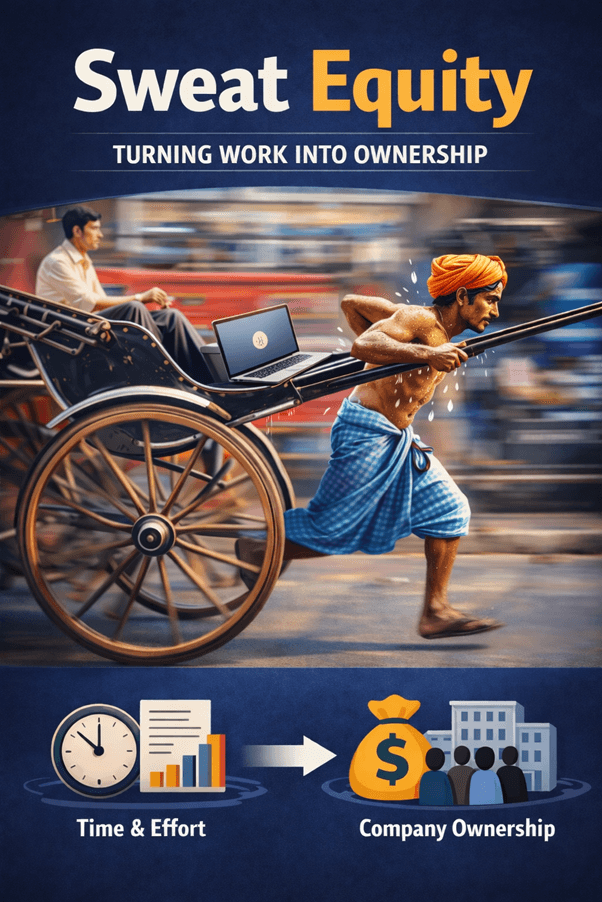
Sweat equity means earning ownership in a company by contributing your time, effort, skills, or expertise, rather than by investing money.
Instead of investing capital, individuals contribute:
- Technical development
- Business strategy
- Product design
- Industry expertise
- Full-time operational commitment
In exchange, they get shares, stock options, or other forms of equity.
It is most common in:
- Founding teams
- Early employees
- Advisors
- Pre-revenue startups
How Sweat Equity Works
Sweat equity is typically structured in three forms:
1. Founder Equity
Co-founders divide ownership based on:
- Execution responsibility
- Capital contribution
- Risk assumed
- Time commitment
- Strategic value
Today, it is best for founder equity to vest gradually over time.
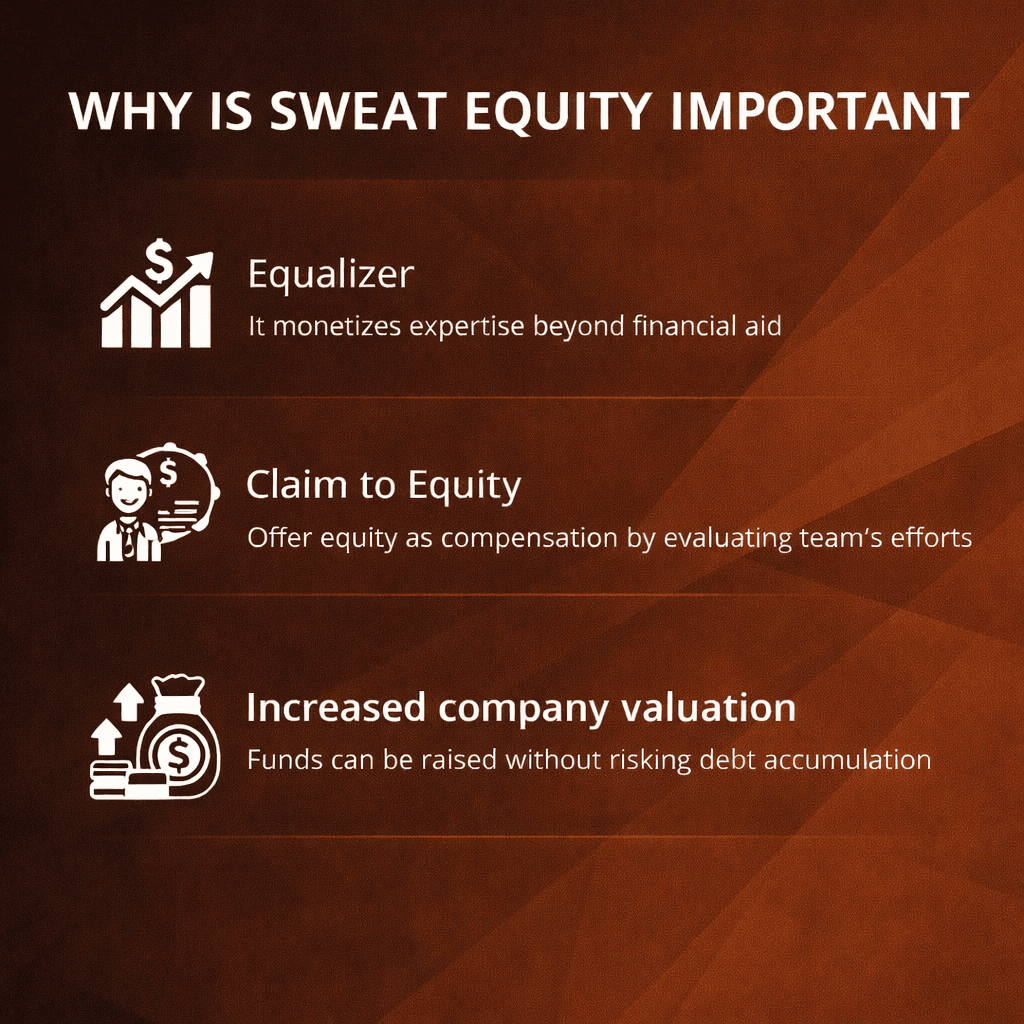
2. Employee Stock Options (ESOP)
Employees receive:
- Stock options (right to buy shares later at a fixed price)
- Restricted stock
- Performance-based shares
This is often used when startups cannot afford to pay full market salaries.
3. Advisor Equity
Advisors usually get 0.1% to 2% equity, which vests over one to two years, in exchange for:
- Strategic guidance
- Industry access
- Fundraising introductions
Vesting: The Critical Protection Mechanism
Equity is rarely given all at once. Instead, it usually vests over time.
Typical structure:
- 4-year vesting
- 1-year cliff
- Monthly vesting thereafter
Example:
You are granted 10% equity.
- After 1 year → 25% vests.
- Remaining 75% vests gradually.
- If you leave before 1 year → you get nothing.
Vesting helps protect the company if a co-founder becomes inactive or leaves early.
Real-World Case: Facebook (Meta)
In Facebook’s early days:
- Mark Zuckerberg held majority control.
- Eduardo Saverin held roughly 30% early on.
- As funding rounds occurred, Saverin’s stake was heavily diluted.
- Legal disputes followed.
Even after dilution, Saverin kept about 4-5% at the IPO, which was worth billions.
Lessons:
- Equity percentage is not static.
- Dilution is real.
- Legal structure matters.
- Control and board rights are often more important than the percentage of ownership.
Benefits of Sweat Equity
For Individuals
- A chance for life-changing financial rewards
- A sense of ownership
- The ability to build wealth without needing to invest money
- A chance to take part in the company’s long-term growth
Example:
2% of a $100M exit = $2M.
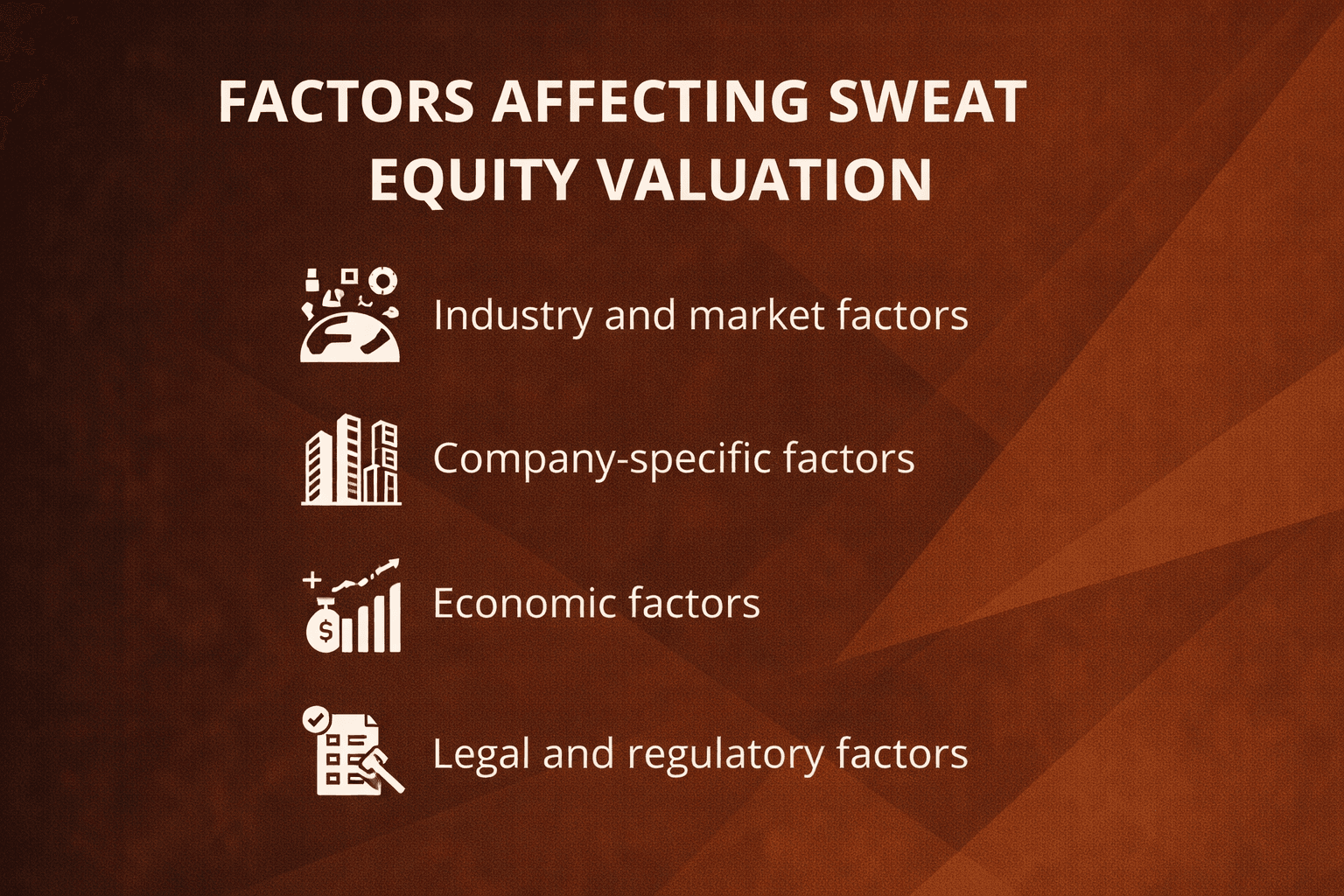
For Companies
- Preserves cash
- Attracts top talent
- Aligns incentives
- Encourages long-term commitment
Sweat equity helps employees become true stakeholders in the company.
Major Risks
Sweat equity comes with both high risks and high rewards.
Key risks include:
- Startup failure (most startups fail)
- Illiquidity (shares cannot easily be sold)
- Dilution from future funding
- Tax liabilities before liquidity
- Loss of control as investors enter
Many people with equity end up with shares that look valuable on paper but never turn into real money.
How to Calculate Fair Sweat Equity
There is no universal formula, but three common methods exist:
1. Replacement Cost Method
If market salary = $120,000
Actual salary = $60,000
Gap = $60,000 per year
Over 2 years = $120,000 contribution.
If company valuation = $2M
$120,000 ÷ $2M = 6% equity equivalent.
2. Contribution-Based Founder Split
Consider:
- Full-time vs part-time involvement
- Capital invested
- Product complexity
- Strategic leverage
- Network value
3. Industry Benchmarks
Typical ranges:
- Technical co-founder: 20%–50%
- Early employee: 0.5%–5%
- Advisor: 0.1%–2%
The situation and details matter more than the equity percentage alone.
Technical & Legal Components
Before accepting sweat equity, understand:
A. Share Types
- Common shares (founders/employees)
- Preferred shares (investors with special rights)
Preferred shares may include:
- Liquidation preference
- Anti-dilution protection
- Enhanced voting rights
B. Dilution
When investors invest, new shares are issued.
Example:
You own 10%.
After funding → becomes 6%.
Still, owning 6% of a much bigger company can be worth more than 10% of a smaller one.
C. Shareholder Agreements
Always review:
- Vesting schedule
- Acceleration clauses
- Drag-along rights
- Tag-along rights
- Buyback terms
- Exit conditions
Always make sure agreements are in writing, not just spoken.
D. Tax Considerations
Tax may be triggered at:
- Grant
- Vesting
- Exercise
- Sale
If equity is not structured properly, you might have to pay taxes even if you cannot sell your shares.
It is important to get advice from a tax professional.
Structuring Sweat Equity: India vs the United States
Legal frameworks differ significantly.
India
Governing Law: Companies Act, 2013
Common structures:
- Sweat equity shares
- ESOPs
- CCPS (in VC-backed structures)
Key Requirements:
- Board approval
- Special shareholder resolution (75%)
- Valuation by a registered valuer
- ROC filing
- Possible lock-in period
Tax:
- Taxed as perquisite at FMV (fair market value)
- Capital gains tax at sale
Challenge:
Tax may arise at allotment, even without liquidity.
United States
Most startups incorporate as Delaware C-Corps.
Common instruments:
- Restricted stock (for founders)
- ISOs and NSOs (stock options)
- RSUs (later-stage companies)
Key Requirements:
- Board approval
- 409A valuation for options
- Equity plan adoption
Important:
Founders receiving restricted stock often file an 83(b) election within 30 days to minimise tax exposure.
The US system offers greater flexibility and a more startup-friendly structure.
How to Negotiate Sweat Equity
Before agreeing:
- Understand current valuation
- Ask about future funding plans
- Clarify dilution expectations
- Confirm vesting schedule
- Understand exit pathways
- Review the cap table
- Understand investor rights
The percentage of equity you get does not mean much without understanding the full context.
Strategic Insight
Sweat equity is not just about how much you own right now.
It is about:
Future valuation × Retained ownership × Exit probability
Even owning just 1 to 2% in a big exit can lead to significant wealth.
But having 20% in a failed startup is worth nothing.
Final Conclusion
Sweat equity can be one of the most powerful financial tools in entrepreneurship when structured correctly.
It enables:
- Startups to attract talent without cash
- Individuals to build wealth without capital
- Teams to align incentives around growth
However, success depends on:
- Proper vesting
- Clear legal documentation
- Understanding dilution
- Smart tax planning
- Careful negotiation
Sweat equity can help create billionaires, but it can also lead to disputes and ownership that turns out to be worthless.
How you structure sweat equity will determine the outcome.


