


business resources
The Best AI Detector Tools In 2026
13 Mar 2026

A few months ago, a colleague in my editorial network reached out with a situation that perfectly captures the challenge we’re all navigating today. She manages a distributed team of freelance writers producing educational content for a large publishing platform. One afternoon, her internal review process flagged a handful of articles that seemed… unusually uniform.
The tone was polished, but oddly consistent. Sentence patterns repeated. Sources felt generalized.
Nothing was clearly plagiarized, but something was off.
We ran the articles through a few AI detection tools, and the differences in accuracy were striking. Some tools flagged nearly everything. Others missed obvious AI patterns entirely.
That experience isn't unusual, and the scale of the problem is only growing. In April 2025, Ahrefs analyzed 900,000 newly created web pages and found that 74.2% contained AI-generated content, making reliable detection less of a nice-to-have and more of a baseline requirement for any serious content operation.
AI detection is only as good as the system behind it. The right tool can bring clarity and confidence to modern content workflows. The wrong one creates more confusion than answers.
Here are the AI detectors that currently stand out for reliability, transparency, and real-world usability.
Top 3 Quick Picks: The Best AI Detector Tools
Quetext: Best for Accurate AI and Plagiarism Detection in One Platform
- DeepSearch™ analysis engine
- Combined plagiarism + AI detection
- Writer-friendly reporting
Copyleaks: Best for Enterprise AI Content Detection
- Enterprise-level integrations
- LMS compatibility
- Code and text detection
Sapling AI Detector: Best for Fast, Lightweight AI Scanning
- Instant detection results
- Simple interface
- Free quick scans
Continue reading for a deeper breakdown of how these tools work and what makes each one stand out.
How To Choose the Right AI Detector
1. Detection Methodology Matters
AI detection accuracy largely depends on the analytical model behind the platform. Some tools rely on surface-level probability scoring, while more sophisticated systems analyze linguistic patterns, token distribution, and contextual predictability.
Advanced detection engines typically evaluate factors such as perplexity, burstiness, and semantic structure. This allows them to distinguish between human writing and machine-generated patterns with greater reliability.
When evaluating AI detectors, look for tools that explain their methodology clearly. Platforms that rely on transparent detection models tend to deliver more consistent results than black-box systems that simply label content as AI-generated without explanation.
Reliable detection is built on layered analysis rather than simple pattern matching.
2. False Positives Are a Real Risk
Even the best AI detectors occasionally flag human-written text as AI-generated. Structured writing, particularly academic or technical content, can resemble AI output because it follows predictable sentence patterns.
This is why responsible AI detection tools present results as probability indicators rather than absolute verdicts. Instead of declaring content definitively AI-generated, they highlight patterns and provide contextual scoring.
This approach helps editors, educators, and reviewers interpret the findings appropriately.
Ultimately, AI detection should support human judgment rather than replace it. The most trustworthy tools present detection results as signals that help guide review decisions.
3. Integrated Content Verification Is Increasingly Valuable
AI detection rarely operates in isolation within real publishing workflows. Editors and educators often need to verify plagiarism, check grammar, or review citation quality during the same evaluation process.
Platforms that combine multiple verification capabilities reduce workflow friction significantly. Instead of running content through separate systems, users can analyze originality, AI likelihood, and writing quality in a single environment.
This integrated approach also encourages more consistent verification practices across teams.
For organizations managing high volumes of content, such as agencies, universities, or publishers, consolidated verification platforms often provide the most practical long-term solution.
4. Reporting and Transparency Make Tools Usable
Detection accuracy is only valuable if the results are easy to interpret. Editors and reviewers need reporting that clearly shows why a piece of text triggered an AI detection signal.
The best AI detectors provide highlighted passages, probability scores, and contextual explanations. These features make it easier to evaluate content without relying solely on a numerical score.
Transparent reporting also helps organizations communicate findings with writers, students, or stakeholders in a constructive way.
Without clear reporting, even accurate detection tools can become difficult to use in real-world editorial workflows.
5. Workflow Compatibility Matters More Than Features
A sophisticated AI detection engine won’t deliver much value if the platform disrupts normal content workflows.
Organizations reviewing large volumes of text need tools that process documents quickly, support larger file uploads, and integrate easily with existing publishing systems.
API access, document scanning capabilities, and content management integrations can significantly improve efficiency for editorial teams.
In practice, the best AI detectors are the ones that fit naturally into existing review processes while maintaining reliable detection performance.
The Best AI Detector Tools Ranked
1. Quetext: Best for Accurate AI and Plagiarism Detection in One Platform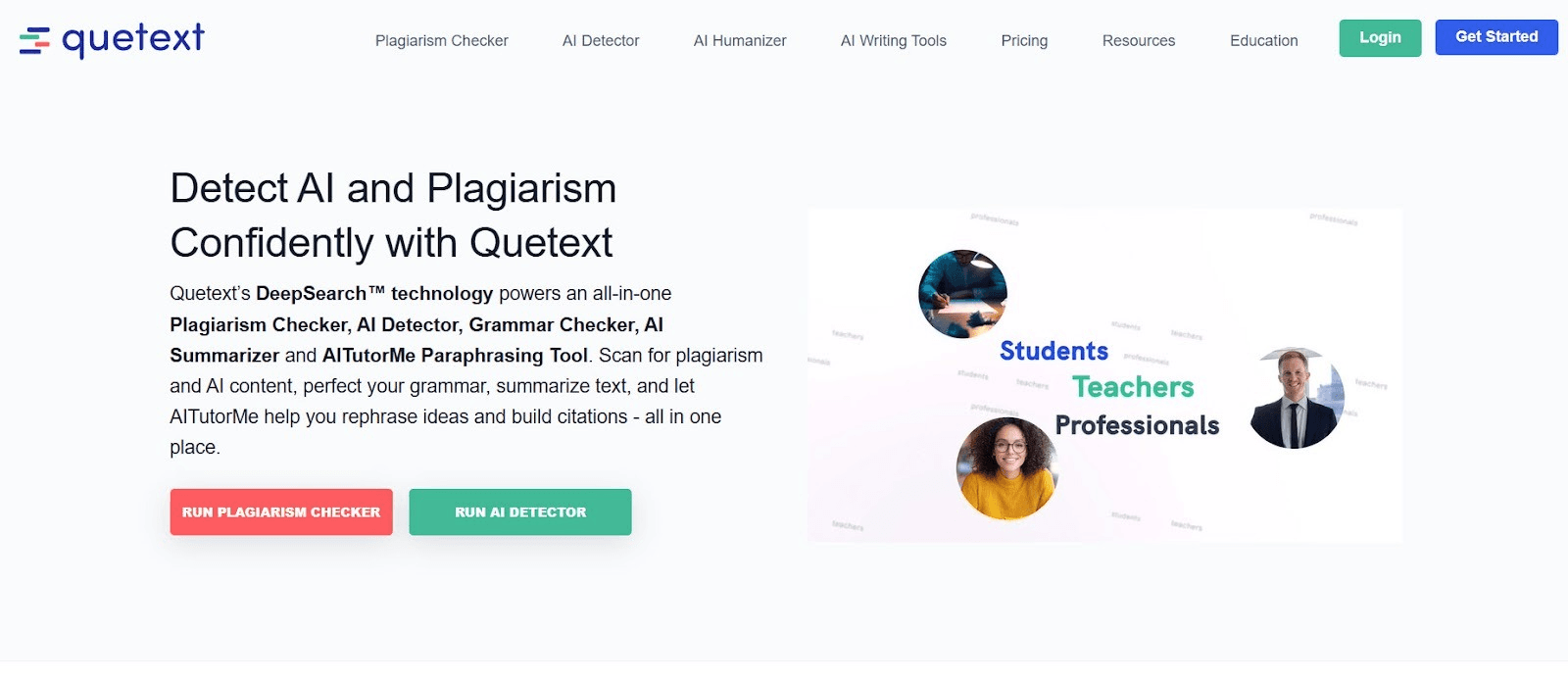
- Founded: 2016
- Headquarters: Kansas City, MO
Why Quetext is the best AI detector company: Quetext stands out as the best AI detector because it combines advanced AI detection with DeepSearch™ plagiarism analysis inside a single verification platform.
Rather than focusing only on AI-generated text patterns, Quetext evaluates both content originality and AI likelihood simultaneously. This dual-layer approach is particularly valuable for educators, publishers, and SEO teams who need confidence in both authorship and source originality.
The platform’s DeepSearch™ technology scans billions of indexed sources while analyzing linguistic patterns that indicate AI-assisted writing.
Quetext also includes additional writing tools such as grammar checking, text summarization, and the AITutorMe paraphrasing system. These capabilities allow teams to verify and refine content within the same environment.
For organizations managing large volumes of written material, this integrated workflow makes Quetext a practical and efficient verification platform.
2. Copyleaks: Best for Enterprise AI Content Detection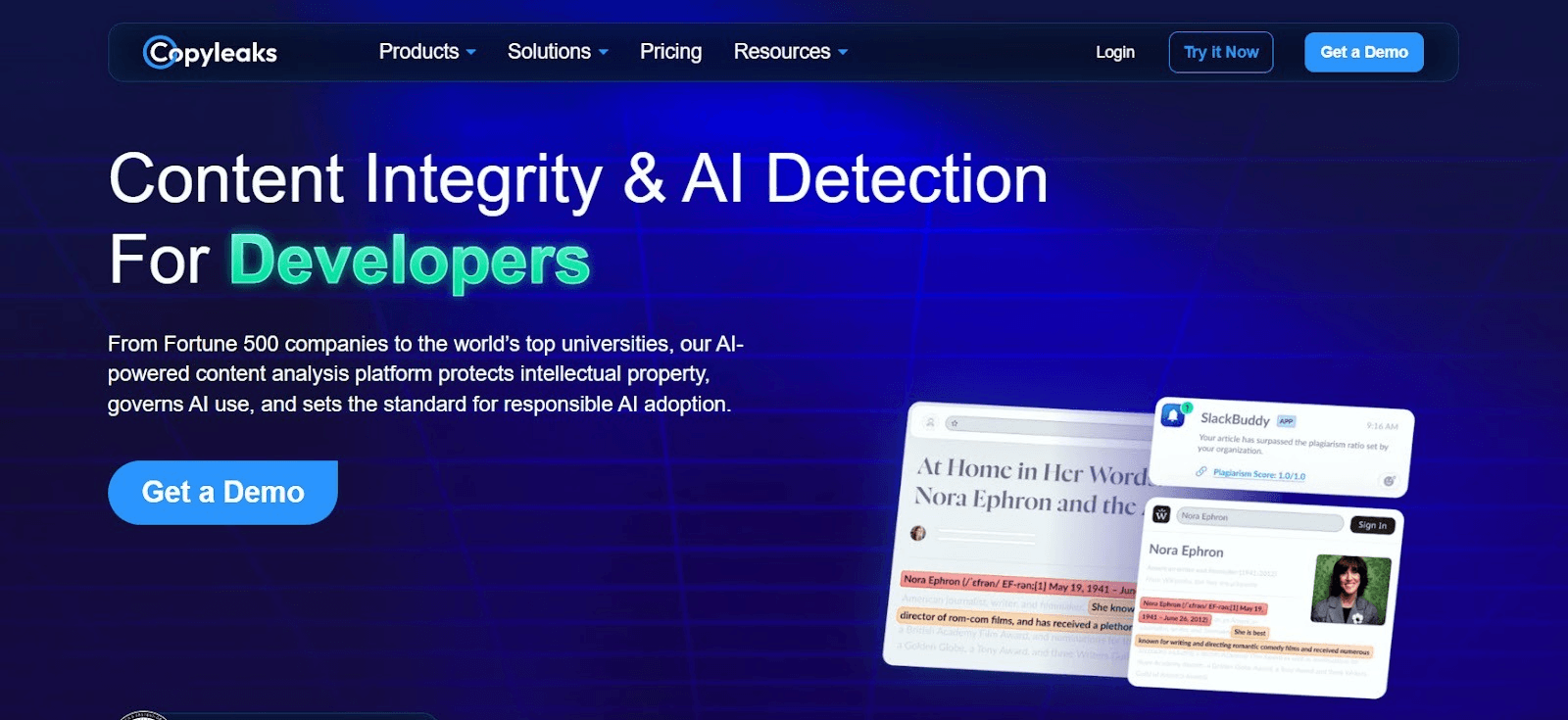
- Founded: 2015
- Headquarters: New York, NY
Copyleaks has built its reputation around enterprise-grade plagiarism and AI detection technology. The platform is widely used by academic institutions, businesses, and publishing organizations that need large-scale verification systems.
One of Copyleaks’ strongest advantages is its integration ecosystem. The platform connects with learning management systems, enterprise APIs, and publishing workflows, allowing organizations to embed AI detection directly into content review pipelines.
Copyleaks also analyzes both natural language and source code, which makes it useful in technical and educational environments where programming assignments are common.
Its reporting includes probability scoring and highlighted text analysis, helping reviewers understand where AI-generated patterns may appear within a document.
For organizations operating at scale, Copyleaks offers a robust infrastructure for automated content verification.
3. Sapling AI Detector: Best for Fast, Lightweight AI Scanning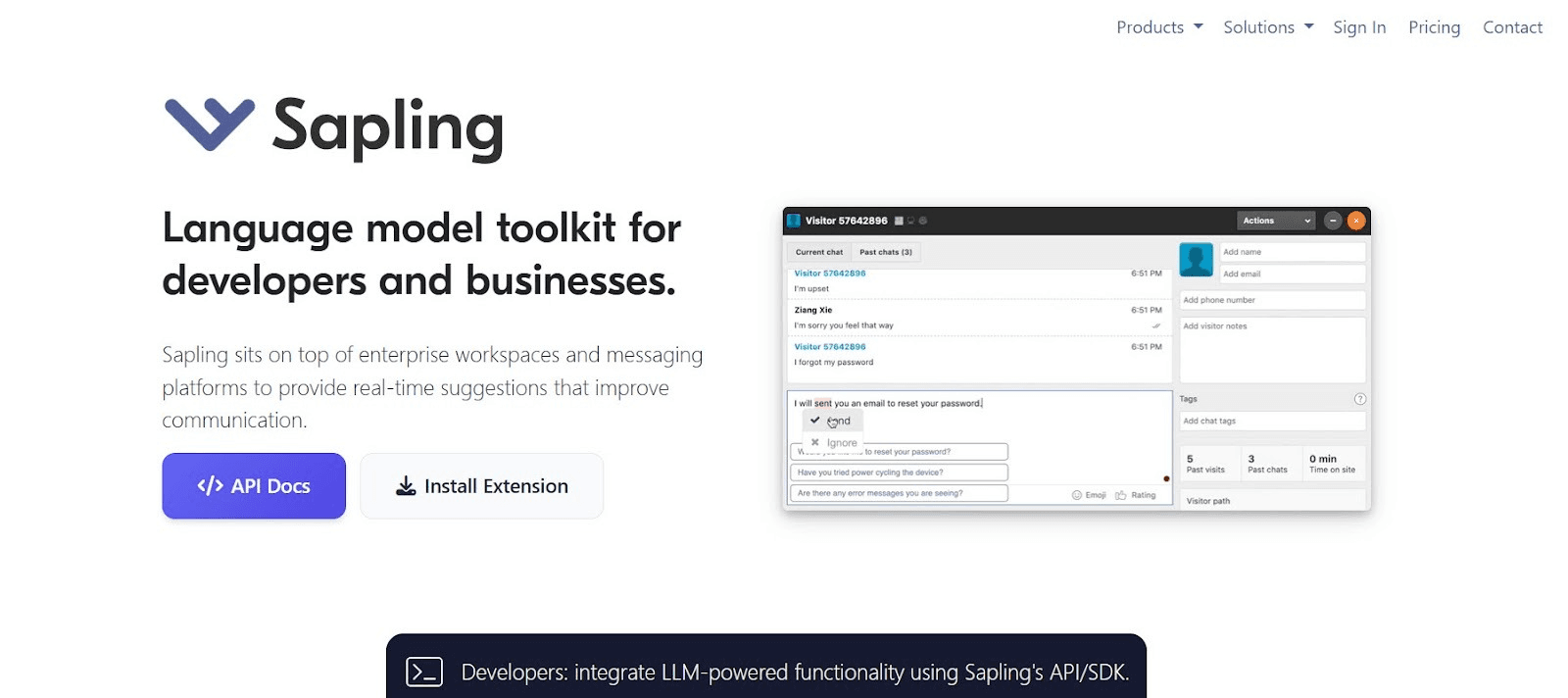
- Founded: 2019
- Headquarters: San Francisco, CA
Sapling AI offers a detection tool designed for speed and accessibility. Its AI detector provides quick probability assessments that allow users to evaluate text in seconds.
The interface is intentionally simple, making it easy for editors, hiring managers, and educators to run quick scans without complex setup or configuration.
Sapling’s broader platform focuses on AI-powered writing assistance for customer support teams and communication workflows, and its detector reflects that same emphasis on efficiency.
While it does not offer the deeper verification ecosystem found in some larger platforms, Sapling’s quick detection capabilities make it useful as a first-pass screening tool.
For teams that need rapid AI detection checks without extensive reporting features, Sapling provides a streamlined solution.
4. Turnitin: Best for Academic AI Detection
- Founded: 1996
- Headquarters: Oakland, CA
Turnitin remains one of the most widely used plagiarism detection platforms in education, and its AI detection capabilities have been integrated into that existing ecosystem.
Because many universities already rely on Turnitin for originality checks, the addition of AI detection allows instructors to evaluate both plagiarism and AI-assisted writing within the same submission workflow.
The platform analyzes writing patterns and linguistic characteristics that may indicate AI-generated text. These signals are incorporated into reports that instructors can review alongside plagiarism results.
Turnitin’s primary strength lies in its deep integration with academic systems and classroom workflows.
However, access is typically limited to institutional partnerships, which makes the platform less accessible for independent writers or smaller editorial teams.
5. Smodin AI Detector: Best for AI Detection and Writing Verification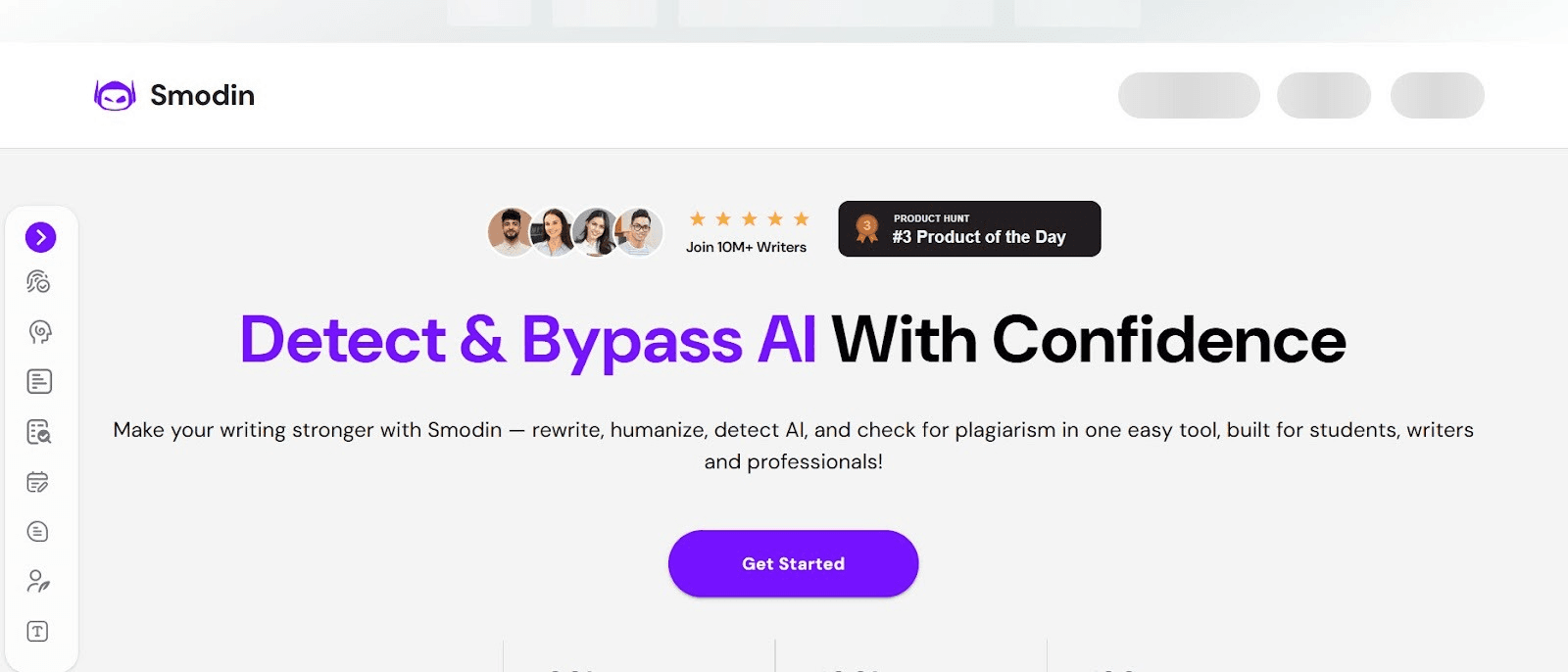
- Founded: 2017
- Headquarters: Casper, WY
Smodin provides a collection of AI-powered writing tools that includes plagiarism detection, AI content analysis, and automated writing assistance.
Its AI detector evaluates linguistic patterns associated with machine-generated text and generates a probability score indicating whether a piece of content may have been created using AI systems.
Because the platform also includes tools for rewriting, summarizing, and citation generation, it is frequently used by students and researchers who want to verify the originality and authorship of their work before submission.
Smodin’s combination of AI detection and writing utilities makes it a practical option for individuals who want both verification and editing tools in a single platform.
6. GPTZero: Best for Accessible AI Detection Built for Educators and Writer
Founded: 2023
Headquarters: New York, NY
GPTZero has become one of the most recognized names in AI content verification since launching in early 2023, particularly within classrooms and newsrooms. The platform was built specifically to help teachers, editors, and writers tell whether a piece of text was likely produced by a human or generated using tools like ChatGPT, and it quickly grew into a go to AI detector for that purpose.
Rather than relying on a single signal, GPTZero analyzes patterns like sentence variation and word predictability across a document, then returns a probability score along with sentence level highlighting so reviewers can see exactly which sections raised concern.
Beyond its core detection engine, GPTZero offers companion tools such as Origin, which lets writers log their drafting process to proactively prove authorship, along with plagiarism checking and an AI powered grading assistant for instructors managing large volumes of student work.
Its growing use among school districts and education networks reflects a broader shift toward integrating detection directly into everyday review workflows rather than treating it as a one off check.
Choosing the Right AI Detector for Long-Term Content Integrity
AI detection is quickly becoming a standard part of modern content verification. Whether you’re managing freelance contributors, reviewing student submissions, or protecting SEO-driven publishing workflows, reliable detection tools are essential.
But accuracy alone isn’t the only factor worth considering.
The best solutions combine clear reporting, strong detection methodology, and seamless workflow integration. Tools that provide broader verification, like plagiarism detection and writing analysis, often deliver more practical value over time.
Platforms like Quetext illustrate this evolution well. By combining AI detection with DeepSearch-powered plagiarism analysis and writing tools, they address the full spectrum of content integrity challenges that editors and educators face today.
In a landscape where AI-assisted writing is becoming the norm rather than the exception, the organizations that thrive will be the ones equipped with the right verification systems.


